
 Try the Workspace
Artists, Labels & Managers: 4K AI Music Videos Matched to Your Track
Upload your track, preview human-shot videos matched by AI, licence the best fit, and download 4K horizontal and vertical files ready for YouTube and Shorts.
Artists, Labels & Managers: 4K AI Music Videos Matched to Your Track
“AI music videos” here means licensed, human-shot, ready-to-edit full-length videos that AI matches to your track by genre, mood and tempo. No prompts, no generated footage. You upload your song, preview real videos suggested by the matching engine, licence the one that fits, and download it in 4K, ready for YouTube and paid campaigns. Music Video Marketplace runs this exact model.
TL;DR:
- The matching AI analyzes videos for genre, mood, and tempo, enabling quick licensing of pre-shot, director-led videos that fit specific songs.
- Buyers must verify the video’s mood, licensing scope, technical specs, customization options, and exclusivity caps before purchasing.
- Licensing options include single purchases starting around €119 and subscription plans suitable for artists releasing multiple singles annually.
- The workflow allows rapid download, customization, and deployment across platforms, with vertical formats prioritized for short-form content.
- Future improvements will enhance emotional tagging, personalized variations, and native vertical video production without replacing human-shot catalogues.
Table of Contents
- What are AI music videos, and how does the matching model work?
- What should you check before licensing a music video?
- How do you buy, customise and export a video in minutes?
- What does a ready-made music video cost?
- How should you deploy a purchased video across campaigns?
- Where does AI actually add value beyond matching?
- Human-made, AI-assisted or fully AI-generated: which actually serves a release?
- What are the legal and ethical questions around AI in music video production?
- Where is AI music video production heading next?
- Why this model fits how artists actually release music now
- Get a matched, licensed video for your song today
- Sources
What are AI music videos, and how does the matching model work?
Forget the idea of typing a prompt and waiting for software to invent visuals from scratch. That’s a different product entirely. What buyers actually get from a marketplace like this is a library of professionally shot, director-led videos, tagged and sorted by AI so the right one finds your song.
The mechanics are straightforward. A tagging system analyses each video in the catalogue for genre, mood, BPM and even lyrical themes, then does the same with your uploaded track. Platforms match uploaded tracks to pre-produced videos using AI tagging for these attributes before surfacing a shortlist you can preview instantly.
This is where the human judgement still matters. The algorithm narrows the field, but you decide whether a slow-motion desert chase actually suits your breakup ballad, or whether the tempo of a video’s edits feels off against your track’s groove. Preview before you commit.
Once you licence a video, delivery is immediate:
- 4K horizontal (16:9) files ready for YouTube
- 4K vertical (9:16) exports for Shorts, Reels and TikTok
- Multiple codec options for different ad platforms
Fast fact: the same catalogue video can be matched to dozens of different songs across different genres, because the tagging system reads mood and tempo rather than lyrics alone. That’s the entire reason this model beats a bespoke shoot on speed: no crew, no location scouting, no six week turnaround. The trade off is that you’re licensing something already filmed rather than commissioning something unique, though limited-exclusivity terms (more on that below) keep it from feeling generic.
What should you check before licensing a music video?
Not every ready-made video deal is built the same, and the difference between a good purchase and a regrettable one usually comes down to five checks.
- Mood and tempo fit. Watch the preview with your track’s chorus playing, not just the intro. A video can look stunning and still fight your song’s energy if the cutting pace doesn’t match your BPM.
- Licence scope. Confirm in writing what platforms the licence covers (YouTube, paid social, broadcast), whether it includes commercial monetisation, and how long the rights last.
- Technical specs. Check resolution (4K should be standard), aspect ratios delivered, and whether codecs suit the ad platforms you plan to run campaigns on.
- Customisation options. Can you add your own logo, captions, or brief clips of your own footage without breaching the licence?
- Exclusivity limits. Ask how many other artists can licence the same video. A curated, director-led library with clear licence terms and a capped number of sales, sometimes as few as 50 artists per video, protects you from your video showing up behind a stranger’s single a month later.
Pro Tip: Don’t judge a video purely on the thumbnail frame. Scrub through the full preview at the point your song’s drop or hook lands, that’s the moment fans actually screenshot and share.
Skipping the licence check is the single most common regret buyers report. A video that looks perfect but only clears you for organic YouTube use is worthless if your plan is a paid TikTok push.
How do you buy, customise and export a video in minutes?
The workflow is genuinely fast once your assets are ready, and most of the delay buyers experience comes from being unprepared, not from the platform.
- Prepare your track first. Have your final master, ISRC code, and contributor credits sorted before you upload. This matters because your video’s metadata should match your distribution metadata exactly, sloppy credits here cause reporting headaches later.
- Upload and review matches. The platform’s tagging engine returns a shortlist within moments. Scroll past the first result. Compare at least three or four before deciding.
- Licence and download. Complete checkout, then go straight to your dashboard. Downloads should be grabbed immediately in both horizontal and vertical formats, as email download links can expire.
- Customise and publish. Add branding, captions or trims, double check the embedded metadata, then upload to YouTube and cut your vertical file down for ad creative.
Done properly, the gap between “I have a finished master” and “I have a published, campaign-ready video” can be measured in minutes rather than weeks.
What does a ready-made music video cost?
Pricing splits into two clear models, and picking the right one depends entirely on how often you release music.
- Single licence purchase: entry pricing for a one-off video typically starts around modest three-figure sums, with example single-video pricing around €119 for a standalone release.
- Subscription tiers: for artists dropping multiple singles a year, a monthly plan (example starting points around £19/month) usually works out far cheaper per video than repeated one-off licences.
- Add-ons: extended or full exclusivity, bespoke trims, and additional vertical cuts for social bundles typically carry a premium over the base licence.
If you’re an artist releasing a single every few months, subscriptions turn video production into predictable operating cost rather than a lump capital outlay you have to justify each time. Compare that against a bespoke shoot, which regularly runs into four figures before you’ve paid for editing, and the maths favours the marketplace model for anyone releasing regularly. Budget for the licence itself, then set aside a small allowance for platform-specific vertical trims if your campaign spans YouTube and short-form ads simultaneously.
How should you deploy a purchased video across campaigns?
Owning the file is only half the job. Where and how you deploy it decides whether the spend pays off.
- YouTube premieres: schedule the 16:9 file as a premiere, optimise the title and description with your track metadata, and pitch it into relevant playlists before launch day.
- Vertical-first ad creative: cut the 9:16 export down to 15 to 30 second segments for TikTok, Reels and Shorts, placing your strongest visual hook in the first three seconds and your call-to-action or link-in-bio prompt near the end.
- Spotify Canvas: a short looping vertical clip from the same video works well as a Canvas loop, reinforcing the visual identity across platforms.
- A/B testing before committing: lease a couple of visual options and run them against each other in a small ad budget before upgrading the stronger performer to a full exclusive licence.
Pro Tip: Track watch-through rate on the vertical cuts separately from the horizontal upload. A video can crush it as a 15 second ad hook while barely holding attention as a full YouTube premiere, and that split tells you where to spend next month’s budget.
For a broader thumbnail and upload strategy, Musicvideomarketplace’s guide to attention-grabbing thumbnails covers the click-through side of the equation.
Where does AI actually add value beyond matching?
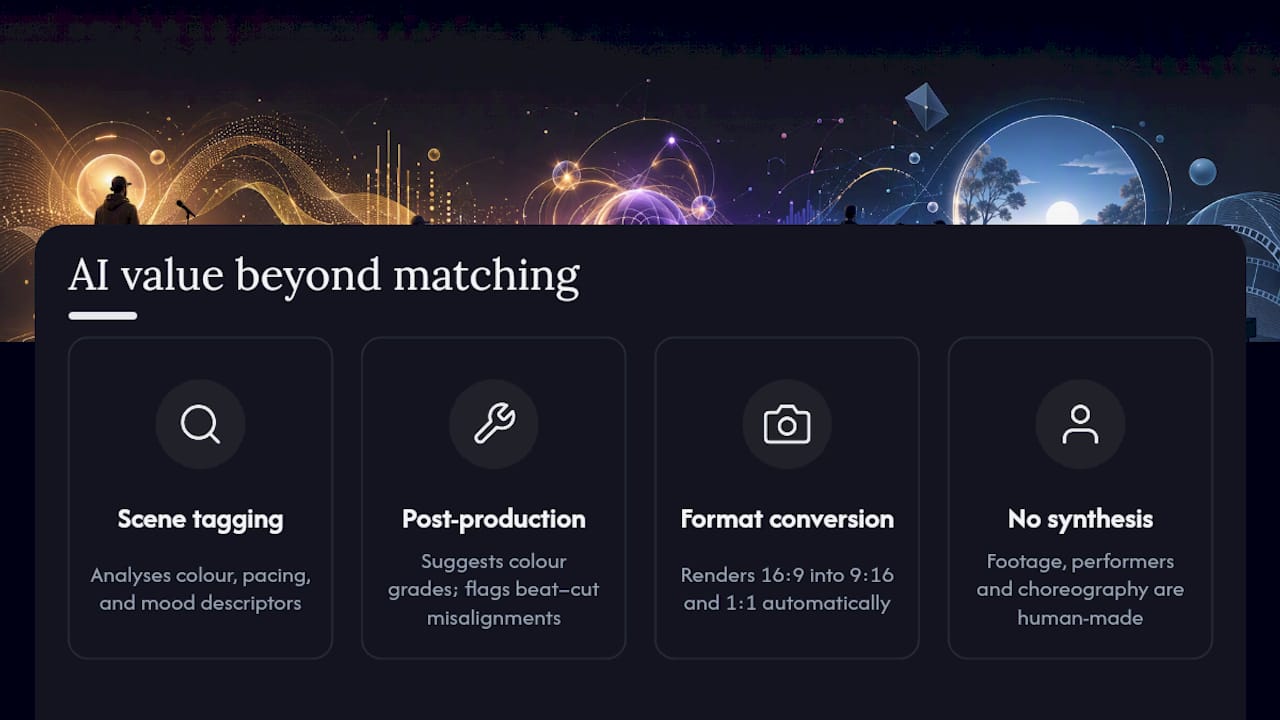
The matching engine is the visible layer, but AI shows up in a handful of quieter, useful ways once you’re inside the editing and delivery stage. None of it involves generating footage from nothing, and that distinction matters for anyone comparing this model to fully synthetic video generators.
Automated scene tagging is the clearest example: every clip in a catalogue gets analysed for colour palette, pacing, and mood descriptors, which is what lets the system suggest videos you’d never have thought to search for manually. Some platforms extend this into lightweight post-production help, using AI to suggest colour grading adjustments or flag where a beat drop in your track doesn’t line up with a visual cut, so you can nudge timing before export.
AI also handles the boring but essential work of format conversion, automatically rendering a 16:9 master down into clean 9:16 and 1:1 crops without a human editor manually reframing every shot. That’s a genuine time saver, particularly for artists who need five different aspect ratios out of one licensed video for a single campaign push.
What AI does not do here is invent the performers, the locations, or the choreography. The library is built by directors and human film crews, and the technology’s job stops at finding the right existing footage and helping you package it correctly. That’s a deliberate positioning choice, and one worth understanding before you assume every “AI video” tool works the same way.
Human-made, AI-assisted or fully AI-generated: which actually serves a release?
Three distinct categories get lumped together under “AI music videos,” and confusing them leads to disappointed buyers.
A fully bespoke human-made video, the traditional custom shoot, gives you complete creative control and total exclusivity, but costs the most and takes the longest, often weeks from concept to delivery. A fully AI-generated video, built entirely by a generative model from a text prompt, can be produced almost instantly and cheaply, but frequently suffers from uncanny motion, inconsistent character rendering, and a look audiences increasingly recognise and, in many cases, dislike.
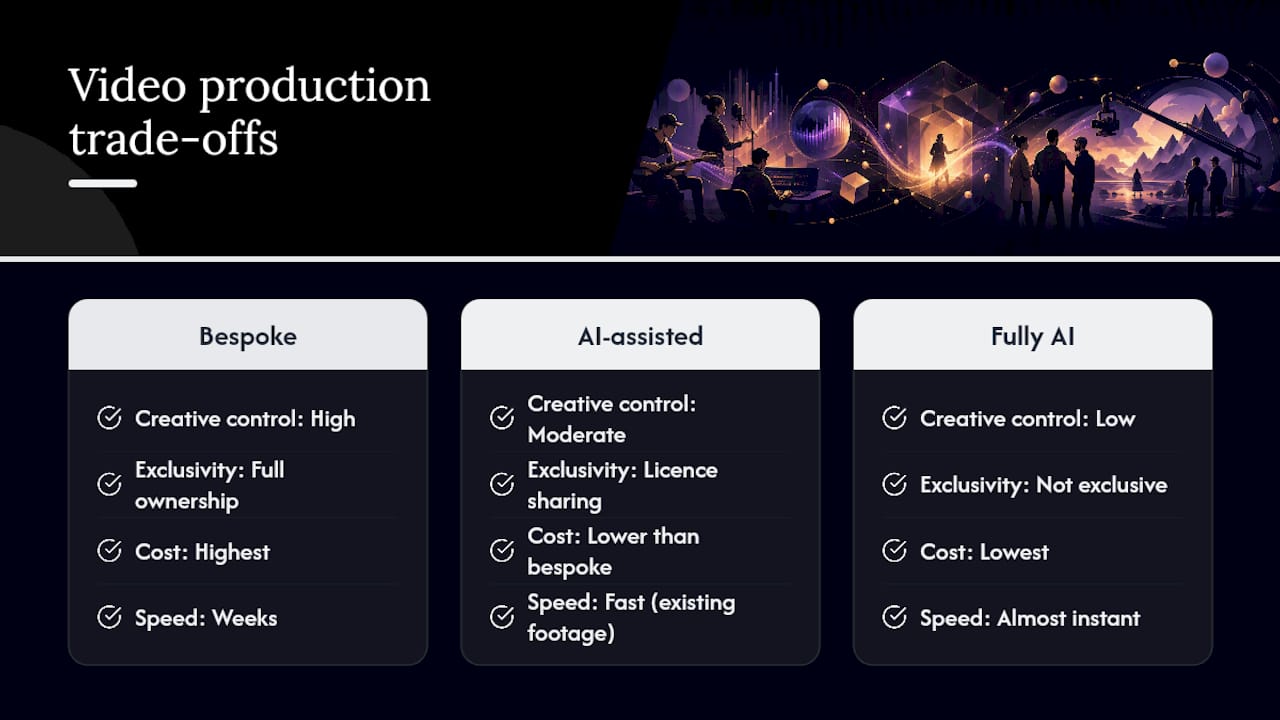
The AI-assisted licensed model sits deliberately between those two extremes. You get real actors, real locations and real cinematography, shot by working directors, but at a fraction of the cost and turnaround of commissioning your own shoot, because the video already exists and AI simply finds it for you. The trade-off is licence sharing rather than full exclusivity, unless you pay for that tier.
For an artist choosing between the three, the decision usually comes down to budget and timeline against how much visual originality your release genuinely needs. A viral TikTok single chasing fast turnaround benefits more from the licensed model’s speed than from a synthetic video’s novelty. A flagship album lead single with a real budget might still justify a bespoke shoot. Most working artists, releasing regularly on a real budget, land in the middle category for exactly that reason.
What are the legal and ethical questions around AI in music video production?
Licensing is the whole ballgame here, and getting it wrong exposes you to takedowns or worse.
Because the videos are human-shot rather than AI-generated, most of the thornier copyright questions swirling around fully synthetic content, disputes over training data, likeness rights, and unclear authorship, largely don’t apply to this model. What replaces them is a more conventional but still critical concern: licence clarity. You need a written, unambiguous licence stating which platforms you can use the video on, whether commercial monetisation is included, how long the rights last, and how many other artists hold a licence to the same footage.
Exclusivity caps matter ethically as well as commercially. A platform that caps sales of a given video at a fixed number of artists, rather than selling it indefinitely to anyone, is being transparent about a limitation that affects your brand distinctiveness. Ask for that number before you buy.
The broader ethical debate around fully AI-generated video, concerns about job displacement for directors, cinematographers and actors, and about audiences being misled into thinking synthetic content is real, doesn’t disappear from the industry conversation, but it sits outside what a licensed, human-made marketplace is selling. If anything, this model keeps working directors and crews employed by monetising their existing footage across multiple licensees, rather than replacing their work with generated alternatives.
Where is AI music video production heading next?
Expect the matching layer to get sharper before anything else changes. Tagging systems will likely move beyond genre and BPM into finer emotional cues, detecting a bridge section’s key change or a lyric’s narrative turn and surfacing videos that reflect that nuance rather than just the track’s overall vibe.
Personalisation is the other obvious direction. Rather than licensing one fixed cut, expect more platforms to offer semi-automated variant generation, swapping colour grades, pacing, or scene order within a licensed video to give artists a version that feels slightly more their own without commissioning a full custom shoot.
Vertical-first delivery will keep growing in priority as short-form platforms dominate discovery. Videos shot with 9:16 crops planned in from the start, rather than reframed afterwards, are likely to become a standard catalogue requirement rather than a nice-to-have add-on.
None of this points towards synthetic generation replacing human-shot catalogues for commercial release videos anytime soon. The uncanny-valley problem in fully generated video is a hard technical limit, not a temporary gap, and audiences notice it. The more realistic trajectory is AI getting better at finding, adapting and packaging real human footage, which is the model this entire article has been describing.
Why this model fits how artists actually release music now
Release schedules have changed. Artists dropping a single every six to eight weeks simply cannot fund a bespoke shoot for each one, and waiting for a shoot to be arranged kills momentum an algorithm rewards.
What’s underappreciated is how much predictability matters here. A repeatable visual pipeline, where ready-made videos remove the production bottleneck entirely, lets an artist plan a quarter of releases in advance rather than scrambling before each drop. Musicvideomarketplace built its catalogue around director-led footage and 4K delivery specifically because speed without quality is a false economy nobody actually wants.
— Music
Get a matched, licensed video for your song today
Musicvideomarketplace is the direct route to a finished, campaign-ready video, not a maybe-someday bespoke shoot or a synthetic clip that looks off the moment a face turns to camera. Upload your track, preview human-shot videos the matching engine suggests for your genre and mood, then licence and download both the 4K horizontal file for YouTube and the vertical export for Shorts, Reels and TikTok.

Pricing starts at an accessible single-licence rate for one release, with a subscription tier available for artists releasing music regularly to make video costs more predictable. Head to the Musicvideomarketplace dashboard to preview matches for your current single, or browse a live example preview page to see exactly what a licensed download includes before you commit.
Sources
Read next
 AI vs Human Music Videos: What Musicians Should KnowAI or human-made music video? Compare cost, quality, originality, UK copyright and audience reaction, and see when a ready-made, human-shot video is the smarter choice.
 Best 4 video creation tools for musicians 2026Discover the best video creation tools for musicians with our comparison of 4 top products to elevate your music videos effectively.
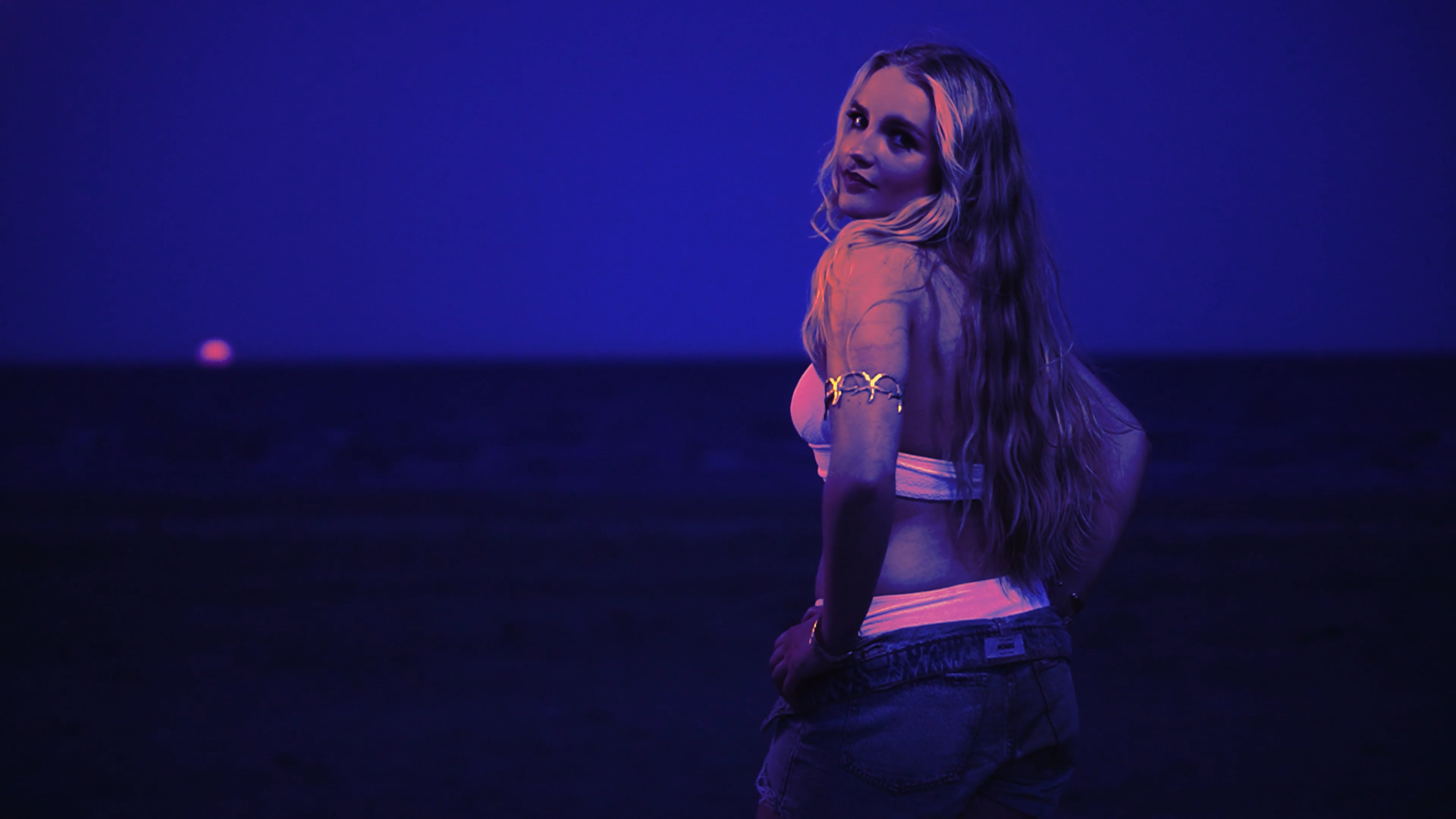 Christopher Wieduwilt's Guide To Buying A Music VideoChristopher Wieduwilt breaks down how musicians can use Music Video Marketplace to quickly license human-made, professionally directed music videos using AI-assisted matching. This post celebrates his guide and the creator-first approach behind the platform.
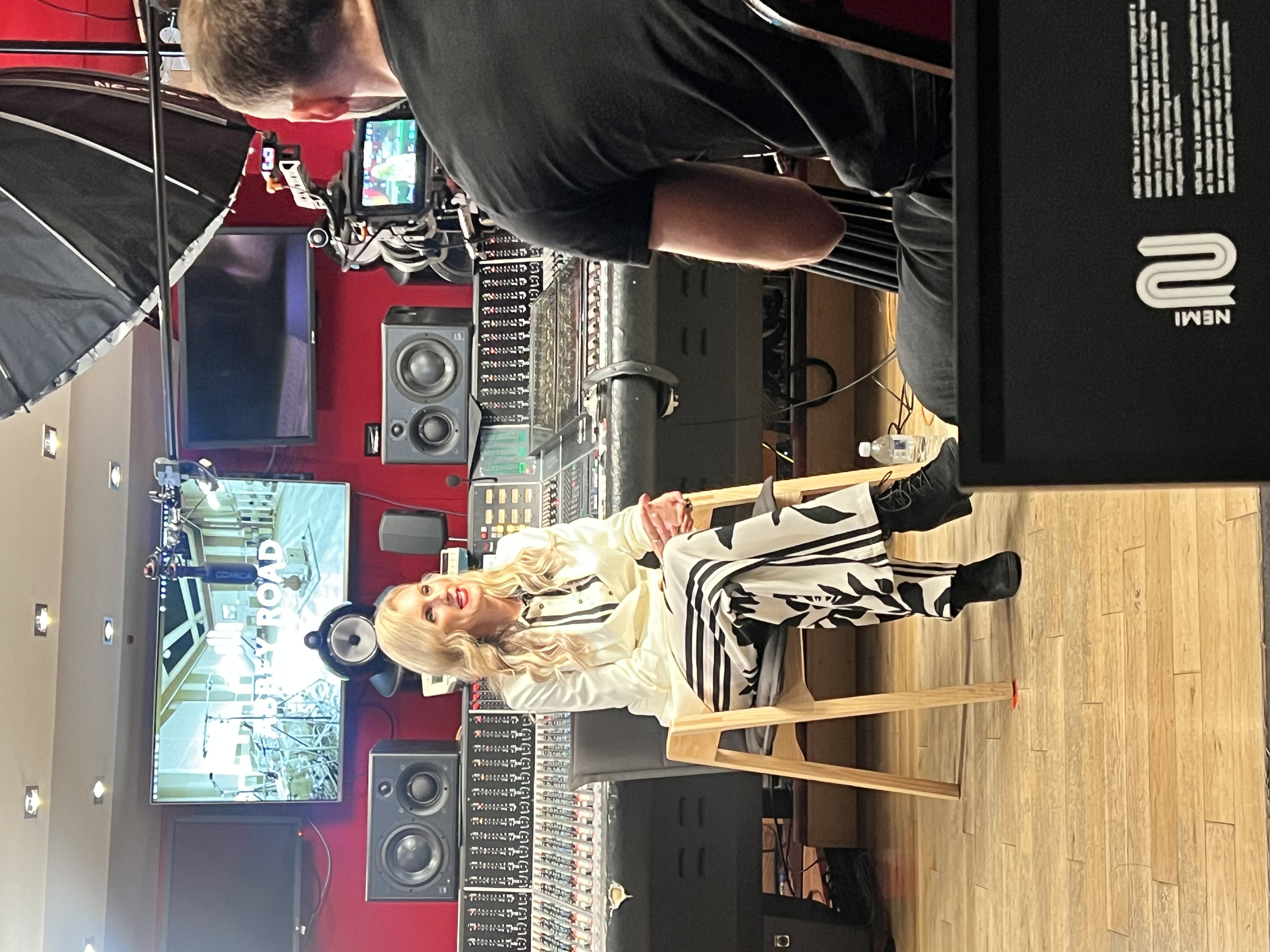 Music Video Marketplace | Innovation and GrowthMusic Video Marketplace is changing how artists create visuals. From idea to innovation, the platform delivers ready-made videos, smart tools, and creative solutions to help musicians stand out and promote their music with ease.
Turn the idea into a finished music video.
Drop your track into the Workspace and build your visual in minutes.