
Why video boosts engagement for indie musicians on YouTube
Discover why video boosts engagement for indie musicians on YouTube. Learn key strategies to enhance audience retention and grow your channel!

Why video boosts engagement for indie musicians on YouTube
TL;DR:
- You do not need a major label budget to gain traction on YouTube; understanding platform algorithms is key. Engaging content with high audience retention and storytelling techniques boosts reach and fan engagement. Consistent analysis of retention data and adopting emerging trends can significantly grow an indie musician’s audience.
You do not need a major label budget or a million subscribers to get meaningful traction on YouTube. The musicians who consistently grow their audiences are not the ones with the flashiest productions. They are the ones who understand how the platform actually rewards video content, and they use that knowledge deliberately. This guide breaks down exactly why video drives engagement, what the data tells us about retention, and how you can put these insights to work for your next release.
Table of Contents
- How video taps into platform algorithms
- The building blocks of effective video engagement
- Musician-tested strategies to boost video engagement
- Comparing music video vs. audio-only releases for engagement
- Emerging video engagement trends indie musicians should watch
- Why most indie musicians still overlook video’s engagement power
- Level up your music promotion with standout videos
- Frequently asked questions
Key Takeaways
| Point | Details |
|---|---|
| Retention drives reach | The longer viewers stay, the more platforms promote your music videos. |
| Intro sets the tone | The first 30 seconds are crucial for capturing attention and minimising drop-off. |
| Video beats audio-only | Music videos deliver higher engagement and fan interaction than audio tracks alone. |
| Real-time analytics matter | Rapid feedback lets you improve your next release within days. |
| Trends favour indie artists | New formats like live or short-form video make it easier for independent musicians to connect and grow. |
How video taps into platform algorithms
With the myth dispelled, we can look at how platforms actually reward video content from creators like you.
YouTube does not distribute content randomly. The platform uses a recommendation system that is heavily weighted towards one thing: how long people watch. That metric, called audience retention, tells the algorithm whether your video is worth showing to more viewers. A high retention rate signals quality. A low one signals that people clicked away fast, which reduces your reach significantly.
Video boosts engagement because it increases the attention and retention signals that recommendation systems optimise for, leading to further distribution. This is not a theory. It is the documented logic behind YouTube’s ranking system, and it applies equally to an indie artist with 300 subscribers as it does to an established act with 3 million.
The algorithm breaks your video’s performance into granular data points. It tracks where viewers drop off, where they rewind, where they click away, and where they share. Every behaviour feeds back into the system. If your video generates a spike of rewatches at the chorus, YouTube reads that as a sign of genuine engagement and pushes the video to more people. Understanding video content importance means understanding that you are not just creating art. You are creating data.
| Engagement signal | What it tells YouTube | Impact on distribution |
|---|---|---|
| High audience retention | Viewers find the content compelling | Strong increase in recommendations |
| Rewatch spikes | A moment resonated deeply | Boosts reach to similar audiences |
| Shares and comments | Emotional or social connection made | Extends reach beyond subscribers |
| Early drop-off | Intro failed to hook viewers | Reduces further distribution |
This feedback loop is powerful. The more people who watch through to the end, the more YouTube shows it to new viewers. The more new viewers watch through, the wider it spreads. For indie musicians, this means a well-structured video with genuine retention can outperform a poorly structured video with a massive marketing budget behind it.
The building blocks of effective video engagement
Understanding platform logic leads into what actually happens within a video that grabs or loses fan interest.
The first 30 seconds of your music video are the most critical. This is where the majority of drop-offs happen. If your opening does not immediately give a viewer a reason to stay, they will leave, and that exit registers as a negative signal. A strong visual hook, an emotionally charged lyric, or an arresting scene in the opening moments can dramatically change your retention curve.
YouTube Studio’s audience retention helps musicians see precisely where fans stay, rewatch, or leave, offering actionable cues for improving future videos. This tool is free, available to every creator, and criminally underused by independent musicians. Most artists upload a video and check the view count. The smarter approach is to open the retention graph and treat it like a diagnostic report.
“The retention graph is not just a metric. It is your audience telling you, in real time, what they love and what they do not. Every spike is a message.”
Here is what to look for in your retention analytics:
- Intro retention: The percentage of viewers still watching after 30 seconds. Anything above 70% is excellent.
- Rewatch spikes: Sections of the video where the graph rises above 100%, indicating people rewound and watched again.
- Drop-off points: Sudden dips in the graph that show where viewers clicked away en masse.
- Flat sections: Areas where the retention line holds steady, indicating consistent viewer interest.
Pro Tip: Before publishing your next video, watch it yourself and predict where the drop-offs will happen. Then check the actual retention graph 48 hours after release and compare. Over time, this practise sharpens your instincts considerably.
The art of storytelling in music videos is not just a creative choice. It is an engagement strategy. Narrative structure keeps viewers invested because they want to see how the story resolves. Even a simple visual concept with a clear beginning, middle, and end will hold viewers longer than a static performance clip.
Musician-tested strategies to boost video engagement
With the structural building blocks covered, readers are ready for actionable strategies they can implement today.
Knowing what drives engagement is one thing. Acting on it consistently is another. Here is a numbered playbook that independent musicians can apply immediately, regardless of production budget.
-
Analyse every drop-off point after release. Within 48 hours, open YouTube Studio and review the retention graph. Note the exact timestamp of every significant dip. Ask yourself: what was happening in the video at that moment? Was the pacing slow? Did the visual change? Use this to refine your next production.
-
Refine your intro relentlessly. The opening of your video is your single biggest engagement lever. Test different intro styles across releases. Compare retention in the first 30 seconds. If your retention drops below 60% in that window, your intro needs work.
-
Use storytelling as a hook, not an afterthought. Build a simple visual narrative into every video. It does not need to be expensive. A walk through a meaningful location, a behind-the-scenes look at recording, or a character-driven concept shot on a phone can all work brilliantly when the story is clear.
-
Ask viewers to rewatch specific moments. In your end screen or during a natural pause in the video, say something like: “Go back to [timestamp] and listen to that again.” This is a direct call to action that encourages rewatch behaviour, which YouTube reads as a strong positive signal.
-
Respond to comments in the first hour. Engagement in the early window after publishing heavily influences how YouTube treats your video. Responding to comments signals activity and keeps the conversation going. Set a reminder to be active immediately after you publish.
-
Release consistently, not just occasionally. Retention data takes only one to two days to process, giving musicians rapid feedback for optimising their next video. This means a consistent release schedule allows you to learn and improve quickly. Even one video per month, reviewed carefully, compounds into significant growth over a year.
Pro Tip: Check out these engagement tips for music videos and pair them with creative video content ideas to keep your output fresh and strategically sound.
The musicians who grow steadily on YouTube are not the ones who go viral once. They are the ones who treat each release as a learning opportunity and make incremental improvements based on real data.

Comparing music video vs. audio-only releases for engagement
Now equipped with practical strategies, you may wonder how video stacks up against simply releasing audio tracks alone.
The numbers here are telling. Music videos hold viewers longer than audio-only tracks, boosting algorithmic reach and fan connection in ways that audio simply cannot replicate. An audio track uploaded as a static image gives YouTube very little to work with in terms of visual engagement signals.
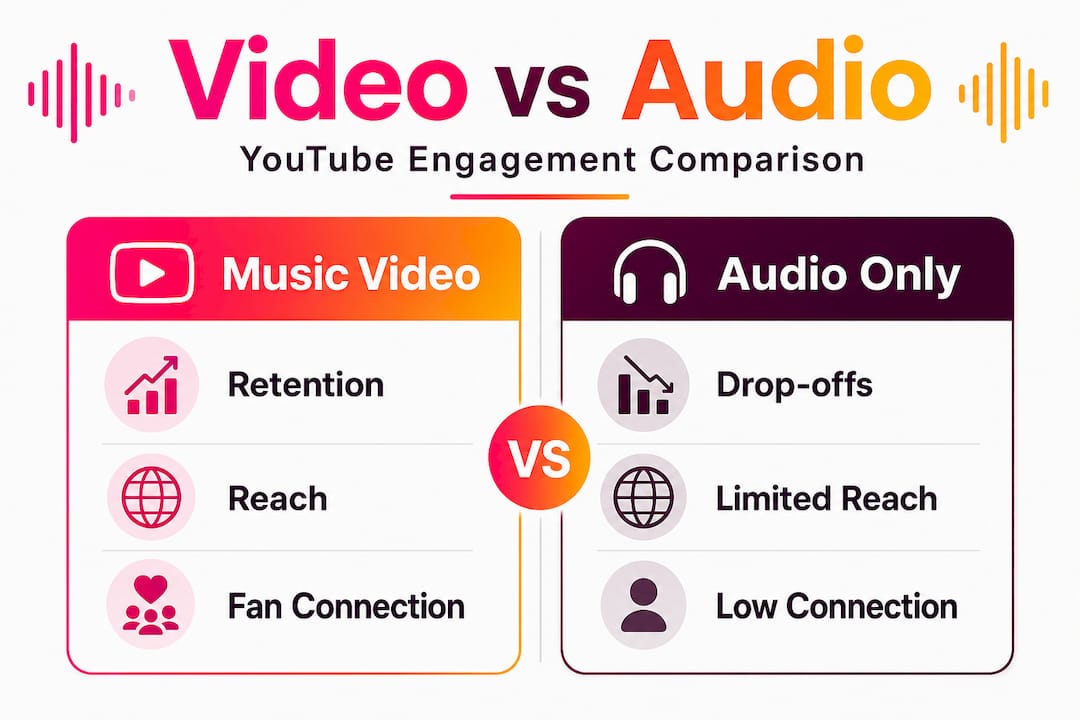
| Format | Average audience retention | Rewatch likelihood | Algorithmic reach | Fan connection depth |
|---|---|---|---|---|
| Music video (full production) | 45 to 65% | High | Strong | Very high |
| Lyric video or visualiser | 35 to 50% | Medium | Moderate | Medium to high |
| Audio with static image | 20 to 35% | Low | Weak | Low |
| Live performance video | 40 to 60% | High | Strong | Very high |
The gap between a music video and a static audio upload is not marginal. It is substantial. Audio uploads struggle to generate the retention signals that YouTube rewards. They rarely produce rewatch spikes. They generate fewer shares. And they do not build the kind of visual identity that turns a casual listener into a loyal fan.
The role of video in music promotion goes beyond reach. It builds something audio alone cannot: a visual world around your music. Fans who see your face, your environment, and your creative vision become more emotionally invested. That investment translates into shares, comments, and repeat listens.
Independent musicians benefit most from this dynamic because video content creates stickiness. Stickiness means people come back. They subscribe. They share with friends. They check your channel for new uploads. Audio tracks do not create this same behaviour pattern.
Research into brand activation and engagement consistently shows that visual media creates stronger emotional connections and longer-term loyalty than audio alone. The same principle applies directly to music. If you want fans who stick around, you need visuals. The good news is that the bar for compelling video content is lower than most indie musicians assume. Authenticity and consistency matter far more than production polish. And song exposure with video has never been more accessible or affordable to achieve.
Emerging video engagement trends indie musicians should watch
After covering the evidence and core techniques, it is crucial to look ahead at what is trending in the video engagement world.
The landscape of video content is shifting rapidly. Recent trends show interactivity, live elements, and short-form video driving increased participation across all creator categories. As an indie musician, staying aware of these shifts means you can adopt new formats before they become saturated.
Here are the trends most relevant to independent artists right now:
- YouTube Premieres and live chat: Releasing a video as a Premiere rather than a standard upload creates a shared viewing event. Fans gather in the live chat, build excitement together, and the engagement spike in that window signals strongly to the algorithm.
- Short-form vertical video: YouTube Shorts are becoming a powerful discovery tool. A 30 to 60 second clip of a hook from your song, a snippet of a music video, or a behind-the-scenes moment can pull viewers to your main channel content.
- User-generated content and remixes: Encouraging fans to create their own content with your music builds community and generates additional distribution across platforms. Even a simple challenge tied to a lyric or melody can spark genuine participation.
- Virtual concert tie-ins: Streaming a live performance and then cutting it into highlights for your main channel gives you multiple pieces of content from a single event. Fans who missed the live stream will seek out the highlights.
- Cross-platform promotion: Your YouTube video should not live in isolation. Teasing it on other platforms and directing fans back to YouTube strengthens the engagement signals in the critical early hours after publication.
Learning to run engaging virtual events is increasingly relevant for musicians who want to connect with audiences beyond traditional releases. And keeping up with music video trends for indie artists ensures you are never caught flat-footed when a new format starts gaining traction.
Why most indie musicians still overlook video’s engagement power
Looking at these trends, it is striking how much engagement potential remains untapped by most independent musicians. We work with artists across a wide range of genres and career stages, and the same barriers come up repeatedly.
The first is the belief that video is expensive. This was true a decade ago. It is not true now. A smartphone with decent lighting and a clear concept can produce a compelling music video. The retention data does not care about your camera resolution. It cares whether people keep watching.
The second barrier is complexity. Many musicians feel overwhelmed by the editing process, the analytics, and the consistency required. But the learning curve is shorter than it looks. Start with one video, review the retention graph, change one thing, and release again. That iterative process, done consistently, is what video in music distribution actually looks like in practise.
The third and most damaging barrier is the “for big acts only” mindset. It assumes that algorithmic success is reserved for artists who already have large audiences. The data disproves this. YouTube’s algorithm is designed to surface engaging content to relevant audiences, not just popular content to existing fans. An indie artist with 200 subscribers can see a video recommended to thousands of new viewers if the retention signal is strong enough.
The honest challenge we would put to any independent musician is this: take your next release seriously from a video perspective. Do not treat the visual component as an afterthought. Plan your intro, think about your story, publish consistently, and study your analytics. The artists doing this are growing. The ones still uploading audio stills and hoping for the best are not.
Level up your music promotion with standout videos
After challenging the common barriers to engaging video, here is how independent musicians can act right away.
You now have a clear picture of what drives video engagement on YouTube and why it matters more than ever for independent artists. The next step is putting it into action without spending months learning video production from scratch.

At Music Video Marketplace, we make it straightforward for musicians to create professional long-form videos in minutes, ready to upload directly to YouTube. You can also launch a targeted ad campaign for your song from the same platform, so your video reaches the right audience from day one. No expensive production team. No complicated workflow. Just your music, given the visual treatment it deserves, with the promotional muscle to back it up.
Frequently asked questions
How quickly can you see the impact of video engagement on YouTube?
Retention data processes within one to two days of publishing, so you can make meaningful strategy changes quickly rather than waiting weeks for meaningful feedback.
Does the length of a music video affect engagement?
Yes, pacing and intro length matter significantly. YouTube Studio highlights the first 30 seconds as the most critical window for retention, so shorter, sharper openings consistently outperform slow-building ones.
What are the most important metrics for music video engagement?
The core metrics to track are audience retention rate, rewatch spikes, and share counts. Engagement is evaluated across intro retention, top moments, rewatch spikes, and drop-off points, all visible inside YouTube Studio.
Should indie musicians focus on live video or pre-produced content?
Both formats deliver strong results when executed with intention. Recent trends show that interactivity and live events increase participation, but pre-produced content with strong retention analytics drives consistent long-term growth. Testing both and comparing your retention data is the best way to find what works for your audience.
Recommended
- Boost music video engagement: proven tips for 28% reach | Music Video Marketplace Blog
- Why video boosts song exposure for musicians in 2026 | Music Video Marketplace Blog
- Music promotion strategies for indie artists on YouTube | Music Video Marketplace Blog
- Why video content matters for musicians in 2026 | Music Video Marketplace Blog
Read next
 Why video boosts song exposure for musicians in 2026Discover why video increases song exposure for musicians in 2026. Learn how YouTube's algorithm prioritises watchtime, retention, and engagement over views to boost your reach.
 Why YouTube matters for DJs: grow your audience and careerDiscover why YouTube is essential for DJ career growth. Learn proven strategies for audience building, SEO optimisation, and overcoming copyright challenges with real success stories.
 Your essential DJ video content checklist for 2026Elevate your YouTube game with our comprehensive DJ video content checklist. Discover essential tips to create videos that shine in 2026!
 Why use long form video for DJs: 2026 guideDiscover why use long form video for DJs in 2026. Build deeper fan connections and elevate your artist career with effective strategies!
Turn the idea into a finished music video.
Drop your track into the Studio and build your visual in minutes.