
Why labels invest in video content: a label marketer's guide
Discover why labels invest in video content to boost revenue, enhance audience engagement, and maximize marketing efforts for lasting results.

Why labels invest in video content: a label marketer’s guide
TL;DR:
- Labels invest in video content because they generate multiple revenue streams, including ad income and catalogue appreciation. Video also enhances fan engagement across the marketing funnel, boosts streams, and increases long-term value through brand recognition and sync licensing. Proper registration and strategic use of different formats are essential for maximizing return on investment and building sustainable catalog assets.
Labels invest in video content because it generates direct revenue across multiple channels and multiplies the commercial return on every other marketing pound spent. The core commercial reasons are:
- Direct monetisation: ad revenue, Content ID claims, and platform royalties from YouTube and Spotify video
- Stream uplift: video viewers stream the same track and wider catalogue significantly more than audio-only listeners
- Tour and merch conversion: video drives fans deeper into the purchase funnel, from awareness to ticket and merchandise sales
- Sponsorship offsets: brand partnerships and product placement reduce net production costs, sometimes to zero
- Catalogue value: a video library appreciates as a long-term asset, generating passive income from back-catalogue views and sync licensing
According to Spotify’s internal data, listeners who watch a full-length video stream that track significantly more over the following three weeks compared with audio-only listeners, and explore the artist’s catalogue significantly more in the same period.
Table of Contents
- 1. Why labels invest in video content: the revenue channels explained
- 2. How video supports the marketing funnel and builds an artist’s visual brand
- 3. Which video formats labels invest in and where they distribute them
- 4. Typical budgets, ROI modelling, and the metrics that convince finance teams
- 5. How sponsorships and product placement work as budget offsets
- 6. Rights, claims, and the UK collecting society infrastructure
- 7. How labels organise video production budgets across their rosters
- 8. What the 2025–26 research says and what it means for label strategy
- Key takeaways
- The case for treating video as infrastructure, not a line item
- Musicvideomarketplace: scale your video output without scaling your budget
- Useful sources for UK label video investment
1. Why labels invest in video content: the revenue channels explained
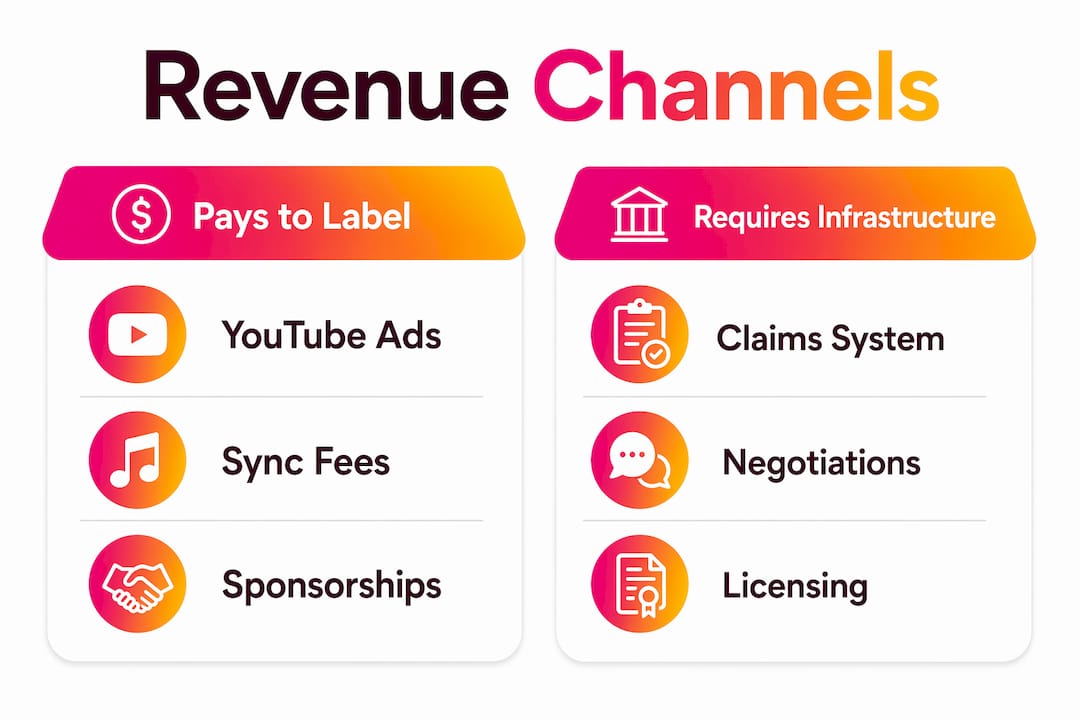
Video is not a single revenue line. It opens at least five distinct income streams, each with different mechanics, payment timelines, and rights complexity.
- YouTube ad revenue: Labels earn a share of advertising revenue generated against their official videos. Payment arrives monthly via YouTube’s partner programme, split between the label (as rights holder) and, depending on contract terms, the artist.
- Content ID claims: When a third party uploads a video containing a label’s sound recording, YouTube’s Content ID system flags it and routes ad revenue to the rights holder rather than the uploader. Content ID and UGC monetisation have become fast-growing revenue lines for labels with large catalogues.
- Spotify video royalties: Full-length music videos on Spotify are royalty-bearing and eligible for official music charts. This is a newer but growing channel, particularly as Spotify phases out short-form Clips in favour of full-length video content.
- Sync and licensing: A video asset increases a track’s sync appeal for TV, advertising, and film. The visual treatment gives commissioners a ready reference for mood and aesthetic, shortening the pitch cycle.
- Sponsorship and product placement: Brands pay to appear in or alongside music videos, either as on-set placement fees or as title sponsors of premiere events.
| Revenue channel | Pays directly to label? | Requires claims infrastructure? | Requires negotiation? |
|---|---|---|---|
| YouTube ad revenue | Yes | No (partner programme) | No |
| Content ID claims | Yes | Yes (Content ID registration) | No |
| Spotify video royalties | Yes | Via distributor/label | No |
| Sync / TV licensing | Yes | No | Yes |
| Sponsorship / placement | Yes | No | Yes |
Payment timing varies considerably. YouTube ad revenue pays 30–45 days after month end. Sync fees are negotiated upfront, with performance royalties collected separately by PRS for Music and PPL. Sponsorship fees are typically paid on delivery of the video or premiere event.

Rights complexity is real. A single music video involves at least three rights layers: the sound recording (label), the underlying composition (publisher/PRS), and the visual content itself (label or production company). Labels must ensure all three are registered correctly before any monetisation infrastructure can function.
2. How video supports the marketing funnel and builds an artist’s visual brand
Video supports every stage of the marketing funnel, from first discovery through to post-purchase loyalty, but only when the format and message are matched to the funnel stage. A teaser clip and a behind-the-scenes documentary serve entirely different commercial purposes.
Funnel mapping by format:
- Awareness: Official music videos, short-form teasers on TikTok and Instagram Reels, Vevo premieres
- Consideration: Live sessions, studio interviews, lyric videos with streaming links in description
- Conversion: YouTube premieres with pinned CTAs to streaming platforms, ticket links, and merch stores
- Retention: Exclusive behind-the-scenes content, fan Q&As, tour diaries
Beyond the funnel, video builds a visual brand that increases an artist’s long-term commercial value. A consistent visual identity across videos, thumbnails, and social clips makes an artist recognisable at a scroll. Booking agents and festival programmers actively benchmark video assets when assessing an artist’s readiness for larger stages. A strong video catalogue signals professionalism and reach in a way that streaming numbers alone cannot.
KPIs label marketers should track:
- Views and unique viewers (reach)
- Average watch time and completion rate (engagement quality)
- Click-through rate to streaming platform, merch store, or ticket link
- Stream uplift in the 3–4 weeks following video release
- Playlist adds and saves (intent signal)
- Social shares and UGC volume generated by the video
Pro Tip: Plan a single shoot day to deliver at least five distinct assets: the full video, a vertical cut for Reels and TikTok, a 15-second teaser, a lyric overlay version, and a behind-the-scenes clip. The marginal cost of each additional asset approaches zero when planned in advance, but the campaign lifespan extends by weeks.

3. Which video formats labels invest in and where they distribute them
Format choice is a commercial decision, not a creative one. Each format has a primary job, and placing it on the wrong platform wastes both budget and attention.
- Official music video: The flagship asset. Primary job is cultural credibility, editorial pitching (Vevo, YouTube editorial), and long-tail catalogue revenue. Budgets range from a few thousand pounds to six figures.
- Lyric video / visualiser: Labels use lyric videos as rapid-turn assets that bridge the gap between audio release and the official video. They feed YouTube premieres, generate early SEO traction, and provide social clips with minimal logistics overhead.
- Vertical short-form clips: 15–60 second cuts optimised for TikTok and Instagram Reels. Primary job is algorithmic discovery and UGC activation. A track that gains traction on TikTok before the official video drops arrives at its premiere with a warm audience.
- Live and studio sessions: Lower production cost, high authenticity signal. These perform well on Spotify’s editorial video playlists (Best New Videos, Live Performances) and sustain engagement between release cycles.
- Longform YouTube content: Tour documentaries, studio vlogs, and extended interviews build subscriber depth and increase watch time, which YouTube’s algorithm rewards with broader distribution.
- Performance films: Sit between the official video and live session. Useful for sync pitching and press, and increasingly pitched to streaming platforms as premium content.
Distribution surfaces by format:
| Format | Primary surface | Secondary surface |
|---|---|---|
| Official music video | YouTube, Vevo | Spotify video, label site |
| Lyric / visualiser | YouTube | Spotify Canvas, Instagram |
| Short-form clips | TikTok, Instagram Reels | YouTube Shorts |
| Live / studio session | Spotify video, YouTube | Facebook, label newsletter |
| Longform content | YouTube | Label/artist website |
Release sequencing matters. The standard approach: publish the lyric video or visualiser on audio release day to capture early search traffic, then hold the official video for a premiere event 2–4 weeks later. Short-form teasers should drop 48–72 hours before the premiere to drive anticipation. Fast video production workflows make this sequencing achievable even for smaller labels without large in-house teams.
4. Typical budgets, ROI modelling, and the metrics that convince finance teams
Production budgets vary enormously, but the commercial logic is consistent: the question is not what a video costs, but what return it generates relative to that cost.
| Budget band | Typical deliverables | Primary KPIs | Indicative time to payback |
|---|---|---|---|
| Low | Lyric video, 1–2 social cuts | Stream uplift, playlist adds | 3–6 months |
| Mid | Official video + social package | Stream uplift, ad revenue, sync enquiries | 6 months or more |
| High | Cinematic video, BTS, performance film | Sync fees, sponsorship, catalogue value | 18 months or more |
A simple mid-tier ROI example. A label spends £15,000 on an official video and social package for a track with 50,000 monthly streams pre-release. If the video drives a stream uplift (conservative, given Spotify’s data showing strong uplift for video viewers), that is an additional 15,000 streams per month. At a blended rate of approximately £0.003 per stream, that is £45 per month in additional streaming revenue from the track alone. Add YouTube ad revenue, Content ID claims from UGC, and a modest sync enquiry, and the payback window shortens considerably. Sponsorship income can eliminate the net cost entirely.
Measurement best practice:
- Set a 4-week attribution window post-release and compare stream velocity against a baseline period
- Use geo-tests where possible: release the video in one territory first and measure uplift against a control market
- Smooth the baseline over 8–12 weeks pre-release to remove seasonal noise
- Track click-through rates from video descriptions to streaming and merch links separately from organic stream data
- Report to finance on a per-release basis, not an aggregate, so underperforming formats can be identified and cut
Video advertising delivers stronger narrative capacity and higher engagement than static formats, and platforms reward completion metrics with broader algorithmic distribution. Paid YouTube and social video ads amplify organic performance and should be budgeted as part of the video investment, not treated as a separate line.
5. How sponsorships and product placement work as budget offsets
Sponsorship and product placement are not just revenue lines. Used well, they reduce net production cost to a point where the label’s financial exposure on a video approaches zero.
Common sponsorship models:
- On-set brand placement: A brand’s product appears naturally within the video. Fee is paid upfront; the brand receives usage rights for their own channels.
- Title sponsorship of a premiere: A brand co-presents the YouTube or Vevo premiere event, gaining logo placement and social amplification in exchange for a fee or media spend.
- Integrated branded content: The brand is woven into the video’s narrative. Higher fee, higher creative risk. Requires careful handling to avoid audience backlash.
- Paid social amplification deals: The brand funds paid promotion of the video on Instagram or TikTok in exchange for a credit or product mention. The label gets free media spend; the brand gets association with the artist.
Negotiation typically centres on four variables: the deliverables (number of placements, duration, prominence), usage rights (can the brand use the video in their own advertising?), visibility metrics (guaranteed view thresholds), and the fee. For emerging artists, brands often prefer a media spend deal over a cash fee. For established acts, upfront placement fees are standard.
Disclosure rules apply. The UK’s Advertising Standards Authority (ASA) and the Competition and Markets Authority (CMA) require that paid-for brand appearances in video content are clearly disclosed, either within the video itself or in the description. Failing to disclose damages both the artist’s credibility and the label’s relationship with platforms. Build disclosure language into every sponsorship contract as a standard deliverable.
6. Rights, claims, and the UK collecting society infrastructure
Capturing video revenue in the UK requires active registration with the right bodies. Leaving this undone means money that should reach the label is either uncollected or paid to the wrong party.
- YouTube Content ID: Labels (or their distributors) register sound recordings with Content ID. When a third party uploads a video containing that recording, Content ID claims the ad revenue automatically. This is the single most important claims infrastructure step for any label with a growing catalogue.
- PRS for Music: Collects performance and broadcast royalties for songwriters and publishers. When a music video is broadcast on TV, streamed on a licensed platform, or played in a public venue, PRS collects and distributes the composition royalty. Labels should confirm that all writers on a release are PRS members and that works are registered before the video goes live.
- PPL: Collects neighbouring rights royalties for record labels and performers. When a video is broadcast or publicly performed, PPL collects on behalf of the label (as sound recording owner) and the featured and session musicians. Labels must register recordings with PPL to receive these payments.
- Vevo: A joint venture between major labels and YouTube, Vevo hosts premium music video content and sells advertising against it at higher CPMs than standard YouTube. Labels with Vevo access benefit from higher ad rates, editorial placement, and a premium brand environment. Independent labels can access Vevo through approved distributors.
Video assets increase sync appeal for TV, advertising, and film commissioners. A well-produced video gives a sync supervisor a visual reference that speeds up the licensing decision. Labels should register all video assets with their sync licensing team or publisher immediately on release, not retrospectively.
For registration queries, the primary UK contacts are PRS for Music and PPL. Both publish detailed guidance on work registration, royalty collection timelines, and split registration for co-written material.
7. How labels organise video production budgets across their rosters
The operational model a label uses to commission and manage video production determines how efficiently it converts budget into commercial output.
Common models:
- Centralised creative team: An in-house video production or creative director function commissions and oversees all video output. Consistent brand standards, but expensive at low roster volumes.
- Commission-by-release: Each release is treated as a standalone project, with an external director or production company commissioned per video. Flexible, but no economies of scale and inconsistent quality.
- Production pool: A retained relationship with one or two production companies across the roster, with a pre-agreed rate card. Balances flexibility with cost efficiency.
- Catalogue reinvestment: A portion of streaming and YouTube revenue is ring-fenced to fund video production for back-catalogue tracks with sync or playlist potential. Turns passive income into active investment.
Squeezing more value from each shoot:
Labels that plan multi-format deliverables in one shoot day — vertical edits, teasers, behind-the-scenes clips, and lyric overlays — reduce per-asset cost and sustain campaign momentum across several weeks. A shoot day that produces only one deliverable is an inefficient use of budget. Brief the director with a full asset list before the shoot, not after.
Creator partnerships with established YouTube or TikTok creators offer another route to scale. A label can co-produce content with a creator whose audience overlaps with the artist’s target demographic, sharing production costs and gaining access to an existing subscriber base.
Governance checklist for label video investment:
- Define KPI thresholds before commissioning (minimum stream uplift target, view target at 30 days)
- Set approval gates: creative brief sign-off, rough cut review, final delivery check
- Agree reporting cadence: weekly during release week, monthly thereafter
- Review per-release ROI at 90 days and use findings to inform the next commission
- Audit Content ID and PPL/PRS registrations at the point of delivery, not retrospectively
8. What the 2025–26 research says and what it means for label strategy
The platform data and research published in 2025–26 consistently point in the same direction: video deepens fan engagement in ways that audio alone cannot replicate, and that engagement converts to measurable commercial outcomes.
Spotify’s internal data is the most striking set of figures available. Video viewers stream the same track significantly more over three weeks, explore the catalogue more, and are more likely to save, share, or add a track to a playlist. For super listeners, catalogue streaming time increases, adding substantial extra listening. These are not marginal uplifts. They represent a material change in fan behaviour driven by a single video view.
“Fans who watch videos alongside audio are 40% more likely to save a track, share it, or add it to a playlist.” — Spotify internal data, via Hypebot
A 2025 study published in Scientific Reports found that short video features influence purchase intention through trust as a mediating factor. Entertainment drives reach, but informativeness drives conversion. Labels running short-form strategies that prioritise entertainment without grounding the content in the music risk building views without building buyers.
Video’s role from discovery to retention is well-documented: Econsultancy’s analysis confirms that format and message must align with funnel stage for video to deliver its full commercial value. A retention-focused documentary published as a cold awareness asset will underperform not because the content is poor, but because the audience is wrong.
For label strategy in 2026, the practical implications are:
- Prioritise full-length video on Spotify for tracks with strong streaming momentum. The catalogue uplift data justifies the production cost.
- Run short-form content with a clear informative hook, not just a visual spectacle. Trust mediates conversion.
- Use 2026 video content trends to align format choices with platform algorithm signals, particularly as Spotify shifts away from short-form Clips.
- Test video impact with a geo-controlled release before scaling budget on a new format.
Key takeaways
Labels that treat video as a revenue asset rather than a marketing cost recover production spend faster, build deeper fan relationships, and generate passive income from catalogue that compounds over time.
| Point | Details |
|---|---|
| Video drives measurable stream uplift | Spotify data shows video viewers stream a track significantly more over three weeks, and explore the catalogue more than audio-only listeners in the same period. |
| Claims infrastructure is non-negotiable | Register all recordings with Content ID, PPL, and PRS for Music before release to capture every revenue stream. |
| Repurposable shoots cut per-asset cost | Plan vertical cuts, teasers, and lyric overlays into every shoot brief to extend campaign life at minimal extra cost. |
| Sponsorship can eliminate net production cost | Brand placement and premiere sponsorship deals offset budgets and bring additional media spend into the campaign. |
| Musicvideomarketplace accelerates output | Ready-to-edit, full-length video licences and short-form clip exports let labels publish video assets without commissioning a full production. |
The case for treating video as infrastructure, not a line item
The labels that consistently outperform on video are not the ones with the largest production budgets. They are the ones that have built repeatable systems: a clear asset brief for every shoot, claims infrastructure registered before release day, a format-to-funnel map that the whole team understands, and a reporting cadence that feeds findings back into the next commission.
What most label finance teams underestimate is the compounding effect of a video library. A video released today generates ad revenue, stream uplift, and sync enquiries not just in its release week but for years. The back-catalogue value of a well-maintained video library, properly registered with Content ID, PPL, and PRS, is a genuine balance-sheet asset. Labels that treat each video as a standalone marketing expense miss this entirely.
The short-form question is where the most interesting tension sits right now. TikTok and Instagram Reels drive extraordinary reach, but the Scientific Reports research is a useful corrective: entertainment without informativeness builds views, not fans. The labels seeing the best conversion from short-form are the ones using it to tease something specific — a release date, a visual world, a live moment — rather than chasing algorithmic virality for its own sake.
Musicvideomarketplace: scale your video output without scaling your budget
Commissioning a full production for every release is not realistic for most label rosters. Musicvideomarketplace gives label marketers and artist managers a faster route: a marketplace of human-made, ready-to-edit, full-length music videos that can be licensed, customised with the artist’s audio and branding, and exported as YouTube-ready files in a fraction of the time a traditional shoot requires.

Short-form clips for TikTok and Reels are generated from the same asset, so a single licence covers the full funnel from YouTube premiere to social teaser. Subscription options mean labels managing multiple releases can maintain a consistent output without negotiating a new production contract for each track. Licensing terms are clear upfront, which removes the rights ambiguity that slows down release schedules.
For labels that need to publish video content at scale, Musicvideomarketplace is a practical alternative to the commission-by-release model. Browse the marketplace, upload your audio, and have a release-ready video in your hands before the end of the day.
Useful sources for UK label video investment
- PRS for Music: Work registration, royalty collection, and split management for compositions. Register all tracks before release.
- PPL: Neighbouring rights registration for sound recordings and performers. Essential for broadcast and public performance revenue.
- YouTube Content ID: Official guidance on how Content ID works and how rights holders can register. Labels without direct access should work through an approved distributor.
- Vevo: Premium video hosting with higher CPM advertising. Independent labels should ask their distributor about Vevo delivery eligibility.
- Spotify for Artists — video: Dashboard for uploading full-length videos, pitching to editorial playlists, and tracking video performance data.
- Music Video Marketplace blog: video content in music distribution: Practical guidance on how video assets fit into distribution and promotional workflows.
- Music Video Marketplace blog: video content matters in 2026: Platform signal synthesis and recommended tests for label campaigns this year.
- Music Video Marketplace blog: video marketing trends 2026: Format and platform updates relevant to label strategy.
- Iguanify: fast video production guide: Practical workflow guidance for labels managing rapid-turn asset production.
This article is general information for music industry professionals and does not constitute legal, financial, or rights-management advice. Confirm current registration requirements and royalty rules directly with PRS for Music, PPL, and your distributor for your specific situation.
Recommended
- Create standout explainer videos for your record label | Music Video Marketplace Blog
- Pourquoi les labels misent sur la vidéo pour booster leur visibilité | Music Video Marketplace Blog
- Common challenges in label video production: 2026 guide | Music Video Marketplace Blog
- Why producers use video campaigns: the 2026 guide | Music Video Marketplace Blog
Read next
 Why producers use video campaigns: the 2026 guideDiscover why producers use video campaigns for measurable success. Learn how to boost sales, brand awareness, and ROI in 2026.
 Why Ready-Made Music Videos Are the Future for MusiciansIndependent artists no longer need huge budgets or months of planning to release professional visuals. Ready-made music videos offer indie musicians a faster, more affordable way to pair their tracks with high-quality visuals—helping them compete with major artists and connect with fans instantly.
 Why video content matters for musicians in 2026Discover why video content has become essential for musicians in 2026. Learn how video boosts engagement, drives discovery, and builds lasting fan connections.
 What is long form music content: a 2026 guideDiscover what long form music content is and how it engages audiences. Learn its benefits for artists in our 2026 guide!
Turn the idea into a finished music video.
Drop your track into the Studio and build your visual in minutes.