
YouTube Music Algorithm: Boosting Song Visibility Fast
YouTube music algorithm explained for musicians: types, ranking signals, session value, AI content labeling, and crucial mistakes to avoid.

YouTube Music Algorithm: Boosting Song Visibility Fast
Struggling to get your music noticed amid the endless scroll of YouTube recommendations is a common challenge for artists everywhere. The truth is, the platform’s algorithm holds real power over what songs reach fresh ears or fade into the digital background. Understanding how YouTube Music’s algorithm analyzes user engagement, listening habits, and content quality can be the turning point for independent musicians ready to share their sound on a global stage.
Table of Contents
- What Is YouTube Music Algorithm Today
- Types of YouTube Algorithm for Music
- Core Ranking Signals for Music Videos
- AI Labeling Rules for Music Content
- Common Mistakes Musicians Should Avoid
Key Takeaways
| Point | Details |
|---|---|
| Algorithm Complexity | YouTube Music’s algorithm uses various metrics like user engagement and contextual recommendations to personalize music suggestions. |
| Content Quality | High viewer retention and quality content enhance visibility, making engagement critical for musicians. |
| AI Classification | AI labeling improves music content categorization, requiring musicians to optimize metadata for better recognition. |
| Avoid Common Pitfalls | Musicians should focus on consistent, high-quality content and avoid neglecting metadata and audience engagement patterns. |
What Is YouTube Music Algorithm Today
YouTube Music’s algorithm represents a sophisticated digital ecosystem designed to recommend, rank, and promote music content based on complex user behavior analysis. Researchers examining algorithmic recommendation systems reveal that this technology goes far beyond simple playlist generation.
The algorithm functions through multiple interconnected mechanisms to understand and predict musical preferences:
- User engagement metrics: Views, likes, watch time, and sharing behavior
- Listening history tracking: Personal musical taste profiling
- Contextual recommendation: Time of day, device type, current mood
- Collaborative filtering: Similarities with other users’ listening patterns
Key performance indicators drive the algorithm’s decision-making process. The system continuously analyzes how users interact with music videos, creating dynamic recommendation pathways that adapt in real-time. Government research into streaming algorithms highlights how these systems fundamentally reshape music consumption worldwide.
The algorithm prioritizes content that generates sustained viewer interest, which means independent musicians must create engaging videos that retain audience attention. Metrics like average view duration, click-through rates, and audience retention become critical signals that influence a song’s visibility.
Pro tip: Design your music videos with audience retention in mind, focusing on compelling visual storytelling and high-quality production to increase algorithmic favor.
Types of YouTube Algorithm for Music
YouTube Music’s recommendation algorithms represent complex systems designed to personalize music discovery through multiple sophisticated approaches. Music recommendation network investigations reveal intricate mechanisms that go beyond simple playlist generation.
Three primary algorithm types dominate the music recommendation landscape:
- Collaborative Filtering: Recommends music based on similarities between user listening patterns
- Content-Based Filtering: Suggests songs with similar musical characteristics and metadata
- Hybrid Recommendation Systems: Combines multiple algorithmic approaches for more nuanced suggestions
AI-based recommendation techniques demonstrate how these algorithms process complex user data and song metadata to create personalized music experiences. Each approach offers unique advantages in understanding and predicting musical preferences.
The collaborative filtering method analyzes collective user behavior, identifying patterns across large listener groups. Content-based filtering examines individual song attributes like genre, instrumentation, and musical structure. Hybrid systems leverage both approaches, creating more sophisticated and accurate recommendations that adapt to evolving user tastes.
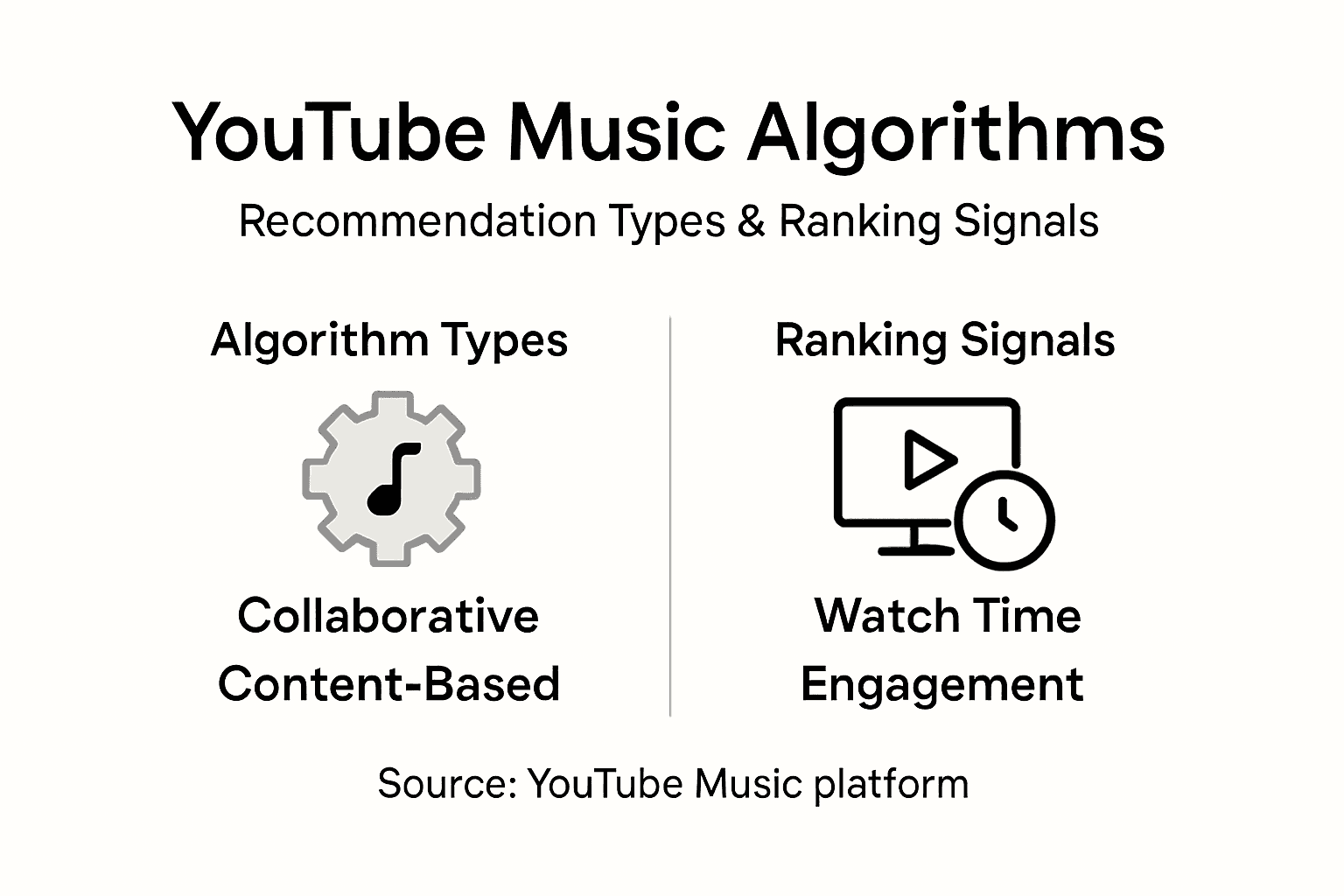
Here’s how the main YouTube Music algorithm types differ in approach and impact:
| Algorithm Type | Main Focus | User Benefit |
|---|---|---|
| Collaborative Filtering | Patterns in group behavior | Finds trends shared by similar users |
| Content-Based Filtering | Song attributes and metadata | Recommends based on personal taste |
| Hybrid Recommendation | Combines multiple approaches | Offers more precise personalization |
Algorithmic recommendations fundamentally transform how musicians reach audiences, making strategic content creation crucial for visibility.
Pro tip: Create diverse, high-quality music content that encourages sustained listener engagement across multiple viewing sessions to trigger positive algorithmic signals.
Core Ranking Signals for Music Videos
YouTube’s ranking signals are sophisticated mechanisms that determine music video visibility and success. Large-scale recommendation systems reveal a complex network of metrics that go far beyond simple view counts.
The core ranking signals for music videos can be categorized into several critical dimensions:
- User Engagement Metrics
- Watch time duration
- Click-through rates
- Like and share interactions
- Content Quality Signals
- Video production value
- Audio clarity
- Metadata accuracy
- User Behavior Indicators
- Repeat viewing frequency
- Playlist inclusions
- Listener demographic matching
Streaming service algorithm research demonstrates that these signals dynamically adjust to create fair and engaging music discovery experiences. The algorithm continuously evaluates multiple data points to understand both individual user preferences and broader audience trends.
The most powerful ranking signals emerge from sustained user interaction. Videos that generate longer watch times, consistent audience retention, and high-quality engagement tend to receive exponentially more visibility. This means musicians must create content that not only attracts initial clicks but maintains viewer interest throughout the entire video.

Common ranking signals have varying influence—here’s a side-by-side look at their importance:
| Ranking Signal | Typical Influence | Why It Matters |
|---|---|---|
| Watch Time Duration | Very High | Indicates deep listener engagement |
| Click-Through Rate | High | Reflects initial content appeal |
| Metadata Accuracy | Medium | Helps with discoverability |
| Playlist Inclusions | Medium-High | Shows lasting user interest |
Algorithmic success is less about viral moments and more about consistent, quality audience engagement.
Pro tip: Design music videos with strategic engagement points that encourage viewers to watch completely and interact meaningfully with your content.
AI Labeling Rules for Music Content
Artificial intelligence has transformed how music content gets classified and recommended on digital platforms. Automatic music content classification represents a complex technological ecosystem that goes far beyond simple genre tagging.
The core AI labeling rules for music content involve multiple sophisticated mechanisms:
- Audio Signal Processing
- Frequency spectrum analysis
- Rhythmic pattern recognition
- Instrumental composition detection
- Metadata Evaluation
- Lyrical content scanning
- Artist historical data
- Release information verification
- Contextual Understanding
- User interaction patterns
- Cross-genre complexity assessment
- Cultural music trend analysis
YouTube’s AI labeling research demonstrates how machine learning models continuously refine their understanding of music content, creating increasingly nuanced classification systems. These systems analyze multiple dimensions simultaneously to generate accurate, contextually relevant labels.
The AI labeling process involves deep learning algorithms that can recognize subtle musical characteristics invisible to human classification. By evaluating audio signatures, listener behaviors, and complex metadata, these systems create dynamic, adaptive music content labels that evolve with changing musical landscapes.
AI labeling transforms music discovery from a manual process to an intelligent, responsive ecosystem.
Pro tip: Optimize your music video’s metadata and audio characteristics to help AI systems more accurately recognize and categorize your musical content.
Common Mistakes Musicians Should Avoid
YouTube Music’s algorithm is an intricate system that can quickly penalize musicians who fail to understand its core mechanisms. Streaming service algorithmic research reveals several critical mistakes that can dramatically reduce music video visibility.
The most prevalent mistakes musicians consistently make include:
- Metadata Negligence
- Incomplete song information
- Inaccurate genre tagging
- Missing critical descriptive tags
- Engagement Pattern Errors
- Irregular content release schedules
- Low audience interaction
- Inconsistent video quality
- Algorithmic Misunderstandings
- Attempting to game the system
- Ignoring user behavior signals
- Failing to adapt to changing trends
Algorithmic music recommendation studies demonstrate that musicians often underestimate the complexity of recommendation systems. The algorithm rewards consistent, high-quality content that generates genuine audience engagement, not manipulative tactics.
Smart musicians understand that the algorithm prioritizes sustained viewer interest over short-term viral moments. This means creating videos that maintain audience attention, encourage repeated viewing, and generate meaningful interactions through compelling musical storytelling.
The algorithm rewards authenticity and strategic content creation, not quick manipulation tricks.
Pro tip: Develop a consistent content strategy that focuses on high-quality, engaging music videos that naturally encourage viewer interaction and retention.
Accelerate Your Song’s Visibility with Easy Music Video Production
The article highlights a critical challenge musicians face: capturing and maintaining audience engagement to satisfy YouTube Music’s algorithm ranking signals such as watch time, click-through rates, and sustained viewer interest. Creating high-quality, long form videos designed for deeper listener connection is essential but can be time-consuming and complex. Musicians want to avoid common pitfalls like inconsistent content release and low audience interaction while optimizing metadata and video content for powerful AI labeling and hybrid recommendation systems.
At Music Video Marketplace, we understand these pain points and provide a seamless solution. Our platform enables you to create professional long form music videos in minutes and launch targeted YouTube ad campaigns designed to boost your song’s engagement and click-through metrics fast. This strategic approach helps you align with YouTube’s collaborative filtering and content-based recommendations, driving consistent viewer retention and improved ranking.
Tap into the power of algorithm-friendly content creation today

Start crafting captivating videos that keep your audience watching longer and interacting more. Visit Music Video Marketplace now to simplify video creation and boost your music’s reach. Learn more about how our tools fit your needs at Music Video Marketplace and take control of your YouTube Music algorithm success.
Frequently Asked Questions
What factors influence the YouTube Music algorithm’s recommendations?
The YouTube Music algorithm analyzes user engagement metrics, listening history, contextual recommendations, and collaborative filtering to predict musical preferences and suggest relevant content.
How can I improve my music video’s visibility on YouTube Music?
To boost visibility, focus on creating engaging content that retains viewers, optimize your video’s metadata for accuracy, and promote consistent audience interaction.
What are the main types of algorithms used in YouTube Music’s recommendation system?
YouTube Music utilizes three primary types of algorithms: collaborative filtering, content-based filtering, and hybrid recommendation systems, each focusing on different aspects of user behavior and song attributes.
How does engagement impact a music video’s ranking on YouTube Music?
Engagement metrics such as watch time, click-through rates, and audience retention are critical signals that can significantly influence a video’s ranking and visibility in YouTube Music’s recommendations.
Recommended
Read next
 YouTube Music Content: Boosting Reach for MusiciansYouTube music content empowers musicians to craft engaging long-form videos, grow audiences, and maximise ad campaigns. Learn key formats and pitfalls.
 YouTube music distribution: 5 key benefits in 2026Discover how independent musicians can use YouTube for music distribution, monetisation, and discovery in 2026. Practical strategies for real growth.
 YouTube Promotion for Musicians: Driving Global ImpactYouTube promotion for musicians boosts song discovery, fan engagement, and career growth using ads, long-form video, and data-driven strategies.
 How YouTube algorithms boost musicians' song visibilityDiscover how YouTube's algorithm works for musicians in 2026. Learn proven strategies to boost song visibility, debunk myths, and grow your audience organically.
Turn the idea into a finished music video.
Drop your track into the Studio and build your visual in minutes.