
 Try the Workspace
Get Your Song Into Upload Ready Video in Days for Music Professionals
Release-ready workflow for music professionals: license a full length, ad ready video, drop in your master, and export platform specific short clips in days.
Get Your Song Into Upload Ready Video in Days for Music Professionals
The fastest, industry-ready way to add a song to a video is to commission or licence a human-made, full-length music video, backed by a planned bank of short-form clips, and deliver upload-ready specs to every platform you release on. That means skipping consumer overlay apps entirely. Start by finalising your master, sorting your metadata, and writing a six-line creative brief. Music Video Marketplace exists precisely to shorten that path from finished song to licensable video asset.
TL;DR:
- Licensing a ready-to-customise full-length video typically provides delivery within days, significantly faster than bespoke productions that take six to ten weeks.
- Planning for multiple aspect ratios from the outset is essential, as retrofitting crops from horizontal shoots often reduces visual quality.
- Pre-production must include a final master, stems, metadata, credits, artwork, a brief, and technical requirements like high-resolution formats and caption files.
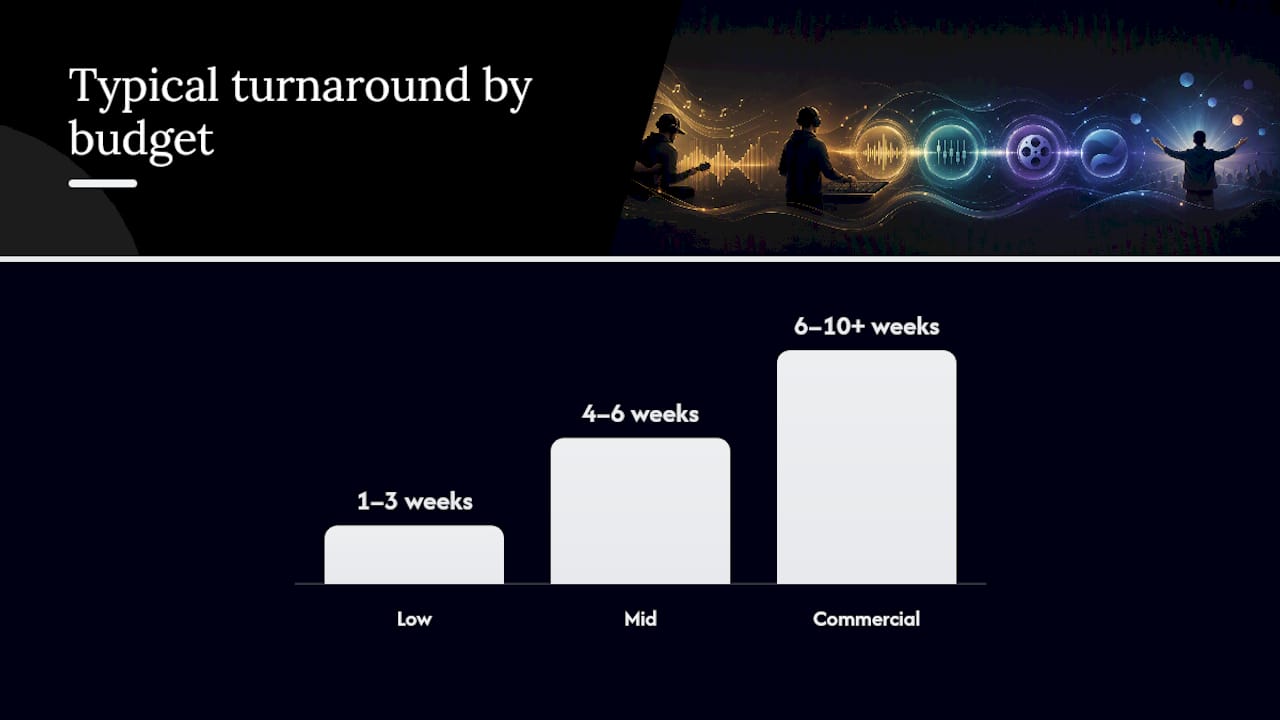
- Turnaround times vary from one to three weeks for simple videos, four to six weeks for mid-level projects, and up to ten weeks for complex commercial shoots.
- Launching short-form clips days before the full video release maximizes engagement and leverages fan-generated content for early sales boosts.
Table of Contents
- Which video format should you commission or licence?
- What do you need to supply before production starts?
- How long does production take and what should it cost?
- How do you sequence promotion to catch platform momentum?
- Why we back licensable, ready-made video assets
- Get your song into an upload-ready video without the six-week wait
- Sources
Which video format should you commission or licence?
Your release goal decides the format, not the other way round. A single going for Spotify’s editorial video slots needs different treatment to a track built purely for TikTok discovery.
Five formats cover almost every commercial release:
- Performance video: artist-led, camera-heavy, fastest to shoot and edit, strong for building an artist’s visual identity over a catalogue.
- Narrative video: storyline-driven, needs casting, locations and more post time, best for lead singles with promotional budget behind them.
- Lyric video: cheap, quick, good for pre-save campaigns and as a stopgap before the full video lands.
- Visualiser: motion graphics tied to the waveform or artwork, minimal shoot requirement, useful for album tracks that will never get a full video.
- Ready-to-customise licensable video: a professionally shot, human-made template you licence and personalise with your own audio, artwork and credits, then export in multiple cuts.
Three routes get you to a finished asset. Licensing a ready-to-customise full-length video is the fastest, typically delivering upload-ready files within days rather than weeks. Commissioning a bespoke shoot gives you total creative control but costs more and takes longer. Preparing a clip family for short-form platforms sits alongside either route as a parallel workstream, not a replacement for it.
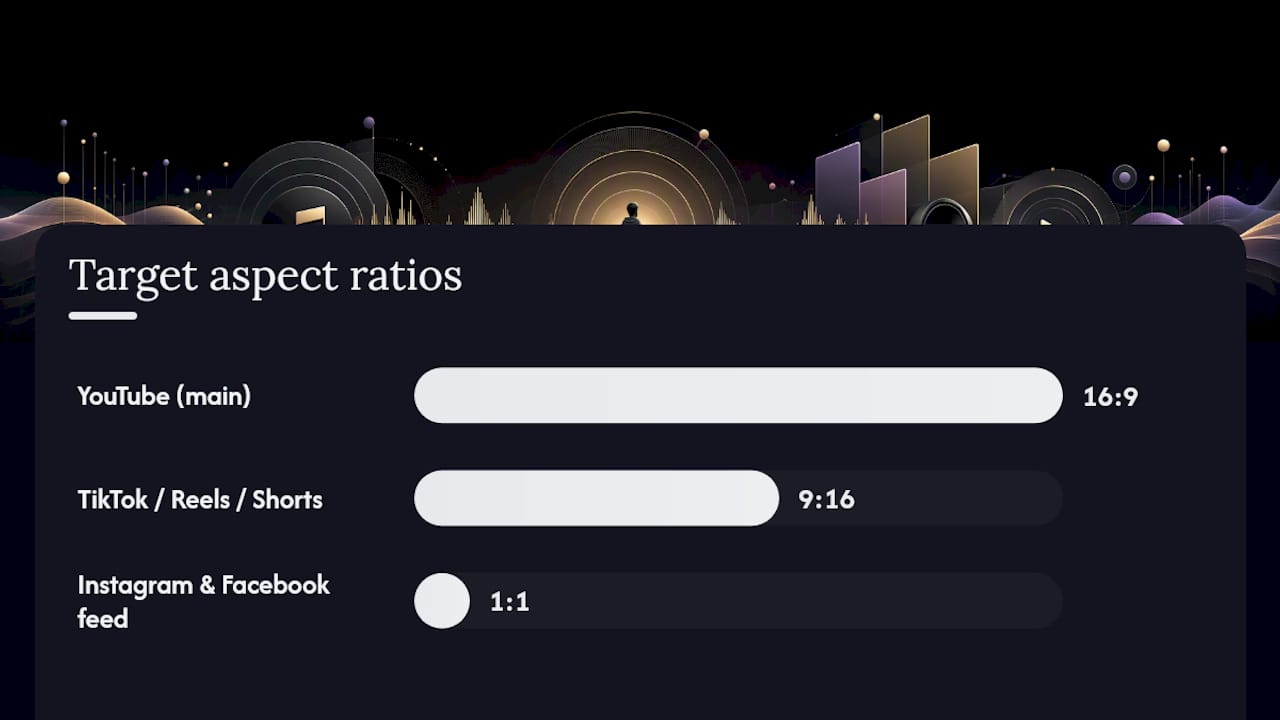
Aspect ratio matters as much as the concept. YouTube still expects 16:9 for the main upload. TikTok, Reels and Shorts all want 9:16. Feed placements on Instagram and Facebook perform better at 1:1. Plan for all three from the outset, because retrofitting vertical crops from a horizontal-only shoot almost always looks compromised.
The trade-off is speed against control against rights clarity. A bespoke shoot gives you the most creative say but the loosest guarantee on turnaround. A licensed asset gives you speed and, crucially, clean commercial rights for advertising, which matters the moment you plan to run paid campaigns behind the video rather than just upload it and hope.
What do you need to supply before production starts?
Nothing slows a video down faster than a producer chasing missing files. Get these ready before you brief anyone.
- Final master in the highest resolution file you have (WAV preferred over MP3).
- Stems, if you have them, in case the edit needs isolated vocal or instrumental sections for sync points.
- ISRC code and full songwriter and publisher metadata, so licensing paperwork isn’t held up later.
- Credits list, spelled exactly as you want them to appear on screen.
- Artwork and brand assets (logo, colour palette, any existing visual identity from previous releases).
- A short brief covering tone, three or four must-have shots or moments, key timing hooks in the track, expected deliverables, and required aspect ratios.
On the technical side, ask for delivery in ProRes or a high-bitrate H.264 master, minimum 1080p (4K if you plan to run ads), at the frame rate you shot on rather than a converted rate. Request closed captions, a separate subtitle or lyric file, and short-form exports cut natively for 9:16 rather than centre-cropped from the horizontal master.
Pro Tip: Ask for two or three thumbnail exports at the brief stage, not after delivery. Thumbnails need to read clearly at postage-stamp size, and testing that late in the process usually means a second invoice.
Set expectations up front on paperwork too. A licensed asset should come with clear terms on where you can use it, commercially and otherwise. A bespoke commission needs its own contract covering ownership, usage rights and any performer releases. Licensed routes tend to deliver in days; bespoke productions run into weeks, which the next section breaks down properly.
How long does production take and what should it cost?
Independent production timelines are fairly consistent across the industry: pre-production runs two to four weeks, the shoot itself is often just one or two days for smaller productions, and post-production takes another two to six weeks, according to a production guide from ProfileTree. That puts a realistic bespoke commission at six to ten weeks from brief to delivery.
On set, play the final master through speakers or in-ear monitors for every take, so lip-sync and rhythmic hits land properly. Map your shot list to the song’s actual structure, intro, verse, chorus, bridge, using an animatic beforehand to check the edit will sit on the beat before you spend a day shooting it, a method Storyflow recommends for exactly this reason. Capture vertical clips in parallel to the main horizontal shoot. Bolting them on afterwards almost always costs more than filming them alongside the primary coverage.
| Budget band | Typical deliverables | Turnaround |
|---|---|---|
| Low | Simple performance or lyric video, single location, minimal crew | 1 to 3 weeks |
| Mid | Full narrative or performance video, small crew, colour grade, short-form cuts included | 4 to 6 weeks |
| Commercial | Multi-location narrative shoot, larger crew, VFX or set builds, full clip family | 6 to 10 weeks plus |
Licensed, ready-to-customise assets sit outside this table entirely. Because the shoot is already done, turnaround runs to days rather than weeks, which is the whole point of that route when a release date is fixed.
How do you sequence promotion to catch platform momentum?
Timing beats polish in the first two weeks of a release. A well-shot video launched with no plan behind it underperforms a rougher one released on a proper cadence.
Run something close to this schedule:
- T-30 to T-14: build pre-save assets, tease footage, and start warming your audience.
- T-21: shoot and cut your clip family, aiming for a dozen or more vertical clips ready to go before drop day, a sequencing approach ChatCut outlines in its 30-day promo framework.
- Drop day to T+2: release short-form clips first. Don’t put the full-length video out on the same day, it competes with your own short-form push for attention.
- T+3 to T+7: premiere the full-length video on YouTube, ideally using a scheduled premiere to concentrate viewers into a live watch window.
- T+1 to T+14: sustain momentum by repurposing performance moments into fresh clips and checking Spotify for Artists for video upload or editorial pitching options, generally within a seven-day window of release.
Encourage fan-made clips from day one rather than relying only on your own assets. A 2018 study found that user-generated content produces a larger initial sales lift than company-generated content, with effect sizes of 0.051 for UGC against 0.037 for CGC in that early period. Company content tends to catch up later, but the early window belongs to fans.
Full-length video viewers on Spotify stream that song 64% more over the following three weeks compared with audio-only listeners, and their catalogue streaming rises too. That’s the single strongest argument for investing in a proper long-form video rather than treating it as an afterthought.
Watch view velocity, save rate, share rate and short-form sound reuse across the first 72 hours. Those four numbers tell you whether the release has algorithmic legs before the first week is even out, and our guide to boosting YouTube engagement covers how to read them properly.
Why we back licensable, ready-made video assets
Most delays we see come down to the same three things: a brief that’s too vague, a master that isn’t finished when the shoot is booked, or clips shot in the wrong aspect ratio for where they’ll actually run. None of that is a creative problem, it’s a process problem, and it’s entirely avoidable.
Ready-to-customise licensed videos solve for exactly that. The shoot risk is gone before you start, the rights are clean for advertising, and the turnaround measures in days rather than the six to ten weeks a bespoke commission realistically needs. Music videos remain a strategic asset for streaming growth, not just a nice-to-have, and a workflow that gets one finished on time beats a perfect concept that misses the release date.
— Music
Get your song into an upload-ready video without the six-week wait
Musicvideomarketplace is the direct alternative to booking a bespoke shoot when your release date is already fixed. Instead of chasing a director’s calendar for six to ten weeks, you licence a human-made, ready-to-customise full-length video, drop in your own audio and branding, and export YouTube-ready files alongside a short-form clip family built for the same rollout.

The platform supplies:
- A ready-to-customise, full-length music video with clean licensing for uploads and paid ad campaigns.
- Short-form exports cut for 9:16 and 1:1 platforms alongside the main 16:9 file.
- Licensing paperwork sorted at checkout, so there’s no separate rights negotiation to chase.
Before you browse, have your final master, artwork and a short brief ready, tone, must-have moments, and any timing hooks in the track. Head to Music Video Marketplace to see what’s available and get your video moving.
Sources
- What if video on Spotify becomes the next big thing? (Hypebot)
- Study on UGC vs CGC effects on music sales (Frontiers in Psychology, 2018)
- Music video production guide (ProfileTree)
- Music video promo in 2026: a 30‑day plan for indie artists (ChatCut)
- How to plan a music video (Storyflow)
Recommended
Read next
 Apple Music motion artwork: get YouTube-ready video fastUnlock the power of Apple Music motion artwork to create stunning YouTube videos and ads quickly. Get ready-made packages for fast, professional results.
 Use one brand colour as a video accent, not a washElevate your videos by using brand colors effectively. Learn how to create eye-catching visuals that enhance viewer engagement and drive action.
 Common challenges in label video production: 2026 guideDiscover the common challenges in label video production and learn effective strategies to overcome obstacles for timely, budget-friendly projects.
 YouTube Shorts specs: the complete technical spec sheetDiscover the key YouTube Shorts specs: aspect ratio, resolution, format, and more to optimize your videos for maximum engagement.
Turn the idea into a finished music video.
Drop your track into the Workspace and build your visual in minutes.