
 Try the Workspace
Audience targeting in music ads: 2026 guide
Discover what audience targeting in music ads means for reaching your ideal listeners. Enhance your music's visibility and engagement in 2026!

Audience targeting in music ads: 2026 guide
TL;DR:
- Audience targeting in music ads involves using platform data and demographic filters to reach listeners most likely to engage with your music. Precise segmentation, especially artist stacking and retargeting, maximizes ad efficiency and builds a loyal fanbase. Focus on creating compelling first seconds in videos, allowing the algorithm to optimize naturally for sustained success.
Audience targeting in music ads is the practice of directing your promotional spend towards specific groups of listeners who are most likely to stream, save, and share your tracks. Without it, you are broadcasting to strangers. 88% of tracks released on major streaming platforms never reach 1,000 streams, which means the average release disappears into silence not because the music is poor, but because it never found the right ears. Platforms like Meta Ads, Spotify for Artists, and smart link tools such as ToneDen give musicians the data infrastructure to change that outcome entirely.
What is audience targeting in music ads?
Audience targeting in music ads is the systematic process of using platform data, behavioural signals, and demographic filters to serve your ad creative only to people who are predisposed to engage with your sound. The industry term for this practice is audience segmentation, and it sits at the centre of every high-performing music ad campaign. Rather than paying for impressions from people who will scroll past your track, segmentation lets you concentrate budget on listeners who already follow similar artists, stream comparable genres, or have previously visited your smart link page.
The core logic is straightforward. Every ad platform, from Meta to TikTok, holds billions of data points about user behaviour. When you define an audience, you are essentially telling the algorithm which subset of those users to prioritise. The more precisely you define that subset, the less budget you waste on disengaged viewers. For independent musicians with limited marketing funds, this precision is not optional. It is the difference between a campaign that builds a fanbase and one that burns through money with nothing to show.
How do ad platform algorithms shape your targeting?
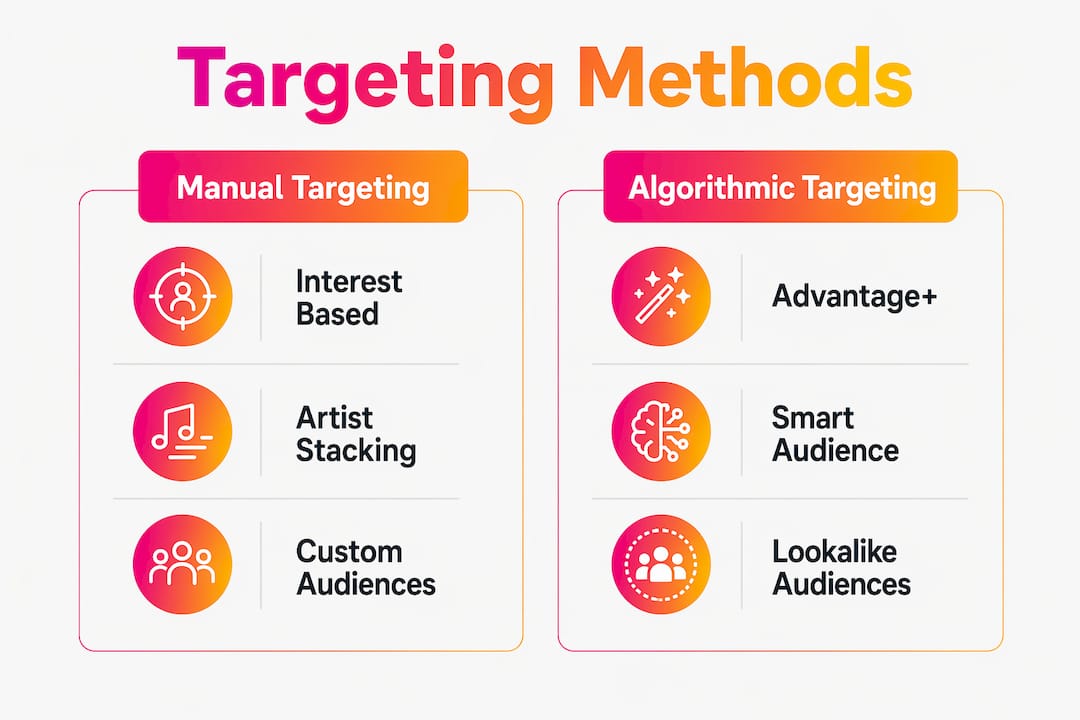
Meta’s Advantage+ system and TikTok’s Smart Audience tool have shifted the balance of power between manual targeting and machine learning. Meta’s Advantage+ uses engagement signals to create the audience profile, which means the algorithm is constantly learning who responds to your creative and expanding delivery towards similar users. This makes your early creative performance critical. If the first people who see your ad engage strongly, the algorithm interprets that as a signal to find more people like them.
The learning phase matters enormously here. Campaigns require 48 to 72 hours of data before the algorithm can optimise delivery effectively. Cutting a campaign short before that window closes forces the system to work from incomplete information, which drives up your cost per result and degrades targeting accuracy. Patience during this phase is not passive. It is a deliberate strategic choice.
The table below compares the three primary targeting approaches available on Meta in 2026.
| Targeting type | How it works | Best use case |
|---|---|---|
| Interest-based | Targets users by declared interests and page likes | New campaigns with no existing audience data |
| Lookalike audiences | Finds users similar to a seed audience you provide | Scaling campaigns once you have 1,000+ engaged fans |
| Broad targeting | Lets Advantage+ define the audience with minimal constraints | High-budget campaigns with strong creative assets |
Pro Tip: Run interest-based and broad targeting as separate ad sets within the same campaign. After 72 hours, compare cost per click and save rate. The winner tells you whether your creative is strong enough to let the algorithm roam freely.
What are the most effective audience segmentation strategies?
The artist stacking technique is one of the most reliable methods for reaching high-intent listeners. Instead of targeting a single artist’s fanbase, you layer the interests of three to five similar artists within one ad set. A bedroom pop artist might stack Phoebe Bridgers, Julien Baker, and Soccer Mommy. This overlap creates a tighter, more specific audience than any single interest could produce. Targeting broad categories like “people who like music” wastes budget and campaign efficiency because the audience is too diffuse to convert.

Custom audiences built from Meta Pixel data take this further. When a listener visits your smart link page, the Pixel records that visit. You can then retarget those visitors with a follow-up ad, and retargeting audiences convert at two to three times the rate of cold audiences. This warm audience layer is where your budget works hardest, because these users have already demonstrated intent by clicking through once.
Lookalike audiences extend your reach beyond people you already know. The key constraint is seed audience size. Valid lookalike audiences require at least 1,000 seed users from engaged listeners. If your seed list is smaller than that, interest stacking will outperform lookalikes every time. Build your custom audience first, then graduate to lookalikes once the data is there.
Geographic and behavioural segmentation add another layer of precision. Targeting listeners in cities with active live music scenes, or users who have streamed music on Spotify in the past 30 days, narrows your audience to people with demonstrated listening habits rather than passive interest. For budget guidance, single-release campaigns typically require £440 to £610 to give the algorithm enough data to optimise properly.
- Build your seed audience from email subscribers, Pixel visitors, and video viewers before launching lookalike campaigns.
- Use artist stacking with three to five comparable acts rather than genre labels alone.
- Separate cold and warm audiences into distinct ad sets to measure performance independently.
- Exclude existing followers from cold audience campaigns to avoid wasting impressions on people who already know you.
- Refresh your custom audiences every 14 days to keep retargeting lists current.
Pro Tip: When building a lookalike audience, use your top 10% most engaged listeners as the seed, not your full fanbase. A smaller, higher-quality seed produces a tighter, more accurate lookalike.
Common mistakes that destroy music ad targeting
The most damaging mistake musicians make is choosing the wrong campaign objective. Running a traffic objective sends your ad to people who click links habitually, not people who will stream and save your track. Musicians should use conversion objectives with pixel-enabled landing pages to avoid targeting low-intent clickers and boost genuine listens. The distinction sounds technical, but the practical impact on your cost per stream is substantial.
Here are the five most common targeting errors, in order of how often they appear:
- Ending campaigns before the learning phase completes. Most artists terminate campaigns prematurely, forcing algorithms to rely on incomplete data. The result is inflated costs and poor audience matching.
- Targeting audiences that are too broad. Selecting “music” as an interest category puts your ad in front of tens of millions of users with no shared taste profile.
- Chasing cheap streams from low-engagement geographies. Targeting countries with low cost-per-click figures looks efficient on paper, but the listeners rarely save or follow after streaming.
- Ignoring the first three seconds of video. 65% of users who watch the first 3 seconds of a video ad will watch at least 10 seconds. A weak opening loses both the viewer and the algorithm’s confidence in your creative.
- Using the same creative for cold and warm audiences. Cold audiences need a hook that introduces your sound. Warm audiences already know you and respond better to social proof or a direct call to stream.
The algorithm is not your enemy. It is a mirror. If your targeting produces poor results, the problem is almost always the creative or the objective, not the platform itself.
How to build a music ad campaign with precise audience targeting
Start with your creative, because on Meta and TikTok, the ad itself is a targeting signal. Meta’s algorithm uses early video engagement in the first three seconds to define who sees more of your ad. A hook that immediately communicates your genre, mood, and energy self-selects the right audience before any demographic filter does. For TikTok specifically, 91.7% of content is consumed with sound enabled, so your audio quality and the first musical phrase carry more targeting weight than your thumbnail.
The campaign build follows this sequence:
- Set up a smart link landing page with Meta Pixel and Conversion API installed before you spend a single pound.
- Launch a cold audience campaign using artist stacking, with a conversion objective pointed at your smart link.
- After 72 hours, review cost per click and video retention data. If retention drops below 30% at the three-second mark, the creative needs reworking before you scale.
- Once your Pixel has recorded 500 or more landing page visits, create a retargeting ad set for warm audiences with a distinct creative variant.
- When your custom audience reaches 1,000 engaged users, build a 1% lookalike audience and run it as a separate ad set.
A/B testing in music ads should isolate one variable at a time, starting with creative format before moving to audience targeting. Testing two variables simultaneously makes it impossible to know which change drove the result. The metrics that validate your targeting are cost per click, save rate on Spotify, and the ratio of streams to landing page visits. A high click-through rate paired with a low save rate signals that your targeting is reaching curious but uncommitted listeners, not genuine fans.
Why I think most musicians are targeting the wrong thing entirely
After watching hundreds of music ad campaigns, the pattern I see most often is artists obsessing over audience selection while neglecting the creative. The uncomfortable truth is that in 2026, with Meta’s Advantage+ and TikTok’s Smart Audience both operating at scale, the algorithm is better at finding your audience than you are. What it cannot do is make a weak creative perform. The hook, the sound quality, and the visual energy of your ad are now the primary targeting tools. The interest selections you make are guardrails, not the engine.
I have seen campaigns with near-perfect artist stacking and meticulous lookalike audiences fail because the video opened on a static album cover with no audio for two seconds. I have also seen campaigns with broad targeting and a single interest selection outperform everything else in the account because the creative was genuinely arresting. The shift I would encourage every musician to make is this: spend 80% of your preparation time on the first three seconds of your video and 20% on audience settings. The algorithm will handle the rest if you give it something worth amplifying. Building custom audiences from engaged fans over time remains the single most durable investment you can make in your ad account, because it compounds. Every campaign adds to your retargeting pool, and every retargeting pool makes the next lookalike audience more accurate.
— Music
How Musicvideomarketplace helps you target smarter
The quality of your video creative determines how well the algorithm can identify and expand your ideal audience. Musicvideomarketplace enables musicians to create a long-form video in minutes, ready to upload to YouTube and deploy as an ad campaign for their song.

A polished video with a strong opening hook gives Meta and TikTok’s algorithms the engagement signals they need to find your listeners at scale. Browse the video ad assets available on Musicvideomarketplace to find a format that matches your sound and gives your next campaign the creative foundation it needs to perform. You can also explore additional video formats suited to different ad placements and audience types.
FAQ
What is audience targeting in music ads?
Audience targeting in music ads is the process of using platform data, behavioural signals, and demographic filters to show your ad only to listeners most likely to engage with your music. It is the core practice that separates efficient campaigns from wasted spend.
How many similar artists should I stack for targeting?
Layering three to five comparable artists in a single ad set creates a tight, high-intent audience. Using fewer than three risks an audience that is too small; using more than five dilutes the specificity that makes artist stacking effective.
When should I use lookalike audiences?
Lookalike audiences become effective once you have at least 1,000 engaged seed users from your custom audience. Below that threshold, interest stacking produces better results because the lookalike model lacks sufficient data to find accurate matches.
Why does my campaign objective affect audience quality?
A traffic objective optimises for clicks, which attracts users who click habitually rather than listeners with genuine interest in your music. A conversion objective, paired with a Pixel-enabled smart link, trains the algorithm to find users who complete meaningful actions such as streaming or saving your track.
How long should I run a music ad campaign before judging results?
Allow at least 48 to 72 hours before drawing conclusions, as this is the minimum time the algorithm needs to exit its learning phase and begin optimising delivery. Ending a campaign before this window closes produces misleading data and higher costs.
Key takeaways
Precise audience segmentation, not broad reach, is the defining factor in whether a music ad campaign builds a real fanbase or burns through budget without result.
| Point | Details |
|---|---|
| Start with conversion objectives | Use pixel-enabled smart links and conversion goals to attract genuine listeners, not casual clickers. |
| Artist stacking beats broad interests | Layer three to five comparable artists to create a specific, high-intent audience segment. |
| Creative is a targeting signal | The first three seconds of your video tell the algorithm who to find. Invest there first. |
| Respect the learning phase | Allow 48 to 72 hours before evaluating results; early termination corrupts algorithm data. |
| Build custom audiences over time | Retargeting warm audiences converts at two to three times the rate of cold traffic and compounds with every campaign. |
Recommended
- Tips for effective song ads: your 2026 guide | Music Video Marketplace Blog
- How to launch music ads on YouTube: A step-by-step guide | Music Video Marketplace Blog
- Best practices for music ads: promote your tracks effectively | Music Video Marketplace Blog
- Pourquoi investir dans la publicité musicale en 2026 | Music Video Marketplace Blog
Read next
 Benefits of video ads for tour announcements in 2026Discover the benefits of video ads for tour announcements in 2026. Boost engagement and reduce costs with effective video campaigns.
 Benefits of YouTube promotion for musicians in 2026Discover the benefits of YouTube promotion for musicians in 2026. Unlock your music's potential and gain the audience you deserve!
 Best Length for Music Ads: Formats, Seconds and TestsWhat is the best length for a music ad? Clear lengths for YouTube in-stream, bumper and Shorts ads, how to cut a song, and what to test.
 ASA Music Advertising Rules: A UK Guide for Artists and LabelsWhat the ASA and the CAP Code expect from UK music ads: spotting #ad labels, targeting, offence, claims and YouTube video campaigns, explained for artists.
Turn the idea into a finished music video.
Drop your track into the Workspace and build your visual in minutes.