
Music video b-roll: a buyer's guide for artists and labels
Discover how to buy licensed music video b-roll quickly. Get the right sync and master rights to ensure a seamless publishing experience.
Music video b-roll: a buyer’s guide for artists and labels
Buying a licensed, ready-to-edit full-length music video is the fastest route to a publishable, cleared asset for musicians who need something on YouTube this week, not next quarter. The verdict is simple: confirm both the sync and master rights are included before you pay, run a short intake checklist, and get the licence terms in writing.
That’s the whole decision in one sentence. Everything else is due diligence.
Before you buy, work through this:
- Confirm sync (composition) and master (recording) rights are both covered in the video you’re purchasing.
- Complete a short intake: song title, exact recording, intended platforms, licence term, and territory.
- Request written licence terms that explicitly cover advertising and repurposing rights, not just organic posting.
Pro Tip: Ask the vendor directly whether their licence survives if you cancel a subscription later. Some don’t, and that’s a problem you want to know about before launch day, not after.
A rights body like PRS for Music exists precisely because composition and recording rights are handled separately, and a platform like YouTube Audio Library shows how narrow a “free” licence can be once you look at its permitted uses. MusicVideoMarketplace.com sits at the other end of that spectrum: full-length videos delivered with cleared rights built in, so the paperwork is done before you press upload.
Key Takeaways
A ready-to-edit, licensed full-length music video clears both sync and master rights upfront, cutting a multi-week legal process down to days.
| Point | Details |
|---|---|
| Two rights, two owners | Sync covers the composition, master covers the recording; both need separate written clearance. |
| Platform licences have limits | YouTube Audio Library and Facebook Sound Collection often restrict commercial or paid promotional use. |
| Get terms in writing | Confirm platforms, territory, term, and advertising rights before paying, never rely on verbal assurance. |
| Format for every destination | Deliver 16:9 for YouTube and 9:16 cutdowns for Shorts, Reels, and TikTok from the same source video. |
| Marketplace route saves time | MusicVideoMarketplace.com delivers pre-cleared, export-ready full-length videos with cutdowns included, avoiding weeks of direct label negotiation. |
Table of Contents
- How licensing works for full-length music video content
- Which route actually gets your video published fastest?
- What should you check before you pay for a video?
- What contract clauses actually protect you?
- How do you publish and repurpose the finished video?
- What mistakes cost buyers the most time and money?
- Best practices for integrating b-roll into a finished video
- What resolution and format standards should you expect?
- Where do buyers actually source quality footage?
- How much should artists budget for footage and production?
- How do you negotiate footage licences for commercial use?
- A note from the marketplace team
- Get a cleared, ready-to-edit video without the clearance chase
- Where to go next for clearance and platform rules
- Frequently asked questions
- Sources
How licensing works for full-length music video content
Two separate permissions sit behind every commercial music video: a sync licence for the composition (the melody and lyrics, controlled by the publisher or a rights body such as ASCAP or PRS for Music) and a master use licence for the actual recording (controlled by the label or whoever owns the master). You need both, from different people, and one without the other doesn’t make the video legal. The ASCAP checklist for using music in film lays this out clearly, and it’s worth reading even if you never plan to negotiate directly with a publisher yourself.
There are three practical paths to a legally usable video:
- Direct negotiation with the publisher and label or master owner, clause by clause.
- Buying a ready-to-edit licensed full-length video where the sync and master permissions are already secured and baked into what you receive.
- Licensing from a music library or platform collection such as Epidemic Sound, Artlist, Musicbed, YouTube Audio Library, or Facebook Sound Collection, then building your own edit around it.
Libraries and platform collections are worth understanding even if you don’t use one, because their limits explain why so many artists end up stuck. Epidemic Sound and Artlist licence library music, not your own commercial recording, so they solve a different problem than clearing an existing song. YouTube Audio Library and Facebook Sound Collection go further still: some tracks are locked to that single platform, and commercial or promoted use is often restricted entirely, a point Legal Clarity’s guide to using music in videos spells out with real consequences attached, including statutory damages that can be very high per work in the US.
A licence that works fine for an organic YouTube upload can fall apart the moment you boost the video as a paid ad. Read the platform scope before you assume coverage carries over.
Pro Tip: Never take a platform’s music library as a blanket green light. Read the specific licence attached to the specific track you plan to use, not the platform’s general terms page.
Which route actually gets your video published fastest?
Four realistic options sit in front of any artist who needs a video: a bespoke high-production shoot, commissioning original music to sidestep clearance entirely, licensing production-library music and editing it yourself, or buying a ready-to-edit licensed full-length video from a marketplace. Each trades speed against control in a different way.
- Bespoke shoot: highest cost, longest timeline, full creative control, but clearance for the recording still has to happen separately if you’re using an existing song.
- Commissioned original music: avoids third-party clearance but adds composition time and doesn’t solve the video production problem at all.
- Production-library music plus DIY edit: cheap and quick, but you’re editing footage yourself and the library licence may not extend to paid promotion.
- Ready-to-edit licensed full-length video: sync and master already cleared, deliverables built for YouTube and social cutdowns, fastest path to a publishable, ad-ready asset.
MusicVideoMarketplace.com is built around that fourth option specifically: browse, customise with your own audio and branding, and export something YouTube-ready without chasing a publisher’s legal team for six weeks.
A label with a single release date and no in-house video team doesn’t have six weeks to spare on clearance emails. A pre-cleared, ready-to-edit video turns what would be a month of legal back-and-forth into a same-week purchase, which matters most when a release date is already locked with distributors and playlist pitches.
What should you check before you pay for a video?
Before any money changes hands, gather what’s often called a clearance intake, or KE FORM, drawing on the checklist approach outlined by Montague’s music clearance guide. Bring these details to the vendor:
- Exact song title and ISRC code, if you have one.
- The exact recording or version (album cut, radio edit, remix).
- The audio file you want embedded in the final video.
- Intended platforms: YouTube, TikTok, Instagram, and whether paid ads are part of the plan.
- Territory and licence term you need coverage for.
- Whether exclusivity matters to you.
- Deliverables required: full-length video, stems, and short-form cutdowns.
Once that’s sorted, work through this before paying anyone:
- Confirm both composition and master clearance exist for the specific video you’re buying.
- Get the licence terms in writing, not a verbal assurance over email.
- Confirm exactly which platforms the licence permits.
- Establish who owns the master and whether your rights extend to paid advertising.
On timing: a pre-cleared marketplace video can move from purchase to delivery in a matter of days, sometimes immediately. Direct label and publisher negotiations are a different world entirely, commonly running several weeks to three months depending on how many parties need to sign off.
Pricing varies enormously and depends on the song’s popularity, your intended use, territory, and whether you need exclusivity. Don’t expect a single fixed number; expect a range that shifts with those variables. Ask any vendor these questions directly: who owns the master, does the licence cover paid promotion, will rights lapse if a subscription ends, what raw files do you actually receive, and are you allowed to re-edit the footage yourself?
Pro Tip: Get the platform list and advertising permissions written into the contract by name. “Social media use permitted” is not the same as “paid promotion on Meta and TikTok Ads permitted,” and vendors know the difference even when the wording is vague.
What contract clauses actually protect you?
The licence document itself is where good intentions either hold up or fall apart. Before paying, confirm these clauses exist in writing:
- A clear definition of exactly which assets are licensed (the video, the audio, or both).
- Explicit sync and master permissions named separately, not bundled into vague language.
- Permitted platforms, territory, and term stated by name and date range.
- Advertising and promotional use rights spelled out, not assumed.
- Sublicensing or transfer rights, particularly if a label or manager might reassign the asset later.
- Termination and revocation clauses, including what happens if you or the vendor stop paying a subscription.
- Warranty language confirming the vendor has actually cleared what they’re selling.
Watch for red flags: a licence that only covers one platform, one that can’t be transferred if you switch distributors, or one that gets revoked the moment a subscription lapses. Unclear ownership of the master is the biggest one. If nobody can tell you plainly who owns the recording, walk away.
Pro Tip: Ask for a short addendum that lists your specific permitted uses in plain English, ads, cutdowns, global territory, and the term length, rather than relying on a generic template licence written for someone else’s use case.
How do you publish and repurpose the finished video?
Once you’ve got a cleared, ready-to-edit full-length video, format matters as much as legality. YouTube still wants 16:9, but Shorts, Reels, and TikTok all want 9:16, so plan for both from the same shoot or edit. DIY Musician’s guide to video for artists confirms YouTube remains the primary home for full-length uploads while short-form clips do the heavy lifting on discovery.
- Build a clip family of 15 to 30 second vertical cuts with captioned lyric hooks before the full-length goes live.
- Keep exported audio matched to the licensed master exactly, no re-recordings or alternate mixes.
- Consider staggering release: short-form first to build momentum, full-length after.
Pro Tip: If a platform flags a Content ID claim, that’s not a strike. Keep your licence documentation ready and submit it through the platform’s dispute process rather than panicking and pulling the video.
What mistakes cost buyers the most time and money?
The same handful of errors trip up buyers repeatedly:
- Assuming one licence automatically covers every platform you plan to post on.
- Relying on a verbal “yeah, that’s fine” instead of a written licence.
- Building an entire edit around a song before confirming it’s actually clearable.
- Believing a short clip is automatically exempt from licensing requirements.
- Ignoring clauses that revoke rights the moment a subscription lapses.
Pro Tip: Define your exact use, channels, term, and territory before you fall in love with a particular song or video. Deciding backwards from a finished edit is how most clearance disasters start.
Best practices for integrating b-roll into a finished video
The footage sitting behind your artist, the cutaways, the texture shots, the mood establishing frames, is what turns a static performance clip into something that holds attention for three minutes. Good editors treat that footage as a storytelling layer, not filler between verses.
Match pacing to the song’s structure. Slower verses can hold on a shot for four or five seconds; a chorus or drop usually wants cuts every one to two seconds to match the energy shift. Mismatched pacing is one of the fastest ways to make a video feel amateur even when the individual shots are excellent.
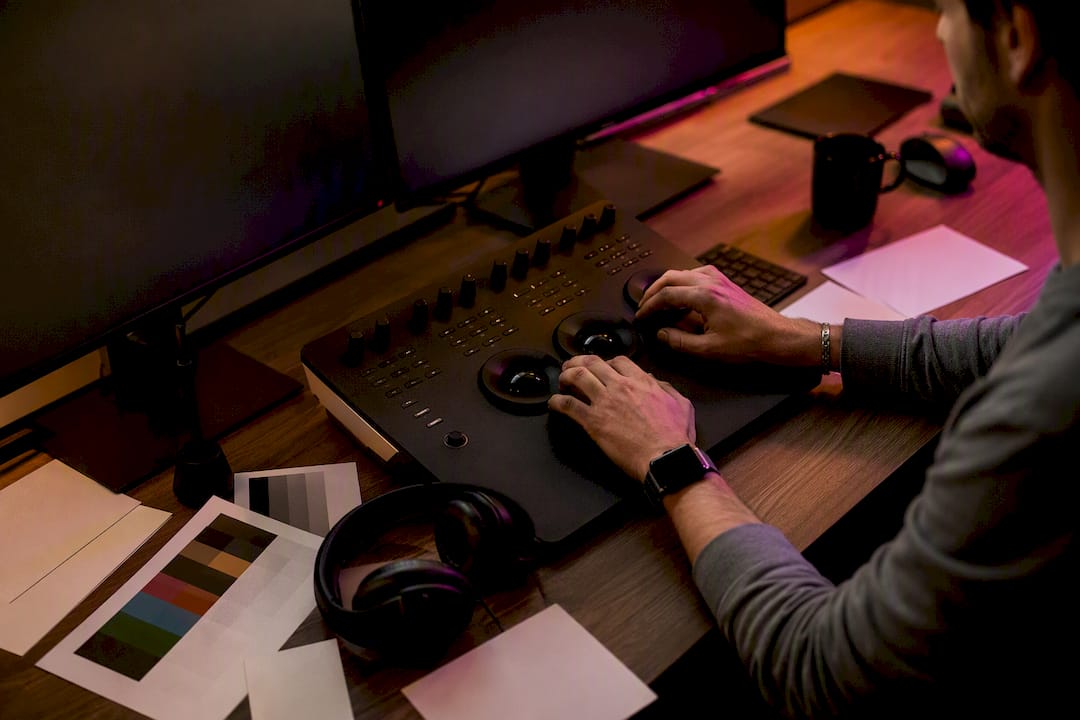
Colour consistency matters more than most first-time buyers expect. If the supplementary footage was shot in a different location, on a different day, or by a different crew than the main performance, an uncorrected mismatch in colour temperature or contrast reads as sloppy even to viewers who couldn’t tell you why. A consistent grade across every shot, no matter how it was sourced, holds the whole video together visually.
Narrative logic still applies even in a video with no dialogue. A montage of city streets, close-ups of hands, or a car interior only earns its place if it echoes something in the lyric or the mood of that section. Random pretty shots dropped in because they looked good on their own tend to feel disconnected once the full edit plays back. This is exactly the kind of judgement a ready-to-edit video from a marketplace already accounts for, since the footage was assembled with the song’s structure in mind rather than bolted on afterwards.
What resolution and format standards should you expect?
A commercially usable music video in 2026 means 1080p as an absolute floor, with 4K increasingly the expectation for anything that might get pitched for a YouTube homepage feature or used in paid ad creative. Frame rate should sit at 24fps or 25fps for a cinematic feel, or 30fps if the performance footage needs to look crisp and immediate rather than filmic.
Aspect ratio depends entirely on destination. The full-length asset needs 16:9 for YouTube, but every cutdown pulled from it for Shorts, Reels, or TikTok needs 9:16, and a square 1:1 crop still has some use on older Facebook placements. Delivering only one aspect ratio and expecting to crop it live on each platform almost always produces awkward, off-centre framing.
Colour grading should be consistent throughout, ideally delivered in a broadcast-safe colour space like Rec. 709 rather than a raw ungrated log profile that looks flat and grey until someone processes it further. If you’re receiving a finished, ready-to-edit video rather than raw footage, confirm the grade is already applied and matches across every scene, not just the main performance segment.
Audio sync tolerance should be effectively zero. A drift of even a couple of frames between the lip movements or beat hits and the audio track is immediately noticeable to anyone who’s heard the song before, which, for a music video, is every single viewer.
Where do buyers actually source quality footage?
Musicians and labels typically pull from four places, and each solves a different problem. Stock footage libraries offer volume and low cost but rarely feel bespoke to a specific artist or song. Commissioned bespoke filming gives full control and a unique look but takes the longest and costs the most. AI-assisted video generation, as Illustrate Magazine’s piece on AI tools for musicians describes, can turn an uploaded audio file into a mood-matched video quickly, useful for artists who need visual output for every release without a production budget attached to each one.
The fourth option, and the one that solves clearance and quality simultaneously, is buying a ready-to-edit full-length video where the footage was shot or assembled specifically for music video use and delivered already synced to a licensed structure. That is the model MusicVideoMarketplace.com is built around: customise an existing, professionally produced video with your own audio and branding rather than sourcing footage from scratch and hoping it holds together in the edit. For a manager juggling several artist rosters, that difference between “commission and wait” and “customise and export” is often the entire difference between hitting a release date or missing it.
How much should artists budget for footage and production?
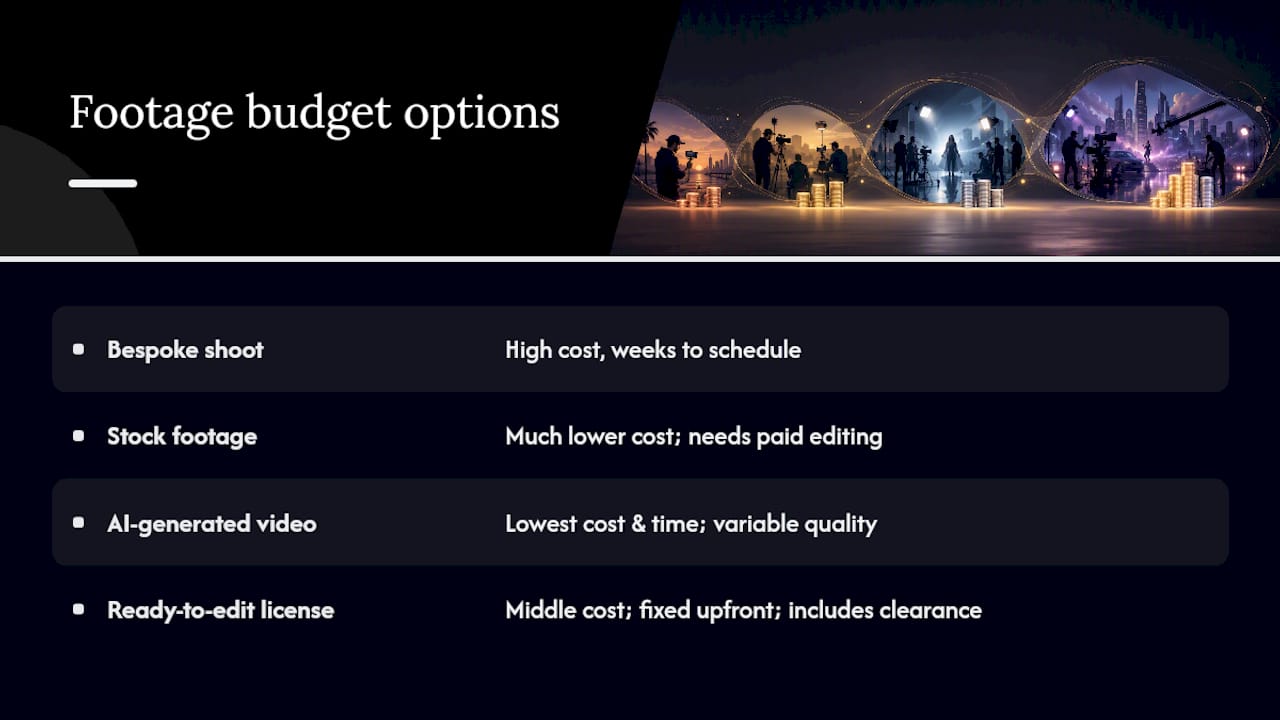
Budget decisions here come down to a genuine trade-off between cost, time, and creative uniqueness, and it’s worth being honest about which one matters most for a given release. A bespoke shoot with a hired crew, location fees, and post-production can run into thousands of pounds and take weeks to schedule around everyone’s availability. That’s justified for a lead single with a marketing budget behind it, but rarely makes sense for an album’s deeper cuts or a fast-turnaround single.
Stock footage libraries reduce cost dramatically but usually require paying separately for editing time, since raw stock clips still need to be assembled, colour matched, and synced to the track by someone with editing skill. AI-generated video tools cut both cost and time further, though output quality and specificity to your exact song can vary.
A ready-to-edit licensed full-length video sits in a useful middle ground: a fixed, known cost upfront that covers both the footage and the clearance, with no separate editing bill and no unpredictable legal fees turning up later. For a label managing several releases a year, that predictability alone often outweighs the appeal of a one-off cinematic shoot, particularly since a coherent, consistently published visual output tends to serve streaming conversion better than a single expensive video released once and never followed up.
How do you negotiate footage licences for commercial use?
Treat every b-roll or footage negotiation the same way you’d treat a music rights negotiation: get the scope in writing before any money moves. Ask specifically whether the licence covers paid advertising, not just organic posting, since many footage and stock licences quietly exclude promoted or boosted use unless you pay for an extended tier.
Push for territory and term clarity. A licence limited to a single country or a fixed twelve-month window can quietly expire mid-campaign if nobody’s tracking it, which is a particularly painful discovery when a video is already live and performing well in paid ads.
Ask who retains ownership of the underlying footage and whether you’re permitted to re-edit or create derivative cutdowns from it. Some footage licences allow the original piece but restrict you from pulling new short-form clips out of it later, which defeats much of the point if your campaign depends on a family of social cuts. Where a vendor already builds cutdown rights into the base licence, as a marketplace purchase typically does, that’s one less negotiation to have separately.
Finally, get exclusivity terms clarified if it matters to your campaign. Non-exclusive licences are usually cheaper and faster to secure, but if a competitor or another artist could use the same footage, decide upfront whether that risk is acceptable for your release.
A note from the marketplace team
We built MusicVideoMarketplace.com because artists kept losing weeks to clearance chasing instead of releasing music. Browse sample videos on the platform, see the deliverables firsthand, and reach out if you want a walkthrough before you buy.
Get a cleared, ready-to-edit video without the clearance chase
Musicvideomarketplace exists for exactly the moment this article describes: you need a legally clean, publishable video and you don’t have three months to spend negotiating with a publisher’s legal team. Every video on the platform comes with sync and master rights already sorted, so the deliverable you download is the one you can actually upload to YouTube and put money behind in an ad campaign the same week.

What you get: pre-cleared licences covering both composition and recording, YouTube-ready export formats, short-form cutdowns built from the same asset for TikTok and Reels, and a turnaround measured in days rather than weeks. That last point matters most for labels running a release calendar, where a video stuck in publisher negotiations can quietly push back an entire campaign timeline.
Browse the Music Video Marketplace catalogue to see what’s available for your genre and mood, or get in touch about a licence addendum if your campaign needs specific advertising or territory terms confirmed in writing before you commit.
Where to go next for clearance and platform rules
Start deeper research with these:
- ASCAP’s checklist for using music in film helps you identify which publisher controls a composition.
- Legal Clarity’s guide to music licensing explains the legal risk of skipping sync or master clearance.
- Montague’s clearance checklist gives a practical intake template for gathering the right details before you buy.
- DIY Musician’s video guide covers platform strategy for full-length videos versus short-form clips.
- MusicVideoMarketplace.com’s example videos show what a finished, cleared deliverable actually looks like.
Frequently asked questions
Do I need a licence if I only use a short clip of a song in my video? Yes. There’s no automatic exemption for short clips, and assuming a few seconds is safe is one of the most common mistakes buyers make, according to Legal Clarity’s breakdown of video music licensing.
What’s the difference between a sync licence and a master use licence? A sync licence covers the underlying composition, usually controlled by a publisher, while a master use licence covers the specific recording, controlled by the label or master owner. You need both for a legally clean video.
Can I use music from YouTube Audio Library in a paid ad campaign? Often not without checking carefully first. Many tracks in platform libraries like YouTube Audio Library or Facebook Sound Collection restrict commercial or promoted use, so confirm the specific track’s licence before building a campaign around it.
How long does it take to clear music for a commercial video? A pre-cleared, ready-to-edit video can be immediate to a few days. Direct negotiation with a publisher or label commonly takes several weeks to three months, depending on how many rights holders are involved.
What happens if my video gets a Content ID claim after I’ve licensed the music properly? A claim isn’t the same as a strike. Keep your written licence documentation on hand and submit it through the platform’s dispute process to resolve it.
This article is general information, not a substitute for advice from a qualified lawyer. Consult a qualified legal professional about your own circumstances before acting on anything here.
Sources
- How to use music in your videos legally | Legal Clarity
- The ultimate guide to video for musicians in 2025 | DIY Musician
- Music clearance checklist for video, apps, podcasts and branded content | Montague
- A checklist for using music in film | ASCAP
Recommended
- Why labels invest in video content: a label marketer’s guide | Music Video Marketplace Blog
- Benefits of video for artist acquisition: 2026 guide | Music Video Marketplace Blog
- Création vidéo pour maisons de disques : guide décision | Music Video Marketplace Blog
- Create standout explainer videos for your record label | Music Video Marketplace Blog
Read next
 Music Video Branding: Repurpose Videos on an Indie BudgetMusic video branding helps independent artists build a lasting identity on a small budget. Define the message first, then reuse visuals across releases.
 £400–£2,500 Music Video Budgets: Licence, Edits & Ads for IndiesSee realistic sample budgets (£400–£2,500) and exact line items — licence, edits/exports, and ad spend — plus a pre-purchase checklist and when Music...
 Music Video Creation Guide for Quick YouTube LaunchExplore this music video creation guide designed for musicians. Follow simple steps to make a long form video and launch a YouTube ad campaign for your single.
 Music promotion ideas for DJs: 2026 guideDiscover effective music promotion ideas for DJs in 2026! Elevate your reach with digital strategies, playlist pitching, and social media tips.
Turn the idea into a finished music video.
Drop your track into the Studio and build your visual in minutes.