
 Try the Workspace
£400–£2,500 Music Video Budgets: Licence, Edits & Ads for Indies
See realistic sample budgets (£400–£2,500) and exact line items — licence, edits/exports, and ad spend — plus a pre-purchase checklist and when Music...
£400–£2,500 Music Video Budgets: Licence, Edits & Ads for Indies
Budget a realistic amount for a full release cycle: a licence for a ready-made, customisable video typically costs tens to several hundreds of pounds, with customisation and exports adding further charges, and the remainder allocated to ad spend. Check usage rights and export formats before you pay. Browsing templates on a marketplace like Music Video Marketplace gives you a realistic sense of pricing before you commit.
TL;DR:
- A typical music video licence costs between £50 and £400, with customisation charges adding to the overall budget, depending on complexity.
- Testing ad creative variations should consume 20% to 30% of your ad spend, with gradual scaling increases of 20% to 30% every few days to maintain efficiency.
- Hidden costs like rush fees, export charges, and usage-right uplifts can significantly inflate the initial price if not clarified before purchase.
- For smaller budgets, allocate around £80 to £120 for licences and customisation, focusing on short testing periods of 5 to 7 days before scaling ad spend.
- Marketplace videos suit most releases when speed and volume matter over bespoke content; repurposing a single asset into multiple formats improves campaign effectiveness.
Table of Contents
- Music video budget breakdown: the licence and customisation line items
- Three sample budgets you can copy for your release stage
- How to allocate and test your ad budget after purchase
- Hidden costs to watch for and a pre-purchase checklist
- When a ready-made video makes more sense than a bespoke shoot
- How Music Video Marketplace fits your budget
- Sources
Music video budget breakdown: the licence and customisation line items
The price you pay for a ready-made video splits into two distinct charges, and conflating them is where most buyers get their maths wrong. The first is the licence itself. The second is what it costs to make that video yours.
Licence types vary more than most buyers expect. A one-off licence usually grants a single track, a set duration of use, and standard digital rights, priced from roughly £50 up to £400 depending on the video’s production quality and exclusivity. A subscription model, by contrast, gives you access to a wider catalogue for a recurring monthly fee, which suits artists or labels releasing several tracks a year rather than a single campaign. Subscriptions tend to work out cheaper per video if you’re releasing quarterly, but they lock you into ongoing payments even in quiet months.
Customisation is where the real variation sits. Expect line items for:
- Branding and logo placement — swapping in your artwork, artist name, and colour palette
- Audio synchronisation — matching visual cuts to your track’s tempo and key moments
- Captions and lyric overlays — increasingly expected on social platforms where sound is off by default
- Aspect-ratio exports — vertical 9:16 for TikTok and Reels, square 1:1 for feed posts, widescreen 16:9 for YouTube
- Short-form clip cuts — 15 to 30 second teasers pulled from the full video for paid ad testing
Export and delivery fees often sit separately from customisation. A YouTube-ready master might be included in the base licence, but each additional platform-specific export can carry its own charge. Then come usage-right uplifts: extending territory coverage, lengthening the licence duration, or adding whitelisting and Spark Ads permissions for paid promotion through an artist’s or influencer’s account. Rush delivery, if you need the video inside 48 hours rather than the standard week, typically adds a premium on top of everything above.
Three sample budgets you can copy for your release stage
Real numbers help more than percentages, so here are three scenarios built around common release stages, using industry-recommended ranges for both video and ad spend.
- Indie release, total budget around £400–£600. Allocate £80 to £120 for a one-off video licence and basic customisation, leaving £320 to £480 for ads. Run a 5 to 7 day testing phase across two or three ad creatives before committing the rest to whichever variant performs. Expect modest but measurable reach at this level, enough to validate whether the song has traction worth building on.
- Developing artist, total budget around £1,000–£1,500. Split roughly £150 to £250 on licence and full customisation (branding, captions, multiple aspect-ratio exports), with £850 to £1,250 for advertising. A 10 to 14 day testing window across four to six creatives is realistic here, followed by a scaling phase that typically runs another two to three weeks. This range aligns closely with the independent-artist budget guidance that puts realistic release spend between roughly £400 and £2,000.
- Label-style release, total budget around £2,000–£2,500. Video licensing, customisation, and premium usage rights (extended territory, whitelisting) might run £300 to £400, with £1,700 to £2,100 going to ads. Testing extends to two to three weeks across six or more creative variants, with a longer scaling runway of four to six weeks to chase playlist placements and sustained streaming growth.
Across all three, testing typically consumes 20% to 30% of the ad budget, with the remainder reserved for scaling once you know which creative actually converts.
How to allocate and test your ad budget after purchase
Buying the video is the easy part. Spending the ad budget well is where campaigns succeed or fail, and it starts with a short, deliberate testing phase rather than dumping the whole budget into one campaign on day one.
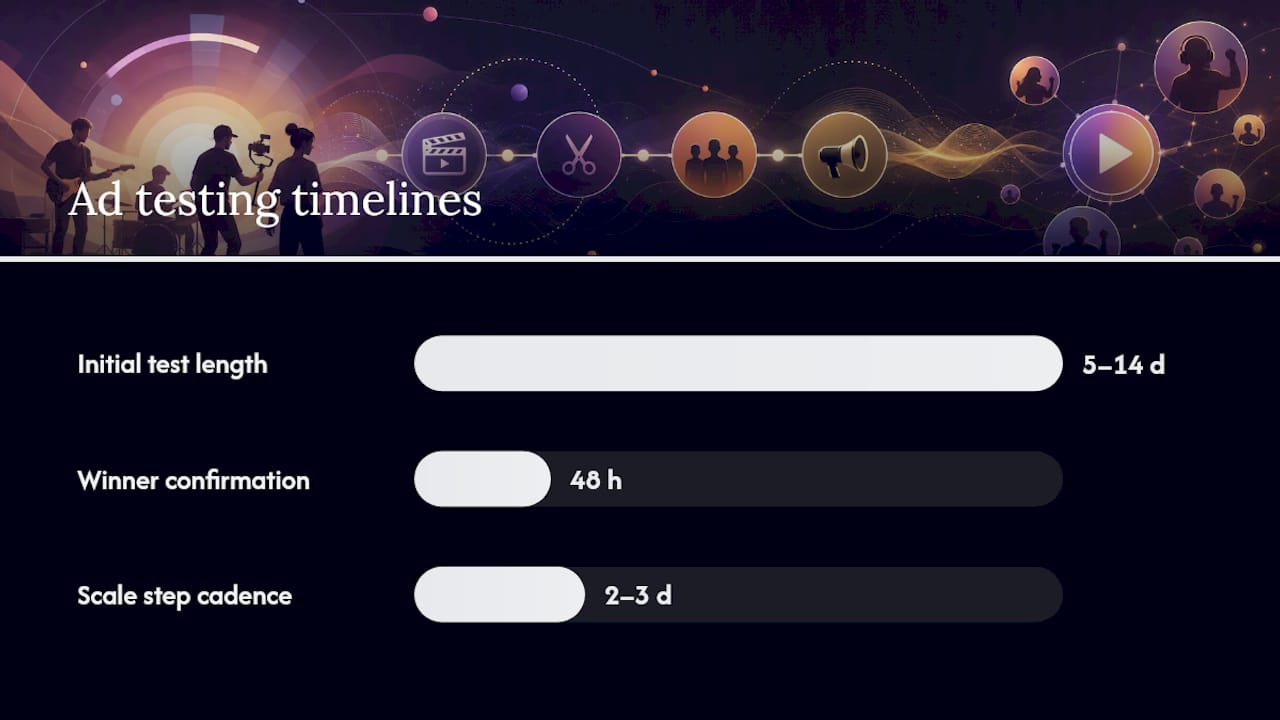
Run your initial test for 5 to 14 days depending on total spend, with a single clear objective: identify which creative variant earns the lowest cost per engaged view or click, not which one gets the most impressions. Three to six creatives is the practical range. Fewer than that and you can’t isolate what’s actually working; more than that and your per-creative spend gets too thin to read reliable data within the testing window.
Platform priority matters. For most releases, Meta (Instagram and Facebook combined) still delivers the most granular targeting and cheapest early testing data, TikTok offers the strongest organic lift when a clip resonates, and YouTube works best once you’ve already got a winning creative to push against warm or lookalike audiences.
Test more than just the video itself:
- Different opening hooks (first 3 seconds)
- Different song sections used as the lead-in
- Caption copy and on-screen text variants
- Calls to action (stream now, watch full video, follow for more)
Pro Tip: Declare a winner only once a creative shows a consistently lower cost per result across at least 48 hours of live spend, not after a single strong afternoon.
Once you’ve got a winner, scale gradually. Doubling daily spend overnight usually resets the algorithm’s learning phase and increases costs. Increasing by 20% to 30% every two to three days tends to preserve efficiency far better, a principle borne out in testing-focused promotion guidance that stresses starting small before committing bigger spend.
Hidden costs to watch for and a pre-purchase checklist
Base licence prices rarely tell the whole story. Production cost benchmarks show hidden licensing and usage fees commonly uplift the headline price, and ready-made video purchases carry the same risk if you don’t ask the right questions upfront.
Watch for these add-ons before you’re surprised by an invoice:
- Brand-kit setup fees for building out your logo, fonts, and colour scheme into reusable templates
- Customisation surcharges on top of the base licence for anything beyond basic swaps
- Per-format export charges if vertical, square, and widescreen versions aren’t bundled together
- Whitelisting or usage-right uplifts for running ads through a specific ad account or influencer profile
- Rush fees for turnaround under the standard delivery window
Before paying, confirm in writing: exact deliverables and file formats, licence duration and territory, whether ad usage rights are included or cost extra, and the refund or revision policy if the final export doesn’t match what you approved. Document your acceptance criteria (resolution, branding placement, caption accuracy) against the initial proof before signing off, so any rework needed later isn’t billed as a new job.
When a ready-made video makes more sense than a bespoke shoot
A marketplace video earns its place in the budget when speed and creative volume matter more than a single hero asset. That’s most releases, most of the time. Budget allocation guidance for independent artists backs this up, arguing video spend pays off once you’ve already got an audience worth targeting rather than before.
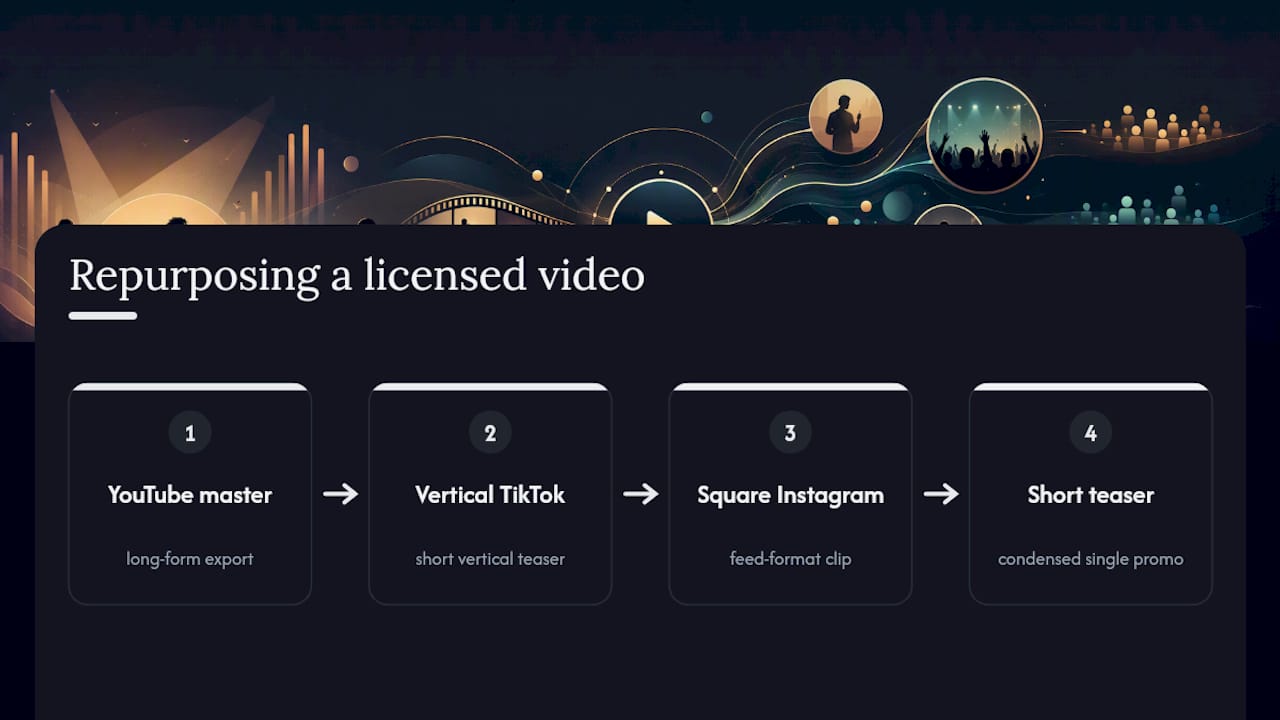
Labels and managers rarely stop at one export. The same licensed video typically gets recut into three or four formats: a YouTube master, a vertical teaser for TikTok, a square clip for Instagram feed placements, and sometimes a shortened cut for the next single’s teaser campaign. That repurposing is exactly why investing in video content tends to outperform one-off spends. It’s not one video, it’s four assets from one purchase, and label marketing teams increasingly build entire campaign calendars around that kind of output.
— Music
How Music Video Marketplace fits your budget
You’ve seen the numbers. Now here’s the part that saves you the guesswork of stitching licence fees, editing tools, and ad platforms together yourself. Musicvideomarketplace puts the whole process on one workflow: browse a catalogue of ready-made videos, customise branding and captions, export in the formats your platforms actually need, and launch your ad campaign from the same account.

Picture the developing-artist scenario above. Instead of paying a licence fee here, a separate editor there, and figuring out ad accounts on a third platform, you’d do all three inside one purchase flow, cutting the time between “I found a video I like” and “my ad is live” from weeks to days. If you’re ready to see what a video costs for your track, browse the marketplace and get a real quote before you finalise your budget.
Sources
External benchmarks used above cover realistic release-stage budgets from Tools 4 Music and One Submit, plus production cost comparisons from Sovran. For campaign execution, see launching music ads on YouTube and multi-channel advertising planning.
- Music Marketing Budget Planning Guide for Independent Artists (2026) | Tools 4 Music Blog | Tools 4 Music 2026
- Music Promotion Budget Guide 2026: How Much to Spend & Where
- Video Ad Production Cost in 2026 — Pricing Benchmarks | Sovran
Recommended
Read next
 Music Video Creation Guide for Quick YouTube LaunchExplore this music video creation guide designed for musicians. Follow simple steps to make a long form video and launch a YouTube ad campaign for your single.
 Music Video Marketing Guide for Independent MusiciansFollow this step-by-step music video marketing guide to create, promote and advertise your song effectively, boosting your music’s online presence and reach.
 Music video rollout guide for independent artistsDiscover the ultimate music video rollout guide for independent artists. Learn strategies to maximize views and engagement for your next release!
 Music Video Branding: Repurpose Videos on an Indie BudgetMusic video branding helps independent artists build a lasting identity on a small budget. Define the message first, then reuse visuals across releases.
Turn the idea into a finished music video.
Drop your track into the Workspace and build your visual in minutes.