
Video monetisation for musicians: complete guide 2026
Learn how musicians earn from YouTube in 2026 with ad revenue, Content ID, and fan funding. Discover RPM benchmarks, YPP tiers, and strategies to maximise income.
Video monetisation for musicians: complete guide 2026
Most independent musicians assume that going viral is the only way to earn real money from YouTube. That belief leaves a lot of income on the table. YouTube actually offers several distinct revenue streams, and many of them do not require millions of views to get started. Whether you have a few hundred subscribers or a few thousand, understanding how the platform pays artists is the first step towards turning your music videos into a genuine income source. This guide breaks down every method, the real numbers behind them, and the strategies that work best for independent artists in 2026.
Table of Contents
- What does video monetisation mean for musicians?
- The YouTube Partner Program tiers: unlocking monetisation
- How much can musicians earn? Ad revenue, RPM, and benchmarks
- Content ID, cover songs, and licensing: navigating rights and revenue
- Common pitfalls and advanced strategies for music video monetisation
- Take your video monetisation further with Music Video Marketplace
- Frequently asked questions
Key Takeaways
| Point | Details |
|---|---|
| Start earning early | You can unlock basic monetisation with only 500 subscribers and 3,000 watch hours. |
| Content ID pays passively | Registering with Content ID allows earnings from your music in others’ videos. |
| Realistic revenue varies | Music RPM is lower than other niches, but income grows with scale and diversity. |
| Diversify income streams | Don’t rely solely on ads; use fan funding, merch, and sponsorships for stability. |
| Quality and licensing matter | Always secure rights for covers and upload your tracks for maximum revenue. |
What does video monetisation mean for musicians?
Video monetisation simply means earning money from your music content on YouTube. For independent artists, this is not just about ad revenue from your own channel. It covers a much wider range of income sources that many musicians overlook entirely.
The main earning methods available to you are:
- Ad revenue via the YouTube Partner Program (YPP), where ads run on your videos and you receive a share of the income
- Content ID, which identifies your original music across all of YouTube and earns revenue when others use it
- Fan funding tools such as Super Chat, Super Thanks, and Channel Memberships
- Merchandise sold directly through your YouTube channel via the Shopping feature
As the YouTube Partner Program overview confirms, musicians can earn from ad revenue, fan funding, Content ID, and more on YouTube. The key distinction is between earning from your own videos and earning from other people’s videos that contain your music. Both are possible, and both matter.
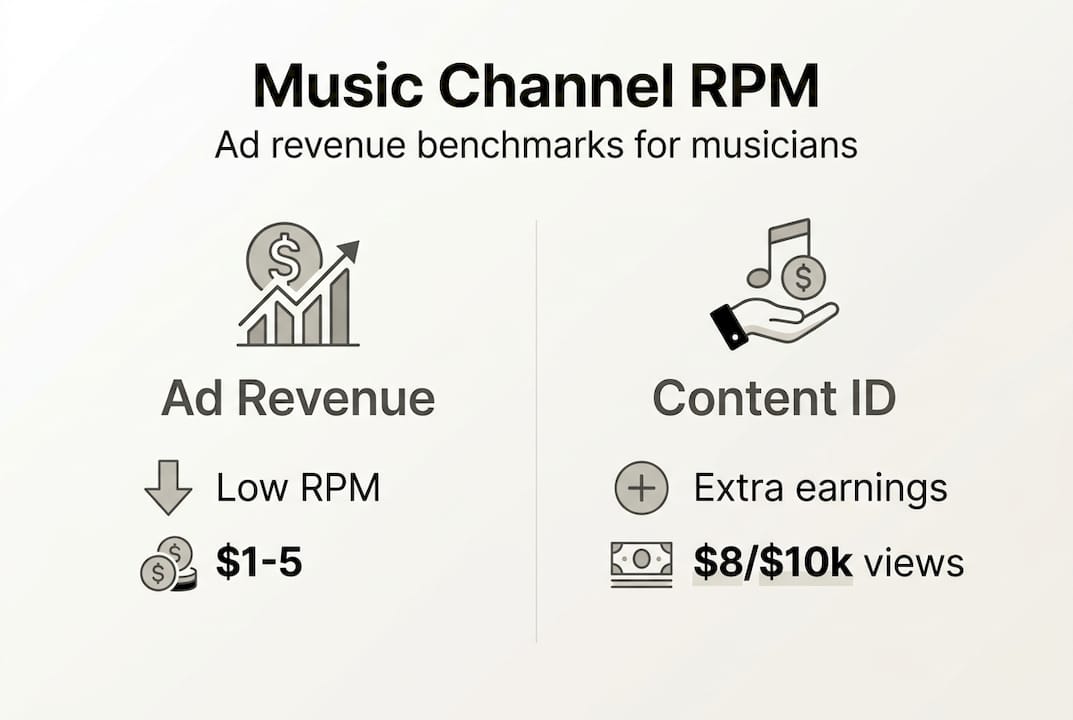
Music video channels on YouTube average $1 to $5 RPM (revenue per thousand views), which is lower than many other niches. That means volume and diversification are essential. The good news is that monetisation is not limited to major labels. Any independent artist can set this up with the right approach.
The YouTube Partner Program tiers: unlocking monetisation
YouTube’s Partner Programme is the gateway to most of these income streams. It is structured in two tiers, and knowing exactly what each one unlocks helps you plan your growth strategy effectively.
Tier 1 requirements:
- 500 subscribers
- 3 public uploads in the last 90 days
- Either 3,000 watch hours in the past 12 months or 3 million Shorts views in the past 90 days
Tier 2 requirements:
- 1,000 subscribers
- Either 4,000 watch hours in the past 12 months or 10 million Shorts views in the past 90 days
As YPP requirements for 2026 outline, Tier 1 unlocks fan funding at 500 subscribers and Tier 2 unlocks full ad revenue at 1,000 subscribers, with a 55% revenue share going to the creator.
Here is a quick comparison of what each tier unlocks:
| Feature | Tier 1 (500 subs) | Tier 2 (1,000 subs) |
|---|---|---|
| Ad revenue | No | Yes (55% share) |
| Super Thanks | Yes | Yes |
| Super Chat | Yes | Yes |
| Channel Memberships | Yes | Yes |
| Shopping / Merch | Yes | Yes |
| Content ID access | Via distributor | Via distributor |
Fan funding tools are genuinely useful even before you hit Tier 2. Super Thanks lets viewers tip on individual videos, Super Chat works during live streams, and Channel Memberships give fans a way to support you monthly in exchange for perks.
For growing your YouTube presence as an independent artist, understanding these tiers gives you a clear roadmap rather than a vague goal of “getting big.”
Pro Tip: YouTube Shorts have a much lower RPM than long-form videos, but they count towards Tier 1 watch thresholds. Use Shorts strategically to unlock fan funding faster, then focus your monetisation efforts on full-length music videos. The advantages for musicians who use both formats together are significant.
How much can musicians earn? Ad revenue, RPM, and benchmarks
RPM stands for Revenue Per Mille, which means the amount you earn per 1,000 views after YouTube takes its cut. For music channels, RPM typically sits between $1 and $5, with Content ID averaging around $0.00087 per monetised view. Those numbers sound small, but they add up at scale.

Here is a realistic earnings table based on view counts:
| Views | Ad revenue (est.) | Content ID (est.) | Combined |
|---|---|---|---|
| 10,000 | $10 to $30 | $8.70 | $18 to $39 |
| 100,000 | $100 to $300 | $87 | $187 to $387 |
| 1,000,000 | $1,000 to $3,000 | $870 | $1,870 to $3,870 |
These figures assume average music RPM and standard Content ID rates. Your actual earnings will vary based on your audience’s location, the time of year, and how well your content retains viewers.
The real-world picture is encouraging for those who commit to the platform. Composer Greg from Secession Studios earned two-thirds of his income via YouTube through a combination of AdSense and Content ID. That is a compelling case for treating YouTube as a primary revenue channel rather than a promotional afterthought.
YouTube Shorts are worth mentioning separately. Their RPM is extremely low, often between $0.01 and $0.06 per 1,000 views. Use them for audience growth and channel discovery, but rely on your long-form [video best practices](https://musicvideomarketplace.com/blog/music-video-best practices-youtube-ads) for actual income generation.
Key insight: Earnings from YouTube require either significant scale or a viral moment. The artists who earn consistently are those who release regularly, optimise their videos properly, and use Content ID to capture passive income from every corner of the platform.
Content ID, cover songs, and licensing: navigating rights and revenue
Content ID is one of the most powerful and least understood tools available to independent musicians. It is YouTube’s automated system that scans every uploaded video for registered audio. When it finds a match, it can monetise, track, or block that video on your behalf.
Content ID allows artists to monetise their tracks whenever they appear in other YouTube videos, including user-generated content. That means if someone uses your original track in a vlog, a workout video, or a gaming stream, you earn from it passively.
Here is what you need to know about accessing Content ID as an independent artist:
- You cannot register directly with YouTube’s Content ID system as an individual
- Music distributors such as DistroKid, TuneCore, and CD Baby offer Content ID registration as part of their distribution services
- Once registered, your music is scanned against all new and existing YouTube uploads
- You choose whether to monetise, track, or block videos that use your music
Cover songs are a different matter entirely. Revenue from covers is shared with publishers based on licensing arrangements, not split with the performer. If you post a cover without the correct licence, the publisher can claim all ad revenue from your video. YouTube’s Creator Music feature offers a way to licence tracks or enter revenue share agreements, but the rules around remixing and use are specific and worth reading carefully.
For a full breakdown of the music upload workflow and how to protect your rights from day one, it is worth reviewing your options before you publish. You can also find tips for licensing music on YouTube to help navigate the more complex scenarios.
Pro Tip: Register every original track you own with Content ID via your distributor, even unreleased or rare recordings. If someone uses that music before you officially release it, you will still earn from it rather than losing that income entirely. A solid content strategy for YouTube includes Content ID as a core component, not an afterthought.
Common pitfalls and advanced strategies for music video monetisation
Even artists who understand the basics often make avoidable mistakes that cost them revenue or put their channel at risk. Knowing what to watch out for is just as important as knowing what to do.
The most common pitfalls are:
- Copyright strikes from cover songs posted without proper licensing, which can lead to channel termination after three strikes
- Reused or AI-generated content that YouTube’s algorithm deprioritises or demonetises entirely
- Inconsistent uploading, which reduces watch hours, slows subscriber growth, and limits Content ID opportunities
- Relying solely on ad revenue, which leaves fan funding, merchandise, and sponsorship income completely untapped
As guidance for indie artists highlights, diversifying with merchandise and fan funding is essential for sustainable income, particularly when ad revenue alone cannot cover costs.
Here are the advanced strategies that make a real difference:
- Release music and videos regularly. Consistency builds watch hours, triggers Content ID opportunities, and signals to YouTube’s algorithm that your channel is active.
- Use Shorts to drive traffic to long-form videos. A 60-second clip from your latest music video can funnel viewers to the full version, boosting watch time and RPM.
- Activate all fan funding tools from Tier 1. Do not wait until you hit 1,000 subscribers to engage your audience financially.
- Pursue sponsorships and brand partnerships. Once your channel has a defined audience, brands in the music gear, lifestyle, or tech space will pay for placement.
- Build off-platform income streams. Patreon, Bandcamp, and direct licensing deals provide income that is not subject to YouTube’s algorithm changes.
Pro Tip: Schedule your video releases in advance and pair each one with a Shorts teaser. This doubles your upload frequency without doubling your production workload, which is critical for YouTube promotion tips that actually move the needle. Combine this with strong music video marketing to maximise reach on every release.
Take your video monetisation further with Music Video Marketplace
For independent musicians hungry to earn more and reach new fans, leveraging the right platform can provide a real head start. Creating consistent, high-quality video content is one of the biggest barriers artists face when trying to grow on YouTube.

Music Video Marketplace is built specifically for artists like you. We enable musicians to create a long-form video in minutes, ready to upload to YouTube, and then launch an ad campaign for their song straight away. No expensive production teams, no lengthy editing process. You get professional video content and promotional reach without the usual overhead, so you can focus on what actually matters: releasing music consistently, building your audience, and unlocking every monetisation tier YouTube has to offer.
Frequently asked questions
What are the minimum requirements to start earning from YouTube as a musician?
You need 500 subscribers, 3 uploads in 90 days, and either 3,000 watch hours or 3 million Shorts views to unlock initial monetisation tools, as confirmed by YPP Tier 1 requirements.
Can I earn money if my music is used in other people’s YouTube videos?
Yes. With Content ID registered through a distributor, your music earns revenue whenever it appears in videos uploaded by others, as Content ID claims confirm.
Do I need a licence to monetise cover songs on YouTube?
Yes. Without proper licensing, revenue from covers goes to the music publisher rather than to you as the performer.
Why is RPM lower for music channels?
Music channels attract lower advertising rates and draw large volumes of international traffic, both of which reduce RPM compared to higher-value niches, as music RPM benchmarks show.
How do fan funding tools help musicians make money on YouTube?
Fan funding features such as Super Thanks, Channel Memberships, and Shopping let your audience support you directly, adding income on top of ad revenue from the moment you reach Tier 1 of the YPP.
Recommended
- What is YouTube monetisation for musicians: a guide | Music Video Marketplace Blog
- Key advantages of YouTube for musicians in 2026 | Music Video Marketplace Blog
- Why video content matters for musicians in 2026 | Music Video Marketplace Blog
- Video Marketing: Boosting Musicians’ Reach on YouTube | Music Video Marketplace Blog
- Guide til musikalske events 2026: 60% mere engagement
Read next
 Visual marketing for DJs: boost engagement in 2026Learn how DJs can use visual content to boost engagement, build brand identity, and increase bookings with proven strategies for social media and live events.
 Ways to increase song visibility: 2026 guide for artistsDiscover effective ways to increase song visibility in 2026. Boost your reach with strategic promotion techniques and engage your audience!
 What is social proof in music: a guide for musiciansDiscover what social proof in music means and how it influences listener perceptions. Boost your career with effective strategies today!
 Understanding copyright in music videos: a 2026 guideLearn essential copyright rules for music videos in 2026. Understand licensing, fair use limits, and practical protections to avoid legal issues and monetise your content legally.
Turn the idea into a finished music video.
Drop your track into the Studio and build your visual in minutes.