
Understanding copyright in music videos: a 2026 guide
Learn essential copyright rules for music videos in 2026. Understand licensing, fair use limits, and practical protections to avoid legal issues and monetise your content legally.
Understanding copyright in music videos: a 2026 guide

Many independent musicians believe adding ‘no copyright intended’ to their video descriptions protects them from legal claims. This misconception costs creators thousands in takedowns and lost revenue annually. Understanding the distinct copyright layers governing music compositions, sound recordings, and video visuals is essential to avoid monetisation problems and legal trouble. This guide clarifies ownership, licensing requirements, fair use boundaries, and practical protections for independent creators in 2026.
Table of Contents
- Copyright Fundamentals In Music Videos
- Types Of Copyrights And Licensing Explained
- Fair Use And Legal Limitations In Music Videos
- Practical Copyright Protection For Independent Creators
- Protect And Promote Your Music Videos With The Right Tools
- FAQ
Key takeaways
| Point | Details |
|---|---|
| Multiple copyright layers | Music videos involve separate copyrights for compositions, recordings, and visuals, each requiring permission. |
| Synchronisation licensing essential | Pairing music with video legally requires synchronisation rights from all relevant rights holders. |
| Fair use rarely applies | Commercial music videos cannot rely on fair use defences, making proper licensing critical. |
| Contracts prevent disputes | Written agreements among collaborators clarify ownership, usage rights, and revenue distribution. |
| Platform enforcement strict | YouTube’s Content ID system automatically detects copyrighted material, risking demonetisation and strikes. |
Copyright fundamentals in music videos
Every piece of recorded music is protected by copyright immediately upon fixation in a tangible medium, making unauthorised use an infringement. Musical compositions covering melody and lyrics hold separate copyright from sound recordings, which protect the fixed audio performance. Visual elements in music videos carry their own distinct copyright protection.
Different rights holders may own each copyright type. A songwriter might control composition rights whilst a record label owns the sound recording, and a director or production company holds rights to video footage. This fragmentation complicates usage permissions.
Creating or distributing music videos requires permission from every relevant rights holder. Missing even one licence exposes you to infringement claims. Copyright exists automatically when you create original work, requiring no registration, but formal registration strengthens enforcement options and enables statutory damages in court.
Pro Tip: Register your copyright with the UK Intellectual Property Office or US Copyright Office within three months of publication to maximise legal protections and damage recovery options.
Copyright ownership breakdown
| Copyright type | What it protects | Typical rights holder |
|---|---|---|
| Musical composition | Melody, lyrics, arrangement | Songwriter, publisher |
| Sound recording | Fixed audio performance | Performer, record label |
| Visual elements | Video footage, editing, graphics | Director, production company |
Key protections:
- Reproduction rights control copying
- Distribution rights govern sharing and sales
- Public performance rights cover broadcasts and streaming
- Derivative work rights manage adaptations and remixes
Types of copyrights and licensing explained
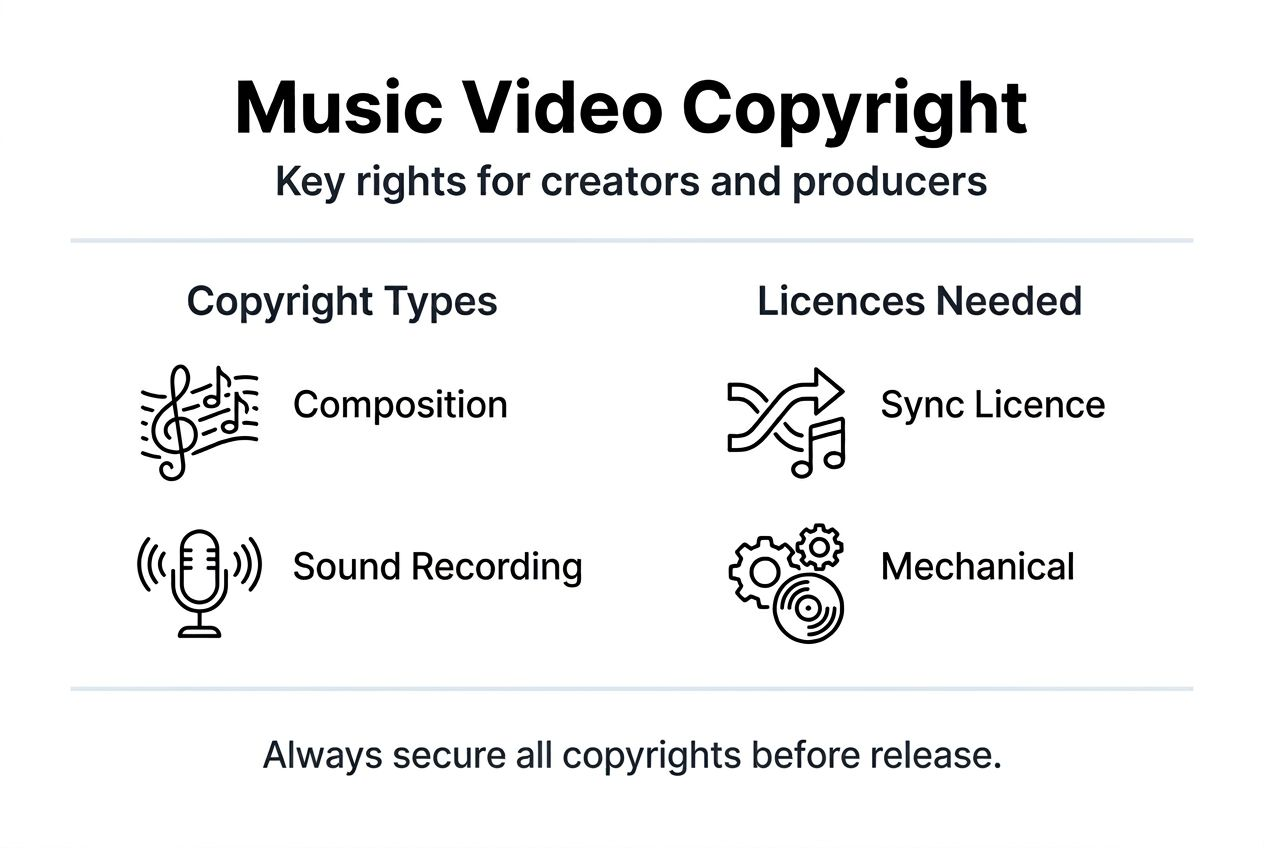
Synchronisation licences legally permit pairing music with visual content. Without this licence, you cannot legally combine copyrighted music with video footage, regardless of how you obtained the audio. This remains the most critical licence for music video creators.
Mechanical rights cover reproducing and distributing musical compositions in physical or digital formats. Whilst less directly relevant to video use, mechanical rights matter when distributing music videos that include cover songs or samples.
Performance rights apply when music is publicly performed, including online streaming platforms. Proper music licensing enables creators to monetise their content freely across all platforms, avoid demonetisation, and secure sponsorship deals. Streaming your music video publicly triggers performance rights requirements.
Sampling rights require separate permission when incorporating even brief excerpts of existing recordings. Courts have ruled that any identifiable sample, regardless of length, requires clearance from both composition and recording rights holders.
Licensing comparison for music videos
| Licence type | Purpose | Required for |
|---|---|---|
| Synchronisation | Pair music with visuals | All music videos |
| Mechanical | Reproduce compositions | Cover songs, distributions |
| Performance | Public performance | Streaming, broadcasts |
| Master use | Use specific recordings | Existing audio tracks |
Pro Tip: Acquiring synchronisation rights early prevents costly re-edits and delays, especially when planning promotional campaigns or marketing strategies that require immediate content deployment.
Licensing guarantees lawful monetisation. Platforms increasingly reject or demonetise content lacking proper clearances, directly impacting your revenue potential.
Fair use and legal limitations in music videos
Fair use in music videos is narrowly defined and typically only applies to commentary, criticism, education, parody, or news reporting, and even then is assessed case by case by courts. Commercial music videos promoting an artist or song almost never qualify, regardless of artistic intent or educational framing.
Courts evaluate four factors when assessing fair use claims: purpose and character of use, nature of the copyrighted work, amount used, and effect on the market value. Using full songs or substantial portions heavily weighs against fair use findings.
Legitimate fair use scenarios:
- Documentary footage analysing music video production techniques
- Parody videos transforming original works for comedic commentary
- Educational content examining specific artistic choices with brief clips
- News reporting on music industry events featuring short excerpts
Disclaimers stating ‘no copyright intended’ or ‘for educational purposes’ provide zero legal protection. Courts ignore such statements entirely, focusing instead on actual use and intent. Relying on these phrases demonstrates legal misunderstanding and offers no defence against infringement claims.
“The law does not recognise creator intent to avoid infringement as a valid defence. Proper licensing remains the only reliable protection for commercial music video content.”
Infringement carries serious consequences. Rights holders can pursue statutory damages ranging from £750 to £30,000 per work infringed, potentially reaching £150,000 for wilful violations. Platforms remove infringing content swiftly, often issuing strikes that jeopardise entire channels.
Practical copyright protection for independent creators
Register your music composition and sound recording copyrights as soon as possible. Formal registration establishes public records of ownership, strengthens your position in disputes, and enables statutory damages and legal fee recovery in successful infringement lawsuits. Registration costs remain minimal compared to potential protection benefits.
Obtaining necessary licences before releasing videos prevents expensive problems. Contact rights holders directly or use licensing agencies that streamline clearances. Proper music licensing enables creators to monetise their content freely across all platforms, avoid demonetisation, and secure sponsorship deals.
Steps to secure synchronisation rights:
- Identify all rights holders for composition and recording
- Contact publishers, labels, or licensing agencies directly
- Negotiate fees and usage terms in writing
- Obtain signed licence agreements before publication
- Maintain licence documentation for platform verification
Draft clear collaboration contracts before production starts. Written agreements prevent disputes by specifying ownership percentages, usage rights, revenue splits, and creative control amongst band members, videographers, editors, and other contributors. Verbal agreements create ambiguity that courts struggle to resolve.
Essential contract provisions:
- Copyright ownership allocation for each contribution
- Revenue sharing percentages and payment schedules
- Usage rights defining how each party can exploit the work
- Credit attribution requirements
- Dispute resolution procedures
Pro Tip: Understanding YouTube’s Content ID system helps you anticipate automated copyright detection and prevents unexpected monetisation blocks that damage channel performance.
YouTube’s Content ID automatically scans uploads against a database containing millions of copyrighted works. Matches trigger actions ranging from tracking and analytics to revenue redirection or complete blocking. Three copyright strikes within 90 days terminates your channel permanently.
Using royalty free music or obtaining proper synchronisation licences eliminates Content ID risks entirely. Many creators underestimate how platform enforcement systems impact revenue potential, making legal compliance essential for sustainable music video marketing and long term investment returns.
Protect and promote your music videos with the right tools
Navigating copyright complexities whilst creating compelling visual content challenges independent musicians. Finding high quality, legally cleared music videos helps elevate artistic projects without legal exposure. The Music Video Marketplace offers 4K music videos with transparent licensing, saving creators time and reducing infringement risks.

Creators gain confidence knowing content is legally cleared for monetisation and promotion across platforms. Instead of spending weeks negotiating licences or risking takedowns, access professionally produced visual content that complies with copyright requirements. Explore the marketplace as a practical resource supporting your creative vision whilst protecting your legal interests and revenue potential.
FAQ
What licences do I need to use music in my videos legally?
Synchronisation licences are essential for legally pairing music with video visuals. Most creators also require mechanical licences if distributing cover songs and performance licences for public streaming. Obtain these from rights holders or licensing agencies before publication.
Can I rely on fair use to avoid copyright claims in my music videos?
Fair use protections rarely apply to commercial or monetised music videos promoting artists. Using copyrighted music without proper licences exposes you to infringement claims regardless of disclaimers. Courts assess fair use narrowly, making licensing the only reliable protection.
How can I protect my rights when collaborating on a music video?
Draft written contracts before production specifying copyright ownership, usage rights, and revenue splits amongst all collaborators. Clear agreements prevent disputes and ensure everyone understands their legal rights and financial responsibilities. Verbal agreements create ambiguity that courts cannot easily resolve.
What impact does YouTube’s Content ID have on independent creators?
Content ID automatically detects copyrighted material in uploads, potentially demonetising videos, redirecting revenue, or issuing copyright strikes against your channel. Three strikes within 90 days results in permanent channel termination. Understanding and complying with Content ID requirements protects your revenue and channel standing.
Recommended
- Guide to YouTube music uploads for indie artists 2026 | Music Video Marketplace Blog
- YouTube Music Content: Boosting Reach for Musicians | Music Video Marketplace Blog
- Master the role of video content in music distribution | Music Video Marketplace Blog
- Educational Video for Musicians: Boosting Song Reach | Music Video Marketplace Blog
Read next
 Video monetisation for musicians: complete guide 2026Learn how musicians earn from YouTube in 2026 with ad revenue, Content ID, and fan funding. Discover RPM benchmarks, YPP tiers, and strategies to maximise income.
 Visual marketing for DJs: boost engagement in 2026Learn how DJs can use visual content to boost engagement, build brand identity, and increase bookings with proven strategies for social media and live events.
 Ways to increase song visibility: 2026 guide for artistsDiscover effective ways to increase song visibility in 2026. Boost your reach with strategic promotion techniques and engage your audience!
 Types of artist income diversification that actually payExplore effective types of artist income diversification to build multiple revenue streams and avoid the feast-or-famine cycle.
Turn the idea into a finished music video.
Drop your track into the Studio and build your visual in minutes.