
What is YouTube monetisation for musicians: a guide
Learn how YouTube monetisation works for musicians, including Partner Programme requirements, revenue streams, Content ID benefits, and practical strategies to maximise earnings from your music content.
What is YouTube monetisation for musicians: a guide

Many musicians believe uploading their tracks to YouTube automatically generates income, but the reality is far more nuanced. YouTube monetisation for musicians involves meeting specific eligibility requirements, understanding multiple revenue streams, and navigating music rights management. This guide explains the YouTube Partner Programme criteria, breaks down how musicians earn through ads, memberships, Shorts, and Content ID, and provides practical strategies to optimise your income whilst promoting your music effectively on the platform.
Table of Contents
- Key takeaways
- Understanding the YouTube partner program and eligibility for musicians
- How musicians can earn revenue on YouTube: streams and shares explained
- Managing music rights and Content ID for maximising YouTube earnings
- Practical tips for independent musicians to optimise YouTube monetisation
- Explore music video marketplace services
- Frequently asked questions about YouTube monetisation for musicians
Key Takeaways
| Point | Details |
|---|---|
| Eligibility thresholds and compliance | To monetise, musicians must meet subscriber and watch time thresholds and stay compliant with YouTube policies. |
| Multiple revenue streams | Ad revenue, channel memberships, Shorts, Premium and shopping contribute to musicians’ income. |
| Content ID monetisation | Content ID lets artists monetise others’ use of their music and share royalties. |
| Shorts revenue dynamics | Shorts operate from a pooled revenue fund after deductions for music licensing, which can reduce the creator’s actual share. |
Understanding the YouTube partner program and eligibility for musicians
Before you can monetise any content on YouTube, you must join the YouTube Partner Programme with specific thresholds: 1,000 subscribers and either 4,000 watch hours within 12 months or 10 million Shorts views in 90 days. These aren’t one-time targets. You must maintain compliance with Community Guidelines, keep your channel free from active strikes, and link an AdSense account to receive payments.
The eligibility criteria exist to ensure creators produce quality content and engage genuine audiences. For musicians, this means building a subscriber base through consistent uploads of original material, whether that’s youtube music content for musicians like lyric videos, live performances, or behind-the-scenes footage. Your channel must also adhere to copyright policies, which becomes particularly important when sharing music content that might contain samples or covers.
Once accepted into the programme, YouTube reviews your channel periodically to confirm ongoing compliance. A single copyright strike can suspend monetisation temporarily, whilst multiple violations can result in permanent removal from the Partner Programme. This makes understanding music rights absolutely critical for musicians who want to maintain steady income from the platform.
Maintaining eligibility requires active channel management. You cannot simply upload a few videos, hit the thresholds, and expect passive income indefinitely. YouTube expects regular content that follows their policies and engages viewers authentically.
Pro Tip: Focus on creating original content rather than relying on covers or remixes during your initial growth phase. Original music videos, acoustic performances, and commentary about your creative process help you avoid copyright strikes whilst building an authentic audience that values your unique artistic voice.
The youtube music upload workflow guide can help you establish consistent upload schedules that support threshold maintenance. Regular uploads signal to YouTube’s algorithm that your channel is active, which can boost your visibility in recommendations and search results.
How musicians can earn revenue on YouTube: streams and shares explained
YouTube offers musicians multiple revenue streams beyond traditional advertising. Understanding how each works and what percentage you actually receive helps you make strategic decisions about content types and promotional efforts.

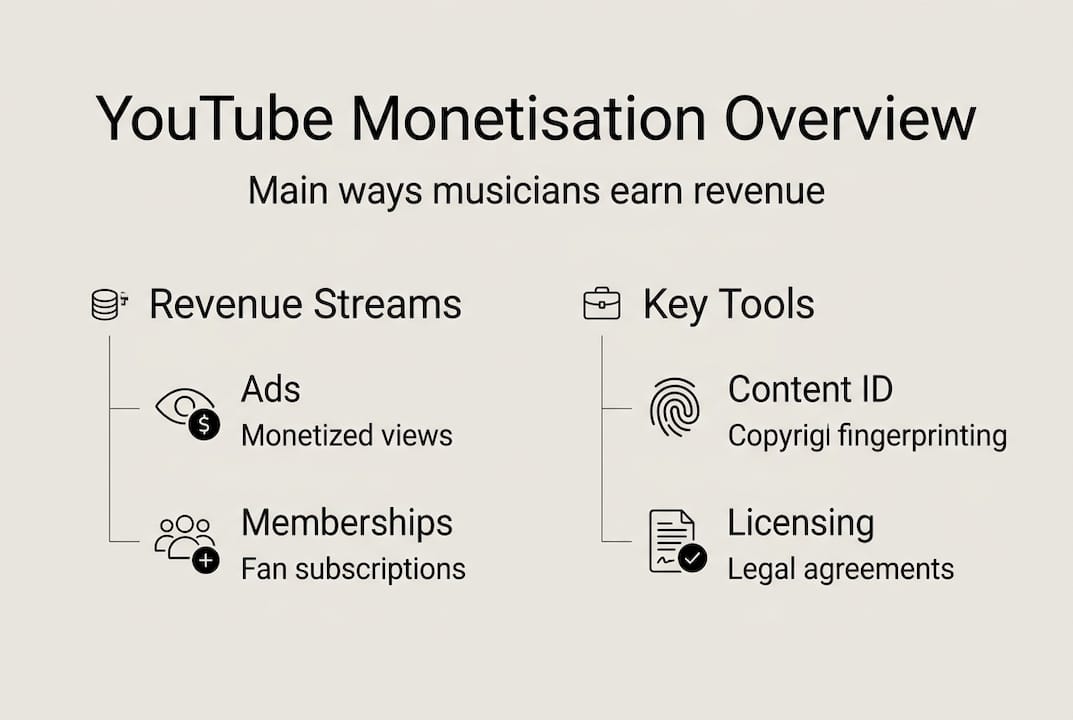
The primary revenue source for most creators is ad revenue from watch page ads, where creators receive 55% of advertising income generated from their long-form videos. Channel memberships and Super features like Super Chat, Super Thanks, and Super Stickers offer higher returns at 70% creator share, making them attractive options for musicians with engaged fan bases. YouTube Shorts operates differently, with creators receiving 45% from a pooled revenue fund after deductions for music licensing, which can significantly reduce your actual share.
| Revenue stream | Creator share | Best for musicians |
|---|---|---|
| Long-form ads | 55% | Original music videos, performances, tutorials |
| Memberships/Super features | 70% | Engaging directly with dedicated fans |
| Shorts | 45% (from pooled fund) | Discovery and funnelling to long-form content |
| YouTube Premium | Proportional to watch time | All content types |
| Shopping | Variable | Merchandise sales and product promotion |
YouTube Premium revenue comes from subscribers who pay for ad-free viewing, with creators receiving payment based on how much Premium members watch their content. Shopping features allow you to promote merchandise, tickets, or other products directly through your videos, though this requires meeting additional eligibility criteria beyond basic Partner Programme membership.
Key revenue considerations for musicians:
- Ad revenue fluctuates based on advertiser demand, viewer demographics, and seasonal trends
- Shorts revenue gets reduced when you use licensed music from the YouTube library
- Memberships work best when you offer exclusive content like early releases or behind-the-scenes access
- Shopping features require at least 10,000 subscribers in most regions
Diversifying across multiple revenue streams protects you from fluctuations in any single source. A musician who relies solely on ad revenue might see income drop during periods of lower advertiser spending, whilst someone who combines ads, memberships, and merchandise sales maintains more stable earnings.
Pro Tip: Don’t put all your monetisation eggs in one basket. Combine ad revenue from your main content with memberships for superfans, merchandise sales for broader audiences, and strategic use of Shorts to drive traffic to your higher-earning long-form videos. This approach maximises total income whilst building deeper connections with your audience.
The key advantages youtube musicians 2026 include these diverse monetisation options, which weren’t available to independent artists just a few years ago. Taking advantage of multiple streams requires planning your content strategy around different audience segments and their willingness to support your work through various channels.
Managing music rights and Content ID for maximising YouTube earnings
Content ID represents one of the most powerful monetisation tools for musicians on YouTube. This system allows you to claim and monetise user-generated videos that use your tracks, earning approximately £0.00087 per monetised view after distributor cuts. When fans create covers, reaction videos, or other content featuring your music, you can earn passive income without creating additional content yourself.
Accessing Content ID typically requires working with official distributors like RouteNote, DistroKid, or TuneCore. These services upload your music to YouTube’s Content ID database, monitor for matches across the platform, and collect royalties on your behalf. The distributor takes a percentage, but the passive income from thousands of user-generated videos often exceeds what you’d earn from your own uploads alone.
Steps to register your music and claim Content ID revenue:
- Choose a distributor that offers YouTube Content ID services (not all do)
- Upload your original recordings with complete metadata and ownership documentation
- Wait for the distributor to process your music into YouTube’s Content ID database (usually 1-4 weeks)
- Monitor claims through your distributor’s dashboard and resolve any disputes
- Collect royalties according to your distributor’s payment schedule (typically monthly or quarterly)
| Revenue source | Your share | Rights holder share | Total creator pool |
|---|---|---|---|
| Original uploads with ads | 55% | 0% | 55% |
| Content ID claims (your music in others’ videos) | ~45-50% (after distributor cut) | 0% | 55% split with distributor |
| Creator Music licensing | 55% | 0% | 55% (you pay upfront licence fee) |
| Creator Music revenue sharing (1 track) | 27.5% | 27.5% | 55% split with rights holder |
| Shorts with 1 licensed track | 22.5% | 27.5% (music deduction from pool) | 50% after music deduction |
Creator Music offers two licensing models: pay an upfront licence fee and keep the full 55% ad revenue share, or use revenue sharing where you split the 55% with rights holders. For Shorts, music licensing deducts from the creator pool before distribution, so using one track means 50% goes to music rights holders, leaving you with roughly 22.5% of the remaining pool.
Covers and remixes require mechanical licences for the composition and potentially sync licences for video use. Without proper licensing, rights holders can claim your video through Content ID, redirecting all revenue to themselves or blocking your content entirely. Many musicians lose significant income by uploading unlicensed covers, only to discover all their ad revenue goes to the original songwriter and publisher.
Pro Tip: Work with established distributors who handle Content ID registration and royalty collection automatically. This eliminates the administrative burden of tracking claims manually whilst ensuring you capture revenue from every use of your music across YouTube. The distributor’s fee is worthwhile when you consider the passive income potential from user-generated content.
The optimise youtube music distribution workflow involves setting up Content ID early in your release cycle, before your music gains traction on the platform. This ensures you capture revenue from the first user-generated video, rather than missing out on early viral moments.
Practical tips for independent musicians to optimise YouTube monetisation
Maximising your YouTube income requires strategic thinking about content types, upload schedules, and audience engagement. Independent musicians should prioritise original music videos, lyric videos, and performance content for direct Partner Programme ad revenue, whilst using Content ID via distributors for passive income from user-generated content.
Content types that maximise monetisation for musicians:
- Original music videos with high production value attract advertisers and longer watch times
- Lyric videos provide searchable content that fans return to repeatedly
- Live performance footage showcases your artistry whilst requiring minimal editing
- Behind-the-scenes content builds deeper connections that support memberships and merchandise sales
- Tutorial videos teaching your techniques position you as an authority and attract music education advertisers
- Reaction videos to other artists’ work (with proper fair use considerations) tap into trending topics
YouTube Shorts deserve special attention in your strategy. Shorts are excellent for discovery and funnelling audiences to long-form content, but they generate significantly lower revenue per view, with RPM (revenue per thousand views) ranging from £0.01 to £0.07. This makes Shorts ideal for building awareness and directing viewers to your monetised long-form videos, rather than serving as a primary income source.
Using original audio in your Shorts maximises your revenue share from the pooled fund. When you use licensed music from YouTube’s library, a substantial portion of the Shorts revenue pool goes to those rights holders before creators receive their 45% share. Creating Shorts with your own unreleased tracks or snippets from your catalogue keeps more revenue in your pocket whilst promoting your music simultaneously.
Diversifying beyond ad revenue creates income stability. Memberships work particularly well for musicians who can offer exclusive content like early song releases, private live streams, or input on creative decisions. Merchandise integration allows you to sell directly through your videos, whilst brand partnerships with music gear companies or other relevant sponsors can provide substantial one-time payments that exceed months of ad revenue.
Pro Tip: Consistency matters more than perfection when building toward monetisation thresholds. Upload on a regular schedule, even if that means releasing simpler content like acoustic performances or lyric videos between your major music video releases. Regular uploads signal active channel status to YouTube’s algorithm, improving your visibility in recommendations and search results.
The youtube music algorithm musicians guide explains how consistent uploads, strong audience retention, and engagement metrics influence your content’s reach. Understanding these factors helps you create content that not only monetises well but also attracts new listeners organically.
Authentic engagement drives long-term monetisation success more effectively than chasing viral moments. Respond to comments, create content based on audience requests, and build a community around your music rather than treating YouTube purely as a distribution platform. Engaged audiences watch longer, return more frequently, and convert to paying supporters through memberships, merchandise, and concert tickets.
Explore music video marketplace services
Navigating YouTube monetisation whilst creating quality music content requires significant time and expertise. Music Video Marketplace enables musicians to create long-form videos in minutes, ready to upload to YouTube and launch ad campaigns for their songs. This streamlines the content creation process that many independent artists find overwhelming.

Our platform addresses the practical challenges musicians face when building a YouTube presence. Rather than spending hours learning video editing software or hiring expensive videographers, you can produce professional content that meets YouTube’s monetisation standards quickly and affordably. Explore our youtube music content for musicians resources to learn how strategic video content supports both monetisation and music promotion goals. Discover how youtube promotion for musicians through targeted ad campaigns amplifies your reach whilst your videos generate revenue through the Partner Programme.
Frequently asked questions about YouTube monetisation for musicians
What is the minimum subscriber and watch time to monetise on YouTube?
You need 1,000 subscribers and either 4,000 watch hours in the past 12 months or 10 million Shorts views in the past 90 days to join the YouTube Partner Programme. These thresholds must be maintained continuously, not just achieved once.
How does Content ID help musicians earn from user videos?
Content ID automatically identifies when other creators use your music in their videos, allowing you to claim and monetise that content. You earn approximately £0.00087 per monetised view on user-generated content featuring your tracks, creating passive income without additional work.
Can I monetise cover songs on YouTube legally?
Yes, but you must obtain mechanical licences for the composition and potentially sync licences for video use. Without proper licensing, the original rights holders can claim your video through Content ID, redirecting all revenue to themselves or blocking your content entirely.
What revenue streams beyond ads can musicians explore?
Musicians can earn through channel memberships offering exclusive content, Super features during live streams, YouTube Shopping for merchandise and tickets, brand partnerships with music companies, and YouTube Premium revenue based on watch time from Premium subscribers.
Is YouTube Shorts profitable for musicians?
Shorts generate lower revenue per view (£0.01 to £0.07 RPM) compared to long-form content, but they excel at discovery and driving traffic to your monetised videos. Use Shorts with original audio to maximise your share and funnel viewers to higher-earning content.
Recommended
- YouTube Music Content: Boosting Reach for Musicians | Music Video Marketplace Blog
- Guide to YouTube music uploads for indie artists 2026 | Music Video Marketplace Blog
- Complete Youtube Music Upload Workflow for Musicians | Music Video Marketplace Blog
- Video Marketing: Boosting Musicians’ Reach on YouTube | Music Video Marketplace Blog
- Elevate Your Music: Professional YouTube Music Videos on a Budget – Stevie The Manager aka Stangr The Man
Read next
 Why build a YouTube presence? Unlock growth as a musicianDiscover why build a YouTube presence is crucial for musicians. Unlock growth and connect with fans on the world's top music discovery platform.
 Why optimise for YouTube to boost your music careerDiscover why optimising for YouTube's algorithm and ads delivers better music promotion results than chasing subscribers. Learn cost-effective strategies to boost visibility.
 Why use long form video for DJs: 2026 guideDiscover why use long form video for DJs in 2026. Build deeper fan connections and elevate your artist career with effective strategies!
 What is video optimisation: a creator's guideDiscover what is video optimization and learn key techniques to boost playback quality and discoverability for your videos.
Turn the idea into a finished music video.
Drop your track into the Studio and build your visual in minutes.