
Why content quality impacts music success
Discover why content quality impacts music success and how it drives listener engagement. Elevate your music strategy for 2026!
Why content quality impacts music success
TL;DR:
- Content quality is the key factor in music success, as it drives engagement signals that algorithms and curators rely on. High-quality releases that earn saves, playlist adds, and full listens build favorable algorithm profiles, while weak content leads to suppression regardless of promotion. Artists should focus on emotional clarity, technical excellence, and audience feedback in early releases before investing in promotion or playlist pitching.
Content quality is the primary determinant of music success on digital platforms because it drives the listener engagement signals that algorithms use to expand or suppress distribution. Before a single pound is spent on promotion, the music itself must earn saves, repeat listens, and playlist adds from real audiences. Sources including Thrive Indie, Vohnic Music, and Hypebot confirm that promotion amplifies proven content but cannot manufacture demand for weak material. Understanding this relationship is the foundation of any credible music success and content strategy in 2026.
Why content quality impacts music success on streaming algorithms
Streaming platforms do not distribute music equally. They train their recommendation systems on listener behaviour, and algorithmic expansion depends on high-intent signals such as saves, playlist adds, and repeat listens rather than raw play counts. A track that gets skipped after ten seconds tells Spotify or Apple Music to reduce its reach. A track that earns saves and full listens tells the algorithm to push it further.
Vohnic Music frames this clearly: promotion is algorithm training, not audience persuasion. Every release you put out teaches the platform who your listener is and how deeply they engage. Consistent, high-quality releases build a data profile that earns broader distribution over time. Inconsistent or low-quality releases erode that profile, regardless of how much you spend on ads.
The practical consequence is stark. Weak content exposed by promotion results in algorithm suppression, not growth. TikTok boosts, playlist pitching, and paid ads all accelerate exposure. If that exposure produces poor engagement, the platform interprets it as a signal to reduce distribution. You end up paying to shrink your reach.
- Save-to-stream ratio is the clearest early indicator of content quality. A high ratio signals genuine listener intent.
- Completion rate measures how many listeners hear the track through to the end. Anything below 50% warrants attention.
- Playlist adds from organic listeners, not curators, reflect whether the music fits naturally into how people actually listen.
Pro Tip: Track your save-to-stream ratio in the first 48 hours after release. If it falls below 5%, treat the release as market research and refine your hook, mix, or emotional framing before scaling promotion.
What do music curators actually look for in a submission?
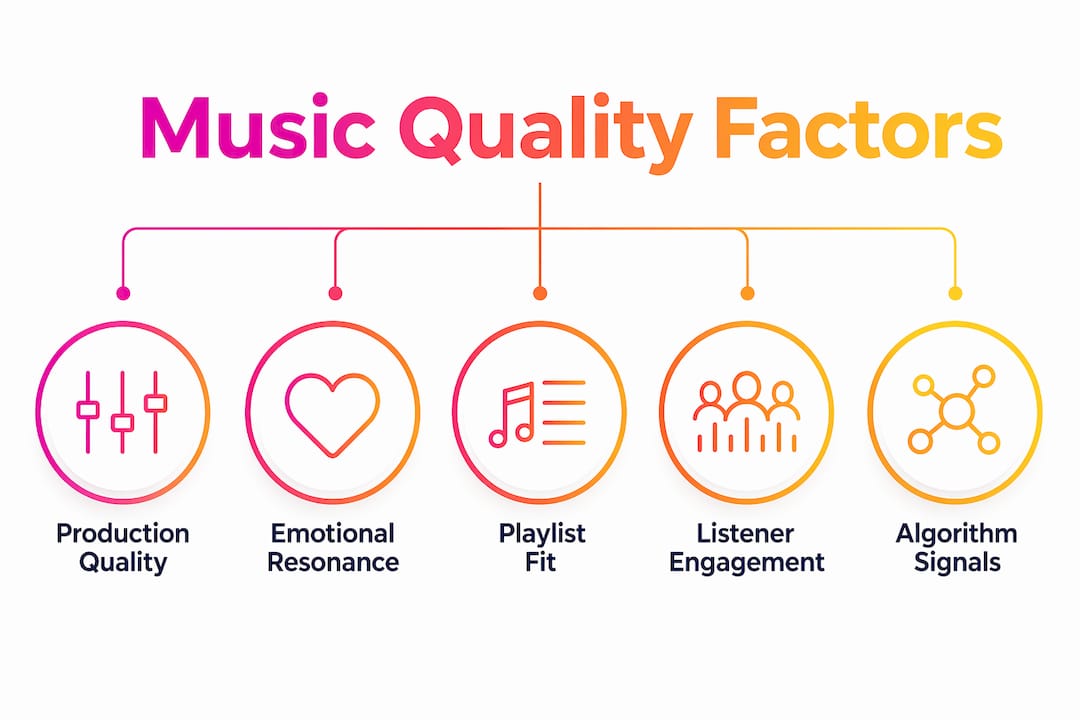
Curators decide in roughly 15 to 20 seconds whether a track belongs on their playlist. That figure comes from Hypebot’s analysis of over 100,000 submissions, and it reframes the entire conversation about music content. Artist reputation, social following, and promotional budget are largely irrelevant at that moment. What matters is whether the production quality, emotional tone, and hook speed match the playlist’s identity within the first phrase of the song.

Production quality functions as a gating factor, not a bonus. A quiet and thin master is rejected not because the song is bad but because it does not sit correctly alongside the other tracks on the playlist. Mastering for streaming is therefore a curatorial requirement, not a finishing touch. The mix must translate across earbuds, car speakers, and laptop audio without losing its energy or clarity.
Emotional resonance operates alongside technical quality. Curators are building listening experiences for their audiences, and a track that does not create an immediate emotional response within the first 15 seconds will not make the cut, regardless of how well it develops later.
| Selection factor | What curators assess | Why it matters |
|---|---|---|
| Production quality | Mix balance, loudness, tonal clarity | Tracks must sit alongside playlist peers without sounding thin or harsh |
| Hook speed | Emotional or melodic payoff within 15 seconds | Curators decide in under 20 seconds; slow builds are a liability |
| Genre and mood fit | Tempo, instrumentation, lyrical tone | Playlists serve specific listener moods; mismatches are rejected immediately |
| Emotional impact | Feeling evoked on first listen | Curators are building experiences, not catalogues of technically correct tracks |
Pro Tip: Before submitting to any playlist, listen to the last five tracks added. If your master sounds noticeably quieter or thinner, return to your engineer before pitching.
How does playlist fit affect streams and long-term revenue?
Playlist placement is not a binary win or loss. The type of playlist and how well your track fits its context determines the scale of the uplift and whether that uplift carries over into sustained listening after the placement ends. Research from UNSW BusinessThink finds that top-quintile playlists generate substantially larger stream and revenue uplifts than lower-tier equivalents, and that attribute fit and co-listing fit both amplify those effects.
Attribute fit refers to how closely your track’s sonic and emotional characteristics match the playlist’s established identity. Co-listing fit refers to how well your track sits alongside the specific other artists currently on that playlist. Both matter independently. A track that fits the playlist’s genre but clashes with its current mood or tempo will underperform relative to its potential.
Platform-curated playlists, such as Spotify’s algorithmic and editorial offerings, generate the largest immediate stream uplifts during the listing period. Label-curated playlists produce stronger carry-over demand after the listing ends. This distinction shapes how you should engineer your content strategy depending on whether you are chasing short-term visibility or long-term audience growth.
- Identify three to five playlists where your track’s tempo, key, and mood align with the existing catalogue before pitching.
- Compare your master’s loudness against the playlist’s current tracks using a tool such as Loudness Penalty or Youlean Loudness Meter.
- Pitch to mid-tier playlists with 10,000 to 50,000 followers first. These curators are more accessible and provide genuine engagement data before you approach editorial teams.
- After a placement ends, monitor whether streams continue organically. Carry-over listening is the clearest signal that your content has earned genuine audience connection.
- Use fan engagement strategies to convert playlist listeners into followers during the active listing window.
Does AI labelling affect how listeners engage with music?
Perceived authenticity is now a measurable component of content quality. A study summarised by Music Business Worldwide found that music labelled as AI-generated elicits less deep listener engagement, fewer imagined narratives, and reduced willingness to pay, even when the music was actually made by a human. The label alone changed the listening experience. This finding has direct implications for how artists communicate about their creative process.
The mechanism is straightforward. Listeners attribute meaning to music partly through the belief that a human made intentional choices in its creation. When that belief is removed or undermined, the emotional depth of the listening experience diminishes. Save-to-stream ratios, completion rates, and playlist adds all suffer as a result. In audience terms, perceived human intent is a component of content quality, not a separate consideration.
For artists using AI tools in production, mixing, or composition, this creates a genuine strategic tension. The tools can raise technical quality. The label can reduce perceived quality. Managing that tension requires transparency without over-disclosure.
- Describe your creative process in terms of decisions made, not tools used. “I wrote this melody over three months” communicates intent more effectively than a list of software.
- Avoid pre-emptive AI disclaimers in promotional copy unless legally required. Unsolicited disclosure raises questions that would not otherwise exist.
- Focus listener attention on the emotional content of the music through visual storytelling, which is where video content matters most for modern artists.
Pro Tip: If you use AI tools in your workflow, frame your artist story around the human decisions and emotional intent behind the music. Listeners respond to meaning, not methodology.
How should musicians prioritise content quality before promotion?
Early releases serve as market research, not auditions for viral success. Vohnic Music’s framework treats each release as a data point in a system designed to identify which content earns genuine engagement before promotional resources are committed. This approach requires a shift in mindset. The goal of the first few releases is not to reach the largest possible audience. It is to understand which emotional hooks, sonic identities, and lyrical themes produce the engagement signals that justify scaling.
Thrive Indie is direct on this point: promotion only amplifies content that already demonstrates organic engagement. Ads, playlist pitching, and TikTok campaigns expose your music to more people. If those people do not engage, the algorithm learns to show your music to fewer people over time. The promotion budget is not wasted on reaching the wrong audience. It is actively training the algorithm against you.
The indicators that signal readiness for promotion are specific and measurable:
- Comments that reference specific lyrics or moments in the track indicate emotional resonance, not just passive listening.
- Cross-platform follow-through, where listeners who find you on TikTok then search for you on Spotify, signals genuine interest rather than algorithmic accident.
- Saves exceeding 10% of streams on early releases suggest the track has earned a place in listeners’ personal libraries.
- Unsolicited shares from listeners who were not incentivised to share indicate the content carries social currency on its own merit.
Mastering quality remains the most commonly overlooked gating factor at this stage. A track that performs well in bedroom listening tests but sounds thin on streaming platforms will underperform regardless of its emotional content. Use reference tracks from your target playlist when finalising your master, and treat the mastering session as a curatorial submission, not a technical formality.
Pro Tip: Release consistently at a rhythm your production quality can sustain. Two well-mastered tracks per quarter outperform six rushed releases every time in terms of algorithm training and audience retention.
Key takeaways
Content quality determines music success because it drives the engagement signals that algorithms, curators, and listeners all use to evaluate and distribute music.
| Point | Details |
|---|---|
| Algorithms reward engagement, not spend | Saves, repeat listens, and playlist adds expand reach; poor engagement triggers suppression regardless of promotion budget. |
| Curators decide in under 20 seconds | Production quality, hook speed, and emotional fit determine playlist inclusion before artist reputation is considered. |
| Playlist fit amplifies quality content | Attribute fit and co-listing fit multiply stream uplifts; top-quintile placements generate the largest revenue gains. |
| Perceived authenticity is part of quality | AI labelling reduces listener engagement even for human-made music; framing creative intent matters as much as technical execution. |
| Early releases are data, not launches | Use initial releases to identify engagement patterns before committing promotion spend to any single track. |
The uncomfortable truth about content and promotion
Most artists I observe spend their first significant budget on promotion before they have a single data point confirming that their content earns genuine engagement. The logic feels sound: more exposure should mean more fans. But the platforms do not work that way, and neither do curators.
What I have found, watching artists navigate this across years of releases, is that the ones who build durable careers treat their first ten releases as a feedback loop rather than a launch sequence. They watch what listeners do, not what they say. A comment saying “this is fire” is pleasant. A save is evidence. A cross-platform search is a signal worth building on.
The technical side of quality, mastering, mix balance, loudness, is genuinely non-negotiable. But the emotional side is where most artists underinvest. A track that is technically correct but emotionally ambiguous will earn passive listens and nothing more. The tracks that train algorithms and earn curator attention are the ones where the emotional intent is clear within the first phrase.
My honest observation is that the artists who succeed consistently are not the ones with the largest budgets or the most sophisticated promotion strategies. They are the ones who refuse to promote content they are not yet confident in, and who use every release to learn something specific about their audience. That discipline, more than any tool or tactic, is what separates sustainable careers from one-release wonders.
— Music
Take your music further with Musicvideomarketplace

High-quality audio deserves equally high-quality visuals. Musicvideomarketplace enables musicians to create professional long-form videos in minutes, ready to upload to YouTube and pair with a targeted ad campaign for your song. A compelling visual presence strengthens listener engagement, supports playlist pitching narratives, and gives your content the social shareability that organic growth depends on. Explore professional 4K music videos that match the production standard of your audio and give your promotion strategy a foundation worth building on. Your music has earned the attention. Make sure the visuals deliver it.
FAQ
Why does content quality matter more than promotion budget?
Promotion exposes your music to more people, but the platform algorithm responds to how those people engage. Weak content produces poor engagement signals, which causes the algorithm to reduce distribution over time regardless of spend.
How quickly do curators decide on a track?
Curators typically decide within 15 to 20 seconds, based on production quality, hook speed, and emotional fit with the playlist. Artist reputation and follower count are secondary considerations at that moment.
Does mastering really affect playlist acceptance?
Yes. A master that sounds quiet or tonally thin relative to the other tracks on a target playlist is a common reason for rejection, even when the song itself is strong. Treat mastering as a curatorial requirement, not a finishing step.
How does AI labelling affect listener engagement?
Music labelled as AI-generated receives less deep engagement and lower willingness to pay from listeners, even when it is actually human-made. Perceived human intent is a measurable component of content quality in audience terms.
When is the right time to start promoting a release?
The right time is when early organic data, saves, cross-platform follow-through, and comments referencing specific moments, confirms that the content earns genuine engagement without paid amplification. Promoting before that point risks training the algorithm against your music.
Recommended
- Why video content matters for musicians in 2026 | Music Video Marketplace Blog
- Contenido musical digital: qué es y cómo potenciar tu música | Music Video Marketplace Blog
- YouTube Music Content: Boosting Reach for Musicians | Music Video Marketplace Blog
- Master the role of video content in music distribution | Music Video Marketplace Blog
Read next
 Why Invest in Music Videos for Artist GrowthWhy invest in music videos: discover audience engagement advantages, promotional value, production options, and essential cost considerations for artists.
 Why managers coordinate video campaigns for musiciansDiscover why managers coordinate video campaigns for musicians: they bring objectivity, expertise, and strategies that boost audience engagement.
 Why Music Video Marketplace is the GO TO for MusiciansMusic Video Marketplace is reshaping how artists release music in 2025. Inspired by a Reel from @bacons.bits, this article explores how ready-made, high-quality visuals help musicians save time, stay consistent, and elevate their promo with fast, affordable video content.
 Why content diversification for DJs matters in 2026Discover why content diversification for DJs is crucial in 2026. Engage audiences and protect your brand from social media volatility.
Turn the idea into a finished music video.
Drop your track into the Studio and build your visual in minutes.