
Why managers coordinate video campaigns for musicians
Discover why managers coordinate video campaigns for musicians: they bring objectivity, expertise, and strategies that boost audience engagement.

Why managers coordinate video campaigns for musicians
TL;DR:
- Managers bring objectivity and strategic planning to music video campaigns, bridging emotional bias and audience needs. They treat videos as long-term assets, focus on quality, coordinate teams, and optimize targeting for sustainable growth. Musicvideomarketplace supports this workflow by streamlining asset creation, campaign setup, and real-time performance analysis.
Managers coordinate video campaigns because musicians are almost always too close to their own work to market it effectively. You wrote the song, you lived it, and that emotional investment is exactly what makes self-promotion so difficult. A manager steps back, reads the room, and builds a campaign around what the audience needs to feel, not what you need to say. Beyond objectivity, they bring structural expertise: treating your music video as a long-term marketing asset rather than a one-off upload, allocating budget where it actually moves the needle, and keeping every collaborator pointed in the same direction.
Here is what that coordination covers in practice:
- Removing emotional bias so the marketing narrative connects with new listeners, not just existing fans
- Treating music videos as evergreen content that builds brand value over months, not days
- Prioritising production quality over scattering spend across low-impact content seeding
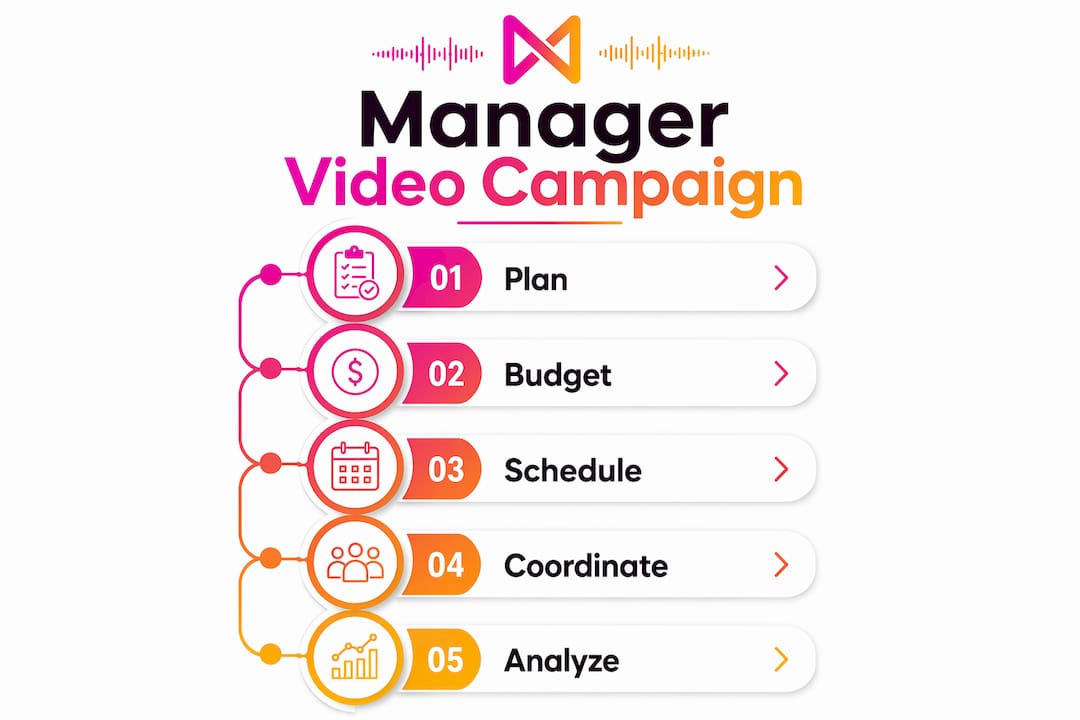
- Coordinating videographers, editors, ad buyers, and social teams around a single coherent plan
- Aligning every video release with the artist’s broader career trajectory and visual identity
Table of Contents
- Why managers provide objectivity in music video storytelling
- Strategic advantages of manager-led YouTube video campaigns
- How managers handle YouTube targeting without wasting your budget
- How Musicvideomarketplace supports manager-coordinated campaigns
- How managers align video campaigns with your artist brand and career goals
- Key takeaways
Why managers provide objectivity in music video storytelling
Artists often struggle with self-promotion because emotional proximity clouds judgement, as music marketing strategist Andy Gesner has noted. When you have spent months on a track, you hear what it means to you. A manager hears what it sounds like to a stranger on YouTube at 11pm deciding whether to skip an ad.
That distance is genuinely useful. Managers can identify the two or three seconds in a video that will hook a cold audience and build the entire campaign angle around those moments. They work with editors and writers to shape a narrative that speaks to YouTube users who have never heard of you, while still feeling authentic to your existing fanbase.
Professional storytelling at this level also means knowing what not to say. Overselling a personal backstory that only resonates with insiders is a common mistake musicians make when managing their own campaigns. A manager cuts that and leads with the visual or sonic hook that travels.
- Craft marketing angles that speak to new listeners, not just the core fanbase
- Collaborate with videographers and editors to maintain narrative consistency across assets
- Identify the strongest creative moments to anchor paid ad creative
- Balance artist authenticity with messaging that works for cold audiences on YouTube
Pro Tip: Brief your manager on the emotional intent behind the video before they build the campaign angle. They cannot replicate what they do not understand, and the best campaigns marry strategic framing with genuine artistic truth.
Strategic advantages of manager-led YouTube video campaigns
1. Managers treat videos as evergreen assets, not one-off uploads
The Manager’s Playbook is clear on this: investing in high-quality visual production pays dividends long after the release week. A well-produced video keeps generating streams, playlist placements, and new fan discoveries for years. Managers plan campaigns with that lifespan in mind, rather than burning budget on a short spike that fades within a fortnight.
2. Budget allocation favours quality over volume
Spreading a modest budget across ten mediocre content pieces rarely outperforms one strong video with a properly funded ad campaign behind it. Managers make that call because they are not sentimentally attached to any single piece of content. They follow the numbers.

3. Timing and scheduling are treated as a discipline
Coordinated release calendars with staged content distribution increase reach and engagement on YouTube. Managers map out pre-release teasers, the main drop, and follow-up content across a 30-day window, matching each stage to platform algorithm behaviour and audience activity patterns.
4. Cross-team coordination keeps branding consistent
A manager running a video campaign is simultaneously briefing the ad buyer, the social media team, the PR contact, and the video editor. Without that central coordination, cross-functional teams pull in different directions and the campaign loses coherence. Consistent visual language and messaging across every touchpoint is what makes a campaign feel like a campaign rather than a collection of posts.
5. Clipping extends organic reach beyond paid ads
Managers now routinely coordinate clipping campaigns, posting short video snippets across multiple accounts to drive organic discovery. This bridges paid YouTube advertising with grassroots social momentum, and the clipping work is typically outsourced to specialist editors so neither the artist nor the manager is buried in post-production.
6. Performance analysis drives continuous improvement
Campaigns that are not measured are not managed. Managers track which ad creatives are holding attention, which audience segments are converting, and where drop-off happens in the video itself. That data feeds directly into the next release.
How managers handle YouTube targeting without wasting your budget
Targeting is where a lot of self-managed campaigns go wrong. Musicians tend to over-filter, chasing a hyper-specific demographic that sounds right but drives up cost-per-view and shrinks the potential audience to the point where the algorithm has nothing to learn from.
Google Ads experts advise trusting YouTube’s skippable ad format as a natural quality filter. If someone watches past the skip point, they are genuinely interested. You only pay for that engaged view. Managers understand this and resist the urge to layer on so many targeting restrictions that the ad barely runs.
- Start broader than feels comfortable, then narrow based on real performance data
- Use YouTube’s audience insights to identify which segments are actually watching, not just which ones you assumed would
- Layer in keyword and topic targeting around the music genre and adjacent interests rather than locking down demographics too tightly
- Integrate short-form video promotion alongside paid ads to build familiarity before the main campaign push
Pro Tip: Track view-through conversions rather than click-through rates. Most YouTube viewers who discover you through an ad will not click immediately. They will search your name later, stream the track, or follow your channel. Click-through rate alone dramatically understates what a well-run video campaign is actually doing.
How Musicvideomarketplace supports manager-coordinated campaigns
Musicvideomarketplace is built for exactly this workflow. The platform lets managers and artists create a long-form video in minutes, upload it to YouTube, and launch an ad campaign for the song without needing a separate production house, ad agency, and analytics tool all running in parallel.
For managers overseeing multiple artists or a complex release schedule, that consolidation matters. Everything from video asset creation to campaign setup sits in one place, which cuts the coordination overhead that normally eats into both time and budget.
The platform also supports the kind of strategic content alignment that managers prioritise: visual assets that fit the artist’s existing brand identity, structured for both long-form YouTube viewing and short-form clipping. Performance data feeds back into the campaign in real time, so managers can adjust targeting, swap ad creative, or shift budget allocation without waiting on a third-party agency to run the numbers.

If you are a musician ready to run a properly coordinated video campaign, Musicvideomarketplace gives you the tools to do it without the overhead.
How managers align video campaigns with your artist brand and career goals
A video campaign that performs well in isolation but contradicts your visual identity or confuses your audience about what kind of artist you are is not a success. Managers prevent that by treating every campaign decision as a branding decision first.
Manager expertise ensures that visual content connects directly to the artist’s broader career trajectory, preventing the brand confusion that comes from inconsistent messaging across releases. That means the colour palette, the tone of the ad copy, the choice of which moments to feature in a thumbnail, and the audience segments being targeted all reinforce the same artistic identity.
Career-stage awareness matters here too. A manager working with an emerging artist will run a very different campaign from one supporting a mid-career artist consolidating a fanbase. The former needs broad discovery; the latter needs depth of engagement. Managers calibrate the campaign objectives, the YouTube ad formats, and the content mix accordingly. Without that strategic lens, campaigns default to chasing views rather than building something durable.
Key takeaways
Managers coordinate video campaigns because musicians need professional objectivity, strategic planning, and cross-team execution that emotional proximity and limited bandwidth make almost impossible to provide for themselves.
| Point | Details |
|---|---|
| Objectivity over attachment | Managers remove emotional bias, shaping campaign narratives that resonate with cold audiences on YouTube. |
| Videos as evergreen assets | Quality production pays back over months and years, not just release week. |
| Smarter targeting | Broad initial targeting, guided by platform data, reduces cost-per-view and improves campaign efficiency. |
| Cross-team coordination | Managers align ad buyers, editors, social teams, and PR around a single coherent campaign plan. |
| Musicvideomarketplace consolidates the workflow | The platform combines video creation, YouTube upload, and ad campaign management in one place for managers and artists. |
Recommended
- Rôle des managers dans la promotion vidéo musicale | Music Video Marketplace Blog
- Rol del manager en producción de video musical | Music Video Marketplace Blog
- Creative video campaign examples for independent musicians | Music Video Marketplace Blog
- Why producers use video campaigns: the 2026 guide | Music Video Marketplace Blog
Read next
 Why Music Video Marketplace is the GO TO for MusiciansMusic Video Marketplace is reshaping how artists release music in 2025. Inspired by a Reel from @bacons.bits, this article explores how ready-made, high-quality visuals help musicians save time, stay consistent, and elevate their promo with fast, affordable video content.
 Why musicians need marketing guides to growDiscover why musicians need marketing guides to ensure long-term growth. Build a consistent brand and engage your audience effectively!
 Why musicians use explainer videos to promoteDiscover when explainer videos actually work for musicians, from crowdfunding campaigns to fan education, and when to focus on formats that grow your audience.
 Why Invest in Music Videos for Artist GrowthWhy invest in music videos: discover audience engagement advantages, promotional value, production options, and essential cost considerations for artists.
Turn the idea into a finished music video.
Drop your track into the Studio and build your visual in minutes.