
Why musicians need marketing guides to grow
Discover why musicians need marketing guides to ensure long-term growth. Build a consistent brand and engage your audience effectively!

Why musicians need marketing guides to grow
TL;DR:
- Music marketing guides provide artists with a strategic framework for sustained brand-building beyond short-term promotion. Structured, phase-based campaigns and owned channels are essential for long-term growth and audience engagement. Focusing on meaningful metrics like engagement and conversion rather than vanity counts optimizes marketing effectiveness.
Marketing guides are the structured roadmap that separates musicians who build lasting careers from those who release music into silence. Without a deliberate framework, even genuinely talented artists default to reactive promotion: posting sporadically, chasing trends, and measuring success by follower counts that rarely translate to income or loyal fans. Understanding why musicians need marketing guides means recognising that music marketing is a distinct discipline from promotion, one that requires consistent brand-building, audience ownership, and data-informed decisions. Tools like Spotify for Artists, Mailchimp, and platforms such as DIY Musician (CDBaby) exist precisely because the music industry rewards strategy, not just talent.
Why musicians need marketing guides more than ever
Music marketing is defined as brand-building rather than a series of tactical announcements, and this distinction changes everything about how an independent artist should operate. Promotion is what you do the week a single drops. Marketing is what you do for the six months surrounding it, and the six months after that.
Most musicians conflate the two, which is why so many release cycles feel exhausting and produce diminishing returns. A marketing guide forces you to separate these concepts and assign each its proper role. Promotion sits inside marketing, not the other way around.
The benefits of marketing for artists become concrete when you see what a guide actually provides:
- A defined artist brand and story that stays consistent across Instagram, YouTube, Spotify, and email
- A pre-planned content calendar that removes the panic of “what do I post today?”
- Clear goals tied to measurable outcomes, not vague notions of “getting bigger”
- A repeatable system you can apply to every release, not just the one you’re working on now
Pro Tip: Before you plan a single post, write two sentences that describe your artist brand: who you are, and who your music is for. Every piece of content you create should pass that filter.
Independent artists must learn marketing skills as a core professional competency, not an optional extra. The artists who treat marketing as a learnable craft, rather than a necessary evil, are the ones who build genuine audiences over time.

How do structured campaign frameworks change a release?
The single most damaging mistake musicians make is treating release day as the finish line. Most artists prematurely cease marketing after release day, missing the compounding growth that comes from sustained momentum. A marketing guide replaces this pattern with a phased campaign structure that begins weeks before the release and continues well after it.
NotNoise presents a 4-phase campaign that spans from 6 to 8 weeks before release through to weeks after. Each phase has a specific purpose, and understanding that structure is what separates a planned campaign from a series of disconnected posts.
A typical phase-based release plan looks like this:
- Pre-campaign (weeks 6 to 8 before release): Build anticipation through teaser content, behind-the-scenes footage, and press outreach. Warm up your email list and social following before you ask anything of them.
- Pre-release (weeks 2 to 4 before release): Announce the release date, share the cover art, pitch to playlist curators, and begin paid advertising if your budget allows.
- Release week: Maximise visibility with coordinated posts across all platforms, activate your email list, and push for playlist placements and press coverage.
- Post-release (weeks 1 to 4 after release): Share listener reactions, behind-the-scenes content, and data-driven follow-up. This is where most artists go quiet, and where the real opportunity lies.
The table below shows what each phase prioritises and which channels carry the most weight:
| Campaign phase | Primary goal | Key channels |
|---|---|---|
| Pre-campaign | Audience warm-up | Email list, social media stories |
| Pre-release | Awareness and anticipation | YouTube, Instagram, press pitching |
| Release week | Maximum reach | All platforms, paid ads, playlists |
| Post-release | Sustain and convert | Email, Spotify for Artists data, social |
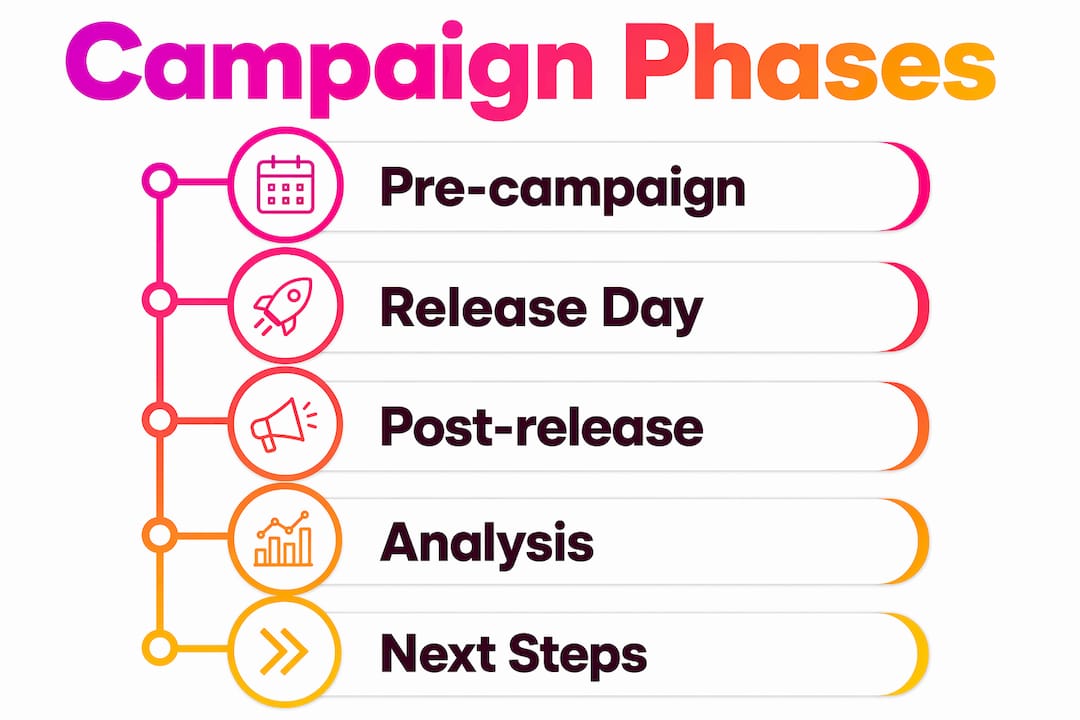
This kind of structured release campaign framework is what guides provide. Without it, you are improvising under pressure at the worst possible moment.
Why do owned channels matter more than social followers?
Social platforms are rented space. You build an audience on Instagram or TikTok at the discretion of an algorithm you do not control and cannot predict. Splitting channels into owned and rented is a foundational principle in every serious music marketing guide, and for good reason. Platform reach can collapse overnight. Your email list cannot be taken from you.
Joel Gouveia’s capture stack approach makes this concrete: every piece of content you publish on a rented platform should have a pathway that moves a fan towards an owned channel. That means a link in your bio to a free download in exchange for an email address, a newsletter that delivers genuine value rather than just release announcements, and a website that acts as your permanent home on the internet.
The practical steps guides recommend for building owned channels include:
- Offer a free, high-value incentive such as an exclusive track, a live recording, or early access to tickets in exchange for an email address
- Use tools like Mailchimp or ConvertKit to segment your list by engagement level, so your most loyal fans hear from you differently than casual listeners
- Send at least one email per month that is not a sales pitch, building the relationship before you need something from it
- Link to your fan engagement strategy from every platform profile, making it easy for interested listeners to deepen their connection
Pro Tip: A list of 500 genuinely engaged email subscribers will outperform 50,000 social followers when it comes to ticket sales, merch purchases, and crowdfunding. Build the list first.
The musician promotion strategies that produce real income are almost always built on owned channels. Social media is the top of the funnel. Email is where the relationship actually lives.
What metrics should musicians actually track?
Vanity metrics are the enemy of good marketing decisions. Orphiq and Musicians Institute recommend focusing on true engagement and conversion rather than follower counts, because a large following with low engagement tells you almost nothing useful about how to improve.
The metrics that actually inform strategy fall into three categories:
| Metric category | What to measure | Why it matters |
|---|---|---|
| Email performance | Open rate, click-through rate | Shows how engaged your list is and whether your content resonates |
| Streaming data | Saves, playlist adds, listener-to-follower ratio | Indicates genuine interest beyond passive listening |
| Social engagement | Comments, shares, saves (not likes) | Reveals content that prompts action, not just passive scrolling |
| Ad performance | Cost per click, conversion rate | Tells you whether your spend is producing fan actions |
Smart links and conversion tracking in campaigns enable you to optimise and repeat what works. Tools like Linktree, ToneDen, or Feature.fm give you click data that shows exactly where your audience is coming from and what they do when they arrive. Without this data, every campaign is a guess. With it, each release teaches you something you can apply to the next one.
The importance of marketing for musicians is nowhere more visible than in this data loop. A guide teaches you not just what to measure, but how to interpret what you find and change your approach accordingly.
How does release cadence affect your visibility?
Algorithms on Spotify, YouTube, and TikTok reward consistency. Berklee’s Christopher Wares emphasises release cadence as a discovery strategy, noting that releasing a single roughly every 6 to 8 weeks keeps an artist visible in the attention economy without burning out their creative output or their audience.
This is one of the music marketing tips for beginners that guides make explicit, because it runs counter to the instinct to release music only when it feels “ready” or when you have a full album to share. The algorithm does not reward perfection. It rewards presence.
A sustainable release cadence supported by a marketing guide looks like this:
- One single every 6 to 8 weeks, with each release supported by a full campaign cycle
- A content mix that balances promotional posts (roughly 20% of output) with community posts and value-driven content (the remaining 80%)
- Platform selection based on where your specific audience already spends time, informed by your analytics rather than assumptions
- A content calendar built at least four weeks in advance, so you are never scrambling for material
Consistent music promotion strategies compound over time. Each release builds on the audience and data from the last, and a guide gives you the framework to make that compounding effect deliberate rather than accidental.
Key takeaways
Marketing guides give musicians a repeatable, data-driven system that turns every release into a learning opportunity and every fan interaction into a long-term relationship.
| Point | Details |
|---|---|
| Marketing versus promotion | Marketing is sustained brand-building; promotion is a short-term tactic within it. |
| Phase-based campaigns | Structured campaigns spanning 6 to 8 weeks before and after release produce compounding results. |
| Owned channels first | Email lists and websites protect fan relationships from algorithm changes on rented platforms. |
| Track the right metrics | Focus on saves, email click rates, and conversion data rather than follower counts. |
| Release cadence matters | One single every 6 to 8 weeks keeps algorithms and audiences engaged between major releases. |
What I’ve learned from watching artists ignore marketing guides
The most common pattern I see is this: a talented musician spends months crafting a genuinely good song, releases it with a single Instagram post, and then wonders why nothing happened. The music was not the problem. The absence of a plan was.
What marketing guides do, at their best, is shift your mindset from “I hope people find this” to “here is how I will make sure people find this.” That shift is not about becoming a marketer instead of an artist. It is about accepting that in 2026, the two roles are inseparable for anyone building an independent career.
The artists I have seen grow most consistently are not the ones with the biggest budgets or the most followers. They are the ones with a repeatable system: a release framework they refine with each cycle, an email list they treat as their most valuable asset, and a data habit that tells them what is working before they spend another pound on advertising. A guide gives you that system. Without one, you are starting from scratch every single time.
— Music
Start your next campaign with Musicvideomarketplace
Knowing why artists need promotional guides is the first step. Putting that knowledge into practice is where Musicvideomarketplace comes in.

Musicvideomarketplace enables you to create a long-form music video in minutes, upload it directly to YouTube, and launch a targeted ad campaign for your song without needing a production team or a marketing agency. The platform is built for independent artists who want to move from strategy to execution quickly, applying the campaign frameworks and release cadence principles covered in this article. If you are ready to build your first campaign or want to explore how video marketing fits into your broader release strategy, Musicvideomarketplace gives you the tools to do it on your own terms.
FAQ
What is the difference between music marketing and music promotion?
Music marketing is brand-building sustained across an artist’s entire career, while promotion refers to short-term tactical activity around a specific release. Marketing guides help musicians understand that promotion is one tool within a broader strategic system.
How long should a music release campaign last?
A well-structured campaign begins 6 to 8 weeks before release and continues for at least two weeks after. Most artists stop marketing on release day, which cuts off the compounding growth that comes from sustained post-release activity.
Why is an email list more valuable than social media followers?
Email lists are owned channels that remain unaffected by platform algorithm changes, whereas social media reach is controlled by third-party platforms. Owning fan relationships through email gives musicians direct access to their most engaged listeners regardless of what any platform decides to change.
How often should an independent artist release music?
Releasing one single every 6 to 8 weeks is the cadence most consistently recommended by music marketing guides for maintaining algorithm visibility and audience engagement without exhausting your creative output.
What metrics matter most for music marketing?
Saves, playlist adds, email open rates, and ad conversion rates are the metrics that inform real decisions. Follower counts and likes are passive signals that rarely correlate with income or genuine fan loyalty.
Recommended
- Why Musicians Need Video Content for Growth | Music Video Marketplace Blog
- Music industry marketing explained: strategies for indie artists | Music Video Marketplace Blog
- Music marketing trends shaping success for independent artists | Music Video Marketplace Blog
- Marketing digital musical : visibilité, engagement et croissance | Music Video Marketplace Blog
Read next
 Why musicians use explainer videos to promoteDiscover when explainer videos actually work for musicians, from crowdfunding campaigns to fan education, and when to focus on formats that grow your audience.
 Your music release campaign process for maximum impactUnlock the secrets of a successful music release campaign process. Learn how to maximize your impact and engage fans effectively!
 YouTube music distribution: 5 key benefits in 2026Discover how independent musicians can use YouTube for music distribution, monetisation, and discovery in 2026. Practical strategies for real growth.
 Why Music Video Marketplace is the GO TO for MusiciansMusic Video Marketplace is reshaping how artists release music in 2025. Inspired by a Reel from @bacons.bits, this article explores how ready-made, high-quality visuals help musicians save time, stay consistent, and elevate their promo with fast, affordable video content.
Turn the idea into a finished music video.
Drop your track into the Studio and build your visual in minutes.