
Why long-term content strategies pay off for musicians
Discover how long-term content strategies can build your audience, increase revenue, and transform casual listeners into loyal fans.
Why long-term content strategies pay off for musicians
A long-term content strategy turns one-off posts into a compounding audience and revenue engine. Where a single campaign fades after a few weeks, a sustained strategy builds assets that keep working: YouTube videos that surface in search months later, a Substack newsletter that converts casual listeners into paying supporters, Bandcamp pages that benefit from the trust you have spent a year building.
The headline benefits, in brief:
- Sustained discoverability on YouTube and Spotify through accumulated watch time, playlist adds, and search ranking improvements
- Fan retention and conversion, moving listeners from a first stream to merch purchases, ticket sales, and memberships
- Lower cost-per-acquisition over time, as organic reach compounds and reduces reliance on paid promotion
- Catalogue monetisation, giving older releases a second life through evergreen content linked via YouTube Analytics and Google Analytics referral data
Key takeaways
A long-term content strategy compounds reach, improves discoverability, and builds sustainable revenue for musicians who commit to consistent, asset-focused publishing over 12 months or more.
| Point | Details |
|---|---|
| Compounding starts at 6–18 months | Measurable organic uplift typically appears between 6 and 18 months; larger gains follow after 12–24 months. |
| Six KPIs to track | Watch time, organic views, subscriber growth, email signups, playlist adds, and conversion to sales are the metrics that matter. |
| Repurpose every long-form asset | One YouTube video can supply short clips, a newsletter post, and a podcast episode, reducing production cost per output. |
| Own at least one channel | Build a Substack list or Bandcamp following as an owned asset alongside Spotify and YouTube. |
| Musicvideomarketplace | Speeds up long-form video production and short-clip generation, supporting a consistent content cadence from a single asset. |
Table of Contents
- Why do long-term content strategies matter more than campaign bursts?
- What concrete benefits can musicians expect?
- Which formats work best long-term, and how do you repurpose them?
- How do you map content to the fan journey with KPIs?
- Which tools help you measure long-term content performance?
- What timeline and budget should UK musicians expect?
- A practical 90-day plan and 12-month roadmap
- What mistakes do musicians most often make with content strategies?
- Why most content advice misses what musicians actually need
- Musicvideomarketplace makes consistent video output achievable
- Sources
Why do long-term content strategies matter more than campaign bursts?
Campaign-based publishing is a sprint. You release a single, spend on ads for a fortnight, then go quiet. The audience you paid to reach disperses. A long-term strategy is different in kind, not just degree: each piece of content becomes an asset that accumulates value rather than depreciating after launch.
Harvard Business School’s content strategy guidance frames this precisely: developing a content strategy forces you to map content to customer pain points at each funnel stage, turning publishing from an expense into something measurable and strategic.
The funnel logic for musicians runs like this. Awareness content (a YouTube performance video, a short clip on Instagram Reels) reaches people who have never heard of you. Consideration content (a behind-the-scenes documentary, a Substack post about your creative process) deepens interest. Decision content (a pre-order announcement, a Bandcamp exclusive) converts that interest into a purchase. Retention content (a members-only live stream, a monthly newsletter) keeps paying fans engaged between releases.
Forbes Coaches Council research confirms that long-term methods produce consistent momentum and compounding returns that campaign-only approaches simply cannot replicate. The compounding mechanism is real: a well-optimised YouTube video earns backlinks, climbs search rankings, and attracts new viewers without additional spend.
What concrete benefits can musicians expect?
Evergreen content behaves like a long-term capital investment: it accumulates value, earns backlinks, and improves search rankings over time. For musicians, that translates into several specific gains.
Sustained discovery on YouTube. A tutorial video explaining the production behind an indie single can surface in YouTube search for years. Video SEO for musicians compounds this effect: optimised titles, descriptions, and chapters increase watch time, which YouTube’s algorithm rewards with wider distribution.
Playlist adds and Spotify uplift. Consistent content that references your catalogue encourages editorial playlist consideration. Spotify’s own data shows that artists with active content presence outside the platform see higher save rates when listeners arrive.
Fan retention and higher conversion. A Substack newsletter that arrives reliably every fortnight builds the kind of familiarity that converts a casual stream into a ticket sale. Bandcamp’s direct-to-fan model rewards artists who maintain an active presence: fans who follow an artist on Bandcamp convert to purchases at a meaningfully higher rate than cold listeners.
Lower cost-per-acquisition. Organic content that ranks and circulates reduces your dependence on paid ads. Topical authority built through consistent, deep coverage is rewarded by search engines, helping you outrank broader but shallower competitors over time.
Which formats work best long-term, and how do you repurpose them?
Long-form YouTube video is the highest-leverage format for most musicians. A 10–20 minute documentary, studio session, or live performance generates watch time that feeds the algorithm, earns backlinks, and can be sliced into a dozen short-form clips for Instagram Reels, TikTok, and YouTube Shorts.
The repurposing workflow matters as much as the original format:
- Extract 30–60 second highlights for short-form social
- Pull the audio for a podcast episode or Spotify Canvas loop
- Turn the narrative arc of a long video into a Substack newsletter post
- Create a lyric or tutorial version of the same session for a different search query
One long-form asset can supply many short-form outputs, making batching and modular production the most efficient approach to sustained output. Live streams, recorded and uploaded to YouTube, function similarly: a two-hour session becomes a permanent searchable asset the moment it ends.
Consistency matters more than frequency. A realistic cadence of fewer, higher-quality pieces outperforms constant low-quality posting. For production support at scale, a content production partner can help teams that need to increase volume without sacrificing quality.
Pro Tip: Batch-produce content in single sessions. Record three YouTube videos in one day, then schedule them weekly. This keeps your cadence consistent without requiring daily creative energy.
How do you map content to the fan journey with KPIs?
Each stage of the fan journey needs a different content type and a different success metric. Treating all content as if it serves the same goal is one of the most common planning errors.
- Awareness: Short-form clips, YouTube search-optimised videos. KPI: organic views, new subscriber rate. Example: a 60-second clip from a single release reaches a new audience on Reels.
- Consideration: Behind-the-scenes videos, podcast appearances, Substack posts. KPI: watch time, email signups per video, click-through from YouTube to Bandcamp. Example: a studio documentary deepens interest ahead of an album pre-order.
- Decision: Pre-order announcements, exclusive Bandcamp bundles, limited merch drops. KPI: conversion rate from email list, Bandcamp sales per campaign. Example: a newsletter exclusive drives pre-orders in the 72 hours before release.
- Retention: Members-only live streams, monthly newsletters, early-access content. KPI: repeat stream rate, membership renewal, open rate. Example: a Substack membership tier sustains income between album cycles.
HubSpot’s content strategy guidance emphasises defining KPIs, benchmarking performance, and using analytics tools to refine strategy at each stage.
Which tools help you measure long-term content performance?
The six KPIs that matter most for long-term content are: organic views, watch time, subscriber growth, email signups, playlist adds, and conversion to sales.
| KPI | Primary tool | What to look for |
|---|---|---|
| Watch time | YouTube Analytics | Sustained growth month-on-month; high average view duration signals algorithm favour |
| Organic views | YouTube Analytics + Google Analytics | Traffic from search and suggested, not just direct |
| Subscriber growth | YouTube Analytics | Net new subscribers per video, not total count |
| Email signups | Substack / Mailchimp dashboard | Signups attributed to specific videos or posts |
| Playlist adds | Spotify for Artists | Adds from editorial and algorithmic playlists |
| Conversion to sales | Google Analytics (referral traffic) | Click-through from content to Bandcamp or merch store |
Google Analytics referral reports show which content pieces drive actual purchases, making it possible to model content as a financial investment with a measurable payback period. MarketingProducts argues that tracking long-term financial indicators such as customer lifetime value and acquisition cost is what separates a content strategy from a content calendar.
What timeline and budget should UK musicians expect?
Measurable organic uplift typically appears between 6 and 18 months. Larger compounding effects, where multiple assets reinforce each other in search and social algorithms, generally emerge after 12–24 months of consistent output.
Budget brackets for UK musicians:
- Solo DIY (under £200/month): One long-form YouTube video per month, repurposed into clips and a newsletter. Sustainable with batching; tools cost is minimal (free tiers of YouTube Analytics, Google Analytics, Substack).
- Small band or manager budget (£200–£800/month): Add a monthly podcast episode, paid Spotify promotion, and occasional short-form video production. Outsource editing to free up creative time.
- Label-scale (£800+/month): Consistent multi-format output across YouTube, Substack, Spotify, and Bandcamp, with dedicated analytics review and paid amplification to accelerate time-to-value.
Timeline milestones:
- 0–3 months: Audit existing content, establish pillar topics, publish first batch of long-form assets, set baseline KPIs.
- 4–12 months: Traction phase. Watch time grows, email list builds, first playlist adds appear. Refine cadence based on analytics.
- 12+ months: Compounding phase. Older videos surface in new searches, catalogue streams increase, fan conversion rates improve.
A practical 90-day plan and 12-month roadmap
The plan balances quick wins in the first 90 days with the systematic building that produces compounding returns by month 12.
Month 1: audit and foundations
Review every existing piece of content. Identify your top three performing videos or posts and note what they have in common. Choose one pillar topic (your genre, your production process, your touring life) that you can cover with genuine depth. Set up Google Analytics and YouTube Analytics dashboards with the six KPIs above as your baseline.
Month 2: pillar content and distribution
Produce two long-form YouTube videos on your pillar topic. Repurpose each into three short clips and one Substack post. Submit your most recent single to Spotify editorial playlists via Spotify for Artists. Effective video content strategies can guide your format choices here.
Month 3: cadence and repurposing
Batch-produce content for months 4 and 5. Build a simple content calendar: one long-form video per month, four short clips per week, one newsletter per fortnight. Review KPIs against your month-1 baseline and adjust.
12-month roadmap by quarter:
| Quarter | Focus | Output target |
|---|---|---|
| Q1 | Foundations: audit, pillar content, KPI setup | 2 long-form videos, 1 newsletter/fortnight |
| Q2 | Traction: repurposing, playlist pitching, email growth | 3 long-form videos, short clips weekly |
| Q3 | Depth: behind-the-scenes series, podcast launch | 4 long-form videos, 1 podcast/month |
| Q4 | Monetisation: membership launch, catalogue reissue campaign | Full multi-format cadence, Bandcamp exclusive |
What mistakes do musicians most often make with content strategies?
The most damaging mistake is having no strategy at all: posting reactively whenever inspiration strikes produces effort without compounding. Every post becomes a one-off rather than a brick in a larger structure.
Common errors and their fixes:
- Inconsistent cadence: Posting five times one week, then nothing for three. Fix: commit to a cadence you can sustain with batching, even if that means one video per month.
- Measuring vanity metrics: Tracking likes and follower counts instead of watch time, email signups, and conversion. Fix: set the six KPIs from the measurement section as your only dashboard.
- Over-reliance on paid ads: Spending on promotion without building owned assets (email list, YouTube catalogue). Fix: allocate at least half your content budget to organic, evergreen production.
- Ignoring owned platforms: Relying entirely on Spotify and Instagram, which can change their algorithms without notice. Fix: build a Substack list and a Bandcamp following as owned channels.
Red flags that your strategy is failing: organic views declining month-on-month after six months, email open rates below 20%, no playlist adds after 12 months of consistent output.
Pro Tip: If you notice declining organic views, check your YouTube Analytics audience retention report. A consistent drop-off before the 30% mark usually signals a title or thumbnail mismatch, not a content quality problem.
Why most content advice misses what musicians actually need
The standard content marketing playbook was written for SaaS companies and e-commerce brands. It optimises for lead generation and purchase funnels with short sales cycles. Music is different: the fan relationship is emotional, long-cycle, and built on repeated exposure over months or years before a meaningful transaction occurs.
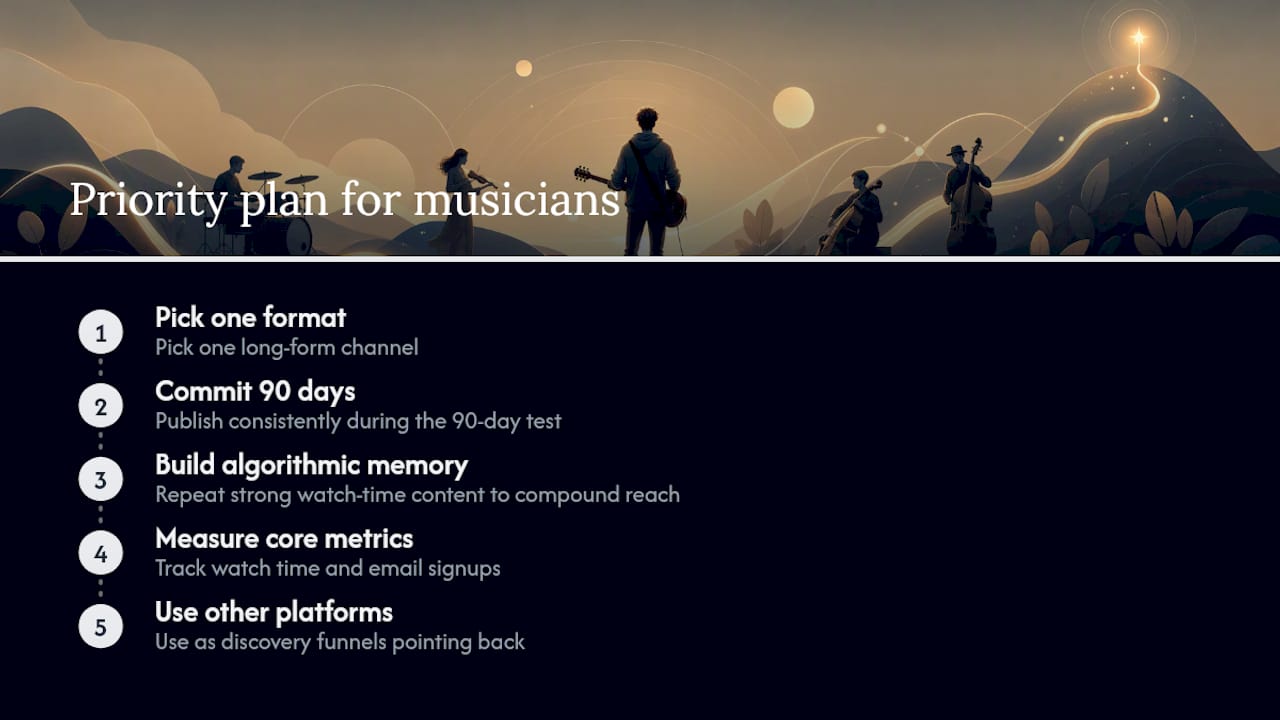
Most guides tell musicians to “post consistently” without explaining why consistency works mechanically. The reason is algorithmic memory: YouTube and Spotify both weight recent engagement history when deciding how widely to distribute new content. An artist who has published 20 videos with strong watch-time signals gets a distribution advantage on video 21 that a first-time uploader simply does not have. That is the compounding effect in concrete terms.
The advice to “diversify across platforms” is also frequently misread. The goal is not to be everywhere simultaneously; it is to build one owned channel (a newsletter, a YouTube catalogue) deeply, then use other platforms as discovery funnels that point back to it. A Bandcamp page with 500 dedicated followers who have opted in is worth more commercially than 50,000 passive Spotify listeners who have never clicked through to anything.
What to prioritise first: pick one long-form format, commit to it for 90 days, and measure watch time and email signups. Everything else is secondary until those two numbers are moving.
Musicvideomarketplace makes consistent video output achievable
Producing long-form video consistently is where most musicians stall. The creative intent is there; the production bottleneck is not. Musicvideomarketplace removes that bottleneck: browse a library of human-made, ready-to-edit full-length music videos, upload your audio and branding, and export a YouTube-ready video in minutes. Short social clips are generated from the same asset, giving you the repurposing workflow described above without the editing overhead.

The platform also supports YouTube ad campaigns directly, so the content you produce feeds both your organic catalogue and your paid amplification in one place. For musicians building a long-term strategy, that means less time in post-production and more time creating the pillar content that compounds. Browse the Musicvideomarketplace video library to find a template that fits your next release and get your first long-form asset live this week.
Sources
- Harvard Business School Online: Content strategy
- HubSpot blog: Six steps to acing your startup’s content strategy
- 11 key advantages of developing a long-term content strategy — Forbes Coaches Council
- The Inkorporated: The long-term benefits of quality content for brand growth
- MarketingProducts: Content marketing as a long-term investment rather than a quick win
- Belvoir Media: Why content consistency really does matter (and how people get it wrong)
- Mischa Communications: Content marketing: why consistency beats frequency
- Upswing Digital: 7 powerful reasons your brand needs a content strategy
Recommended
- Effective video content strategies for musicians: a guide | Music Video Marketplace Blog
- What is long form music content: a 2026 guide | Music Video Marketplace Blog
- Top video marketing trends for musicians: 2026 strategies | Music Video Marketplace Blog
- Key advantages of YouTube for musicians in 2026 | Music Video Marketplace Blog
Read next
 Benefits of video for artist acquisition: 2026 guideDiscover the benefits of video for artist acquisition. Learn how video transforms listeners into loyal fans and boosts engagement.
 Benefits of video promotion for DJs in 2026Discover the benefits of video promotion for DJs in 2026. Boost engagement, secure gigs, and turn listeners into loyal fans—start now!
 Best practices for song promotion in 2026Unlock the best practices for song promotion in 2026. Discover actionable steps to boost your release and reach your audience effectively!
 Why a centralised artist dashboard transforms your releasesDiscover how a centralized artist dashboard enhances marketing efficiency, streamlines asset management, and boosts revenue for musicians.
Turn the idea into a finished music video.
Drop your track into the Studio and build your visual in minutes.