
 Try the Workspace
Distributor artist onboarding: examples, templates and checklists
Discover effective distributor artist onboarding processes with copy-paste templates, checklists, and a practical timeline to streamline your workflow.

Distributor artist onboarding: examples, templates and checklists
This article gives you three copy-paste onboarding process flows, an editable intake form, an asset and metadata checklist, a 30–60–90 timetable, SLA examples, contract red flags to catch before ingestion, and a one-page implementation checklist you can drop into any project management tool today.
Here is what you can use immediately:
- Three process flows: single release, EP with multiple contributors, and catalogue ingestion for a small indie label
- Onboarding intake form: suggested fields covering legal, platform access, payment, and metadata
- Asset and metadata checklist: audio specs, ISRC, UPC, artwork dimensions, credits, and PRO details
- 30–60–90 timetable: milestone plan with KPIs for each phase
- SLA examples: internal review windows and artist reply deadlines
- Contract red flags: six checkpoints to clear before you ingest a single file
- One-page implementation checklist: copy it into Notion, Asana, or ClickUp and start this week
Pro Tip: Download the templates from the Musicvideomarketplace blog resources page and adapt them to your label’s house style before your next artist sign-on.
Key takeaways
A well-run distributor artist onboarding process front-loads governance, validates metadata before ingestion, and aligns commercial targets in writing so that every release goes live on time and every royalty is attributed correctly.
| Point | Details |
|---|---|
| Front-load governance | Collect contracts, PRO registrations, and split sheets in the first 5–7 days to prevent post-release disputes. |
| Validate metadata at intake | Run ISRC, UPC, and artwork checks before ingestion; a first-pass approval rate of 90% or above is a realistic target. |
| Use a 30–60–90 timetable | Map tasks to three phases: foundation (—), optimisation (—), and integration (—) with KPIs at each stage. |
| Resolve contract red flags first | Undisclosed prior agreements, missing PRO registrations, and uncleared samples must be resolved before any file is ingested. |
| Musicvideomarketplace for video assets | Include a licensed, ready-made video in the welcome packet to give artists a YouTube-ready asset and social clips from day one. |
Table of Contents
- What do distributor artist onboarding processes actually cover?
- 1. Stage-by-stage distributor onboarding workflow
- 2. Asset and metadata checklist for onboarding
- 3. Contract and rights checkpoints to confirm during onboarding
- 4. Fillable templates and example form fields
- 5. A concrete 30–60–90 timetable and the KPIs to measure onboarding success
- 6. Recommended tooling, SLAs and feedback loops for smooth onboarding
- 7. Three copy-ready example process flows you can adapt
- 8. One-page implementation checklist to launch onboarding this week
- What UK labels and distributors do well (and what you can copy)
- Common challenges during artist onboarding and how to fix them
- UK legal compliance considerations for music industry onboarding
- What I have learned from running distributor onboarding
- Ready-made video assets belong in your artist welcome packet
- Sources
What do distributor artist onboarding processes actually cover?
Distributor onboarding is a structured process that readies an authorised distributor for operations: contract execution, system access provisioning, product and pricing training, inventory alignment, and reporting workflow configuration. In music, that definition stretches to cover the artist side too, which is where most indie labels and managers run into trouble. The process is not just about getting files into a portal; it is about aligning rights, metadata, commercial expectations, and communication protocols before a single track goes live.
Successful onboarding depends on clear expectations, legal agreements signed early, and scheduled system access to avoid the operational friction that kills release timelines. Get those three things wrong and you are chasing corrected metadata at 11pm the night before a Friday release.
1. Stage-by-stage distributor onboarding workflow
A clean workflow runs through five stages, each with a clear owner and a rough time budget.
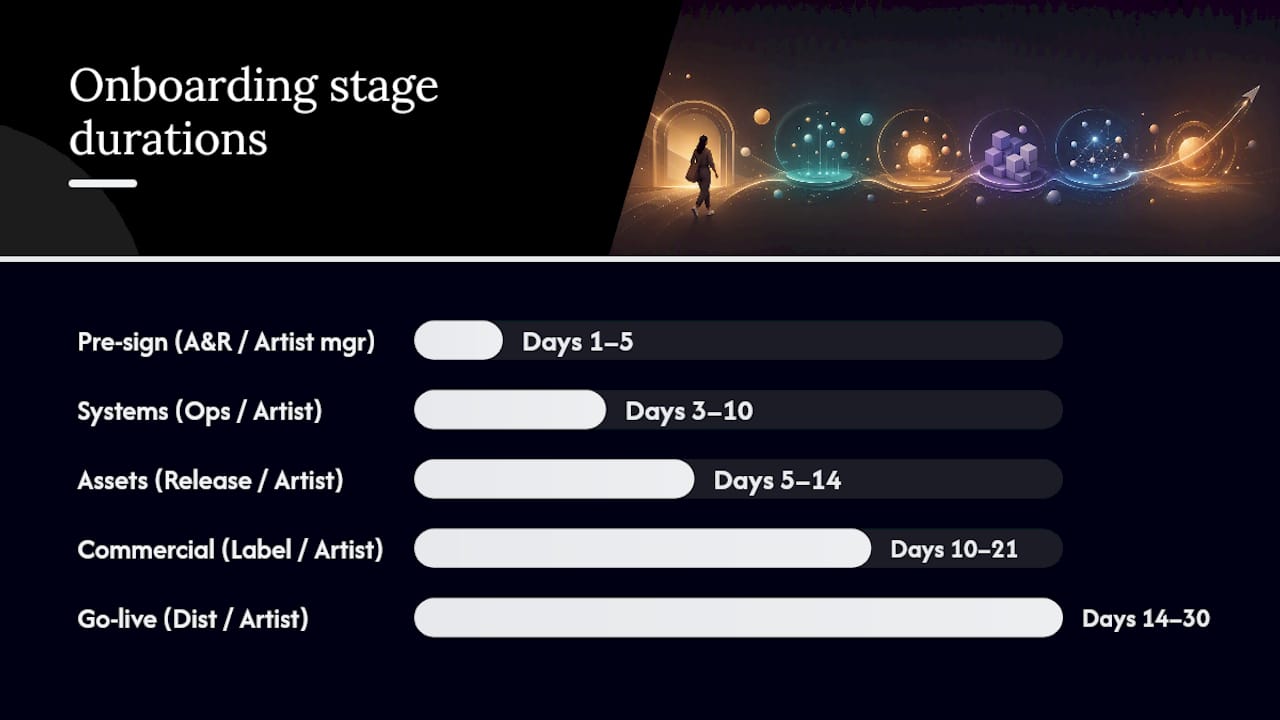
Stage 1: Pre-sign checks (Days 1–5)
Before any contract is countersigned, verify exclusivity status, confirm the artist holds or controls the rights they are granting, and run basic KYC checks. Collect existing agreements (prior distribution deals, publishing contracts, sync licences) so you can spot conflicts early. A structured 90-day framework recommends collecting platform access and existing contracts within the first 5–7 business days so that constraints shaping strategy are visible before any commercial plan is set.
Stage 2: Account and systems setup (Days 3–10)
Provision distributor portal access, analytics dashboard credentials, and catalogue ingestion logins. Assign internal account manager and confirm the artist’s or label’s nominated contact. Send a welcome packet with team contacts, escalation paths, and a release calendar template.
Stage 3: Asset intake and validation (Days 5–14)
Collect master audio files, artwork, ISRC codes, UPC, metadata, and credits. Run a first-pass validation against your distributor’s technical spec sheet. Flag errors immediately rather than letting them sit in a queue.
Stage 4: Commercial alignment (Days 10–21)
Agree pricing, territories, payment terms, and an initial commercial plan with targets. Treating distributors as partners and aligning incentives through joint commercial planning improves long-term distribution outcomes, so document the targets in writing and share them with both sides.
Stage 5: Go-live and first-period operations (Days 14–30)
Schedule the release, confirm reporting cadence, and set up deal registration. For physical distribution, align inventory and fulfilment processes. Run a post-go-live check at day 30 against your KPI baseline.
Role matrix
| Stage | Internal owner | Partner/artist owner |
|---|---|---|
| Pre-sign checks | A&R / Legal | Artist manager / solicitor |
| Systems setup | Operations / IT | Artist or label admin |
| Asset intake | Release manager | Artist / producer |
| Commercial alignment | Label manager | Artist manager |
| Go-live and reporting | Distribution coordinator | Artist manager |
2. Asset and metadata checklist for onboarding
Rejected uploads and delayed releases almost always trace back to the same handful of missing or incorrect fields. Use this checklist at intake, not the night before delivery.
Audio masters
- WAV or AIFF, 44.1 kHz / 16-bit minimum; 24-bit preferred for streaming masters
- Stems delivered separately where required for sync or remix licensing
- File naming convention: Artist_Title_Version_ISRC.wav
- No clipping; integrated loudness to LUFS target specified by the distributor
Identifiers and rights data
- ISRC per track (registered via PPL in the UK)
- UPC / EAN for the release
- Composer and lyricist splits confirmed and signed off
- Publisher IDs and PRO registration details (PRS for Music, MCPS)
- Neighbouring rights registration confirmed with PPL
Artwork and credits
- 3000 × 3000 px minimum, RGB, 72 dpi for streaming; CMYK 300 dpi for physical
- Bleed added for physical formats; fonts outlined or embedded
- Photographer and artwork credits confirmed in writing
- Parental advisory label applied where applicable
Additional assets
- Lyric sheet (plain text, time-coded where possible)
- Full credits: producers, engineers, session musicians, featured artists
- Metadata for editorial placement: genre, mood, language, BPM, key
Pro Tip: Validate ISRCs against the PPL database before ingestion. A duplicate or incorrectly formatted ISRC will cause royalty misattribution that can take months to untangle. Tools like bespoke metadata validators built into platforms such as Delivermytune or your distributor’s own portal often catch these automatically if you run the check before submission rather than after.
3. Contract and rights checkpoints to confirm during onboarding
Indie-label onboarding should include contract details, royalty and split information, team contacts, and project timelines before signing or ingesting releases. Here are the specific checkpoints to clear.
Rights granted
- Confirm which rights are being licensed or assigned: master recording rights, synchronisation rights, distribution rights
- Territories: worldwide, UK-only, or specific exclusions
- Term: fixed term with reversion clause, or rolling
- Exclusivity: confirm no conflicting prior agreements are in force
Payment and reporting
- Royalty splits documented and countersigned
- Recoupment terms stated clearly (what costs are recoupable, at what rate)
- Payment frequency: monthly, quarterly; currency in GBP for UK-based agreements
- Audit rights: confirm the artist or manager has the right to request an accounting audit
Mechanical and performance rights
- Confirm MCPS mechanical licence is in place for physical or download releases
- PRS for Music registration confirmed for performance royalties
- Publishing notifications sent to any co-publishers before release
IP clearance
- Sample clearances obtained and documented before ingestion
- Any third-party sync rights confirmed in writing
- Featured artist agreements signed
Red flags that should pause onboarding
Before ingesting any assets, pause the process if you encounter any of the following: an undisclosed prior distribution agreement still in term; missing PRO registrations for any credited writer; a sample that has not been cleared; conflicting ownership claims on the master recording; or a contract that lacks a reversion clause. Each of these can result in takedowns, withheld royalties, or legal liability after release. Resolve them in writing before proceeding.
4. Fillable templates and example form fields
A well-designed intake form does two things: it collects everything you need in one pass, and it signals to the artist that you run a professional operation. Here are the fields to include.
Onboarding intake form fields
- Legal artist name and trading name (if different)
- Registered address and company number (if applicable)
- Primary contact: name, email, phone
- Manager contact: name, email, phone
- Bank details for royalty payments (sort code, account number, or IBAN for international)
- Distributor portal login email
- Streaming platform profile URLs (Spotify, Apple Music, YouTube)
- ISRC block or existing ISRCs per track
- Writer splits: percentage per writer, publisher name, PRO affiliation
- Publisher IDs (PRS, MCPS, PPL)
- Preferred release date and territory
Creative brief example fields
- Brand voice: three adjectives describing the artist’s sound and visual identity
- Reference tracks: up to five tracks that represent the target aesthetic
- Required deliverables: single artwork, lyric video, social clips, press photo set
- Deadlines: artwork approval by [date], final assets by [date]
- Approval points: who signs off at each stage (artist, manager, label A&R)
- Restrictions: anything the artist does not want used (fonts, colour palettes, imagery)
Welcome packet content checklist
- Team contacts with roles and response-time commitments
- Release calendar template (editable)
- FAQ covering royalty payment schedule, metadata correction process, and takedown procedure
- Escalation path: who to contact if a release is delayed or a dispute arises
For making forms fillable and secure, Google Forms works for straightforward intake; Typeform adds conditional logic for more complex flows; JotForm supports e-signature and GDPR-compliant data handling, which matters for UK-based operations under the UK GDPR framework. Store completed forms in a password-managed environment using 1Password or Bitwarden.
Pro Tip: Build a separate short form for metadata corrections post-release. Giving artists a clear, low-friction way to flag errors means you catch problems before they compound across multiple platforms.
5. A concrete 30–60–90 timetable and the KPIs to measure onboarding success
A production-system onboarding approach with prepared documentation can complete full onboarding in under three weeks, but for a full distributor relationship with catalogue depth, a 90-day plan is more realistic and more defensible.
KPIs to track
- Time-to-go-live: days from contract signature to first release live on platforms
- Metadata error rate: percentage of tracks requiring correction after first submission
- First-pass approval rate: percentage of asset batches approved without revision
- On-time delivery rate: percentage of releases hitting the scheduled date
- Early revenue or streams: agreed target for the first 30 days post-release
For catalogue ingestions, stagger the release schedule rather than ingesting everything at once. A batch of 10–15 tracks per week gives your team time to validate metadata and respond to platform rejections without a backlog building up.
6. Recommended tooling, SLAs and feedback loops for smooth onboarding
A stalled onboarding almost always comes down to one of two things: a file sitting in someone’s inbox unreviewed, or a question that nobody knows who should answer. Tooling and SLAs fix both.
Core tooling stack
- Project management: Notion or Asana for task tracking, deadline visibility, and role assignment
- File transfer: Dropbox or WeTransfer Pro for large audio and video files; avoid email attachments for masters
- Metadata validation: your distributor’s portal validation tool, or a dedicated metadata editor such as Mp3tag or bespoke ingestion tools
- Analytics: distributor dashboard (Spotify for Artists, Apple Music for Artists) plus a consolidated view in Chartmetric or Soundcharts
Communication SLAs
- Internal review of submitted assets: 48 hours
- Artist or manager reply to revision requests: 72 hours
- Contract queries escalated to legal: 5 business days
- Royalty query response: 10 business days
Pilot project guidance
Scope the pilot around a single release, not a full catalogue. Choose a track with clean metadata, no sample clearance issues, and a flexible release date. Measure time-to-go-live, metadata error rate, and first-pass approval rate. Use the results to calibrate your SLAs before scaling.
Pro Tip: For UK-based teams working with offshore contributors or international artists, establish a daily overlap window of at least two hours during UK business hours (9 AM–5 PM GMT). Async-first communication works well for file delivery, but time-sensitive decisions — release holds, contract queries — need a live window to avoid a 24-hour delay becoming a 72-hour one.
7. Three copy-ready example process flows you can adapt
Example A: Single release, direct upload (2–3 weeks)
This is the minimal-path flow for a solo artist with clean metadata and no co-writers outside the UK.
- Day 1: Contract countersigned; portal access provisioned; welcome packet sent
- Day 2–3: Artist submits intake form; ISRC confirmed with PPL; UPC assigned
- Day 4–7: Master audio and artwork submitted; first-pass validation run
- Day 8–10: Metadata approved; release scheduled; DSP pitching window opens
- Day 14–21: Release goes live; streaming links confirmed; royalty reporting set up
Owner: Release manager (internal); artist or manager (external)
Example B: EP with multiple contributors (3–5 weeks)
The added complexity here is splits, publishing checks, and multiple artwork versions.
- Collect signed split sheets from every credited writer before ingestion begins
- Run MCPS mechanical licence check for any physical or download component
- Confirm featured artist agreements are countersigned
- Deliver two artwork versions: standard streaming square and a widescreen version for YouTube
- Schedule a mid-process check-in call at day 14 to catch any outstanding clearances
Owner: A&R coordinator (splits and clearances); release manager (assets and scheduling)
Example C: Catalogue ingestion for a small indie label (6–10 weeks)
Batch ingestion requires a different rhythm. Speed is less important than accuracy.
- Week 1: Full catalogue audit; metadata spreadsheet built; ISRC gaps identified
- Week 2–3: Missing ISRCs registered; artwork resized to spec; credits verified
- Week 4–5: First batch (15 tracks) ingested and validated; errors corrected
- Week 6–7: Second batch ingested; royalty reporting structure confirmed
- Week 8–10: Full catalogue live; historical royalty data reconciled; KPI baseline set
Owner: Label manager (catalogue audit and rights); operations coordinator (ingestion and validation)
8. One-page implementation checklist to launch onboarding this week
Copy this into Notion, Asana, or ClickUp and assign owners before your next team meeting.
Days 1–7 (high priority)
- [ ] Countersign distribution agreement; confirm term, territory, and exclusivity
- [ ] Provision portal access and send login credentials
- [ ] Send welcome packet: team contacts, release calendar, FAQ, escalation path
- [ ] Collect completed intake form: legal details, bank details, PRO IDs, platform URLs
- [ ] Confirm ISRC and UPC assignment
- [ ] Run pre-ingestion contract check against the six red flags listed above
Days 8–30 (operational)
- [ ] Ingest first asset batch; run metadata validation
- [ ] Schedule pilot release and set go-live date
- [ ] Establish reporting cadence and confirm royalty payment schedule
- [ ] Set KPI baseline: time-to-go-live, metadata error rate, first-pass approval rate
- [ ] Book 30-day review call with artist or manager
Delegation note: assign the contract and rights checks to your legal or A&R lead; asset ingestion and metadata validation to your release manager; communication and calendar management to your operations coordinator. Do not let one person own all three.
What UK labels and distributors do well (and what you can copy)
The UK music industry has a few structural advantages that shape how effective onboarding looks in practice. PRS for Music and PPL have well-documented registration processes, and most UK-based indie labels have learned to front-load those registrations rather than chase them post-release. The labels that run the tightest onboarding processes tend to share three habits.
First, they treat the welcome packet as a commercial document, not an admin formality. It includes the release calendar, the commercial targets, and the escalation path alongside the standard team contacts. That framing sets the tone for the whole relationship.
Second, they run a mandatory metadata audit on every new artist, even when the artist insists their data is clean. It rarely is. A quick pass through PPL’s ISRC lookup and a check against PRS for Music’s works database takes under an hour and catches the errors that cause royalty misattribution six months later.
Third, they scope a pilot release before committing to a full catalogue deal. One track, clean metadata, flexible date. The pilot surfaces process gaps without the pressure of a major campaign behind it.
Common challenges during artist onboarding and how to fix them
Incomplete or incorrect metadata is the most frequent cause of delayed releases. The fix is a mandatory pre-ingestion checklist (see Section 2) and a clear policy: no submission without a completed form.
Missing PRO registrations surface at royalty payment time, not at release time, which makes them easy to overlook during onboarding. Build a PRO verification step into your intake form so it is caught at the start.
Conflicting prior agreements are more common than most managers expect, particularly for artists who have self-released on multiple platforms. A direct question in the intake form (“Do you have any existing distribution agreements currently in term?”) and a request for copies of those agreements resolves this before it becomes a legal problem.
Slow asset delivery from artists is usually a communication problem, not a motivation problem. A clear deadline in the welcome packet, with a named consequence (release date moves), changes behaviour faster than a follow-up email.
Artwork rejections from DSPs typically come down to text coverage, resolution, or explicit content. A one-page artwork spec sheet sent at intake prevents most of them.
UK legal compliance considerations for music industry onboarding
UK GDPR and data protection
Any personal data collected during onboarding (bank details, contact information, platform credentials) must be handled in line with the UK GDPR framework, which is administered by the Information Commissioner’s Office (ICO). You need a lawful basis for processing, a clear privacy notice, and a data retention policy. Store completed intake forms in an encrypted environment and do not retain bank details longer than necessary.
Copyright and rights clearance
Under the Copyright, Designs and Patents Act 1988, the creator of a sound recording holds the copyright unless it has been assigned in writing. Confirm in writing that the artist either owns or controls the master recording rights before ingestion. For compositions, confirm PRS for Music registration and that all co-writers have been notified of the release.
Mechanical licensing
For physical formats and permanent downloads, an MCPS licence is required. MCPS operates as part of PRS for Music in the UK. Confirm the licence is in place before manufacturing or distributing any physical product.
Contract law
UK contract law requires offer, acceptance, and consideration. A countersigned distribution agreement satisfies this, but verbal agreements do not. Never begin ingesting assets on the basis of a verbal commitment alone.
This section provides general information about UK legal requirements and is not a substitute for advice from a qualified solicitor. Confirm current requirements with a music industry lawyer or the relevant regulatory body.
What I have learned from running distributor onboarding
The single most expensive mistake in distributor onboarding is treating governance as something you sort out later. The release moves anyway, but now you are correcting it under pressure.
Front-loading governance does not slow onboarding down. It speeds it up. When the contract is clean, the metadata is validated, and the PRO registrations are confirmed before ingestion starts, the release itself becomes almost mechanical. The 48-hour internal review SLA holds because there is nothing to argue about.
The one thing I would tell any manager starting this process: run a pilot on a low-stakes release before you commit to a full workflow. Not because the process will fail, but because the pilot will show you exactly where your team’s weak points are, before those weak points cost you a campaign.
Ready-made video assets belong in your artist welcome packet
Most artist welcome packets stop at metadata forms and release calendars. That is a missed opportunity. An artist who arrives at their release date with a YouTube-ready long-form video and a set of social clips already licensed and customised is weeks ahead of one who is still briefing a video director.

Musicvideomarketplace gives labels and managers access to a library of human-made, ready-to-edit full-length music videos. Upload the artist’s audio, apply their branding, and export a YouTube-ready video in minutes. The same asset generates short social clips for Instagram, TikTok, and Facebook, and feeds directly into a YouTube ad campaign. Including a licensed video asset in the welcome packet means the artist’s video content strategy is set from day one, not bolted on after release. For labels managing multiple artists, the benefits of video for artist acquisition compound quickly: consistent visual branding, faster time-to-market, and a ready-made campaign asset that does not require a production budget. Browse the library and licence your first video at Musicvideomarketplace.
Sources
The sources below underpin the workflow, legal, and tooling guidance in this article.
- What is Distributor Onboarding? | ZINFI Glossary
- Distributor Onboarding: How to Build the Perfect Process | Extensiv
- How Offshore Illustrators Are Onboarded in 2026
- Turn your industrial distributors into partners | HBR
- Client Onboarding for Managers: A Structured 90-Day Framework | AndR. Learning Center
- Onboarding Artists: What Indie Labels Should Have in Place Before Signing Anyone
Recommended
- Checklist esencial para distribuir tu música con éxito | Music Video Marketplace Blog
- Tipps für Musikdistribution: Dein Leitfaden 2026 | Music Video Marketplace Blog
- Label digital asset organisation checklist for UK labels | Music Video Marketplace Blog
- Music video rollout guide for independent artists | Music Video Marketplace Blog
Read next
 Genre-focused distributor services: a UK guide for indie artistsExplore top genre-focused distributor services for UK indie artists, offering tailored support to enhance your music's reach and impact.
 7 Inspiring Examples of Viral Music Videos for ArtistsDiscover 7 exciting examples of viral music videos and learn practical tips to boost your YouTube engagement as an independent musician or emerging artist.
 Explainer content for musicians: engage and growDiscover the power of explainer content for musicians. Engage your audience and grow your following with creative, accessible video solutions.
 Effective types of music promotion for indie artistsDiscover the best types of music promotion for indie artists in 2026. Learn strategies to stand out and successfully reach your audience!
Turn the idea into a finished music video.
Drop your track into the Workspace and build your visual in minutes.