
 Try the Workspace
Genre-focused distributor services: a UK guide for indie artists
Explore top genre-focused distributor services for UK indie artists, offering tailored support to enhance your music's reach and impact.

Genre-focused distributor services: a UK guide for indie artists
For UK independent artists, labels, and managers, the distributors that genuinely offer genre-focused services are Label Worx (electronic/DJ stores), PIAS (indie/European), Symphonic (labels needing analytics), EmuBands (UK indie), and Horus Music (broad UK-based service with genre metadata support). Each goes beyond simple DSP delivery to offer something scene-specific.
- Label Worx delivers to Beatport, Traxsource, and DJ promo pools. Built for electronic and dance labels.
- PIAS combines European physical and digital reach with A&R support. Strong for indie labels with continental ambitions.
- Symphonic provides label-grade analytics, promotional services, and DSP relationships. Suited to managers and labels.
- EmuBands is a UK-based distributor with personal service and physical fulfilment. Good for indie artists who want a human on the other end.
- Horus Music is a Leicester-based distributor with broad DSP delivery, genre metadata support, and a reputation for responsive UK service.
These are not the only options, but they are the ones where genre-specific capability is demonstrably built into the service rather than bolted on as marketing copy.
Key takeaways
Genre-specialist distributors win when they combine accurate metadata, scene-specific editorial pitching, and DJ-store or niche-storefront delivery, not simply by delivering to more DSPs than a generalist aggregator.
| Point | Details |
|---|---|
| Genre-focus is about pitching, not just delivery | Most distributors reach the same DSPs; genre-specialists add value through editorial relationships and promo pools. |
| DJ-store access requires verification | Beatport and Traxsource delivery is often an add-on or label-account feature; confirm before signing. |
| Test before migrating your catalogue | Release one track first and check delivery accuracy, metadata, and royalty statement quality. |
| Metadata accuracy is the cheapest lever | Correct genre, subgenre, and mood tags cost nothing extra but significantly affect algorithmic discoverability. |
| Musicvideomarketplace pairs with any distributor | A ready-made music video and YouTube ad campaign amplifies genre-focused distribution with no production overhead. |
Table of Contents
- What makes a distributor genuinely genre-focused?
- Types of distributors and which ones offer genre-specialist features
- Comparing UK-relevant distributors with genre-focused services
- Short profiles: what each featured distributor offers UK artists
- How to choose a genre-focused distributor
- UK artists using genre-focused distributors: what the evidence shows
- How genre specialisation affects playlist pitching and sync licensing
- How emerging artists can use genre-focus to grow their fanbase
- How genre-focused distributors tailor analytics for specific music styles
- The case for genre-focus is real, but it is often oversold
- A music video paired with genre-focused distribution multiplies your reach.
- Sources
What makes a distributor genuinely genre-focused?
Most distributors deliver to the same core DSPs: Spotify, Apple Music, Amazon Music, Tidal, and YouTube Music. That part is table stakes. A genre-focused distributor does something on top of that delivery layer that is specifically useful to artists in a particular scene.
Concrete capabilities that separate genre-specialists from generalists:
- DJ-store delivery: Access to Beatport, Traxsource, and Juno Download. These stores matter enormously for electronic, techno, house, and drum and bass artists. Not every distributor delivers there, and some charge extra or require a label account to access them.
- Promo pools and DJ pools: Services like DJcity or Promo Only distribute tracks directly to DJs ahead of release. A distributor with pool relationships can get your track into a DJ’s bag before it charts anywhere.
- Scene-specific editorial pitching: Pitching to Spotify’s “Techno Bunker” or Apple Music’s “Pure Hits” is a different skill from pitching to “New Music Friday.” Genre-specialist distributors have staff who know which curators cover which scenes.
- Niche storefronts and metadata accuracy: Bandcamp, Boomkat, and Bleep serve specific audiences. Accurate genre tagging, subgenre metadata, and catalogue curation matter for discoverability on these platforms.
- Sync pitching for niche markets: Some distributors have sync teams that pitch to specific brief types: horror film soundtracks, LGBTQ+ content, sports, gaming. A generalist sync team rarely has those relationships.
What genre-focus does not guarantee: playlist placement. No distributor can promise a Spotify editorial playlist. What a genre-specialist can do is pitch more credibly to the right curators and increase the probability of consideration. That distinction matters when you are evaluating a distributor’s claims.
As Distribution Team’s analysis of niche strategies notes, focusing on underserved niches creates perceived expertise and builds loyal volume through specialised service knowledge. That is the business logic behind genre-specialist distributors.
Types of distributors and which ones offer genre-specialist features
Understanding the category a distributor sits in tells you a lot about what genre services it can realistically provide.
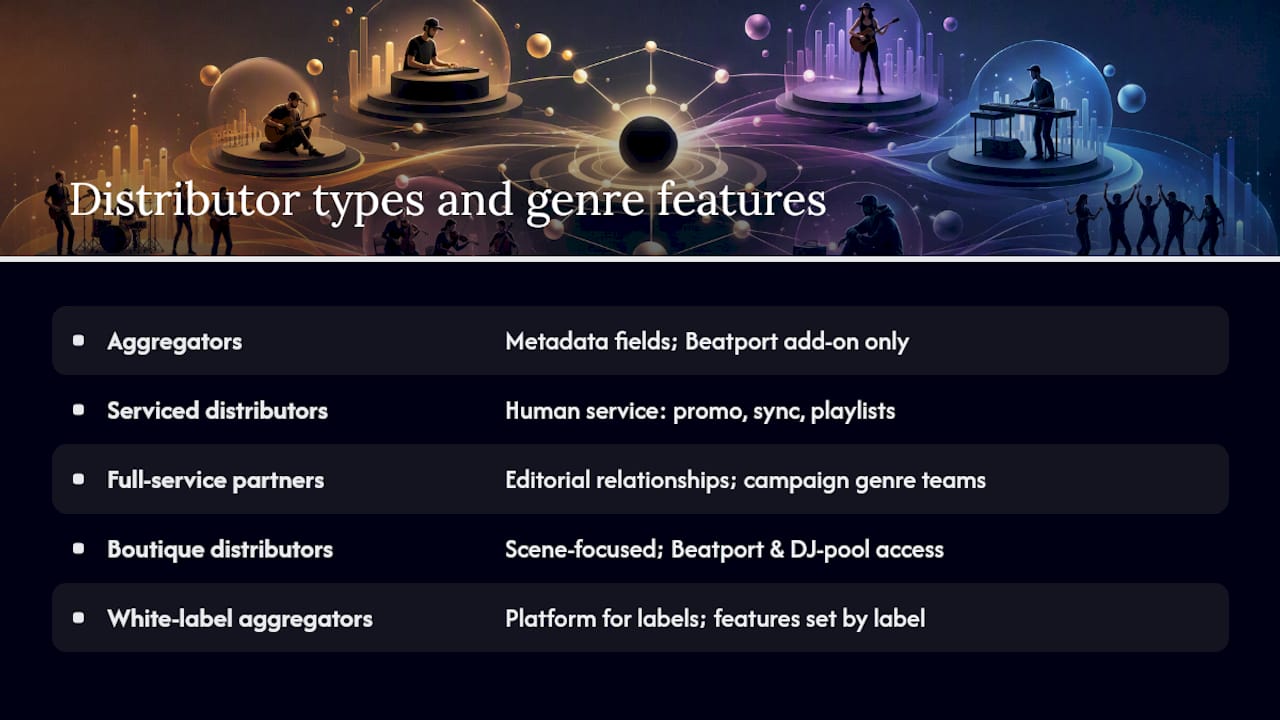
Aggregators (DistroKid, TuneCore, RouteNote, Amuse, Fresh Tunes, Record Union, SoundOn, MondoTunes, Soundrop, recordJet) handle DSP delivery at scale with minimal human involvement. Genre-specialist features at this tier are limited to metadata fields and, occasionally, Beatport delivery as a paid add-on. Speed and cost are the main advantages.
Serviced distributors / label-services partners (CD Baby, Ditto Music, EmuBands, Horus Music, LANDR, OneRPM, Symphonic) add a layer of human service: promotional tools, sync pitching, playlist pitching, and sometimes physical distribution. Genre-specialist features are more likely here because there is a team to support them.
Full-service / label partners (AWAL, The Orchard, Believe, PIAS, InGrooves, FUGA, Kontor New Media, Triple Vision) work with established artists and labels. They offer campaign-level genre marketing, editorial relationships, and often dedicated genre teams. Entry is selective.
Boutique / scene distributors (Label Worx, Cargo Records, Label Engine) are built around specific genres or scenes. Label Worx is the clearest UK-relevant example: it exists specifically to serve electronic and dance labels, with Beatport delivery and DJ pool access as core features rather than add-ons.
White-label / retail aggregators (FUGA, Label Engine) provide infrastructure for other labels and distributors. Genre-specialist features here are determined by the label using the platform.
Genre-specialists typically add the most value at the boutique and serviced-distributor tiers. Aggregators are fast and cheap but rarely have the scene relationships that make genre focus meaningful. Full-service partners have the relationships but are selective about who they work with.
Comparing UK-relevant distributors with genre-focused services
One nuance the table cannot show: Label Worx’s Beatport access typically requires a label account rather than a single-artist account. If you are releasing as an individual artist rather than a label, check their current account tiers before signing up. Similarly, PIAS and The Orchard operate on a selective basis; they do not accept open submissions in the way DistroKid or TuneCore do.
For electronic artists specifically, DJ-store access is critical and worth confirming directly with any distributor before committing a release.
Short profiles: what each featured distributor offers UK artists
DistroKid is the go-to for prolific self-releasers. Unlimited annual uploads at a flat fee, fast DSP delivery, and simple royalty splitting. Genre-specialist features are minimal: no Beatport delivery by default, no promo pools, no sync team. Use it for volume and speed, not scene credibility.
CD Baby has been around long enough to have physical distribution infrastructure that most newer aggregators lack. Sync licensing through CD Baby Pro is a genuine differentiator for artists in film, TV, or advertising-adjacent genres. Pay-per-release pricing suits artists who release infrequently.
TuneCore operates on a per-release model with broad DSP coverage. Its artist-focused dashboard is familiar and reliable. Genre-specialist features are limited, but its sync licensing arm (TuneCore Publishing Administration) is worth noting for songwriters in any genre.
Ditto Music is UK-based and offers label account features at subscription pricing. Chart registration (UK Official Charts) is included, which matters for UK artists tracking commercial performance. No Beatport delivery as standard.
AWAL is selective. If you get in, you get marketing support, editorial pitching, and A&R attention that aggregators cannot match. Best for artists who have already built an audience and need campaign-level support.
The Orchard is Sony-owned and operates at label scale. Deep catalogue monetisation, video distribution, and long-term platform relationships. Not for emerging artists; relevant for established labels and catalogue owners.
Believe has international scale and full-service options. Strong for artists targeting markets beyond the UK, particularly in continental Europe and Latin America.
PIAS has genuine indie-label heritage and European physical distribution reach. If your genre has a physical collector audience (post-punk, jazz, classical, metal), PIAS’s physical network is hard to match among independent distributors.
Symphonic is built for labels and managers who need reporting granularity. Its analytics dashboard is more detailed than most aggregators, and it has promotional services and DSP relationships that support genre-specific pitching.
Label Worx is the clearest example of a genre-specialist distributor in the UK market. Beatport delivery, Traxsource delivery, and DJ promo pool access are core features. If you run an electronic or dance label, this is the most purpose-built option on this list.

EmuBands is a Scottish-based distributor with a reputation for personal service.
Horus Music is Leicester-based and has built a solid reputation among UK independent artists. Broad DSP delivery, playlist pitching support, and label tools. Not genre-specialist in the way Label Worx is; however, its metadata support and UK-based team make it a strong generalist choice for UK artists across genres.
Cargo Records handles physical UK distribution for independent labels. If your genre has a vinyl or CD audience and you need indie retail placement in the UK, Cargo is one of the few remaining independent physical distributors with genuine retail relationships.
LANDR combines mastering and distribution in one subscription. The sync licensing feature is useful for artists in genres with sync potential (electronic, ambient, cinematic). Not a genre-specialist, but the mastering integration is a practical advantage for artists releasing frequently.
No genre-specialist features, but the free entry point makes it worth knowing for emerging artists testing the market.
Amuse is mobile-first with a free plan. Simple onboarding, no genre-specialist features. Useful for emerging artists who want to release without upfront cost.
OneRPM is strong in Latin American markets and has editorial relationships in those regions. Worth considering for UK artists targeting Spanish-speaking audiences.
Soundrop focuses on cover songs and collaborative releases. Useful for artists in genres where covers are commercially relevant (country, pop standards, jazz).
SoundOn is TikTok’s distribution arm. Relevant for artists in genres where TikTok discovery is a primary driver (pop, hip-hop, dance).
InGrooves is a Universal-owned label services partner. Selective, with strong DSP relationships and marketing support. Relevant for established independent labels.
FUGA provides white-label distribution infrastructure. Used by labels and distributors rather than individual artists.
Kontor New Media is Hamburg-based with strong electronic music credentials and European DSP relationships. Relevant for UK electronic labels with European ambitions.
Triple Vision specialises in electronic music distribution with Beatport delivery and DJ pool access. A European alternative to Label Worx for electronic and dance labels.
Label Engine provides label management and distribution infrastructure. Used by labels that want to run their own distribution operation.
Fresh Tunes, MondoTunes, Record Union, and recordJet are aggregators with standard DSP delivery and no genre-specialist features of note. They serve artists who prioritise low cost and simplicity over scene-specific services.
How to choose a genre-focused distributor
The right distributor depends on your goals, budget, and career stage. Here is a practical checklist.
Decision criteria:
- Platform reach: Does the distributor deliver to the DSPs your audience uses? For electronic artists, that means Beatport and Traxsource. For classical, it might mean Idagio or Primephonic. Verify the delivery list, not just the headline claim.
- DJ-store access: Is Beatport delivery included, or is it an add-on? Does it require a label account? Get this in writing before signing.
- Promo pools: Does the distributor have relationships with DJ pools (DJcity, Promo Only)? Ask for specifics, not generalities.
- Metadata quality: Does the distributor support subgenre tagging, mood tags, and ISRC assignment? Poor metadata is the most common reason tracks fail to surface in algorithmic playlists.
- Reporting granularity: Can you see stream counts by territory, by platform, and by track? Label Worx and Symphonic both offer more granular reporting than most aggregators.
- Payment cadence: Monthly, quarterly, or on a threshold? Monthly payments with a low threshold are better for cash flow.
- Contract terms: What are the notice periods? Who owns the masters? Are there minimum term commitments? Read the contract, not the FAQ.
- Territory and physical distribution: Does the distributor cover the territories where your audience is? If you need physical UK distribution, the list shortens to PIAS, CD Baby, EmuBands, and Cargo Records.
Questions to ask a distributor before signing:
- Which DJ stores do you deliver to, and is that included in my plan or an add-on?
- Do you have relationships with editorial curators at Spotify, Apple Music, or Beatport?
- What is your process for playlist pitching, and how do you handle genre-specific pitches?
- Do you have a sync team, and which genres or brief types do they focus on?
- What are your payment terms and minimum payout thresholds?
- What is the notice period to remove my catalogue?
Red flags:
- Opaque accounting with no track-level reporting
- Payment delays beyond 90 days with no explanation
- Clauses that assign any rights beyond distribution rights
- No UK or territory-specific support contact
- Promises of playlist placement (no distributor can guarantee this)
Pro Tip: Test a distributor with a single new release before migrating your catalogue. Check the delivery timeline, the accuracy of metadata on each DSP, and the quality of the first royalty statement. A distributor that gets the basics wrong on a test release will not improve with your full catalogue.
How we selected these examples and verified UK relevance
The distributors on this list were selected based on three criteria: explicit evidence of genre-specific services (DJ-store delivery, promo pools, niche storefronts, or scene-specific marketing), confirmed UK availability or UK-based operations, and publicly verifiable service information.
Verification steps used:
- Checked each distributor’s DSP delivery list against their published documentation
- Confirmed Beatport and Traxsource delivery claims against provider pages
- Cross-referenced UK availability against distributor terms and territory pages
- Used the Spotify for Artists provider directory to verify official provider status for key distributors
Readers can replicate these steps: visit each distributor’s website, check their DSP delivery list, and search the Spotify provider directory for their name. For Beatport delivery specifically, check whether the distributor is listed as an approved content partner on Beatport’s label portal.
The list is not exhaustive. New distributors enter the market regularly, and existing distributors change their service tiers. Treat this as a starting point for your own due diligence, not a final answer.
UK artists using genre-focused distributors: what the evidence shows
Concrete named case studies from UK artists using specific distributors are not publicly available in sufficient detail to cite reliably. What is documented is the pattern: electronic artists in the UK who have broken through on Beatport charts have almost universally used either a label with a Label Worx or Triple Vision relationship, or a boutique electronic label with its own Beatport account. The chart infrastructure at Beatport rewards consistent, genre-accurate releases from labels with established store relationships, not one-off uploads from aggregators.
For indie artists in the UK, EmuBands and Horus Music have both been cited in industry discussions as distributors that have supported artists to Official Charts eligibility, partly because both handle chart registration as part of their service. Chart registration matters for UK artists in genres where physical and streaming sales are tracked together (pop, rock, country).
The broader pattern, supported by IFPI’s reporting on streaming’s role in music revenue growth, is that streaming now drives the majority of recorded music revenue. That makes playlisting and algorithmic discovery the primary battleground for most genres, and it is precisely where genre-accurate metadata and targeted editorial pitching make a measurable difference.
How genre specialisation affects playlist pitching and sync licensing
Genre specialisation changes the quality of editorial pitching, not just the quantity. A distributor with a dedicated electronic music team knows that “Techno Bunker” on Spotify is curated differently from “Mint” or “Electronic Rising.” They know which Apple Music editors cover ambient versus club music. That knowledge translates into more targeted pitches and, over time, better placement rates.
For sync licensing, genre focus matters even more. Sync supervisors brief by mood, tempo, and genre. A distributor with a sync team that specialises in horror film soundtracks, for example, has relationships with supervisors who are actively looking for that content. A generalist sync team pitches everything to everyone and lands fewer placements per track.
Psyfeature’s model illustrates this clearly: a psy-trance-focused distributor delivers to over 150 DSPs including Beatport and Bandcamp, offers genre-specific analytics, and pitches to curators who cover psychedelic and underground electronic music. That is a fundamentally different service from uploading to DistroKid and hoping the algorithm finds your audience.
One important caveat: as one detailed distribution analysis notes, most distributors deliver to the same core DSPs, so genre specialisation rarely changes where your music lands. The difference is in how it is presented, pitched, and promoted once it gets there. Metadata accuracy, editorial relationships, and promo pool access are where genre-specialist distributors earn their fees.
How emerging artists can use genre-focus to grow their fanbase
The most effective approach for an emerging UK artist is to treat genre-focused distribution as one part of a release strategy, not the whole of it. Here is what that looks like in practice.
Start with a clear genre identity. Distributors can only pitch to genre-specific curators if your music has a clear genre home. Hybrid or experimental music is harder to pitch, not because it is less good, but because curators brief by genre. If your music sits between two genres, decide which community you want to build in first.
Use a genre-specialist distributor for your scene-facing releases and a fast aggregator for everything else. An electronic artist might use Label Worx for their club-focused EPs (Beatport delivery, DJ pools) and DistroKid for their ambient or experimental work. This hybrid approach, recommended by distribution specialists for electronic artists, gives you scene credibility where it matters and speed and cost efficiency everywhere else.
Prioritise metadata over marketing spend at the early stage. Correct genre tags, mood tags, subgenre labels, and ISRC codes cost nothing extra but significantly affect algorithmic discoverability. A track tagged accurately as “UK Garage” will surface in different algorithmic playlists than one tagged only as “Electronic.”

Build relationships with genre-specific blogs, playlist curators, and radio shows before your release date. A distributor can pitch to Spotify editorial, but independent curators and community playlists are often more accessible for emerging artists and can drive meaningful streams in niche genres.
Pro Tip: Before choosing a distributor, search for your genre on Beatport or Traxsource and look at which labels the top-charting tracks are on. Then find out which distributor those labels use. That is the fastest way to identify which distributor has real traction in your scene.
How genre-focused distributors tailor analytics for specific music styles
Analytics from a genre-specialist distributor look different from a standard aggregator dashboard. The differences are practical, not cosmetic.
Beatport-focused distributors like Label Worx provide chart position data alongside stream counts. For electronic artists, a Beatport chart position in a specific genre (Techno, Deep House, Drum and Bass) is a meaningful metric that a standard Spotify stream count does not capture. Knowing that a track peaked at number 12 in Beatport’s Techno chart tells you something about scene traction that 50,000 Spotify streams does not.
Symphonic’s reporting dashboard offers territory-level breakdowns and platform-level data that is more granular than most aggregators. For labels managing multiple artists across different genres, that granularity is the difference between knowing which releases are working and guessing.
Genre-specific analytics also affect release timing decisions. Electronic music releases typically perform best when timed to DJ purchasing cycles before major festivals or club nights. A distributor with genre-specific data can advise on release windows that maximise DJ-store chart impact. A generalist aggregator has no reason to know or care about that timing.
The practical implication: when evaluating a distributor’s analytics offering, ask for a sample report. Not a screenshot of the dashboard, but an actual report from a release in your genre. That will tell you more than any feature list.
The case for genre-focus is real, but it is often oversold
The conventional advice in most distribution guides is to pick the distributor with the lowest fees and the most DSPs. That advice is not wrong for artists who release pop or hip-hop, where Spotify and Apple Music are the primary discovery channels and editorial pitching is the main lever.
For artists in genres with their own ecosystem, that advice misses the point entirely. An electronic artist who ignores Beatport is leaving their primary commercial channel unserved. A metal artist who does not have a distributor with relationships in the metal press and sync market is missing the placements that build long-term catalogue value. A classical artist whose metadata is tagged generically rather than by period, instrumentation, and composer will not surface in the algorithmic playlists that drive classical streaming.
The problem is that genre-specialist services are often marketed with more confidence than the evidence supports. No distributor can guarantee playlist placement, chart positions, or sync deals. What a genre-specialist can do is increase the probability of those outcomes by pitching more accurately and building scene relationships over time.
The honest test: ask a distributor to name three artists in your genre that they have successfully pitched to editorial playlists or sync in the past 12 months. If they cannot name three, they are selling you a service they have not yet built.
A music video paired with genre-focused distribution multiplies your reach.
Genre-focused distribution gets your track to the right stores and curators. What it cannot do is give you a visual asset that works on YouTube, Instagram Reels, or TikTok, where a significant portion of genre discovery now happens, particularly for electronic, hip-hop, and indie music.

Musicvideomarketplace gives you a ready-made, human-crafted music video you can customise in minutes: upload your audio, add your branding, export a YouTube-ready long-form video, and generate short clips for social media. For an electronic single going to DJ pools via Label Worx, a short club-focused video ad on YouTube Shorts can drive algorithmic traction that reinforces the Beatport push. The role of YouTube in music distribution is well documented: a strong visual presence on YouTube supports streaming discovery across platforms, not just on YouTube itself.
You do not need an agency or a production budget. Browse the video catalogue at Musicvideomarketplace, pick a template that fits your genre, and have a campaign-ready asset the same day you submit to your distributor.
Sources
- Best music distribution service: how to choose the right platform
- Best distribution for electronic artists (Orphiq)
- Psyfeature — music distribution for psychedelic and underground electronic music
- The riches are in the niches (Distribution Team)
- Spotify for Artists — providers directory
- IFPI global music report 2019
Recommended
- Tipps für Musikdistribution: Dein Leitfaden 2026 | Music Video Marketplace Blog
- Label digital asset organisation checklist for UK labels | Music Video Marketplace Blog
- Music distribution explained: how to get your songs heard | Music Video Marketplace Blog
- Why labels invest in video content: a label marketer’s guide | Music Video Marketplace Blog
Read next
 7 Inspiring Examples of Viral Music Videos for ArtistsDiscover 7 exciting examples of viral music videos and learn practical tips to boost your YouTube engagement as an independent musician or emerging artist.
 Explainer content for musicians: engage and growDiscover the power of explainer content for musicians. Engage your audience and grow your following with creative, accessible video solutions.
 Create standout explainer videos for your record labelDiscover how independent musicians and record labels can create standout explainer videos using AI tools and proven strategies, without a big budget.
 Distributor artist onboarding: examples, templates and checklistsDiscover effective distributor artist onboarding processes with copy-paste templates, checklists, and a practical timeline to streamline your workflow.
Turn the idea into a finished music video.
Drop your track into the Workspace and build your visual in minutes.