
 Open Workspace
Music video ad campaign templates for UK indie artists
Explore effective music video ad campaign templates for UK indie artists, boosting visibility and engagement across platforms like YouTube and TikTok.

Music video ad campaign templates for UK indie artists
In the context of independent music promotion, “distributor partner programme campaigns” means something specific: ready-made, YouTube-ready music videos paired with a structured ad campaign you can buy, customise and run within days. Not channel-partner recruitment. Not B2B reseller incentives. These are video-led promotional campaigns for a single song, built around a long-form music video and a set of derived short clips, run across YouTube, Instagram Reels, TikTok and Meta.
Here are four campaign types that UK indie artists actually use:
- YouTube awareness push: long-form video as a skippable in-stream ad targeting similar-artist audiences
- Pre-save conversion campaign: 15-second teaser clip driving traffic to a smart link before release day
- Shorts-led discovery: vertical clips posted across TikTok/Reels/YouTube Shorts in the two weeks before the single drops
- Stream-conversion campaign: post-release ads pointing to Spotify and Apple Music landing pages
The minimum asset set for any of these: one long-form video (3–5 minutes), three to five 15–30 second vertical clips, a custom thumbnail, captions, and a pre-save or streaming smart link. A realistic starter budget for a UK indie campaign sits around £5–£15 per day for the first two weeks.
Pro Tip: Set up your YouTube Premiere before you run a single pound of paid ads. The Premiere page itself is a shareable, linkable destination that warms up your audience before the video goes live.
Key takeaways
Ready-made music video campaigns work best when the long-form video, short clips and ad setup are treated as a single workflow from day one, not three separate tasks.
Table of Contents
- What do real distributor partner programme campaigns look like?
- How does a 6-week campaign calendar actually work?
- What should your creative brief include before buying a video?
- How do you buy, export and clear rights for a ready-made video?
- How do you set up UK-targeted YouTube and social ads?
- How do you measure whether your campaign is working?
- What should you check before pressing go?
- Why bundling video production and ad launch in one workflow changes outcomes
- Ready to buy your video and launch your first campaign?
- Sources
What do real distributor partner programme campaigns look like?
Four templates, ready to copy. Each maps to a campaign objective, platform, asset list and budget band.
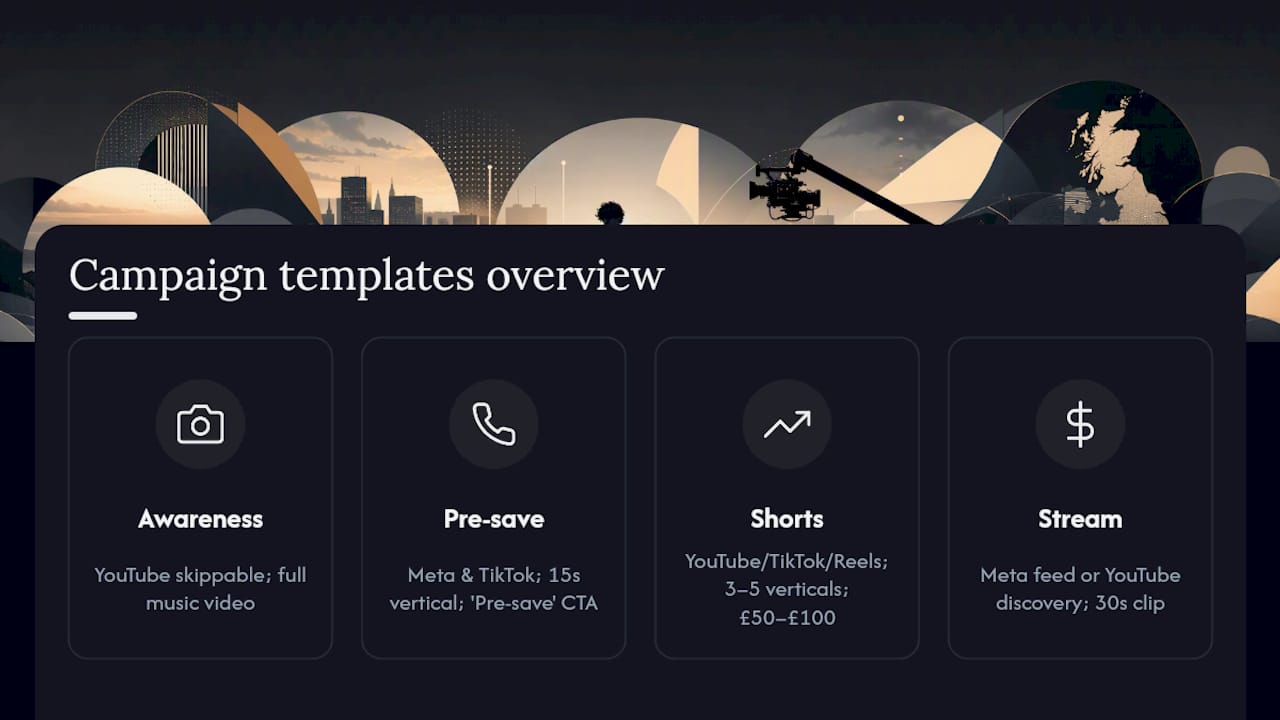
Template 1: Awareness push. Run a skippable in-stream ad on YouTube using the full music video. Target custom audiences built from people who searched for similar artists. Hook within the first five seconds: a visual or lyric that stops a scroll. Best for: artists releasing into an established genre with clear reference points.

Template 2: Pre-save conversion. A 15-second vertical clip, punchy hook in the first two seconds, ending on a clear call-to-action: “Pre-save now, link in bio.” Run on Meta and TikTok in the seven days before release. KPI: cost per pre-save click. Best for: artists with an existing small following who want to convert warm listeners.
Template 3: Shorts-led discovery. Post three to five short vertical clips across YouTube Shorts, TikTok and Instagram Reels in the fortnight before the single. No paid budget required to start, though a small boost (£50–£100) on the best-performing clip accelerates reach. KPI: profile visits and new followers. Best for: artists with no existing video presence who need organic traction first.
Template 4: Stream conversion. Post-release, run a 30-second clip as a Meta feed ad or YouTube discovery ad pointing to a streaming smart link. KPI: cost per stream click. Best for: artists whose track is already live and who want to sustain momentum beyond launch week.
According to YouTube ad guidance for musicians, skippable in-stream is the recommended starting format because it only charges when a viewer watches past 30 seconds, keeping costs predictable for indie budgets.
How does a 6-week campaign calendar actually work?
The six-week single rollout is standard practice for UK indie artists. The music video is usually released a few weeks before the single to build anticipation and allow the algorithm time to index it.
- Week 1: Finalise and export the long-form video. Cut 5–7 short vertical clips (15–30 seconds each). Set up the YouTube channel, thumbnail, description and smart links. Do not publish anything yet.
- Week 2: Schedule the YouTube Premiere for the end of this week. Post the first teaser clip on TikTok and Reels. Activate collaborator shares on premiere day and engage in the live chat to build early velocity.
- Week 3: The video is live. Start the awareness ad campaign (£5–£10/day). Post a second short clip mid-week. Share behind-the-scenes content on Stories.
- Week 4: Single release day. Switch ad objective from awareness to stream conversion. Post a third short clip. Send to your mailing list with a streaming link.
- Week 5: Sustain with a fourth clip, a performance or acoustic version if available, and a boosted Meta post. Monitor view rate and adjust targeting if below 15%.
- Week 6: Final push. Post the fifth clip. Run a short retargeting campaign to people who watched more than 50% of the video. Review all KPIs and document what worked.
Cutting the main video into multiple 15–30 second clips and engaging actively in the first 24 hours of a Premiere both improve YouTube’s algorithmic recommendation signals. Spacing clips across the six weeks keeps the song in feeds without burning out your audience in a single day.
Pro Tip: Export your short clips in 9:16 vertical format at 1080×1920 pixels. A clip that needs reformatting before posting costs you momentum at the worst possible moment.
What should your creative brief include before buying a video?
Buying a ready-made video without a proper brief is how you end up with something that looks great but fits your song like a borrowed coat. Supply these fields before purchase:
- Genre and subgenre (e.g. UK garage, lo-fi indie pop, Afrobeats)
- Mood (e.g. melancholic, euphoric, gritty, cinematic)
- Visual style (e.g. performance-led, narrative, abstract, lyric-driven)
- Instruments featured (matters for performance-style videos)
- “If you like” artists (give 3–5 reference artists whose visual aesthetic matches)
- Cultural context (UK regional references, community, language)
- Promo plans (release date, platforms, whether ads are planned)
Optional but useful: tour dates, press mentions, collaborator handles and any existing brand colours or logo files.
A short template you can copy:
- Genre/subgenre:
- Mood (3 words max):
- Visual style:
- “If you like” artists (3–5):
- Release date:
- Platforms:
- Paid ads planned? Y/N
How do you buy, export and clear rights for a ready-made video?
- Browse the Musicvideomarketplace catalogue and shortlist two or three videos that match your brief.
- Upload your audio file and any branding assets (logo, colour palette).
- Select a licence tier: single-use, multi-platform or full commercial.
- Complete checkout and download the exported YouTube-ready file.
- Generate short social clips from the platform’s clip tool.
- Confirm rights clearance before running paid ads.
File specifications for ad platforms:
Licensing checklist before running UK ads:
- Commercial sync licence confirmed (covers audio + visual combination in ads)
- Territorial rights cover the United Kingdom
- Performance rights cleared (PRS for Music registration checked)
- Ad platform terms reviewed (YouTube and Meta both require rights confirmation at campaign setup)
Pro Tip: Download a separate caption/subtitle file (.SRT) at export. YouTube and Meta both reward captioned videos with higher completion rates, and it takes two minutes to upload.
How do you set up UK-targeted YouTube and social ads?
YouTube ad formats and when to use each:
- Skippable in-stream: best for awareness; charges only after 30 seconds watched
- Non-skippable bumper (6 seconds): best for retargeting warm audiences
- Discovery ads: thumbnail + headline in YouTube search results; good for genre-specific searches
- YouTube Shorts ads: vertical, 15–60 seconds; best for reaching younger UK audiences
Targeting recipes for UK indie campaigns:
- Custom intent audience: people who searched for similar artists on YouTube in the past 30 days
- Placement targeting: music channels and playlists in your genre
- Geographic layering: start with the UK nationally, then narrow to cities where you have existing fans (check YouTube Analytics)
- Interest layering: music fans + specific genre interests
Budget bands:
Custom audiences built from similar-artist searchers consistently outperform broad demographic targeting for indie music campaigns. Start narrow and expand only when the data supports it.
How do you measure whether your campaign is working?
KPIs to track from day one:
- View rate: percentage of people who watched past the skip point (target: above 15%)
- Average view duration: aim for above 30 seconds or 50% of video length
- CTR (discovery ads): aim above 2%
- Cost per view: typical range for indie campaigns is £0.01–£0.05
- Pre-save clicks and stream conversion clicks (tracked via smart link analytics)
If metrics miss targets:
- View rate below 15%: recut the hook. The first five seconds are losing people.
- CTR below 2%: test a new thumbnail or headline.
- High views, low stream clicks: the landing page or smart link is the bottleneck.
A simple A/B test plan:
- Run two creative variants (different hooks) with identical targeting and equal budget for seven days.
- Pause the underperformer. Run two audience variants (custom intent vs. interest-based) for another seven days.
- Scale the winning combination with the sustain-phase budget.
The Musicians’ Union’s promotion guidance reinforces that maintaining a consistent online profile across platforms amplifies paid ad results rather than competing with them.
What should you check before pressing go?
File and metadata:
- Captions/subtitles uploaded to YouTube
- Custom thumbnail uploaded (1280×720 pixels minimum)
- Description includes smart links to pre-save or streaming platforms
- Tags include genre, artist name and song title
- Video added to a relevant playlist
Ad account and tracking:
- Ad account linked to the correct YouTube channel or Meta page
- Landing page tested on mobile (most UK listeners click from mobile)
- Conversion pixel or smart link tracking confirmed live
- Ad creative approved by platform (allow 24–48 hours)
Pro Tip: Test your smart link on three different devices before launch. A broken pre-save link on release day is the single most avoidable campaign failure.
Why bundling video production and ad launch in one workflow changes outcomes
The gap between finishing a music video and actually running ads with it is where most indie campaigns stall. Artists spend weeks on production, then face a separate technical process to export ad-ready files, cut short clips, set up tracking and configure ad accounts. Each handoff is a point where momentum dies.
Packaging video production and ad launch together removes that gap. When the export step produces YouTube-ready files, vertical clips and caption files simultaneously, the campaign can go live within hours of purchase rather than days. The Musicvideomarketplace and KIFFIX® integration addresses exactly this handoff, connecting the creative output directly to the promotional workflow so nothing falls through the gap between production and campaign activation.
The six-week cadence only works if the assets are ready at the start of week one. A video that arrives in week three compresses the entire schedule and forces shortcuts on targeting and testing.
Ready to buy your video and launch your first campaign?
Skip the production queue. Musicvideomarketplace gives UK indie artists and managers a faster route from song to live ad campaign: browse a catalogue of human-made, full-length music videos, upload your audio, export a YouTube-ready file and generate vertical social clips in a single workflow. No agency retainer. No waiting weeks for a production house to deliver.

Browse creative campaign examples to find a visual style that fits your track, then follow the six-week cadence in this article to build your ad campaign around it. Licence options cover single-use through to full commercial, so the asset works across YouTube, Meta and TikTok without separate rights negotiations.
Browse the Musicvideomarketplace catalogue and have your first ad-ready video exported today.
Sources
- YouTube ads: how musicians can use video ads to grow listeners (Orphiq)
- How to Promote a Music Video in 2026: From Zero Views to Viral | NotNoise
- Music Marketing | Marketing & Promotion As A Musician | The MU
Recommended
- Creative video campaign examples for independent musicians | Music Video Marketplace Blog
- YouTube ad campaigns for indie musicians: a clear guide | Music Video Marketplace Blog
- Video Ads in Music Promotion: Power for Indies | Music Video Marketplace Blog
- Music Video Marketing Guide for Independent Musicians | Music Video Marketplace Blog
Read next
 Smart bidding para anuncios de música: qué estrategia elegirDescubre cómo utilizar Smart Bidding en anuncios de música para optimizar tus campañas y alcanzar mejores conversiones. ¡Mejora tus resultados ahora!
 Audio video maker para músicos: guía práctica de licenciasDescubre cómo un audio video maker te ayuda a lanzar tus canciones en YouTube Ads. Aprende a elegir licencias y preparar tus materiales. ¡Actúa hoy!
 Cuánto cuestan los anuncios de YouTube en Reino UnidoDescubre cuánto cuestan los anuncios de YouTube en el Reino Unido. Conoce factores clave como formato, segmentación y calidad creativa.
 Ad-Kampagnen für Musiker: Praxisleitfaden für DIY-ArtistsEntdecke, was Ad-Kampagnen für Musiker sind und wie sie dir helfen, deine Streams und Follower gezielt zu steigern. Starte jetzt durch!
Turn the idea into a finished music video.
Drop your track into the Workspace and build your visual in minutes.