
YouTube ad campaigns for indie musicians: a clear guide
Learn how YouTube ad campaigns work for independent musicians. Discover campaign types, targeting tips, and how to promote your music on a realistic budget.

YouTube ad campaigns for indie musicians: a clear guide
TL;DR:
- YouTube ad campaigns are accessible tools for independent musicians to reach targeted audiences.
- Campaigns involve selecting objectives, targeting parameters, budgets, and ad formats to grow audiences.
- Consistent, optimized campaigns focus on quality engagement rather than just high view counts.
Many independent artists assume YouTube ad campaigns are the exclusive territory of major labels with deep pockets. That assumption is costing you listeners. A YouTube ad campaign is simply a paid video promotion run through Google Ads, and it is far more accessible than most indie musicians realise. Whether you have released your first single or your fifth album, understanding how these campaigns work gives you a genuine competitive edge. This guide walks you through exactly what a YouTube ad campaign is, how it is structured, and how you can use one to grow a real audience around your music.
Table of Contents
- What is a YouTube ad campaign?
- Key components of a YouTube ad campaign
- Standard vs smart video campaigns: what’s the difference?
- How YouTube ad campaigns drive music promotion
- Tips for indie musicians: setting up your first campaign
- What most indie musicians miss about YouTube ad campaigns
- Next steps: promote your music with expert support
- Frequently asked questions
Key Takeaways
| Point | Details |
|---|---|
| YouTube campaigns explained | A YouTube ad campaign lets musicians pay to showcase their music videos to targeted audiences using video ads. |
| Essential campaign elements | You need to decide your goal, who you want to reach, your budget, and the ad format to get started. |
| Manual vs Smart setup | Manual (standard) campaigns give more control, while Smart campaigns automate much of the setup with Google’s help. |
| Growth for indie artists | YouTube ad campaigns can boost video views, fan engagement, and channel subscribers, even with modest budgets. |
| Easy first steps | Indie musicians can start small, test, and refine campaigns to find out what works best for their music. |
What is a YouTube ad campaign?
At its core, a YouTube ad campaign is a paid strategy with a defined goal, targeting parameters, budget, and ad format designed to engage specific users on the platform. Think of it as renting a billboard, except you choose who walks past it, how often they see it, and what they do next.
For musicians, this means you can place your music video in front of people who already listen to artists similar to you, watch live performance content, or search for new music in your genre. You are not broadcasting to everyone and hoping for the best. You are speaking directly to people who are already primed to care.
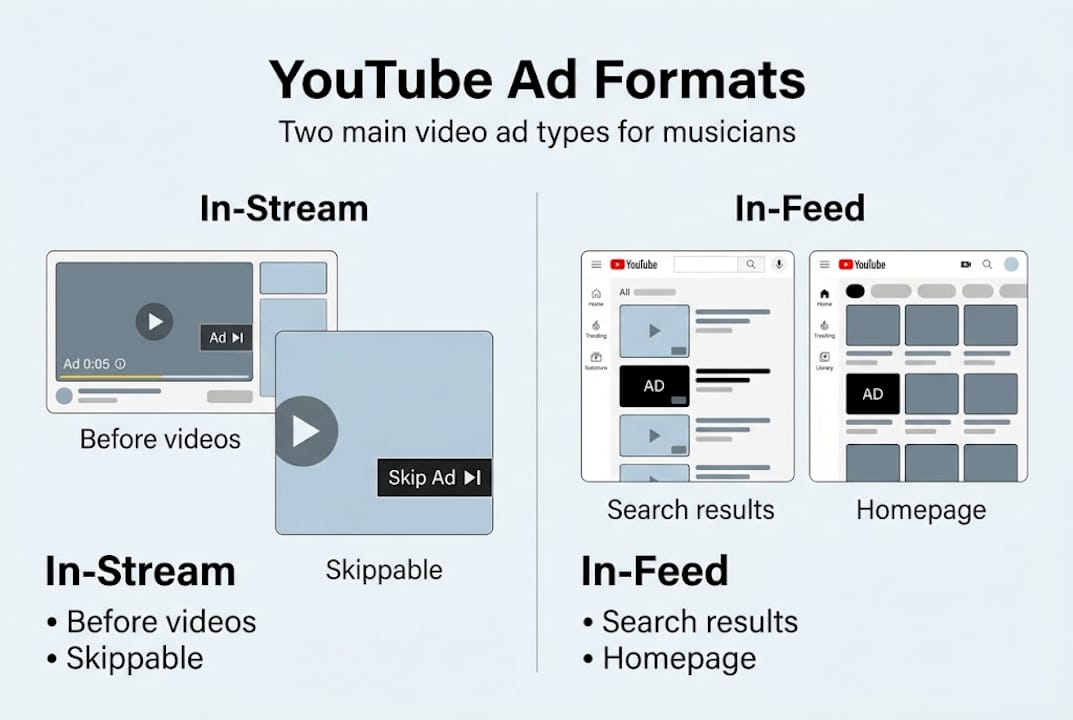
YouTube ad campaigns are managed through Google Ads. The most relevant campaign type for artists is the Video campaign, which allows you to run video ads across YouTube and Google video partners. These ads appear in two main formats:
- In-stream ads: Play before or during another video. Viewers may skip after five seconds.
- In-feed ads: Appear in YouTube search results and alongside suggested videos.
Some YouTube campaign examples show how artists have used both formats to build substantial audiences from a standing start.
A common misconception is that YouTube ads are just for selling products. For musicians, they are one of the most direct ways to connect your music with people who are ready to listen.
Key components of a YouTube ad campaign
A campaign setup involves five core decisions: objective, targeting, bidding, budget, and ad format. Each one shapes how effectively your music reaches new ears.
Here is how each element works in practice for musicians:
| Campaign element | What it means for you |
|---|---|
| Objective | The goal: views, awareness, website traffic, channel growth |
| Targeting | Who sees your ad: location, age, interests, music taste |
| Bidding | How you pay: per view (CPV) or per thousand impressions (CPM) |
| Budget | Daily or total spend cap you control |
| Ad format | In-stream, in-feed, or bumper ads |
Targeting is arguably the most powerful component for indie musicians. You can narrow your audience by genre interest, specific YouTube channels they watch, or even keywords they have searched. This precision is what separates a campaign that builds a loyal fanbase from one that burns through your budget with nothing to show.

Different video ad formats for musicians suit different goals. In-stream works well for new releases where you want maximum visibility. In-feed ads are better when you want curious listeners to actively choose to watch your content.
Understanding the advantages of YouTube music ads also helps you see why this platform is particularly well suited to music promotion compared to social media alternatives.
Pro Tip: Set your daily budget to a modest amount when starting out, such as five to ten pounds. This gives the algorithm enough room to learn your audience without committing to a large spend before you know what works.
Standard vs smart video campaigns: what’s the difference?
Not all YouTube campaigns are built the same way. There are two primary setups available, and choosing the right one depends on your experience level and how much control you want.
Standard campaigns give you full manual control over targeting, keyword lists, bidding strategies, and placements. Smart campaigns automate much of this using Google’s AI, making decisions about who to show your ads to based on your goal and creative content.
Here is a direct comparison:
| Feature | Standard campaign | Smart campaign |
|---|---|---|
| Targeting control | Full manual control | Automated by Google AI |
| Setup complexity | Higher | Lower |
| Bidding options | Multiple manual strategies | Automated |
| Best for | Experienced advertisers | Beginners |
| Optimisation | Manual review required | Self-optimising |
For video ads for indie musicians just getting started, Smart campaigns reduce the learning curve significantly. You upload your video, set a goal, define a budget, and let the system run. The trade-off is reduced transparency into exactly who is seeing your ads.
Standard campaigns reward musicians who are willing to learn. You can target fans of specific artists, exclude irrelevant audiences, and test different bidding strategies to reduce cost per view over time.
- Standard campaigns work best when you have a clear sense of your audience and want to refine targeting over multiple campaigns.
- Smart campaigns are ideal for a first release when you are still discovering who your listeners are.
Pro Tip: Start with a Smart campaign to gather data on which demographics engage most. Then use those insights to build a more targeted Standard campaign for your next release.
How YouTube ad campaigns drive music promotion
A well-run ad campaign can drive views, engagement, subscribers, and genuine awareness for your music release. But what does that look like in practice?
Here is the typical promotional journey for an indie release using YouTube ads:
- Upload your music video to your YouTube channel, fully optimised with a strong title, description, and tags.
- Launch a targeted campaign focused on users with interests matching your genre and listening habits.
- Accumulate early views that signal to YouTube’s algorithm that your video is worth surfacing organically.
- Convert viewers into subscribers through compelling content and a clear call to action within the video.
- Monitor performance data to see which audience segments engage most deeply.
- Refine targeting based on real results, lowering cost per engaged viewer over time.
This cycle is what separates musicians who grow steadily from those who upload and wait. Following music video ad best practices ensures your ad creative holds attention long enough to make an impression.
It is also worth investing time in video engagement tips so your content encourages viewers to watch longer, subscribe, and share. Engagement signals directly influence how YouTube rewards your video with organic reach.
The promotional lifecycle does not end at launch. Successful musicians treat each campaign as an ongoing conversation with their audience, not a one-time announcement.
Tips for indie musicians: setting up your first campaign
Knowing what is possible, the next step is actually building your first campaign. Here is a streamlined process to get started without feeling overwhelmed.
- Create or prepare your video. Your ad needs a hosted YouTube video. A compelling music video or lyric video works well. Quality matters, but authenticity matters more.
- Set up a Google Ads account. Link it to your YouTube channel. This is free and takes only a few minutes.
- Choose your campaign goal. For music promotion, select “Product and brand consideration” or “Brand awareness and reach” depending on whether you want views or impressions.
- Select your ad format. In-stream works for new releases; in-feed suits discovery-focused campaigns.
- Define your targeting. Choose locations, age ranges, and audience interests aligned with your genre. Use music content targeting strategies to refine your reach.
- Set your budget. YouTube campaign setup lets you define a daily spend, keeping costs predictable.
- Launch and monitor. Review performance every two to three days in the first week. Pause underperforming placements and increase spend on what works.
Pro Tip: Do not judge a campaign in the first 48 hours. The algorithm needs time to learn. Give it at least five to seven days before making significant changes.
For musicians managing distribution alongside ads, reviewing YouTube music distribution tips can help you align your release schedule with campaign launch timing for maximum impact.
What most indie musicians miss about YouTube ad campaigns
Here is an uncomfortable truth: most indie musicians who try YouTube ads either give up too early or obsess over the wrong numbers. Views feel exciting. They are visible. But a thousand views from disengaged listeners is worth less than a hundred views from people who add your track to a playlist and follow your channel.
The artists who see real returns from campaigns are consistent and patient. They are also ruthlessly honest about targeting. Broad targeting might inflate your view count, but tight targeting grows a real fanbase. That is a meaningful difference.
Campaigns are not a switch you flip once. They need regular review and adjustment. Genre trends shift, audience behaviours change, and what worked in January may underperform in April. The musicians who treat campaigns as a learning process rather than a vending machine are the ones building something lasting.
If growing your music audience is your genuine goal, shift your attention from chasing virality to nurturing consistent engagement. Long-term audience building always outperforms the overnight spike.
Next steps: promote your music with expert support
Understanding the mechanics of YouTube ad campaigns is one thing. Putting them into action with the right creative and strategy behind you is another.

At Music Video Marketplace, we help independent musicians create long-form videos in minutes, ready to upload to YouTube and power a full ad campaign for their song. From creating your video asset to setting up and optimising your campaign, we cover every stage of the process. If you are ready to explore music video promotion and get your music in front of real listeners, we are here to make that happen. Learn more about the video promotion power available to independent artists today.
Frequently asked questions
Do I need a big budget to run a YouTube ad campaign as an indie musician?
No. You set your own budget and daily spend limits, meaning even a few pounds a day is enough to run a meaningful campaign and reach new listeners.
What is the difference between in-stream and in-feed video ads?
In-stream and in-feed formats serve different purposes: in-stream ads play before or during videos, while in-feed ads appear in search results and suggested video sections on YouTube.
Can a YouTube ad campaign help grow my music channel’s subscribers?
Absolutely. Ad campaigns can increase both video views and subscriber counts when your targeting is well defined and your content gives viewers a compelling reason to follow your channel.
Is Google Ads required for all YouTube ad campaigns?
Yes. Every YouTube ad campaign, including simplified Smart campaigns, is managed via Google Ads, which you link directly to your YouTube channel during setup.
Recommended
- YouTube ad campaign examples for musicians: proven strategies | Music Video Marketplace Blog
- Video Ads in Music Promotion: Power for Indies | Music Video Marketplace Blog
- Guide to YouTube music uploads for indie artists 2026 | Music Video Marketplace Blog
- Music ad campaigns: expert strategies for real results | Music Video Marketplace Blog
Read next
 YouTube ad specs 2026: the complete technical checklistMaximize your video impact with essential YouTube ad specs for 2026. Understand resolution, format, and length to boost your campaign.
 6 Key Advantages of YouTube Music Ads for MusiciansExplore 6 major advantages of YouTube music ads for independent musicians and learn practical tips to boost your song promotion and audience reach.
 ASA Music Advertising Rules: A UK Guide for Artists and LabelsWhat the ASA and the CAP Code expect from UK music ads: spotting #ad labels, targeting, offence, claims and YouTube video campaigns, explained for artists.
 Why use video ads to grow your music audienceDiscover why video ads are the most cost-effective way for musicians to build genuine fanbases on YouTube through strategic targeting and emotional engagement.
Turn the idea into a finished music video.
Drop your track into the Studio and build your visual in minutes.