
 Try the Workspace
Label roster promotion checklist: the complete campaign guide
Boost your music release with this essential label roster promotion checklist and a strategic week-by-week campaign timeline.

Label roster promotion checklist: the complete campaign guide
A single, well-structured label roster promotion checklist, paired with a week-by-week campaign timeline, is what separates a professional release from a scramble. Here is the short version you can act on immediately.
Core checklist items for every release:
- Audio master (WAV, 24-bit/48kHz), stems and ISRC/UPC registered
- Artwork (3000×3000px JPEG/PNG, RGB), social crops and video thumbnail
- Electronic press kit (EPK): short bio, long bio, hi-res photos, listening link, press coverage links, contact details
- Full-length music video and at least two vertical short-form edits (9:16, under 60 seconds)
- DSP profiles verified (Spotify for Artists, Apple Music for Artists, YouTube Music)
- Pre-save link live and promoted
- PR pitch sent to editorial and radio contacts
- Paid-ad creative ready (Meta and YouTube)
- Measurement plan: KPIs set, dashboard built, UTM links active
High-level timeline:
Start asset preparation 8–12 weeks before release. Submit editorial pitches around 8 weeks out, typically through Spotify for Artists. weeks out. Begin PR and radio outreach about 5–6 weeks before release. weeks out. Launch social teasers 4 weeks out. Execute the full release-week push. Spend 2–4 weeks post-release reusing coverage, running retargeting ads and reporting. Foundational tasks including complete artist profiles, an EPK and professional assets are prerequisites before any distribution or promotion begins.
Immediate owners:
- Label manager: asset delivery, distribution, budget sign-off
- Artist manager: artist-facing coordination, social content scheduling
- Press contact: PR pitching, radio plugging, editorial follow-ups
Key takeaways
A complete label roster promotion checklist, built around a 12-week timeline and a single measurable objective per release, is the most reliable framework for independent labels running professional campaigns with limited resources.
| Point | Details |
|---|---|
| Start 8–12 weeks out | Deliver masters to your distributor and submit the Spotify editorial pitch before any outreach begins. |
| PR and playlist outreach at weeks 5–6 | Send press pitches and curator emails with enough lead time for editors to respond before the release date. |
| Short-form video drives discovery | TikTok, Reels and YouTube Shorts are the primary discovery channels; build your content bank before the campaign launches. |
| One measurable objective per release | Concentrate budget and creative tests on a single KPI rather than spreading spend across every channel simultaneously. |
| Musicvideomarketplace speeds up production | Browse ready-to-edit full-length videos and short-form cuts to cover the video asset line items on your checklist without a lengthy production brief. |
Table of Contents
- What does a label roster promotion checklist cover?
- Asset-by-asset breakdown: what editors and DSPs actually expect
- What does a week-by-week campaign schedule look like?
- How do you pitch editors, radio and playlist curators effectively?
- Where should you focus social content and ad spend?
- How do you handle distribution and pre-saves correctly?
- Which KPIs actually matter and how do you reuse coverage?
- Where should a small label spend its budget first?
- Technical delivery specs for UK releases
- Ready-to-use templates: EPK, launch-day run sheet and social captions
- How do long-form YouTube assets power your ad funnel?
- What do successful small labels actually do differently?
- Get your release assets production-ready with Musicvideomarketplace
- Sources
What does a label roster promotion checklist cover?
A compact, repeatable checklist prevents the avoidable errors that cost placements: a missing ISRC, a low-resolution artwork file, a Spotify pitch submitted too late. Use the three phases below for every artist on your roster.
Pre-release essentials
- Audio master delivered to distributor (WAV, 24-bit/48kHz minimum)
- ISRC assigned per track; UPC assigned per release
- EPK complete and hosted at a shareable URL
- Spotify editorial pitch submitted via Spotify for Artists (at least 8 weeks before release date)
- Pre-save link live and shared across all channels
- Distribution confirmed: release date locked, territories selected, metadata approved
- Artwork approved by distributor (3000×3000px, sRGB, under 10MB)
- Press and radio outreach sent (5–6 weeks before release)
- Social content bank scheduled (teasers from 4 weeks out)
- Paid-ad creatives approved and campaigns set up in draft
Release-day essentials
- All assets published and live across DSPs
- Email blast sent to mailing list (pre-save converts to stream link)
- Social push: organic posts, Stories, Reels/Shorts/TikTok live
- Paid campaigns activated (Meta, YouTube)
- YouTube video published with full metadata, chapters and end screens
Post-release essentials
- Streams, saves, playlist adds and ad performance reviewed at 48–72 hours
- Editorial coverage shared across socials and email
- Quote graphics and short clips cut from coverage and interviews
- Follow-up pitches sent to outlets that did not respond initially
- Monthly reporting compiled: KPIs vs targets, spend vs result, learnings for next release
Owner and deadline columns (adapt to your project management tool):
Asset-by-asset breakdown: what editors and DSPs actually expect
Getting a placement rejected because of a wrong file format or a missing credit is one of the most preventable problems in music promotion. Here is what each asset requires.
Audio
Deliver your master as a WAV file at 24-bit/48kHz (some distributors accept 44.1kHz; confirm with yours). Loudness target: integrated loudness of around -14 LUFS for streaming, with a true peak no higher than -1 dBTP. Keep stems organised by instrument group (drums, bass, synths, vocals) in a clearly named folder. Register your ISRC with PPL UK before distribution. Your UPC is typically assigned by your distributor, but confirm it is correct on every platform after delivery.
Visual assets
Full-length music video: deliver as H.264 or H.265 MP4, minimum 1920×1080px (1080p), ideally 4K (3840×2160px). YouTube requires a 16:9 master. Short-form vertical edits: 1080×1920px (9:16), under 60 seconds for Reels and Shorts, under 3 minutes for TikTok long-form. Thumbnails: 1280×720px JPEG, under 2MB, with crop-safe text kept within the central 80% of the frame. Add closed captions (SRT file) to all YouTube uploads.
Press and EPK
Editorial coverage provides enduring, searchable context that lasts beyond any single social post. Your EPK should include:
- Short bio (100 words): artist name, genre, key release, one memorable fact
- Long bio (300–400 words): story, influences, previous coverage, touring history
- Hi-res press photos (minimum 300 DPI, JPEG, at least three images)
- Listening link (private SoundCloud or Dropbox, never a file attachment)
- Links to previous press coverage
- Contact name, email and phone for the press contact
Smaller, genre-specific outlets are often more accessible than major titles and carry genuinely engaged audiences. One strong niche placement can open doors to larger outlets on the next release, so targeting Tier 2 and Tier 3 editorial is a smart early move for independent labels.
Social content bank
Prepare at minimum: two 15–30 second audio snippets with captions, one behind-the-scenes clip from recording or video shoot, one lyric or quote graphic, and three caption templates (announcement, release day, post-release repost of coverage). Hashtag strategy: use three to five genre-specific hashtags plus one location tag per post; avoid stacking 30 generic hashtags, which suppresses reach on Instagram.
Merch and commerce assets
Product photos: minimum 2000×2000px, white or neutral background, multiple angles. Confirm SKUs, fulfilment window (allow 3–4 weeks for print-on-demand), and that your online store URL is live before release week.
Legal clearances
- Publishing splits confirmed and registered with PRS for Music and MCPS
- Sample clearances obtained in writing before distribution
- Sync licences in place for any third-party footage in the video
- All featured artist, producer and co-writer credits confirmed and formatted correctly for metadata
Pro Tip: Keep a single master folder per release with a consistent naming convention: ARTISTNAME_RELEASETITLE_ASSETTYPE_DATE. Share it with every team member from day one. It prevents the “which version is final?” conversation at 11pm the night before release.
What does a week-by-week campaign schedule look like?
The table below maps primary actions from 12 weeks before release to 4 weeks after. Drop it into Notion, Trello, Asana or a shared Google Sheet and assign owners.
| Week | Primary actions | Owner |
|---|---|---|
| Week -12 | Confirm audio master, register ISRC/UPC, brief video production | Label manager |
| Week -10 | Deliver master to distributor, lock release date, confirm territories | Label manager |
| Week -9 | Complete EPK, brief press photos and artwork | Press contact |
| Week -8 | Submit Spotify editorial pitch, brief short-form video edits | Label manager |
| Week -7 | Artwork approved, pre-save link created, social content bank briefed | Label manager |
| Week -6 | Pre-save link live, PR outreach sent to Tier 1 and Tier 2 press | Press contact |
| Week -5 | Radio plugger briefed, follow-up PR emails sent, ad creatives briefed | Press contact / Paid-media lead |
| Week -4 | Social teasers begin (Reels, Shorts, TikTok), pre-save promoted | Artist manager |
| Week -3 | Ad campaigns built in Meta Ads Manager and Google Ads, UTM links set | Paid-media lead |
| Week -2 | Final asset QA, YouTube video uploaded as unlisted, email draft ready | Label manager |
| Week -1 | Confirm all DSP profiles live, pre-save reminder push, press embargo lifts | Label manager |
| Release week | Campaigns activated, email blast sent, organic social push, YouTube published | All |
| Week +1 | 48-hour review: reallocate ad budget to best-performing creative | Paid-media lead |
| Week +2 | Share editorial coverage on socials, cut quote graphics, follow-up pitches | Press contact |
| Week +3 | Remix or alternate version campaign if data supports it | Label manager |
| Week +4 | Full campaign report: KPIs vs targets, spend, learnings | Label manager |
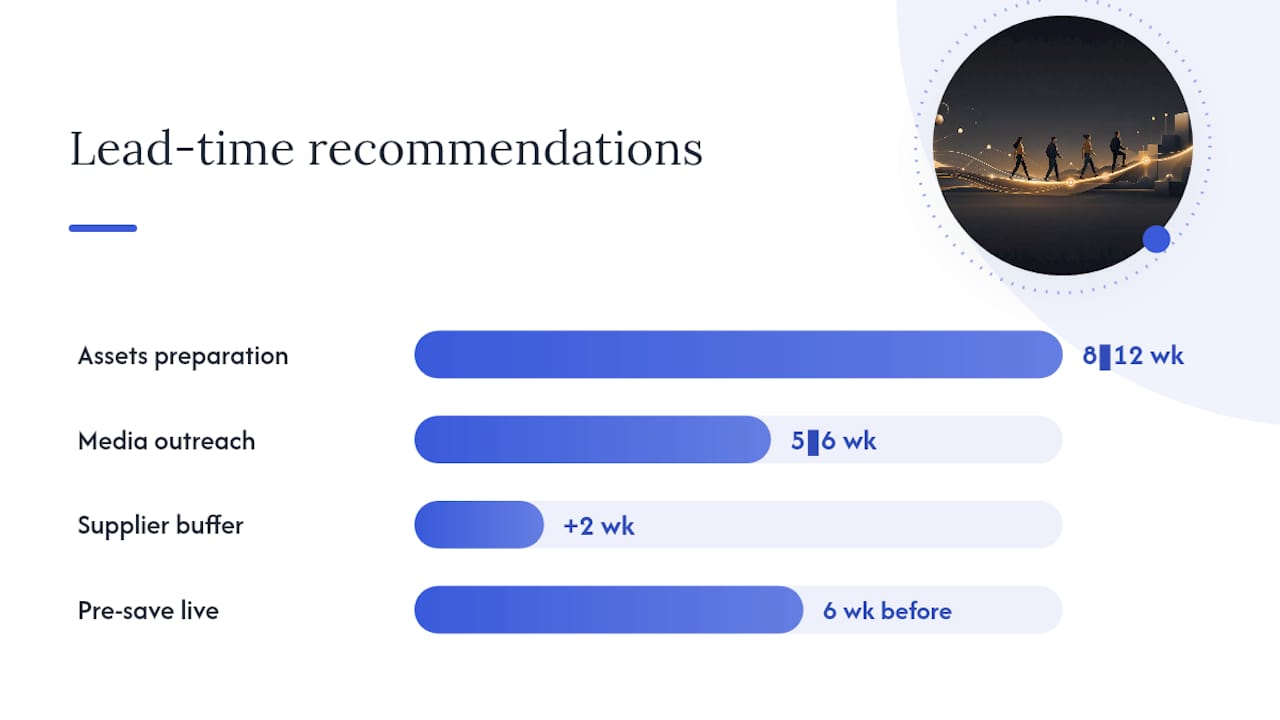
Prepare assets 8–12 weeks before release and begin media outreach around 5–6 weeks ahead so editors and curators have genuine time to respond. Rushing this window is the single most common reason independent labels miss editorial placements.
For third-party suppliers (video production, radio plugging, PR agencies), add two weeks to any quoted turnaround time. Suppliers working across multiple clients rarely hit tight deadlines without early briefing. Release scheduling best practices recommend confirming all supplier deliverables before the pre-save link goes live, so the campaign does not launch with missing assets.
How do you pitch editors, radio and playlist curators effectively?
The reply rate on a cold pitch is low by default. A precise, well-researched approach moves it from near-zero to genuinely workable.
Subject-line formula
[Artist Name] – [Song Title] – [Release Date] – [One-line angle]
Example: Mara Voss – “Coastline” – 14 March – Post-punk debut from South London, FFO Dry Cleaning
Keep it under 60 characters where possible. Avoid “EXCLUSIVE” or “URGENT” in subject lines; editors see through it immediately.
What to include in the pitch
- One-sentence artist description (genre, location, comparable artists)
- Song title and release date
- One editorial angle (why this song, why now, why this artist)
- Private streaming link (SoundCloud or Dropbox, never an attachment)
- EPK link (hosted, not attached)
- Your name and direct contact details
What to leave out
Never attach audio files, large image files or PDFs to a cold pitch. They trigger spam filters and irritate editors. Never CC multiple outlets in the same email. Never send a pitch without researching the outlet first.
Follow-up cadence
Send the initial pitch 5–6 weeks before release. Follow up once, 7–10 days later, with a single sentence referencing the original email. A second follow-up is acceptable if the release date is imminent. Beyond that, move on.
Playlist outreach
Spotify editorial pitches go through Spotify for Artists only, submitted at least 7 days before release (though 8 weeks is the practical standard for editorial consideration). For independent playlist curators, research their playlist size, update frequency and genre focus before reaching out. A curator with 500 engaged followers in your genre is worth more than a 50,000-follower playlist that has not been updated in six months.
Pro Tip: Before pitching any independent curator, check their playlist on Spotify. If the last track was added more than 30 days ago, the playlist is likely dormant. Use playlist outreach templates to structure your approach and prioritise active curators with genre alignment.
Dos and don’ts:
- Do personalise every pitch with the outlet’s name and a specific reference to their recent coverage
- Do include streaming numbers or previous placements if they are strong
- Don’t send a generic mass email
- Don’t follow up more than twice
- Don’t pitch radio without a radio edit (3 minutes 30 seconds or under, no explicit content unless the station accepts it)
Where should you focus social content and ad spend?
Short-form video is the primary discovery engine in 2026, and Meta ads are the most reliable tool for measurable conversions. That is the strategic frame. Everything else supports it.
Priority channels
TikTok, Instagram Reels and YouTube Shorts drive organic discovery. Meta ads (Facebook and Instagram) drive measurable conversion events. YouTube long-form builds the asset library that feeds everything else. For UK-based labels, Instagram Reels currently delivers strong reach for music content, while TikTok remains the fastest route to viral discovery for the right genres.
Creative workflow
Film short-form content in batches: one shoot session per month, producing 6–10 clips. Repurpose your long-form YouTube video into vertical cuts by identifying the 15–30 second moments with the strongest hook. Add captions to every clip (85% of social video is watched without sound). Schedule posts using a tool like Later or Buffer, and keep a content calendar that maps each post to a campaign phase.
For creative ideas and format examples, video content formats for musicians in 2026 covers the short-form approaches that are generating the most engagement.
Ad funnel structure
- Awareness: Short-form video ads (6–15 seconds) on TikTok and Instagram Reels, targeting cold audiences by genre interest and demographic
- Engagement: Longer video ads (30–60 seconds) retargeting users who watched 50% or more of the awareness creative
- Conversion: Link-click or landing-page ads targeting warm audiences, with a single conversion event (pre-save, email signup or merch purchase)
Route all paid traffic through a dedicated landing page with UTM parameters and a Meta pixel or Google Tag installed. This gives the ad algorithm a conversion signal to optimise against, rather than just a click.
Budget priorities for limited spend
Test short-form creative first with a small daily budget (£5–£10 per day per creative variant). Pause underperforming variants at 72 hours and concentrate remaining budget on the top performer. Only scale a campaign once you have a cost-per-conversion figure you can justify.
Pro Tip: Produce at least three creative variants per campaign: different hooks, different visual treatments, same song. A/B testing creative is where most of the performance gain comes from. The audience targeting matters far less than the creative quality at the top of the funnel.
How do you handle distribution and pre-saves correctly?
Distribution is not just uploading a file. The checklist below covers the tasks that most labels skip, and that most DSPs penalise through lower algorithmic priority.
DSP profile hygiene
- Claim your artist profiles on Spotify for Artists, Apple Music for Artists and YouTube Music before the release date
- Upload a high-quality artist photo (minimum 1000×1000px) to every profile
- Write a consistent artist bio across all DSPs (same tone, same key facts)
- Add team members (label manager, artist manager) to Spotify for Artists with appropriate access levels
- Verify that the artist name is spelled identically across every platform
Inconsistency in artist name spelling (capitalisation, spacing, punctuation) causes DSPs to create duplicate profiles, splitting your streams and follower counts.
Spotify editorial pitch
Submit via Spotify for Artists at least 7 days before release, but practically 8 weeks out for any realistic editorial consideration. The pitch form asks for: mood, genre, instrumentation, city, and a short description of the song’s story. Be specific. “Melancholic indie-pop recorded in a converted warehouse in Glasgow” is more useful to an editor than “emotional guitar music.”
Pre-save mechanics
Pre-saves serve two purposes: they signal intent to DSPs (which can influence algorithmic playlist consideration) and they convert social interest into an owned contact. Email and owned channels remain high-ROI ways to capture intent; use pre-saves and gated offers to turn social followers into email subscribers.
Tools for pre-save links include Hypeddit, ToneDen and Submithub’s pre-save feature. Gate the pre-save with an incentive: an exclusive demo, early access to merch, or a behind-the-scenes video.
Distribution delivery windows
Submit your release to your distributor at least 10 weeks before the release date to allow for processing, quality checks and territory-specific approval. Confirm the release date is locked across all territories. Check that the release appears correctly on each DSP at least 48 hours before the release date.
Which KPIs actually matter and how do you reuse coverage?
Not every metric deserves equal attention. The ones that tell you something useful in the first 72 hours are saves, completion rate and playlist add rate.
Primary KPIs
- Saves per stream ratio: a high ratio (above 10%) indicates genuine listener intent
- Completion rate: on YouTube and TikTok, completion rate above 50% signals strong content
- Playlist add rate: tracks being added to user playlists indicate organic discovery
- Follower growth: net new followers on Spotify and social platforms during the release window
- Email sign-ups: from pre-save and landing-page campaigns
- Conversion events: pre-saves, merch purchases, mailing-list signups tracked via UTM and pixel
Setting up a campaign dashboard
Use Spotify for Artists, Apple Music for Artists and YouTube Analytics as your primary data sources. Pull ad performance from Meta Ads Manager and Google Ads. Consolidate into a single Google Sheet or Notion dashboard, updated weekly. Track spend alongside performance so you can calculate cost-per-conversion for each channel.
The first 48–72 hours after release tell you where to reallocate paid budget. If one creative variant is generating saves at a lower cost than others, shift budget to it immediately. Treat analytics as a feedback loop: identify which formats and territories are driving profile actions and feed that intelligence into targeting for the next release.
Reusing coverage post-release
- Cut quote graphics from press reviews and share on Instagram and Twitter/X
- Clip interview segments into short-form video for TikTok and Reels
- Add press logos to the artist’s EPK and website
- Use coverage excerpts in ad copy for retargeting campaigns
- Pitch the coverage to larger outlets as social proof for the next release
A release does not end on release day. The 2–4 weeks after release are when most independent labels go quiet, which is precisely when a sustained push can compound early traction.
Where should a small label spend its budget first?
Set a single measurable goal per release and concentrate limited budgets on the channels that most directly support that objective rather than spreading spend across every available channel. This is the most consistent piece of advice from experienced independent label operators, and it is consistently ignored.
Suggested spend order
- Visuals and assets (video production, photography, artwork)
- PR and editorial outreach (press contact or agency fee)
- Short-form creative production (filming, editing, captions)
- Targeted Meta ads (conversion-focused, after creative is tested)
- Playlist pitching and testing (submission services, curator outreach)
Sample budget allocation
The figures below are indicative allocations for an independent release; adjust based on your label’s strengths and the specific objective for each release.
| Budget bucket | Suggested allocation | Rationale |
|---|---|---|
| Streaming and playlist outreach | 25–30% | Drives DSP performance and algorithmic consideration |
| PR and editorial | 25–30% | Builds searchable coverage and credibility for future pitches |
| Social content and paid ads | 20–25% | Short-form discovery and measurable conversion events |
| Visuals and video production | 15–20% | Foundation asset that feeds every other channel |
| Contingency | 5–10% | Covers last-minute needs and opportunities |
These allocations reflect practitioner guidance for independent releases. A label with strong in-house video capability might shift 5–10% from visuals into paid ads; a label with no press relationships might weight PR more heavily in the first two or three releases.
Triage checklist for tight budgets
- Do you have a releasable master and artwork? If not, nothing else matters.
- Is your Spotify for Artists profile claimed and complete? Free, and non-negotiable.
- Have you submitted the Spotify editorial pitch? Also free.
- Can you produce one short-form video clip in-house? Do that before buying ads.
- Do you have a pre-save link and a landing page? Set these up before spending on traffic.
Only once those five are in place does paid spend make sense.
Technical delivery specs for UK releases
Getting the technical details wrong wastes weeks. Here is the full delivery checklist.
Audio specifications
Artwork and visual specifications
Metadata checklist
- Track title (exact capitalisation, no trailing spaces)
- Artist name (consistent across all platforms)
- Featured artist credits (format: “Artist Name feat. Feature Name”)
- Songwriter credits (legal names, not stage names, for PRS/MCPS registration)
- Producer credits
- ISRC (one per track, registered with PPL UK)
- UPC (one per release, assigned by distributor)
- Genre and sub-genre
- Release date and label name
- Explicit content flag (if applicable)
- Language
Common metadata pitfalls: using a stage name instead of a legal name for songwriter credits, omitting featured artist credits, and mismatching the artist name capitalisation between the distributor submission and the DSP profile. Each of these creates administrative problems that take weeks to resolve.
File naming convention
Use this format for every file in your release folder:
ARTISTNAME_RELEASETITLE_ASSETTYPE_SPEC_DATE
Example: MARAVOSS_COASTLINE_MASTER_WAV_24BIT_20260314
Ready-to-use templates: EPK, launch-day run sheet and social captions
EPK template
Mandatory fields:
- Artist name and genre
- Short bio (100 words)
- Long bio (300–400 words)
- Hi-res press photo (minimum 300 DPI, at least three images)
- Private streaming link (current release)
- Links to previous press coverage (minimum two)
- Social media links (Spotify, Instagram, TikTok, YouTube)
- Press contact name, email and phone
Optional extras that add credibility:
- Touring history or upcoming dates
- Previous chart positions or streaming milestones
- Radio play history (BBC Introducing, community radio, commercial stations)
- Sync placements or brand partnerships
- Video links (YouTube, Vimeo)
For creative format ideas to include in your EPK video section, video content examples for musicians shows the formats that currently perform best.
Launch-day run sheet
Social caption templates
Announcement (4 weeks before release): “[Song title] is coming [date]. Pre-save now and be the first to hear it. Link in bio.”
Release day: “[Song title] is out now. This one means a lot to us. Stream it, save it, share it. Link in bio.”
Post-release (repost of coverage): “[Outlet name] said [quote from review]. Grateful for the love. Stream [song title] now. Link in bio.”
How do long-form YouTube assets power your ad funnel?
The most efficient music promotion funnels in 2026 are not built on individual posts. They are built on a single long-form asset that gets repurposed into every layer of the campaign.
Here is how the funnel works in practice:
A full-length music video (4–5 minutes, 16:9, published on YouTube) becomes the anchor asset. From that single video, you cut: two or three 15–30 second vertical clips for TikTok and Reels, one 60-second YouTube Short, and one 30-second paid ad creative. The long-form video runs as a YouTube in-stream ad targeting genre-relevant audiences. The short clips run as organic content and as Meta awareness ads. Warm audiences (those who watched 50% or more of any clip) get retargeted with a conversion ad routing to a landing page with a pre-save or merch link.
Repurposing long-form video into short edits and routing paid traffic through a landing page produces clearer optimisation signals for Meta and YouTube ad systems. The algorithm learns faster when it has a single, trackable conversion event to optimise against.
When ordering a video from Musicvideomarketplace, brief the following to ensure the deliverables fit this funnel:
- Request edit points (natural cut points at 15, 30 and 60 seconds) flagged in the timeline
- Specify crop-safe framing: keep the artist’s face and key action within the central 60% of the frame so vertical crops work without reframing
- Request export presets for both 16:9 (YouTube) and 9:16 (social) at the time of order
The most underused tactic in independent label promotion is the long-form YouTube asset as a paid ad. Most labels publish the video organically and stop there. Running it as a YouTube in-stream ad against a genre-targeted audience, then retargeting viewers with a conversion event, turns a one-time upload into a multi-week acquisition engine. The video does not need to be expensive. It needs to be long enough to generate a retargeting audience and specific enough to attract the right viewers.
Pro Tip: Install your Meta pixel and Google Tag on your landing page before the campaign launches. Set a custom conversion event for the pre-save or email signup action. Without a conversion signal, the ad algorithm optimises for clicks rather than the outcome you actually want, and your cost-per-result will be significantly higher.
What do successful small labels actually do differently?
Most independent labels treat each release as a standalone event. The ones that build genuine momentum treat each release as a data point in a longer experiment.
The discipline that separates them is not budget or connections. It is the habit of choosing one measurable objective per release and refusing to dilute it. A label that decides “this release is about growing the Spotify follower count” will make different decisions about where to spend and what to test than a label trying to hit streams, grow email, sell merch and get press simultaneously. Trying to do all four at once usually means doing none of them well.
The second habit is using analytics as a feedback loop rather than a scoreboard. A poor streams number is not a verdict on the music. It is information: which creative did not connect, which territory showed unexpected interest, which channel drove saves rather than passive plays. Labels that carry those learnings into the next release compound their knowledge. Labels that move on without reviewing the data repeat the same mistakes.
The third habit, and the one most rarely discussed, is asset hygiene. Successful small labels maintain a consistent folder structure, a consistent metadata format and a consistent EPK template across every artist on the roster. When a journalist asks for assets at short notice, the answer is a shared link, not a frantic search through email threads. That consistency is what makes a label look professional to press, curators and potential signings alike.
Get your release assets production-ready with Musicvideomarketplace
The checklist above works best when your video assets are ready before the campaign clock starts. Musicvideomarketplace gives independent labels direct access to human-made, full-length music videos and short-form social cuts, all ready to customise with your audio and branding and export in the formats this checklist requires.

Upload your track, select a video that fits the artist’s visual identity, and export a YouTube-ready long-form video alongside vertical social cuts in a single workflow. That covers the video production and short-form edit line items on your asset checklist in one step, rather than briefing a production company weeks in advance. Browse a full-length video example to see the quality and format options available, or view a video bundle with social cuts included to see how the deliverables map to the campaign timeline above. When you are ready to brief, visit Musicvideomarketplace to browse the full catalogue and place your order.
Sources
- How to promote your music | Magnetic Magazine
- The Complete Guide to Music Promotion (2026) | AMW®
- Progressrec
Recommended
- Label digital asset organisation checklist for UK labels | Music Video Marketplace Blog
- Checklist esencial para distribuir tu música con éxito | Music Video Marketplace Blog
- Tipps für Song-Promotion: Dein Guide 2026 | Music Video Marketplace Blog
- Digital music promotion explained: proven strategies | Music Video Marketplace Blog
Read next
 Maximise your music income: a guide to smart monetisationLearn how independent musicians can build sustainable income in 2026 with practical strategies across streaming, sync, video, and direct-to-fan sales.
 Master multi-channel music marketing for indie growthLearn how to sequence multi-channel music marketing for real growth. A practical guide for independent artists covering platforms, analytics, and proven tactics.
 Music Branding Through Video: Amplifying Artist IdentityMusic branding through video maximizes artist visibility, connects with fans, and powers YouTube ad campaigns. Learn visual branding essentials and strategies.
 Label digital asset organisation checklist for UK labelsEnsure smooth music distribution with our label digital asset organization checklist. Follow essential steps for accurate asset management.
Turn the idea into a finished music video.
Drop your track into the Workspace and build your visual in minutes.