
Master multi-channel music marketing for indie growth
Learn how to sequence multi-channel music marketing for real growth. A practical guide for independent artists covering platforms, analytics, and proven tactics.

Master multi-channel music marketing for indie growth
TL;DR:
- Effective music marketing requires sequencing channels to build momentum and maximize impact.
- Prioritize streaming optimization, social content, email capture, then paid ads for best results.
- Focus on retention metrics and owned channels like email for long-term artist growth.
Master multi-channel music marketing for indie growth
Most independent artists waste months posting everywhere and wondering why nothing sticks. The problem is not effort. It is the belief that simply showing up on every platform creates momentum. Real multi-channel music marketing is about sequencing, integration, and letting each channel do the job it is best suited for. This guide breaks down the strategic approach that successful independent artists use in 2026, from the correct order of operations to the analytics signals that tell you what to amplify. You will leave with a clear, practical framework that replaces guesswork with a repeatable system.
Table of Contents
- What is multi-channel music marketing?
- How sequencing channels multiplies your impact
- Core tactics: content, platforms and analytics
- Pitfalls and expert nuances in multi-channel campaigns
- Why most musicians get multi-channel marketing wrong
- Take your next release further with expert solutions
- Frequently asked questions
Key Takeaways
| Point | Details |
|---|---|
| Sequence matters most | Launching channels in the right order multiplies impact, while random activation can backfire. |
| Track meaningful metrics | Retention and engagement rates predict your actual growth, not just raw streams. |
| Own your audience | Building your email list protects you from algorithm changes and boosts conversions. |
| Content batching scales reach | Creating social assets in batches keeps your presence fresh and your campaigns strategic. |
| Quality beats quantity | Focusing on channel fit and audience alignment delivers long-term results, not just surface numbers. |
What is multi-channel music marketing?
Multi-channel music marketing means promoting your music across several platforms in a coordinated way, not just posting the same content everywhere and hoping for the best. Each channel serves a distinct purpose, and the real skill lies in knowing which platform to activate first, what content belongs where, and how to connect the dots between them.
Music marketing for independent artists in 2026 defines multi-channel marketing as promoting music across multiple platforms such as streaming services like Spotify, short-form social media including TikTok, Instagram Reels, and YouTube Shorts, email lists, and paid ads, with each channel sequenced to build on the previous one for maximum effect. That sequencing detail is often what separates artists who grow from those who plateau.
Many artists confuse multi-channel with omnichannel, but they are meaningfully different. The omnichannel versus multichannel marketing distinction matters because multichannel uses independent channels that may deliver a fragmented listener experience, while omnichannel integrates them into a unified journey. For most independent artists, a well-sequenced multi-channel approach is entirely sufficient and far easier to manage than full omnichannel integration.
Here is a quick comparison to make the differences concrete:
| Approach | Channel relationship | Listener experience | Best for |
|---|---|---|---|
| Single-channel | One platform only | Narrow, limited reach | Early-stage testing |
| Multi-channel | Independent, sequenced | Broader, grows over time | Independent artists scaling up |
| Omnichannel | Fully integrated | Seamless, unified | Major labels, large teams |
The typical channels available to you include streaming platforms such as Spotify and Apple Music, short-form social video, long-form YouTube content, email newsletters, and paid advertising. Each one serves a different audience relationship:
- Streaming platforms build algorithmic credibility and discoverability
- Social media creates discovery and cultural context around your music
- Email lists convert listeners into genuine fans with direct communication
- Paid ads amplify what is already working, not what you hope will work
“The biggest misconception is that more channels automatically means more results. Integration and sequencing are the actual engines of growth.”
Familiarise yourself with the broader music marketing trends shaping what platforms reward in 2026, and read up on proven indie artist marketing strategies to see how other independent musicians are structuring their campaigns.
How sequencing channels multiplies your impact
Understanding each channel’s role is one part of the equation. Grasping the right order is what transforms results from incremental to compounding.

When you activate every channel simultaneously on release day, you scatter your energy and confuse your data. You cannot tell which channel drove saves, which drove streams, or which one converted listeners into fans. Sequencing solves this by treating your release campaign as a series of deliberate steps rather than a single launch event.
The recommended sequence for independent artists in 2026 breaks down like this:
- Streaming optimisation first. Before anything else, ensure your DSP profiles are fully set up. Your artist bio, profile image, and upcoming releases should be in place on Spotify for Artists, Apple Music for Artists, and any other platform where your audience lives. Target a 15-25% streams-to-saves ratio as your benchmark, because saves signal genuine listener intent to the algorithm and trigger editorial consideration.
- Short-form social content second. Once your streaming foundation is solid, start building cultural momentum through TikTok, Instagram Reels, and YouTube Shorts. This stage is about discovery. The goal is not virality but consistent, genre-appropriate content that introduces your sound to new audiences.
- Email capture third. As social content drives traffic, funnel those viewers toward an email sign-up. A free download, exclusive lyric sheet, or early access to your next release works well as an incentive. This step converts casual viewers into owned contacts that no algorithm can take from you.
- Paid ads last. Paid promotion should only arrive after you have streaming credibility and a warm audience. Running ads into a cold, unoptimised profile wastes budget. Use ads to amplify what is already resonating.
Case study data shows that artists sequencing channels correctly see compounding growth. One indie pop artist grew from 2,400 to 29,700 monthly listeners in just three months by applying targeted, sequenced campaigns rather than blasting all channels at once. That kind of growth does not happen by accident.
Here is how sequenced versus unsequenced outcomes typically compare:
| Metric | Unsequenced approach | Sequenced approach |
|---|---|---|
| Streams-to-saves rate | 4-8% | 15-25% |
| Email conversion rate | Under 1% | 4-8% |
| Paid ad return | Weak, scattered | Amplified, measurable |
| Monthly listener growth | Slow or flat | Compounding over weeks |
Pro Tip: Email capture consistently outperforms social media by four to eight times for conversions. A fan who gives you their email address is ten times more likely to buy a ticket, stream your next release on day one, or share your music with friends than a follower who double-tapped a post.
For a deeper look at building these systems, explore digital promotion strategies and proven promotion strategies that independent artists are using right now.
Core tactics: content, platforms and analytics
Now that you see how sequence compounds your results, let us get practical about what actually works from week to week.
Content batching is one of the highest-leverage habits you can build. Rather than creating one TikTok the night before you post it, sit down and produce 20 to 30 short-form pieces per song during a focused session. Key methodologies include content batching of 20 to 30 short-form pieces per song, pre-save campaigns two to three weeks before release, unified messaging across channels, and data-driven sequencing rather than simultaneous activation. Batching protects your creative energy and ensures you maintain consistent visibility even during busy periods.
Platform selection matters more than most artists realise. Not every platform is right for every genre. Country and Americana artists tend to find warmer communities on Facebook and YouTube, while hip-hop and electronic music thrive on TikTok and Instagram. Choose platforms where your target listeners already spend time, not platforms that simply have the largest overall user base.
Here are essential multi-channel tactics to implement in 2026:
- Pre-save campaigns launched two to three weeks before your release date to prime the algorithm
- Consistent visual branding across every profile so fans recognise you instantly across platforms
- Genre-specific hashtag and keyword research to align your content with algorithmic discovery
- Cross-channel calls to action that direct social followers to your email list and streaming profiles
- Monthly analytics reviews tracking save rates, completion rates, geographic listener data, and email open rates
- DSP diversification beyond Spotify to include Apple Music, Amazon Music, and Tidal
Analytics is where many independent artists underinvest their attention. Your streaming dashboard tells you which cities your listeners are in, how long they stay in your songs, and which tracks generate saves versus skips. That data shapes where you tour, which songs you promote next, and which geographic markets deserve a paid ad push.
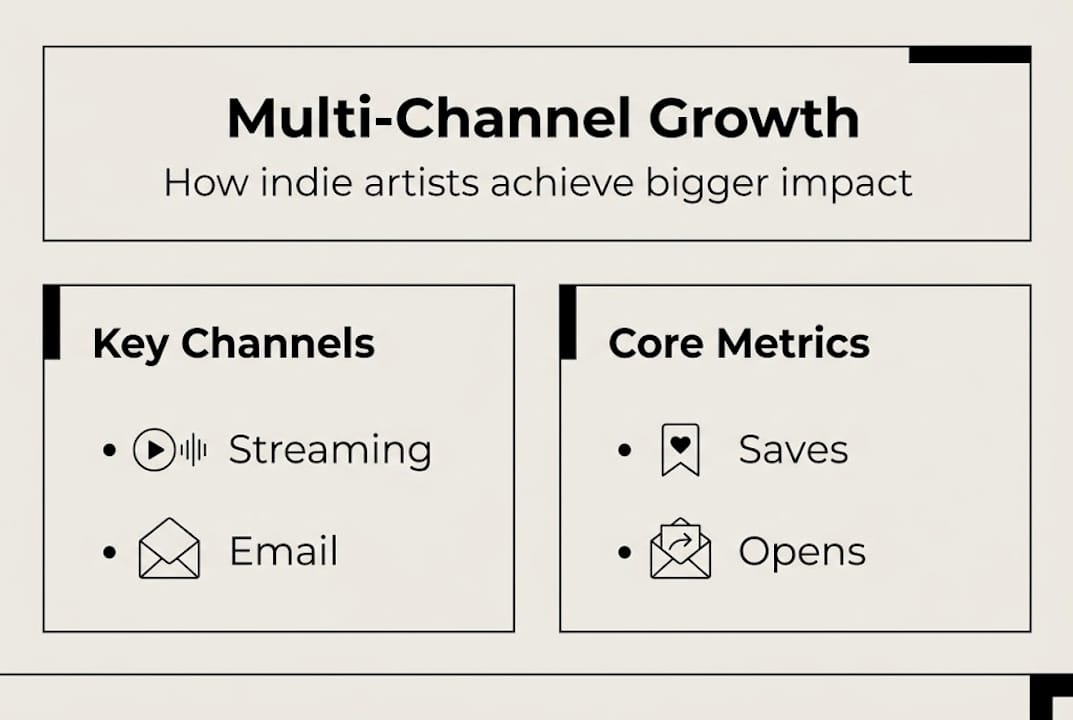
Owned channels like email deliver 30-50% open rates compared to just two to five percent organic social reach. That gap is staggering. One email to your list is worth roughly ten to twenty-five social posts in terms of the percentage of your audience who actually see it.
Pro Tip: Prioritise building your email list and diversifying across multiple DSPs from your very first release. Social platforms change their algorithms regularly, but an email address belongs to you forever.
For practical examples of how campaigns come together, look at ad campaign strategies and creative campaign examples from independent musicians who have run successful multi-channel releases.
Pitfalls and expert nuances in multi-channel campaigns
Effective campaigns not only deploy more tactics. They also avoid the common mistakes that cause frustration and wasted resources.
The most costly error independent artists make is activating channels in the wrong order. Running channels out of sequence, for example launching paid ads before building streaming momentum, consistently leads to underperformance. You pay for traffic that arrives at a profile with few saves, no playlist placements, and weak engagement signals. The algorithm reads that as a red flag, not an opportunity.
Here are the most frequent mistakes to avoid:
- Launching paid ads too early before streaming credibility exists, which wastes budget and sends poor signals to DSP algorithms
- Pursuing low-quality playlist placements from services that inflate play counts without genuine listener engagement, which can actively harm your algorithmic standing
- Over-relying on a single platform such as Spotify or TikTok, which leaves your entire audience vulnerable to a single algorithm change overnight
- Ignoring retention metrics in favour of raw stream counts, which tells you nothing meaningful about whether listeners actually connect with your music
- Posting inconsistently across social channels, which signals to algorithms that your profile is low priority
“Running paid ads without streaming traction delivers weak returns and can actually damage your long-term algorithmic standing on DSPs.”
The expert nuance that separates artists with sustained growth from those chasing one-off boosts is a focus on retention metrics over raw streams for long-term growth. Save rates, completion rates, and email sign-ups are the metrics that actually predict whether your next release will perform better than your last. Raw stream counts feel satisfying, but a song with a million streams and a two percent save rate is telling you something uncomfortable: most listeners did not care enough to come back.
Also consider the risk of genre misalignment. Placing your indie folk track in a high-volume electronic playlist may generate streams but zero meaningful engagement. Those low completion and save rates send negative signals to the algorithm, which can suppress your music in genuinely relevant editorial playlists. Genre alignment is not just an aesthetic preference. It is a strategic signal.
Read more about managing visibility through YouTube algorithm strategies to understand how platform-specific signals shape long-term discoverability across the largest video platform in the world.
Why most musicians get multi-channel marketing wrong
Here is an uncomfortable truth: most independent artists mistake activity for strategy. They post every day, join every platform, and run ads on a whim, then feel genuinely confused when nothing compounds. The problem is not the work ethic. It is the model they are working from.
The temptation to go wide is understandable. More platforms feels like more chances. But spreading thin without sequencing produces superficial results everywhere and deep results nowhere. Your energy is finite, and so is your audience’s attention. Choosing where to show up with intention beats showing up everywhere with mediocrity.
The artists who build genuine long-term audiences treat email as their most valuable asset, not their afterthought. Social media is rented land. Algorithms shift, reach drops, and accounts get restricted. Your email list is yours. Learn the online promotion essentials that put owned channels at the centre of your strategy rather than the edge of it.
Algorithm dependence is the other quiet danger. When your entire strategy depends on Spotify’s editorial team or TikTok’s recommendation engine, you are one policy change away from starting over. The artists who weather those changes are the ones with direct relationships with their fans through email, Patreon, or Discord communities.
Pro Tip: When building your next campaign, work backwards from the question: which channel will bring your listeners back when all the others shift? That answer should be at the centre of your strategy, not an optional extra.
Long-term advantage comes from retention and iteration. Run a release, study the data honestly, adjust your sequence, and run the next one smarter. That cycle, repeated consistently, is what separates artists who build careers from those who rely on moments.
Take your next release further with expert solutions
You now have a clear framework for sequencing, content, analytics, and avoiding the mistakes that hold most artists back. The next step is putting it into action without spending weeks building everything from scratch.

At Music Video Marketplace, we help independent musicians create long-form video content in minutes and launch targeted ad campaigns around their songs, so the sequencing you have just learned becomes straightforward to execute. Rather than stitching together ten different tools, you get everything needed to move from streaming setup to social content to paid promotion in one focused workflow. If you are ready to run a release campaign that actually compounds, explore what Music Video Marketplace offers and take your next release further with video and ad support built specifically for independent artists.
Frequently asked questions
How many platforms should I focus on when starting multi-channel marketing?
Start with two to three key platforms that match where your audience already listens, then sequence your activation rather than spreading your energy thin. Some sources recommend prioritising depth over breadth to avoid diluting your impact across too many channels at once.
What’s the most important metric to track for multi-channel campaigns?
Retention and engagement metrics such as save rates, completion rates, and email sign-ups matter far more than raw stream counts for long-term growth. Experts consistently advise artists to prioritise retention metrics over raw streams when assessing whether a campaign is truly working.
Can I run paid ads before launching on streaming platforms?
It is best to build initial streaming engagement first, as running paid ads early without streaming momentum typically delivers weak returns and can send poor signals to DSP algorithms.
Why is owning my email list crucial for music promotion?
Email lists deliver far higher engagement than social media, and they are immune to algorithm changes. Email open rates sit at 30-50% compared to just two to five percent organic reach on most social platforms, making email your most reliable direct channel.
What’s the difference between multi-channel and omnichannel approaches?
Multi-channel means using several independent platforms each with their own experience, while omnichannel integrates every channel into a seamless, unified listener journey. For most independent artists, a well-sequenced multi-channel approach is the most practical and effective starting point.
Recommended
- Music industry marketing explained: strategies for indie artists | Music Video Marketplace Blog
- Promote your music online: essentials for indie artists | Music Video Marketplace Blog
- Music marketing trends shaping success for independent artists | Music Video Marketplace Blog
- Digital marketing for producers: grow your audience fast | Music Video Marketplace Blog
Read next
 Music Branding Through Video: Amplifying Artist IdentityMusic branding through video maximizes artist visibility, connects with fans, and powers YouTube ad campaigns. Learn visual branding essentials and strategies.
 Music distribution explained: how to get your songs heardDiscover what is music distribution and how it ensures your songs reach Spotify, Apple Music, and more. Get your music heard today!
 Music industry marketing explained: strategies for indie artistsLearn what music industry marketing really means for indie artists, with actionable strategies, real case studies, and channel benchmarks to grow your career in 2026.
 Maximise your music income: a guide to smart monetisationLearn how independent musicians can build sustainable income in 2026 with practical strategies across streaming, sync, video, and direct-to-fan sales.
Turn the idea into a finished music video.
Drop your track into the Studio and build your visual in minutes.