
 Try the Workspace
Digital music promotion explained: proven strategies
Learn proven digital music promotion strategies for independent artists, covering YouTube, playlist pitching, release cycles, and the metrics that drive real growth.
Digital music promotion explained: proven strategies
TL;DR:
- A structured multi-channel promotional system is essential for sustainable music career growth.
- YouTube, playlist pitching, and social media are key channels to build long-term discovery and engagement.
- Consistent release cycles and proper metrics tracking outperform viral moments and build lasting audience ownership.
You put months into writing, recording, and mixing a track, only to watch it disappear into the digital void within days of release. It is a frustration almost every independent artist knows. The problem is rarely the music itself. It is the absence of a structured promotional system. Release cycles compound growth for musicians who plan them properly, turning a single release into weeks of sustained momentum. This guide walks you through the channels, tactics, and frameworks that actually move the needle, from YouTube optimisation to playlist pitching, so your next release gets the attention it deserves.
Table of Contents
- Understanding the digital music promotion landscape
- Mastering YouTube as a hub for music promotion
- Playlist pitching, social discovery, and release cycles
- Measuring success and avoiding digital promotion pitfalls
- Why consistency matters more than chasing virality
- Take your digital music promotion further
- Frequently asked questions
Key Takeaways
| Point | Details |
|---|---|
| Multi-channel approach | Effective digital promotion requires coordinated efforts across streaming, video, email, and social platforms. |
| YouTube optimisation | Setting up your artist channel and capitalising on Shorts can dramatically boost song exposure and fan conversions. |
| Playlist pitching strategy | Pitch to editorial playlists ahead of release and prioritise authentic, algorithmic methods for lasting results. |
| Measurable growth targets | Track save rates, monthly listener increases, and engagement benchmarks to inform your next moves. |
| Consistency vs. virality | Long-term, consistent execution builds lasting fans far more effectively than chasing viral trends. |
Understanding the digital music promotion landscape
Digital music promotion is the practice of using online channels to build awareness, grow your audience, and drive streams or sales for your music. It sounds straightforward, but the sheer number of platforms available makes it easy to spread yourself too thin and see results on none of them.
The most effective approach in 2026 is a multi-channel strategy that combines streaming profiles, short-form video, email marketing, playlist pitching, paid ads, and structured release cycles. Each channel plays a different role, and together they create a system that compounds over time.
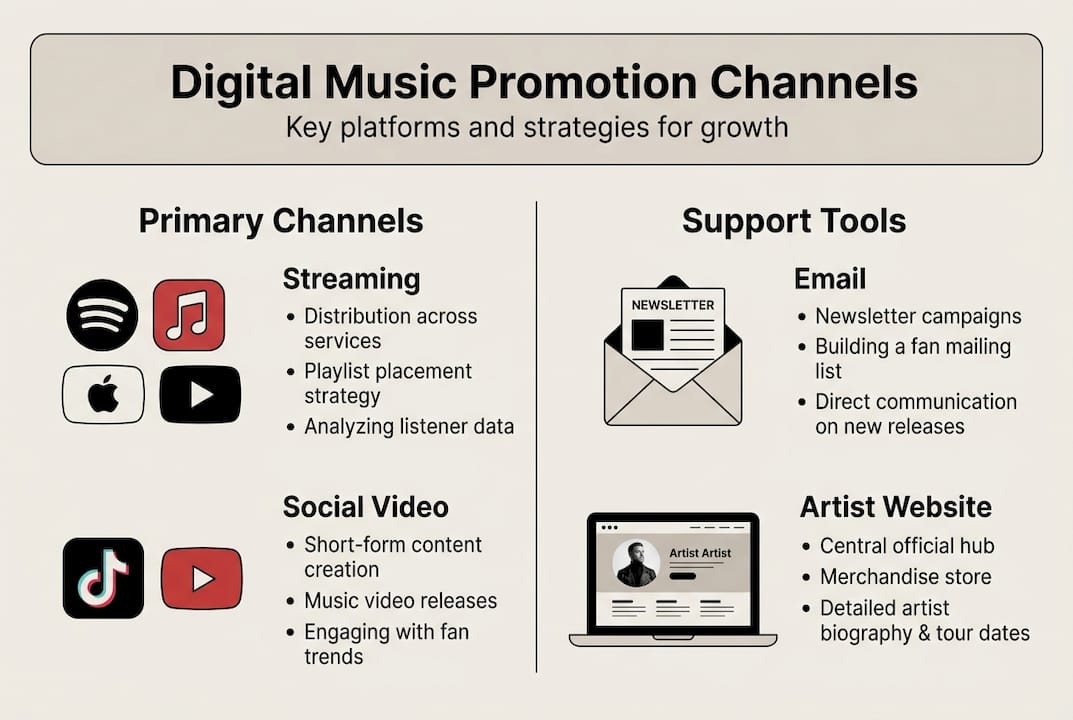
Here is a breakdown of the core channels and what each one does best:
| Channel | Primary role | Key benchmark |
|---|---|---|
| Spotify / Apple Music | Streaming and discovery | Save rate above 3% is strong |
| YouTube | Long-form video and search | Watch time drives algorithm |
| TikTok / Instagram Reels | Viral discovery and reach | Engagement rate 5 to 10% |
| Email marketing | Audience ownership | Open rates 30 to 50% |
| Playlist pitching | Curated discovery | Editorial placement is gold |
| Paid ads | Amplification | Use after organic proof |
The music promotion essentials every artist needs come down to three priorities: reach, growth, and retention. Reach gets new ears on your music. Growth converts those ears into followers and subscribers. Retention keeps them coming back release after release.
Core platforms to prioritise:
- Spotify for Artists: Claim your profile, pitch to editorial playlists, and monitor save rates
- YouTube: Build your Official Artist Channel for search-driven discovery and long-term views
- TikTok and Instagram Reels: Use short clips to spark organic discovery before a release
- Email list: Your most resilient asset, owned entirely by you and immune to algorithm changes
- SubmitHub and similar tools: Pitch to independent playlist curators and blogs efficiently
Pro Tip: Do not try to master every channel at once. Pick two or three that align with where your audience already spends time, build consistency there first, then expand.
Release cycle structure matters enormously. A well-planned cycle moves through teasers (building anticipation), the release push (maximising first-week streams), and post-release fan engagement (sustaining momentum with reactions, covers, and behind-the-scenes content). This three-phase rhythm is what separates artists who grow steadily from those who spike and fade. You can explore more about how to promote your music using this kind of structured thinking.
Mastering YouTube as a hub for music promotion
YouTube is not just a place to upload your music video and hope for the best. For independent artists, it is the single most powerful long-term discovery engine available, combining search, recommendation, and community in one place.
Start by claiming your Official Artist Channel through your distributor. This merges your topic channel and any existing uploads into one verified presence. From there, optimising metadata, including titles, descriptions, tags, and custom thumbnails, is what determines whether the algorithm surfaces your content to new viewers.
Here is a comparison of YouTube content types and their promotional value:
| Content type | Reach potential | Engagement potential | Best use |
|---|---|---|---|
| Official music video | High | Medium | Core release asset |
| YouTube Shorts | Very high | High | Discovery and teasers |
| Live session / acoustic | Medium | Very high | Fan deepening |
| Lyric video | Medium | Medium | Cost-effective release |
| Behind the scenes | Low | Very high | Community building |
The algorithm rewards specific behaviours. Click-through rate (CTR), which is the percentage of people who click your thumbnail after seeing it, and watch time are the two most important signals. The first 24 to 72 hours after upload are critical. A strong early performance tells YouTube the content is worth recommending more broadly.
Steps to set up and launch a YouTube release:
- Claim and verify your Official Artist Channel
- Research keywords your audience searches and build them into your title and description
- Design a thumbnail with high contrast, a clear focal point, and readable text
- Schedule your upload and notify your email list and social followers in advance
- Publish a YouTube Short teaser 48 hours before the main video
- Respond to every comment in the first 48 hours to boost engagement signals
- Add end screens linking to your Spotify profile or email sign-up
Pro Tip: Add a pinned comment with a link to your Spotify or email list within the first hour of publishing. It is a simple way to boost music video engagement and convert viewers into long-term fans rather than one-time listeners.
“YouTube rewards consistency and audience signals, not just view counts. Artists who treat it as a community platform, not just a video host, see compounding returns over time.”
Paid ads on YouTube are powerful amplifiers, but only once you have organic proof. If your video already shows a healthy CTR and watch time, a targeted ad campaign can multiply that reach significantly. Learn how to optimise your YouTube workflow before spending money on amplification. You can also explore a detailed YouTube promotion guide for more channel-specific tactics. For broader YouTube music promotion tips tailored to indie artists, there are proven frameworks worth studying.
Playlist pitching, social discovery, and release cycles
Getting your music onto playlists, particularly Spotify editorial playlists, can transform your monthly listener count almost overnight. But the process requires planning, timing, and a clear understanding of how the system works.

For editorial playlists, submit through Spotify for Artists four to seven weeks before your release date. This gives the editorial team time to review your pitch. For algorithmic playlists like Discover Weekly and Release Radar, the key is driving pre-saves and strong first-week engagement, which signals the algorithm to push your track to similar listeners. Playlist pitching strategy for indie artists must account for both editorial and algorithmic routes simultaneously.
Social discovery through TikTok, Instagram Reels, and YouTube Shorts works differently. Here, the goal is to create a moment around your music, a hook, a visual concept, or a challenge that encourages other users to engage with or recreate your content. Even a modest viral moment on TikTok can translate into thousands of new Spotify streams within 48 hours.
Indie artists scaling listeners via playlist campaigns and sustained releases show a consistent pattern: those who release regularly and pitch strategically outperform those who release sporadically, regardless of budget.
Dos and don’ts for playlist pitching and release cycles:
- Do pitch to editorial playlists four to seven weeks before release
- Do set up a pre-save campaign to boost algorithmic placement
- Do plan teasers, countdown content, and post-release fan engagement in advance
- Don’t pay for bot playlists. They inflate numbers without building real audience
- Don’t release music without visual assets ready. Curators and fans both notice
- Don’t go silent after release week. Post-release content sustains the momentum
Pro Tip: When evaluating a playlist promotion service, check the playlist’s follower-to-stream ratio. A playlist with 50,000 followers but only 200 streams per track is almost certainly using bots. Real playlists show consistent listener behaviour and track engagement. Pair smart pitching with strong music ad campaign strategies for maximum impact.
Check indie streaming benchmarks to understand what realistic growth looks like at your stage.
Measuring success and avoiding digital promotion pitfalls
Knowing which numbers to watch is just as important as knowing which tactics to use. Without clear metrics, you end up optimising for the wrong things.
The metrics that actually matter for independent artists are:
- Save rate: Above 3 to 5% is excellent and signals genuine listener intent
- Monthly listener growth: A 15 to 30% monthly increase is considered strong for indie artists
- Engagement rate: Instagram 3 to 6%, TikTok 5 to 10% indicates an active audience
- Email open rates: Between 30 and 50% shows a highly engaged list
Vanity metrics, such as total plays or follower counts, can feel rewarding but rarely reflect genuine growth. An artist with 500 highly engaged email subscribers often has more commercial leverage than one with 50,000 passive social followers.
“Systems beat campaigns. One well-structured release cycle teaches you more about your audience than ten random posts ever will.”
Common release mistakes include launching without a pre-release plan, neglecting visual assets, and underfunding sustained promotional efforts. These are not minor oversights. They are the difference between a release that builds momentum and one that flatlines.
Warning signs and fixes:
- High streams, low saves: Your track is being skipped. Revisit the first 30 seconds
- Low engagement despite followers: Your content is not resonating. Test different formats
- Email list not growing: Add a clear sign-up incentive tied to your next release
- Playlist streams with no profile growth: Listeners are not converting. Improve your artist profile and bio
Pro Tip: Treat your email list as your most valuable long-term asset. Unlike social platforms, you own it completely. Even a list of 500 engaged fans can fund a release campaign if nurtured correctly. Review YouTube ad best practices to ensure your paid efforts support rather than replace organic growth. For a broader view, the music metrics guide covers what data to prioritise at each stage of your career.
Why consistency matters more than chasing virality
Here is something the music industry rarely admits: virality is mostly luck, but consistency is entirely within your control. Most artists who chase viral moments end up neglecting the slow, compounding work that actually builds a sustainable career.
Consistency and compound growth outperform chasing fleeting viral moments for independent artists in 2026. Every release you put out with a proper cycle teaches you more about your audience. Every email you send strengthens a relationship. Every YouTube video you publish adds to a searchable catalogue that works for you while you sleep.
The artists who grow steadily are not necessarily the most talented. They are the most systematic. They treat promotion as a craft, not a gamble. Understanding the YouTube global impact on music discovery reinforces why building a consistent presence there pays dividends over years, not just weeks. For a grounded perspective on long-term thinking, music promotion wisdom from experienced practitioners is worth absorbing.
Viral spikes feel extraordinary, but they rarely translate into lasting audience ownership. A system does.
Take your digital music promotion further
You now have the framework. The next step is putting it into practice with the right tools behind you.

At Music Video Marketplace, we help independent musicians create professional long-form videos in minutes, ready to upload to YouTube and pair with a targeted ad campaign for your song. No production team required. No months of waiting. You can go from track to live campaign faster than you thought possible. If you want to deepen your knowledge before launching, the indie artist promotion guide covers the essentials in practical detail. Your next release deserves a proper system behind it.
Frequently asked questions
How long should my digital music release cycle last?
Most experts recommend a structured release cycle spanning four weeks of teasers, one week countdown, release week full push, and two to four weeks of post-release fan engagement.
What are the most important metrics when promoting music online?
Save rate above 3 to 5%, monthly listener growth of 15 to 30%, and engagement rates between 3 and 10% depending on platform matter most for indie musicians tracking real progress.
Should I run paid ads before or after proving organic traction?
Paid ads work best after your organic save and engagement rates are already strong. Wait to boost until you have proven genuine listener interest, otherwise you are amplifying a signal that has not yet been validated.
Are bot playlists safe for music promotion?
No. Bot playlists risk low retention, poor algorithm signals, and potential account suspension. Focus entirely on authentic independent curators and editorial playlist pitching for sustainable results.
Recommended
- Digital marketing for producers: grow your audience fast | Music Video Marketplace Blog
- Promote your music online: essentials for indie artists | Music Video Marketplace Blog
- Music Video Promotion: Growing Your YouTube Audience | Music Video Marketplace Blog
- Music promotion strategies for indie artists on YouTube | Music Video Marketplace Blog
Read next
 Educational Video for Musicians: Boosting Song ReachEducational video for musicians explained: types, creation process, copyright rules, and best practices for impactful YouTube promotion by independent artists.
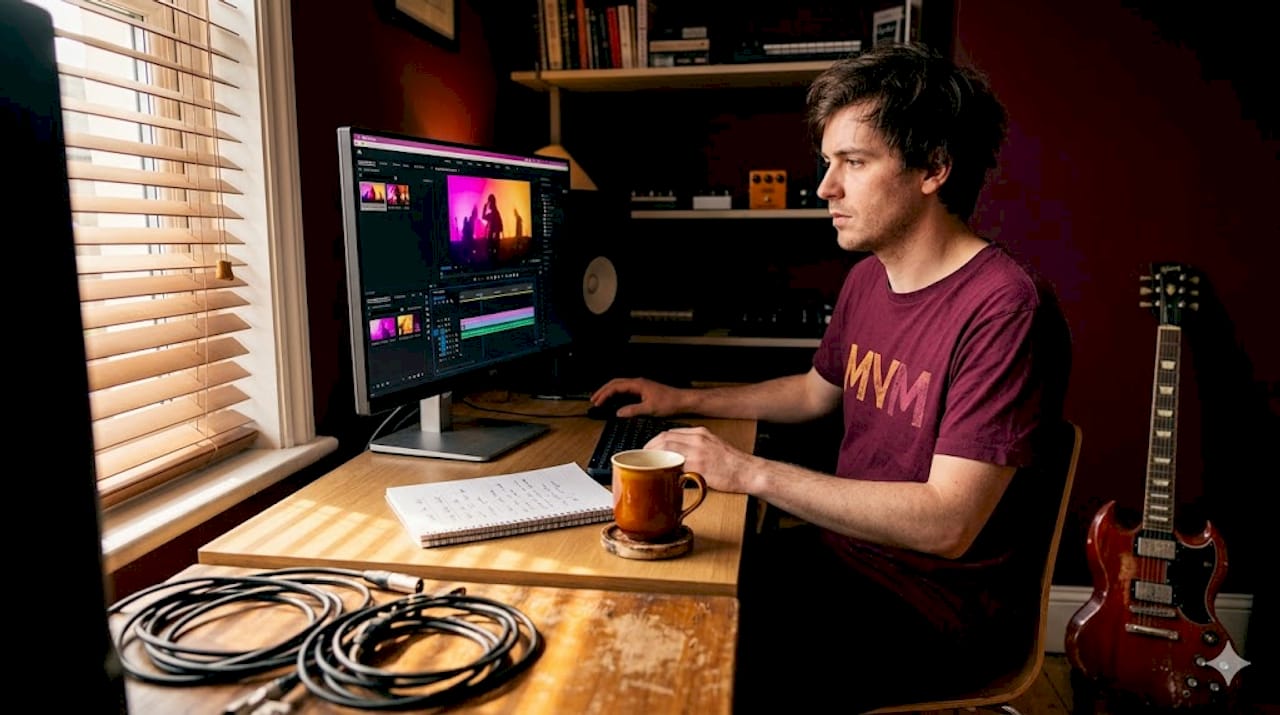 Effective types of music promotion for indie artistsDiscover the best types of music promotion for indie artists in 2026. Learn strategies to stand out and successfully reach your audience!
 Distributor artist onboarding: examples, templates and checklistsDiscover effective distributor artist onboarding processes with copy-paste templates, checklists, and a practical timeline to streamline your workflow.
 Defining multimedia content strategy for music artistsDiscover the power of defining multimedia content strategy for music artists. Learn how to unify your message across platforms and engage fans.
Turn the idea into a finished music video.
Drop your track into the Workspace and build your visual in minutes.