
2026 trends in music promotion: what works now
Discover the 2026 trends in music promotion that truly work! Learn how to build genuine fan relationships and leverage AI effectively.
2026 trends in music promotion: what works now
TL;DR:
- The music industry in 2026 emphasizes genuine fan relationships, AI as an operational tool, and security as a core component of promotion. Streaming dominates revenue, with Instagram serving as the premier platform for superfans, while content saturation and fraud risks demand smarter, security-conscious strategies. Successful promotion involves integrated systems focusing on subscription funnels, data-driven targeting, and authentic engagement to stand out amidst rapid industry growth.
The music industry is moving faster than most promotional playbooks can keep up with. The 2026 trends in music promotion are not simply about being on every platform or throwing budget at ads. They are about understanding where genuine fan relationships live, how to use AI without alienating the listeners you are trying to reach, and why your security setup is now as critical as your release strategy. This article cuts through the noise to give musicians, marketers, and industry professionals a clear, grounded picture of what actually drives results this year.
Table of Contents
- Key takeaways
- The global music market heading into 2026
- Social media, superfans, and Instagram’s edge
- AI in music promotion: the real picture
- Managing content overload and fraud risks
- Building a complete 2026 promotion system
- My honest take on 2026 music promotion
- How Musicvideomarketplace can help
- FAQ
Key takeaways
| Point | Details |
|---|---|
| Streaming dominates revenue | Paid streaming accounts for over half of global music income, making subscription funnels the backbone of any promotion strategy. |
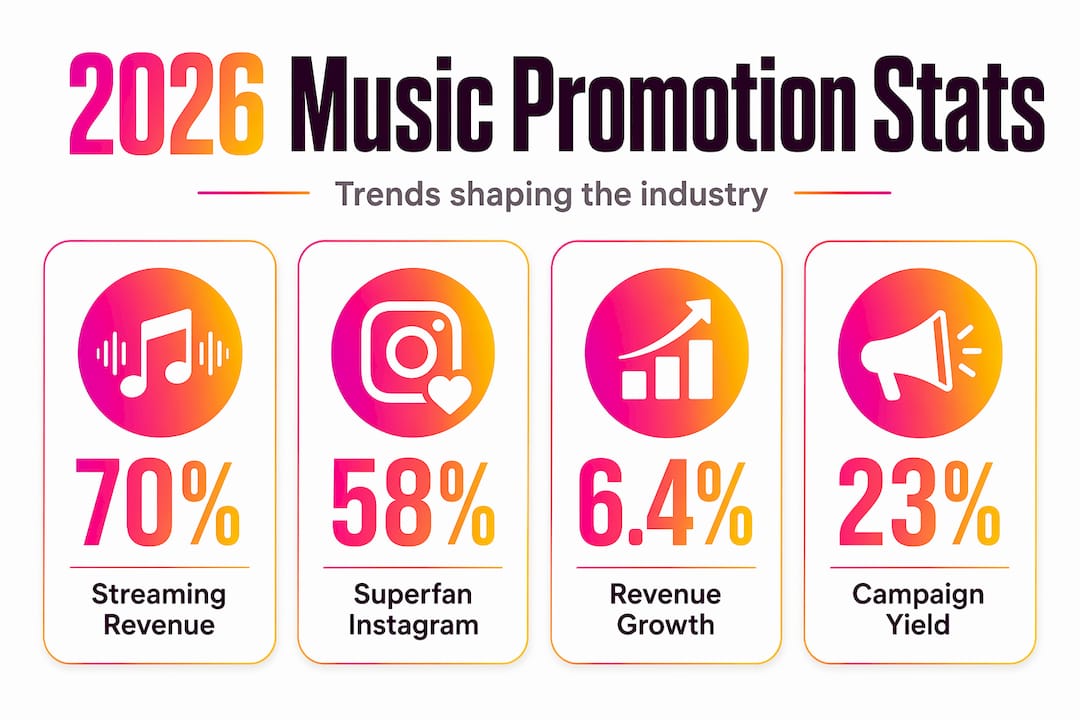
| Instagram is the superfan hub | 58% of superfans engage on Instagram, and campaigns there have driven up to 23% year-over-year streaming growth. |
| AI requires careful positioning | Consumer interest in AI-assisted music is falling among Gen Z and Gen Alpha, so use AI behind the scenes rather than as a selling point. |
| Content saturation demands smarter tactics | With 120,000 songs uploaded daily, discoverability depends on data-driven targeting and consistent short-form video. |
| Security is part of promotion now | Fraud and data breaches targeting unreleased music are rising, so security measures must be built into campaigns from pre-release onwards. |
The global music market heading into 2026
Understanding where money flows in music tells you where to direct promotional energy. Global recorded music revenues grew 6.4% in 2025, reaching US$31.7 billion. That is not modest growth for an industry of this scale.
Streaming is the engine behind those numbers. Streaming revenues surpassed US$22B and accounted for nearly 70% of all recorded music income, supported by 837 million paid subscriptions worldwide. The practical implication is direct. If your promotion strategy does not convert casual listeners into paid subscribers, you are leaving the most durable revenue stream untouched.
| Metric | 2025 figure |
|---|---|
| Global recorded music revenue | US$31.7 billion |
| Revenue growth rate | 6.4% |
| Streaming share of total income | ~70% |
| Paid streaming subscriptions | 837 million |
| Streaming revenue total | US$22 billion+ |
Regional growth is also reshaping priorities. Markets across Latin America, Africa, and South-East Asia are expanding rapidly, which means geo-targeted promotion on streaming platforms is no longer optional for artists with international ambitions. New technologies, particularly spatial audio and AI-personalised playlists, are also influencing how listeners discover music and how long they stay with it. Understanding these drivers is the starting point for the future of music promotion.
Social media, superfans, and Instagram’s edge
Not all followers are created equal. A superfan does not just stream your music once. They attend concerts, buy physical formats, share your content without being asked, and convert other listeners. Identifying and feeding that relationship is one of the most powerful 2026 music marketing trends you can act on right now.

Instagram is the leading superfan hub after YouTube, with 58% of superfans actively engaging there. Campaigns tied to Instagram activations have shown up to 23% year-over-year streaming growth. That is a striking figure given how much attention the industry has directed toward short-form video on other platforms.
Why does Instagram outperform the competition for sustained engagement? The answer is in repeat interaction types. Stories, live sessions, close-friends lists, and DM-based community features keep fans in a tighter loop with artists than passive video scrolling does. The impact of social media on music is most visible when artists treat Instagram as a relationship tool rather than a broadcast channel.
Here are the engagement tactics that convert casual followers into genuine superfans on Instagram:
- Series content: Post regularly scheduled content tied to a theme, such as a weekly behind-the-scenes clip, so fans have a reason to return rather than simply discover.
- Direct replies and polls: Use Stories to ask specific questions about upcoming releases, tour dates, or merch designs. Fans who feel consulted become advocates.
- Early access drops: Share unreleased clips or acoustic versions exclusively with engaged followers before a wider release to reward loyalty.
- Cross-platform funnels: Use Instagram to drive fans toward your streaming profiles, email list, or paid community, where the relationship deepens beyond the algorithm.
Pro Tip: Superfans display higher rates of concert attendance and physical music purchases, so Instagram engagement is not just a vanity metric. It maps directly to multiple revenue streams simultaneously.
For independent artists especially, understanding fan engagement strategies on Instagram offers a practical edge without requiring major-label budgets.
AI in music promotion: the real picture
The music industry digital trends of 2026 include a lot of AI conversation, but most of it is pointed in the wrong direction. The assumption that AI-generated content or AI-assisted music is a promotional advantage is increasingly at odds with what listeners actually feel.
Consumer interest in AI-assisted music has declined sharply among younger audiences, dropping from net -6% to -16% between May and November 2025 among Gen Alpha and Gen Z. Millennials remain more open, but even there, initial spikes in interest are followed by listener drop-off. The data suggests that novelty does not build fanbases.
“AI can spike initial interest, but the lack of long-term fandom suggests campaigns should focus on authenticity and listener value over novelty.” — Luminate via Billboard
So where does AI genuinely serve music promotion in 2026? Behind the scenes, almost entirely. AI as a promotional headline faces real scepticism, but as an operational tool, it is genuinely valuable. Smart promotion teams are using AI for:
- Metadata optimisation: Improving how tracks are tagged and categorised across platforms to increase playlist placement probability.
- Targeting precision: Running AI-assisted ad targeting that identifies micro-audiences likely to convert to subscribers, not just streamers.
- Campaign iteration speed: Testing multiple creatives simultaneously and reallocating budget to performers within hours rather than days.
- Content scheduling: Using predictive tools to identify optimal posting windows on social platforms based on historical engagement data.
The distinction matters. Hyper-personalisation via AI can create sharper discovery pathways, but the promotional story that reaches fans should still centre on the human artist. Keep AI in the engine room, not in the headline.
Managing content overload and fraud risks
Here is a number that reframes the discoverability problem entirely. 120,000 new songs are uploaded daily to streaming platforms. Even with perfect release timing and a solid social following, getting noticed is genuinely harder than it was two years ago. The answer is not to release more content. It is to make each piece of content work across more surfaces.
Short-form video tied to a longer promotional arc, combined with consistent social presence and well-targeted ads, is how artists cut through. Emerging trends in music marketing point clearly toward quality over volume for both artists and labels.
Alongside content saturation, fraud is now a structural threat to music campaigns. 55 data breaches involving unreleased music were reported between early 2024 and late 2025. Social media account hijacking, streaming fraud via automated fake plays, and royalty payment scams are all increasing. The FBI has specifically warned musicians and industry professionals about criminal activity targeting the music business.
Protecting your campaign requires treating security as a professional discipline, not an afterthought. Here is a practical sequence to follow:
- Activate two-factor authentication on every platform account used in your campaign, including streaming distributor logins, social media profiles, and email.
- Apply role-based access controls so that collaborators, managers, and marketing teams only have the permissions they genuinely need. Shared passwords are a liability.
- Run recovery tests before release to confirm you can regain account access if a breach occurs. Discovering your recovery email is outdated mid-campaign is the worst possible timing.
- Monitor streaming data for anomalies such as sudden spikes in plays from unusual geographies, which may indicate fraudulent activity that could trigger distributor penalties.
- Brief your whole team on active scams, particularly romance scams and non-delivery fraud targeting royalty payments, both of which are on the rise.
Pro Tip: Build your security protocols into the pre-release checklist, not the post-breach response plan. Delays caused by account compromises cost artists real revenue and real reputation.
Building a complete 2026 promotion system
The artists and labels seeing the strongest results in 2026 are not executing isolated tactics. They are running connected systems where each component reinforces the others. Understanding how to promote music in 2026 means thinking in terms of architecture, not just individual campaigns.
The core model is a paid subscription funnel paired with superfan retention. Paid subscriptions are the primary growth engine across the industry, and the most effective campaigns funnel discovery through to subscription rather than treating streams as an end goal. Instagram superfan engagement feeds directly into this model by identifying and rewarding the listeners most likely to become long-term subscribers and buyers.
The table below outlines how the major tactical pillars of a 2026 promotion system connect, and where each one tends to go wrong.
| Tactic | Key benefit | Common pitfall |
|---|---|---|
| Instagram superfan engagement | Drives repeat streaming and physical purchases | Treating it as a broadcast rather than a conversation |
| AI-assisted targeting and metadata | Increases playlist and ad efficiency | Leading with AI in the promotional narrative |
| Short-form video content | Expands discovery reach cost-effectively | Inconsistent output dilutes algorithmic momentum |
| Pre-release security setup | Protects campaign integrity and revenue | Leaving it until after a breach has occurred |
| Subscription funnel design | Converts listeners into durable revenue | Focusing on streams without a conversion pathway |
Quality engagement, superior audience data, and speed of iteration are the differentiators in an environment flooded with AI-generated content. The artists who understand this and act on it have a structural advantage over those still treating promotion as a one-time push around release day. For a deeper look at how independent artists can apply these principles, the guide on music marketing for independent artists is worth reading alongside this one.
My honest take on 2026 music promotion
I have watched the industry chase every shiny new tool for years, and the pattern with AI is following a familiar arc. The technology is genuinely useful. The hype around it as a promotional centrepiece is not. In my experience, the artists who lean on AI as a headline are usually the ones who do not have a strong enough human story to tell. That is the real problem to solve.
What I have seen actually work is simple, even if it is not easy. Consistent, specific engagement with the people who already care about your music. A clear pathway from discovery to something deeper, whether that is a subscription, a community, or a live experience. And a security setup that protects the work you have put in from being exploited before it even reaches listeners.
The superfan model is not new. What is new is the data confirming it and the tools available to act on it at scale. I would rather an artist have five hundred deeply engaged fans than fifty thousand passive ones. The numbers follow when the relationships are genuine.
Embrace data as a decision-making tool, but never let it replace the question of whether your music actually means something to the person hearing it for the first time.
— Music
How Musicvideomarketplace can help
If the system described above sounds like the right direction but the execution feels daunting, Musicvideomarketplace is built precisely for this moment.

Musicvideomarketplace lets musicians create a long-form video in minutes and launch it directly as a YouTube ad campaign for their song. That means you can connect the social engagement and superfan tactics discussed above with a proper video presence and paid promotion, without needing a production team or a large budget. The platform also offers video marketing strategies for musicians and proven promotion frameworks to help you build the subscription funnel your music deserves. Visit Musicvideomarketplace to see how quickly you can turn a release into a running campaign.
FAQ
What are the biggest 2026 trends in music promotion?
The leading trends are superfan engagement via Instagram, AI used operationally rather than as a promotional headline, short-form video tied to subscription funnels, and pre-release security protocols to protect campaigns from fraud.
How important is Instagram for music promotion in 2026?
Extremely important. 58% of music superfans are active on Instagram, and campaigns leveraging it have shown up to 23% year-over-year streaming growth, making it the most concentrated superfan environment after YouTube.
Should musicians use AI in their music promotion?
Yes, but behind the scenes. Use AI for metadata accuracy, ad targeting, and campaign iteration speed. Positioning AI as a promotional selling point risks alienating Gen Z and Gen Alpha listeners, whose interest in AI-assisted music declined sharply through 2025.
How do you stand out when 120,000 songs are uploaded daily?
Focus on quality of engagement over volume of output. Data-driven targeting, consistent short-form video, and building genuine superfan relationships through repeat interaction types all outperform the strategy of simply releasing more content more often.
Why is security now part of a music promotion strategy?
Because fraud directly disrupts campaigns. With 55 breaches of unreleased music reported in under two years, and rising streaming fraud and account hijacking, security measures like two-factor authentication and role-based access must be in place before a campaign launches.
Recommended
- Proven strategies to promote your songs online in 2026 | Music Video Marketplace Blog
- Digital music promotion explained: proven strategies | Music Video Marketplace Blog
- Music marketing trends shaping success for independent artists | Music Video Marketplace Blog
- Top video marketing trends for musicians: 2026 strategies | Music Video Marketplace Blog
Read next
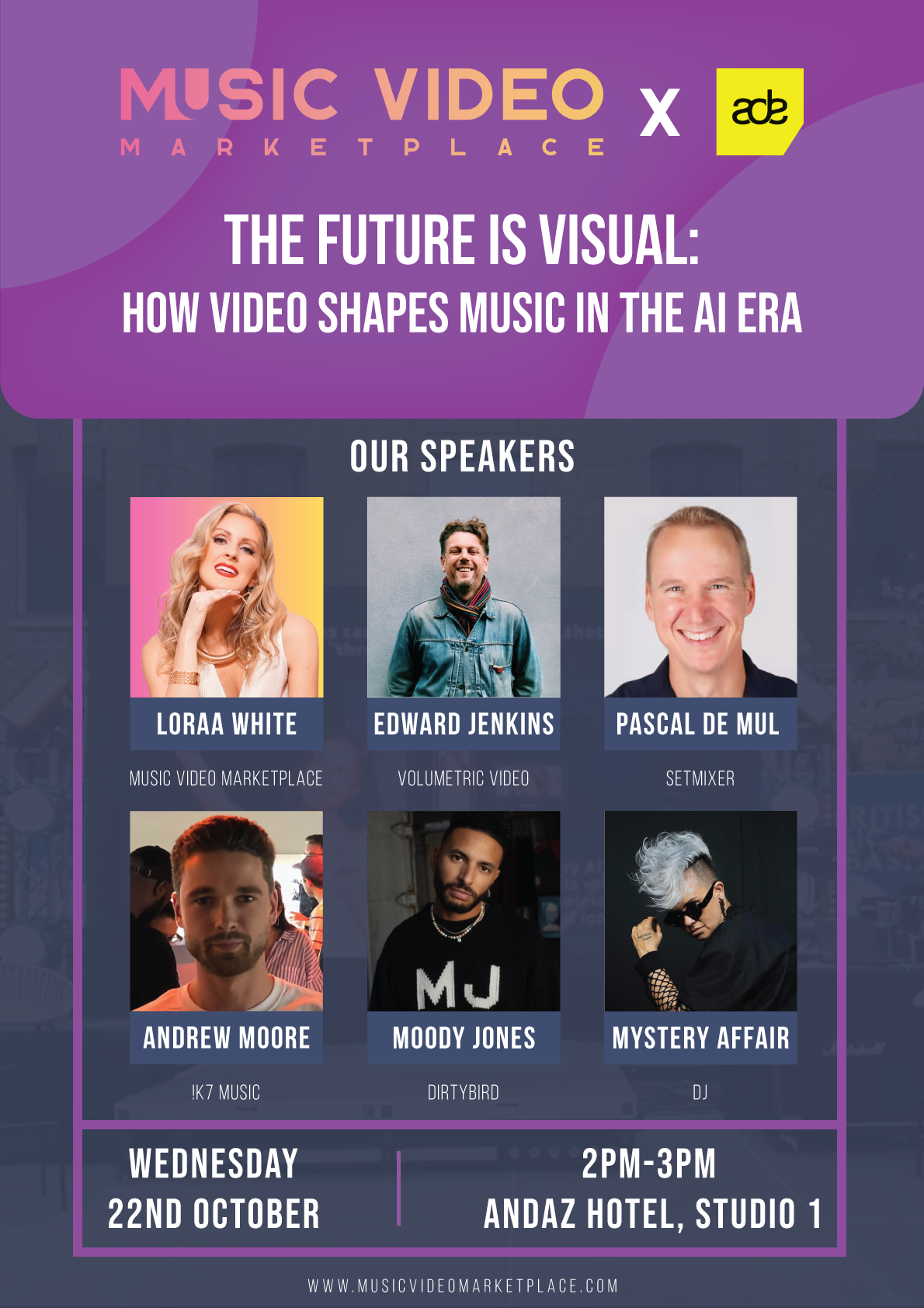 The Future Is Visual: Music Video Marketplace at ADE 2025Music Video Marketplace is heading to Amsterdam where CEO Loraa White will host a panel titled “The Future Is Visual” The session will explore how video and AI are shaping the future of music. Plus, exclusive ADE offers include 25% off all videos and a chance to win a free music video,
 Benefits of tracking artist KPIs for managersDiscover how tracking artist KPIs empowers managers to make data-driven decisions for better tours, marketing, and negotiations.
 Benefits of video for artist acquisition: 2026 guideDiscover the benefits of video for artist acquisition. Learn how video transforms listeners into loyal fans and boosts engagement.
 2025 Dance & Electronic Music - Top TracksDance and electronic music dominated 2025 with chart-topping club anthems, rising UK talent, and a renewed focus on visuals. Discover the biggest tracks, what’s coming in 2026, and why music videos now matter more than ever for DJs and producers.
Turn the idea into a finished music video.
Drop your track into the Studio and build your visual in minutes.