
Content outreach for musicians: your 2026 guide
Discover what is content outreach for musicians. Learn how to engage fans, promote your music, and boost your career with effective strategies.

Content outreach for musicians: your 2026 guide
TL;DR:
- Content outreach for musicians involves creating valuable content and targeting media to grow an engaged audience. Successful artists combine content marketing and strategic pitching, focusing on owned channels like email for reliable communication. Prioritizing quality, research-backed outreach and long-term consistency builds sustainable music careers.
Content outreach for musicians is the practice of combining strategic content creation with direct media pitching to grow an engaged fanbase and secure meaningful music promotion. The industry term for this broader discipline is music marketing, but content outreach specifically describes the two-pronged effort of producing valuable material and placing it in front of the right people. Most musicians focus on one or the other. The artists who build lasting careers do both. This guide covers what content outreach actually involves, which content formats for musicians deliver results, and how to measure whether your efforts are working.
What is content outreach for musicians?
Content outreach for musicians is defined as the deliberate use of content creation and targeted pitching to expand reach, attract new listeners, and deepen relationships with existing fans. It sits at the intersection of content marketing and PR. Content marketing pulls listeners in through value-driven material. Pitching pushes your music out to curators, bloggers, and playlist editors who can amplify it to their audiences.
The two pillars work differently in the fan funnel. Content marketing builds trust over time. Pitching creates placement opportunities that accelerate discovery. Neither replaces the other. A musician who only creates content waits for the algorithm. A musician who only pitches without supporting content gives journalists nothing to work with.
Key tools in this discipline include Spotify for Artists for editorial playlist submission, Meta ads for paid social amplification, and email marketing platforms such as Mailchimp or ConvertKit for direct fan communication. Professional email marketing returns between £30 and £40 for every £1 spent, which makes it one of the highest-return channels available to independent artists. That figure puts email far ahead of social media in terms of direct revenue per pound invested.
What are the core components of content outreach?
Content outreach rests on two pillars: content marketing and strategic pitching. Each serves a distinct purpose, and confusing them is one of the most common mistakes independent musicians make.
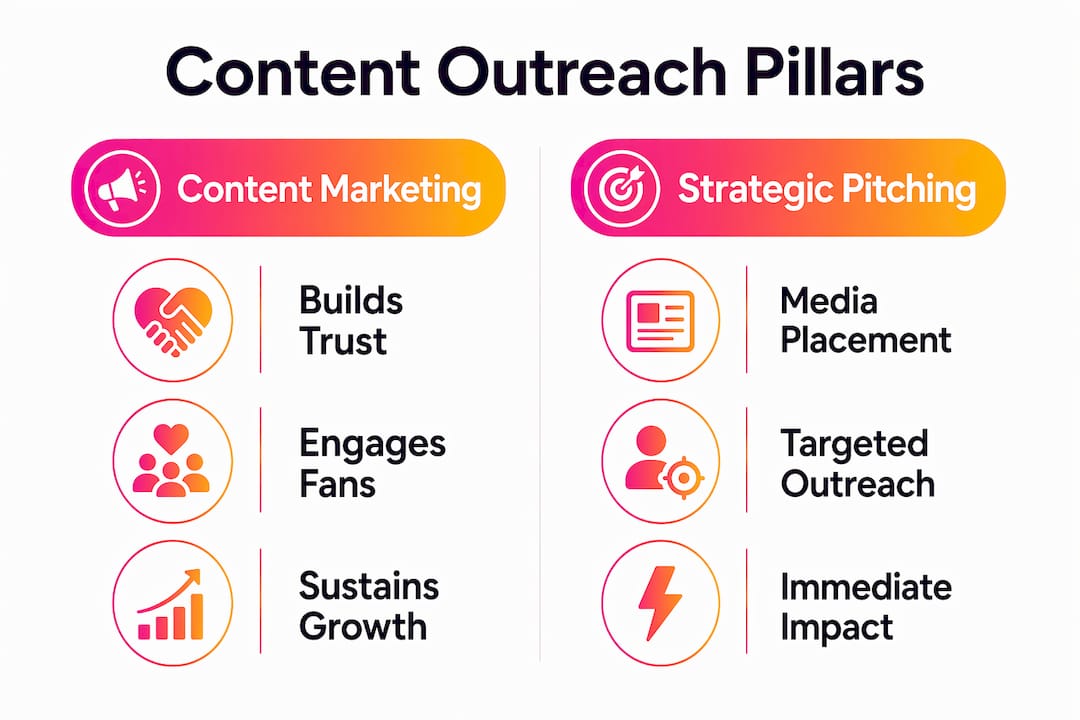
Content marketing means creating material that offers genuine value beyond promoting a release. Tutorials, behind-the-scenes footage, personal stories, and opinion pieces all qualify. The goal is to attract listeners who connect with your personality and values, not just your latest single. Splice’s content guidance for musicians confirms that value-driven content focused on tutorials and personal values attracts lifelong fans rather than casual streams.
Strategic pitching means researching specific outlets, blogs, playlist curators, and journalists, then sending personalised messages that fit their editorial focus. DIY artists typically see acceptance rates of 8–12% from well-targeted pitches. That figure sounds low, but it means one in ten pitches lands when done properly. Mass cold emails without research yield far less.
- Identify 10–15 outlets that cover your genre specifically
- Study their recent coverage before writing a single word of your pitch
- Write one paragraph that explains why your music fits their audience
- Include a link to your electronic press kit, not an attachment
- Follow up once, politely, after seven days
Pro Tip: Keep a pitching spreadsheet with outlet name, contact, date sent, and response. Patterns emerge quickly. You will spot which outlet types respond and which ignore you entirely.
How do musicians choose the right content formats and platforms?
The right content format is the one you can sustain without burning out. That sounds obvious. Most musicians ignore it and spread themselves across five platforms within a month of a release, producing mediocre content everywhere instead of excellent content somewhere.

The Format-Identity Fit principle states that artists should select one or two platforms that align with their personality to avoid burnout and maintain consistent content quality. Forcing formats that feel unnatural leads to audience dilution and creative exhaustion. A classically trained pianist who hates speaking on camera will not thrive on TikTok. A storytelling singer-songwriter with a gift for long-form conversation belongs on YouTube or a podcast.
| Format | Best platform | Effort level | Audience benefit |
|---|---|---|---|
| Long-form video | YouTube | High | Deep connection, searchable |
| Short social clips | TikTok, Instagram Reels | Medium | Discovery, viral potential |
| Behind-the-scenes | Instagram Stories, YouTube | Low | Authenticity, loyalty |
| Podcast or interview | Spotify, Apple Podcasts | Medium | Niche authority |
| Email newsletter | Mailchimp, ConvertKit | Low to medium | Direct, owned relationship |
YouTube deserves particular attention for music promotion techniques. Long-form videos are searchable, evergreen, and indexable by Google. A well-produced video explaining your songwriting process can attract listeners two years after you upload it. Short clips on Instagram Reels or TikTok drive discovery but rarely build the depth of connection that converts a casual viewer into a paying fan. Video content for musicians builds direct audiences in ways that audio alone cannot replicate.
Spotify editorial pitching sits in a category of its own. Submit unreleased tracks through Spotify for Artists at least seven days before release. The editorial team reviews submissions and places qualifying tracks in algorithmic and editorial playlists. This is free, takes ten minutes, and is one of the highest-leverage actions an independent artist can take.
What practical steps execute an effective outreach campaign?
Effective musician outreach strategies follow a sequence. Skipping steps wastes time and money.
-
Build your email list before your next release. Offer a free download, exclusive demo, or early access to lyrics in exchange for an email address. Social media followers are rented. Email subscribers are owned. Musicians must move fans from social platforms to owned channels rapidly to avoid algorithm interference.
-
Create a press kit that journalists can use immediately. Include a 100-word biography, three high-resolution press photos, streaming links, and a one-paragraph pitch. Providing a blog-ready package with a professional EPK link and press photos significantly increases consideration rates compared to cold emails with no supporting material.
-
Periodise your outreach around release cycles. Start pitching six to eight weeks before a release date. Begin content creation four weeks out. Launch paid amplification only after organic engagement confirms the track resonates.
-
Verify organic traction before spending on ads. A track with strong saves-to-streams ratio on Spotify and genuine comment engagement on social media is ready for paid acceleration. Recommended starting ad spend is £5–£20 per day on songs with proven organic traction. Spending money on a track that has not yet found organic interest accelerates nothing.
-
Follow up on pitches once. Send a brief, polite follow-up seven days after your initial pitch. Reference the original email. Do not send a second follow-up. Journalists who are interested respond. Those who are not will not change their minds because you emailed again.
Pro Tip: Personalise every pitch with one sentence that proves you have read the outlet. Name a specific article they published and explain why your music fits the same audience. This single step separates your pitch from the hundreds of generic submissions they receive weekly.
How to measure and refine your outreach effectiveness
Measurement turns guesswork into a repeatable process. Without tracking, you cannot tell whether your content is working or whether your pitching is landing.
Email open rates can reach 52% for music artists with engaged lists, compared to typical social media engagement rates of 15–20%. That gap is significant. It means a list of 1,000 engaged email subscribers delivers more reliable reach than a social following five times that size.
Key metrics to track across your outreach efforts:
- Email: open rate, click-through rate, unsubscribe rate per campaign
- Spotify: saves-to-streams ratio, playlist adds, monthly listener growth
- Social content: saves and shares (not just likes), follower growth rate
- Pitching: response rate, placement rate, publication domain authority
Combining organic content growth with paid acceleration is more effective than either approach alone. The key is sequencing. Organic signals tell you the content works. Paid promotion then amplifies what is already resonating. Spending on ads before organic validation is the single most common budget mistake independent artists make.
Common pitfalls include tracking vanity metrics such as likes and follower counts rather than saves, shares, and email sign-ups. Likes are passive. Saves signal genuine intent to return. Shares extend your reach to new audiences without additional spend. Prioritise these three metrics above all others in your content performance reviews.
What are common misconceptions about musician outreach?
The most damaging misconception in music marketing is that social media presence alone constitutes a promotion strategy. Social media is a discovery tool. It is not a fan ownership tool. An artist with 50,000 Instagram followers but no email list has no direct line to their audience. One algorithm change can cut their organic reach overnight.
Journalists cover music that fits their publication’s editorial mission, not simply to support artists. Understanding this changes how you pitch. Your job is to make their job easier by presenting your music as an obvious fit for their readership. Effective outreach facilitates the journalist’s work rather than asking for a favour.
A second misconception is that more content equals more growth. Quality and consistency beat volume every time. An artist publishing one well-crafted YouTube video per month builds a more loyal audience than one posting daily content that feels rushed or generic. Choosing formats that align with artist identity is a long-term success factor that most musicians underestimate until they have already burned out trying to maintain the wrong channels.
“The goal is not to go viral. The goal is to build a direct relationship with the people who will still be listening to you in ten years.”
That principle separates artists who sustain careers from those who chase trends and exhaust themselves in the process.
Key takeaways
Content outreach for musicians works when content creation and targeted pitching operate together, supported by owned channels that remove dependence on social media algorithms.
| Point | Details |
|---|---|
| Define your two pillars | Content marketing builds trust; strategic pitching creates placement. Both are required. |
| Own your fan channel | Build an email list before every release to communicate directly without algorithm interference. |
| Match format to identity | Select one or two platforms that fit your personality to maintain quality and avoid burnout. |
| Pitch with preparation | Include a press kit, personalised one-paragraph pitch, and press photos to reduce friction for journalists. |
| Measure what matters | Track saves, shares, and email open rates rather than likes and follower counts. |
Why owned channels are the most underrated tool in music marketing
Most musicians I speak with are still treating social media as their primary fan relationship tool in 2026. That approach made more sense five years ago. Algorithms now throttle organic reach on every major platform, and the artists who built large followings without email lists are discovering that reach does not equal access.
The artists I have seen build genuinely sustainable careers share one habit: they move fans off social media and into owned channels as quickly as possible. Not because social media is useless, but because it is unreliable as a primary communication channel. A 52% email open rate versus a 15–20% social engagement rate is not a marginal difference. It is a structural advantage.
The other thing I would push back on is the obsession with pitching volume. Sending 200 generic emails to music blogs is not outreach. It is spam. The artists who get covered are the ones who send 15 carefully researched pitches to outlets that genuinely cover their genre, with a press kit that makes the journalist’s job straightforward. Patience and specificity outperform volume every single time.
Consistency in content creation matters more than frequency. One excellent video per month, paired with a monthly email to your list, beats daily posting that exhausts you and dilutes your message. Build for the long term. The artists who are still releasing music in ten years are the ones who treated outreach as a sustainable practice, not a sprint.
— Music
How Musicvideomarketplace supports your music promotion
Musicvideomarketplace enables musicians to create a long-form video in minutes, upload it to YouTube, and launch an ad campaign for their song without needing a production team or a large budget. Video content sits at the centre of effective content outreach, and YouTube remains the most searchable, evergreen platform available to independent artists.

If you are ready to put the outreach principles in this guide into practice, Musicvideomarketplace gives you the tools to produce professional video content and get it in front of the right audience quickly. Pair that with the song promotion best practices covered on the Musicvideomarketplace blog, and you have a complete foundation for your next release campaign. Start with one video, one email, and one well-researched pitch.
FAQ
What is content outreach for musicians in simple terms?
Content outreach for musicians is the combination of creating valuable content and sending targeted pitches to blogs, curators, and journalists to grow an audience and promote music. It requires both consistent content creation and direct, research-informed outreach to media contacts.
How do I start building a fanbase online as a musician?
Start by choosing one or two platforms that match your personality, create consistent value-driven content, and build an email list from day one. Owned channels such as email deliver far higher engagement than social media alone.
What email open rates should musicians expect?
Musicians with engaged email lists can achieve open rates of up to 52%, compared to typical social media engagement rates of 15–20%. This makes email the most reliable direct communication channel for independent artists.
How many pitches should I send to music blogs?
Send 10–15 highly personalised pitches per release rather than mass emailing hundreds of contacts. DIY artists who research editorial fit and provide a complete press kit typically see acceptance rates of 8–12%.
When should musicians start spending on paid ads?
Spend on paid ads only after a track shows strong organic engagement signals, such as a healthy saves-to-streams ratio on Spotify and genuine social interaction. A starting budget of £5–£20 per day is sufficient to test paid amplification on a track with proven traction.
Recommended
- Examples of video content for musicians in 2026 | Music Video Marketplace Blog
- Types de contenus pour musiciens : guide 2026 | Music Video Marketplace Blog
- Why video content matters for musicians in 2026 | Music Video Marketplace Blog
- Key advantages of YouTube for musicians in 2026 | Music Video Marketplace Blog
Read next
 Create DJ promo videos that drive engagement and bookingsLearn how to create DJ promo videos that boost visibility, grow your fanbase, and attract more bookings with this step-by-step guide for DJs and producers.
 Defining multimedia content strategy for music artistsDiscover the power of defining multimedia content strategy for music artists. Learn how to unify your message across platforms and engage fans.
 Digital music promotion explained: proven strategiesLearn proven digital music promotion strategies for independent artists, covering YouTube, playlist pitching, release cycles, and the metrics that drive real growth.
 Content ID Claims on Your Music Video: What to DoGot a Content ID claim on your music video? Learn why it happens, what each claim type means, how to dispute it and how to stop repeat claims.
Turn the idea into a finished music video.
Drop your track into the Studio and build your visual in minutes.