
Defining multimedia content strategy for music artists
Discover the power of defining multimedia content strategy for music artists. Learn how to unify your message across platforms and engage fans.

Defining multimedia content strategy for music artists
TL;DR:
- A multimedia content strategy coordinates different formats to deliver a unified message across digital channels. Artists should use a hub-and-spoke model and three-horizon approach to maximize reach and long-term growth effectively. Regular content audits and measuring engagement metrics linked to business outcomes ensure sustained performance.
A multimedia content strategy is the planned, coordinated use of multiple formats, including video, audio, text, and visuals, to deliver a single, unified message across digital channels. For music artists and managers, this is the industry term for what many loosely call “content planning.” Getting it right means every music video, social clip, blog post, and podcast episode pulls in the same direction. Without that coordination, even great music gets lost in the noise.
What is defining multimedia content strategy, and why does it matter?
A multimodal content strategy is not simply posting across multiple platforms. It is a deliberate plan that assigns each format a specific role in moving a listener from discovery to loyal fan. The distinction matters because most artists produce content reactively, releasing whatever feels right that week. That approach wastes budget and fragments the audience’s perception of who you are.
Content fails mostly from lack of strategy, not poor writing or weak production. Strategy defines why you are creating content, who it is for, where it will live, and how you will measure whether it worked. For a music professional, that means knowing whether a YouTube long-form video serves discovery, whether Instagram Reels serve retention, and whether a blog post serves search visibility. Each format earns its place.
The hub-and-spoke model is the most practical framework for artists starting out. One pillar asset, typically a long-form music video or artist documentary, sits at the centre. Shorter clips, lyric breakdowns, behind-the-scenes posts, and audio snippets radiate outward from it. This approach maximises reach from a single production effort, which matters enormously when budgets are tight.
Core frameworks for multimedia content planning
Two frameworks dominate effective digital content development in 2026: the hub-and-spoke model and the three-horizon approach. Both are worth understanding before you produce a single piece of content.
The hub-and-spoke model
The hub is your pillar content. For a music artist, that is usually a full-length music video, a live session recording, or a long-form interview. The spokes are derivative assets: a 30-second teaser for Instagram, a lyric graphic for Twitter, a podcast clip for Spotify, and a written breakdown for your website. One production session generates six to ten pieces of content. That is the efficiency gain that makes the model so widely adopted.
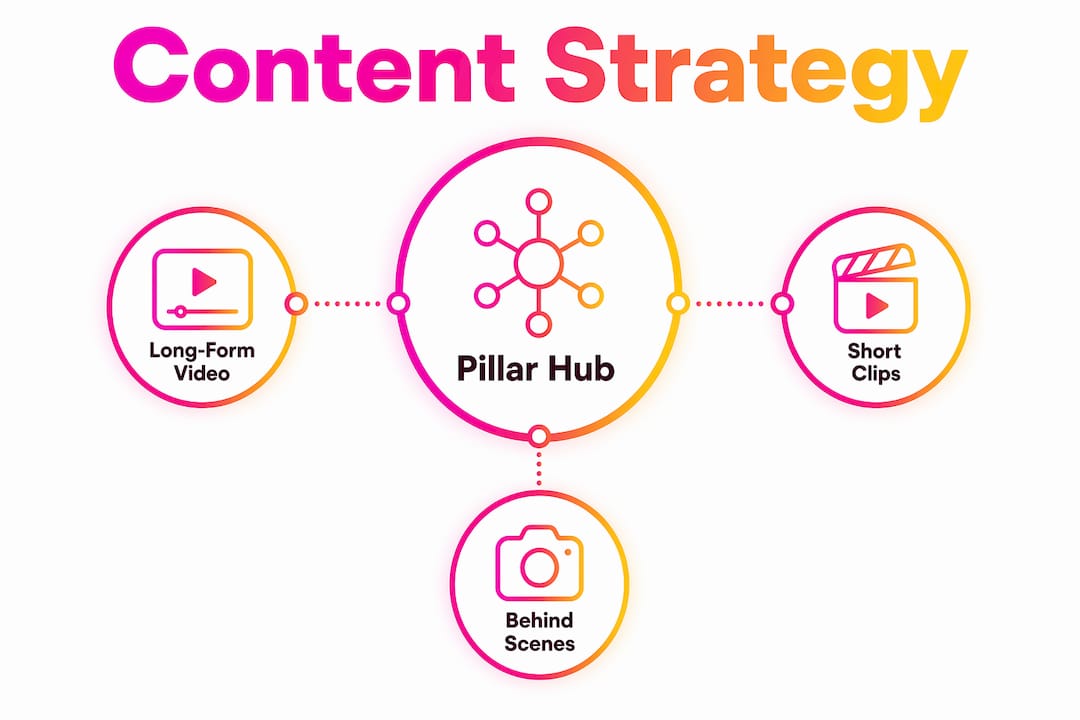
Pro Tip: Film your music video shoot with a second camera operator capturing behind-the-scenes footage. That footage becomes your spokes without any additional studio time.
The three-horizon approach
A three-horizon content plan balances three types of content simultaneously. Horizon one captures immediate demand: new release announcements, tour dates, and trending audio formats. Horizon two builds authority over the medium term: artist interviews, genre explainers, and fan community content. Horizon three compounds over time: evergreen content like “how I wrote this album” documentaries or music theory breakdowns that attract search traffic for years.
Most artists only operate in horizon one. They announce releases and react to trends. The artists who build lasting careers invest in all three horizons at once. A structured three-horizon framework can drive significantly more audience growth than single-horizon approaches because compounding content keeps working long after the release cycle ends.
| Framework | Primary benefit | Best used for |
|---|---|---|
| Hub-and-spoke | Production efficiency | Single releases, album campaigns |
| Three-horizon mapping | Long-term audience compounding | Career-stage content planning |
| Content lifecycle loop | Sustained performance | Ongoing catalogue management |
Outcome-driven KPIs matter more than vanity metrics. Pipeline contribution and audience engagement depth replace raw traffic numbers as the measures that actually tell you whether your strategy is working. For artists, that means tracking stream conversions, email sign-ups from content, and ticket sales attributed to specific content pieces.
How do AI and search engines affect content visibility in 2026?
Effective 2026 strategies treat Google and AI answer engines as a single visibility surface. That is a significant shift from the old approach of optimising purely for Google rankings. AI tools like ChatGPT and Perplexity now surface content directly in answers, and the overlap between what ranks on Google and what gets cited by AI is often small. You need to satisfy both.
The practical implication is that your content must tell a complete problem-to-solution story in crawlable text. A music video alone cannot be indexed meaningfully by a search engine or cited by an AI tool. The video needs a written companion: a description, a transcript, or a blog post that explains the context, the story behind the track, and the artist’s intent.
- State the main point of any page in the first two sentences, not buried in paragraph four.
- Use descriptive H2 and H3 headings that mirror the questions your audience actually types into search.
- Crawlable text must accompany every video or image-heavy page; answers hidden inside media files are invisible to both search engines and AI crawlers.
- Link between related content on your site to signal topical authority and help crawlers map your catalogue.
- Write for music storytelling that spans platforms rather than treating each channel as a separate silo.
Pro Tip: Write a 300-word “story behind the track” post for every release. It costs little time, gives search engines something to index, and gives AI tools a narrative to cite when fans ask about your music.
How do you create a multimedia strategy for music campaigns?
Creating a multimedia strategy starts with a single document: the multimodal content brief. A multimodal brief aligns a 2,000-word article, a long-form video, and a series of short clips around the same core message, audience, and goals. Without this document, different team members produce content that looks disconnected even when it covers the same release.
The brief answers four questions before production begins: What is the core message? Who is the primary audience? Which channels will carry which formats? How will performance be measured? Answering these questions upfront reduces revision cycles and keeps the campaign coherent from the first teaser to the final retrospective post.
- Define your core message. Every piece of content in the campaign must connect to one central idea. For a new single, that might be the emotional theme of the track or the story of how it was made.
- Map your formats to your channels. Long-form video goes to YouTube. Short clips go to Instagram Reels and TikTok. Written content goes to your website and email list. Each format serves the channel’s native consumption behaviour.
- Produce the pillar asset first. Film the music video or record the long-form session before creating any derivative content. This gives you the raw material for all spokes.
- Repurpose systematically. Extract clips, quotes, stills, and audio segments from the pillar asset. Each becomes a spoke in the hub-and-spoke model.
- Schedule for sustained release. Do not publish everything on release day. Spread spokes across four to six weeks to maintain algorithmic momentum and keep the audience engaged beyond the initial announcement.
Musicvideomarketplace makes step three significantly faster. Artists can create a long-form music video in minutes, upload it to YouTube, and launch an ad campaign for the track without needing a production team. That speed changes the economics of the hub-and-spoke model for independent artists.
Short-form video is a spoke, not a hub. Short-form videos promote music effectively in 2026, but they work best when they point back to a richer pillar asset. An artist who only posts Reels builds attention without depth. Attention without depth does not convert to streams, ticket sales, or loyal fans.

How do you manage content performance over time?
Content strategy is a continuous loop, not a one-off campaign. Treating it as a loop means planning, creating, maintaining, and pruning assets on a regular cycle. Artists who audit their content catalogue every quarter consistently outperform those who only create new material.
An audit classifies every existing asset into one of four categories: keep as is, optimise with updated information, consolidate with a related piece, or retire because it no longer serves the strategy. This process is faster than producing new content from scratch, and it protects the authority you have already built.
Common pitfalls in music content management, and how to avoid them:
- Producing without auditing. New content cannibalises old content when topics overlap. Audit before you create.
- Measuring only streams and views. AI visibility metrics and audience engagement depth tell you far more about long-term growth than raw play counts.
- Abandoning evergreen content. A “making of” documentary from two years ago still attracts new fans. Update it with a new introduction rather than letting it go stale.
- Ignoring the email list. Social algorithms change. Your email list is the only audience you own outright. Every content campaign should include a mechanism to grow it.
Track music campaign metrics that connect content to business outcomes: email sign-ups per campaign, stream conversions from YouTube, and ticket sales attributed to specific content pieces. These numbers survive budget reviews in a way that view counts do not.
Key takeaways
A multimedia content strategy works because it coordinates every format around one message, measured against outcomes that actually matter to your career.
| Point | Details |
|---|---|
| Define before you produce | Write a multimodal brief answering message, audience, channels, and KPIs before any production begins. |
| Use hub-and-spoke | Build one pillar asset per release and repurpose it into six to ten derivative pieces across channels. |
| Satisfy AI and search | Pair every video with crawlable text so both search engines and AI tools can surface your content. |
| Plan all three horizons | Balance immediate release content, medium-term authority building, and long-term evergreen assets simultaneously. |
| Audit, do not just create | Classify existing assets quarterly as keep, optimise, consolidate, or retire before producing anything new. |
What I have learned from watching artists get this wrong
Most artists I work with arrive with the same problem. They have great music and terrible content coordination. They release a single, post a few clips, and then go quiet for three months while they make the next track. The audience they built during the release evaporates. The algorithm forgets them. They start from zero every time.
The fix is not more content. The fix is a plan that keeps the campaign alive after release day. That means scheduling spokes across weeks, publishing evergreen content that keeps working in the background, and treating the email list as the most valuable asset in the catalogue.
The other mistake I see constantly is treating video as the whole strategy rather than the centre of it. A music video is a pillar, not a complete plan. The artists who grow consistently are the ones who surround that video with written context, social conversation, and search-visible text. They think about music branding through video as one layer of a larger identity, not the identity itself.
The platforms will keep changing. The principle will not. Coordinate your formats, measure what matters, and keep the loop running.
— Music
How Musicvideomarketplace fits into your content plan
Musicvideomarketplace is built for the exact moment when artists need to move from strategy to production without losing weeks to logistics.

The platform lets you create a long-form music video in minutes, upload it directly to YouTube, and launch an ad campaign for your track from a single workflow. That means your pillar asset, the hub of your entire content plan, is ready before your competitors have finished briefing a production company. Artists and managers who want to put a coordinated multimedia campaign into motion quickly will find the tools they need at Musicvideomarketplace, without the overhead of a full production team.
FAQ
What is a multimedia content strategy?
A multimedia content strategy is the planned, coordinated use of multiple formats, including video, audio, text, and visuals, to deliver one unified message across digital channels. For music artists, it connects every release asset into a single, measurable campaign.
What is the hub-and-spoke model in content planning?
The hub-and-spoke model places one pillar asset, such as a music video, at the centre of a campaign. Shorter derivative pieces, including clips, posts, and audio segments, radiate outward from it to maximise reach from a single production effort.
How does AI affect music content visibility in 2026?
AI answer engines and Google now function as a unified visibility surface. Content must include crawlable text alongside video and images so that both search engines and AI tools can index and cite it accurately.
How often should artists audit their content?
A quarterly content audit is the standard practice for sustained performance. Classifying assets as keep, optimise, consolidate, or retire is faster than producing new content and protects existing authority.
What KPIs should music artists track for content strategy?
Track email sign-ups, stream conversions from specific content pieces, and ticket sales attributed to campaigns. Raw view counts and traffic volume are less useful than metrics that connect content directly to career outcomes.
Recommended
- Effective video content strategies for musicians: a guide | Music Video Marketplace Blog
- Artist video content strategy for YouTube success 2026 | Music Video Marketplace Blog
- Content-Formate für Musiker: Der Praxis-Guide 2026 | Music Video Marketplace Blog
- Explaining music release strategies: your 2026 guide | Music Video Marketplace Blog
Read next
 Digital music promotion explained: proven strategiesLearn proven digital music promotion strategies for independent artists, covering YouTube, playlist pitching, release cycles, and the metrics that drive real growth.
 How to Earn From Music Videos: Seven UK Income RoutesLearn how UK artists earn from music videos: YouTube ads, Content ID, royalties, sync licensing and Subsequent Payments, with the rules and figures behind each.
 Educational Video for Musicians: Boosting Song ReachEducational video for musicians explained: types, creation process, copyright rules, and best practices for impactful YouTube promotion by independent artists.
 Create DJ promo videos that drive engagement and bookingsLearn how to create DJ promo videos that boost visibility, grow your fanbase, and attract more bookings with this step-by-step guide for DJs and producers.
Turn the idea into a finished music video.
Drop your track into the Studio and build your visual in minutes.