
Music distribution explained: how to get your songs heard
Discover what is music distribution and how it ensures your songs reach Spotify, Apple Music, and more. Get your music heard today!
Music distribution explained: how to get your songs heard
TL;DR:
- Music distribution connects recordings to major streaming platforms by ensuring compliance, rights management, and proper formatting. Properly executed, it enables discoverability, accurate royalty collection, and effective promotion, making your music accessible worldwide. Mistakes in metadata or content details can cause delays, rejection, or lost revenue, so thorough preparation and best practices are essential.
Clicking “upload” feels like it should be enough. You’ve written the song, recorded it, mixed it, and now you just want people to hear it. But the reality of getting your music onto Spotify, Apple Music, or Amazon Music involves a layered process that trips up thousands of independent artists every year. Music distribution is the process of making a recording available on digital and sometimes physical sales and streaming channels by satisfying each platform’s technical and rights requirements and delivering properly formatted audio and metadata. This guide breaks all of that down so you can release with confidence.
Table of Contents
- What is music distribution and why does it matter?
- How music distribution works: the step-by-step workflow
- Major distribution pitfalls and how to avoid them
- Distribution, promotion, and getting noticed
- The overlooked realities of independent music distribution
- Get support for your next release
- Frequently asked questions
Key Takeaways
| Point | Details |
|---|---|
| Distribution ensures platform access | Proper music distribution gets your songs onto Spotify, Apple Music, and other key streaming services. |
| Metadata quality is crucial | Accurate metadata and artwork are non-negotiable for a smooth release and proper credit. |
| Plan releases in advance | Scheduling releases a few weeks early can prevent costly delays or missed momentum. |
| Avoid common pitfalls | Most release failures come from avoidable mistakes in metadata or asset preparation. |
| Promotion follows distribution | Getting your music live is step one—use smart promotion to maximise listener reach. |
What is music distribution and why does it matter?
Music distribution is the bridge between your recorded track and every listener who could potentially discover it. Without it, your song simply does not exist on any major platform. With it, your track becomes searchable, streamable, and monetisable across dozens of digital storefronts worldwide.
At its core, music distribution is the process of making a recording available on digital and sometimes physical sales and streaming channels by satisfying each platform’s technical and rights requirements and delivering properly formatted audio and metadata. That definition matters because it tells you that distribution is not just logistics. It is also compliance, rights management, and identity verification.
Every digital platform, known in the industry as a DSP (Digital Service Provider), has its own technical standards. Spotify requires lossless audio files in WAV or FLAC format. Apple Music enforces strict artwork specifications. YouTube Content ID requires you to register ownership before you can monetise. Each of these requirements must be met before your music goes live, and failing even one of them can result in a rejected release.
Why does this matter for your career?
- Your music cannot be found in search results without proper metadata tagging
- Royalties depend entirely on correct rights attribution, which starts at distribution
- Playlist curators and algorithmic discovery systems rely on accurate genre, mood, and release data
- Incorrect information can split your streaming numbers across duplicate artist profiles
The role of video content in music distribution is also growing rapidly. Artists who pair audio releases with strong visual content see significantly higher engagement rates. Distribution now stretches beyond audio files alone.
| Distribution element | What it does |
|---|---|
| Audio file delivery | Gets your track onto DSP servers in the correct format |
| Metadata submission | Ensures correct crediting, searchability, and genre tagging |
| ISRC/UPC codes | Uniquely identifies each track and release for royalty tracking |
| Rights registration | Confirms ownership and unlocks monetisation |
| Territory configuration | Controls which countries your music is available in |
The numbers reflect how vital this ecosystem is. Over 100,000 tracks are uploaded to streaming platforms every single day, which means getting your distribution right is not just about being present. It is about being correctly represented in a sea of competition.
How music distribution works: the step-by-step workflow
Now that it is clear what music distribution entails, let us walk through a typical distribution workflow so you can see how it is put into practice.
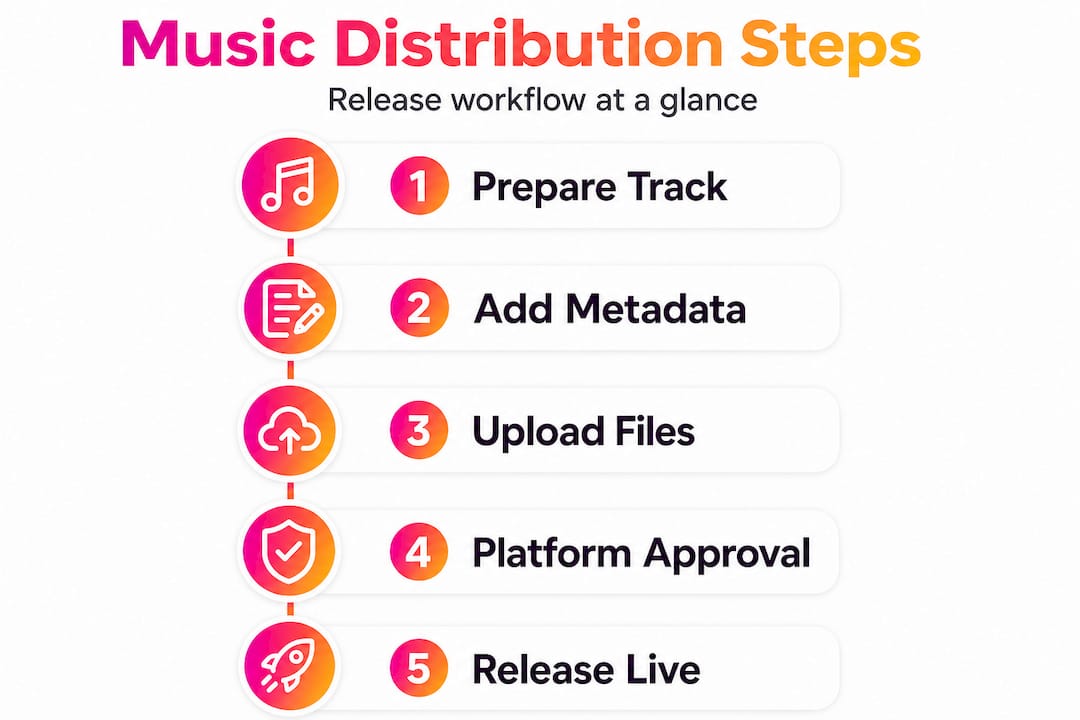
A practical independent release workflow that is consistently emphasised by artist distribution guides is: prepare compliant audio assets and artwork, gather complete metadata and required identifiers, schedule release with lead time, deliver via distributor for DSP ingestion, then promote while tracking royalties.
Here is what that looks like in real steps:
- Prepare your audio files. Export your final mix as a 24-bit WAV file at 44.1 kHz. This is the standard that most distributors and DSPs require. Do not submit a compressed MP3 as your master file.
- Create compliant artwork. Most platforms require a square image that is at least 3000 x 3000 pixels in JPEG or PNG format. It must not contain any URLs, social media handles, or blurred imagery.
- Gather your metadata. This includes your track title, artist name, featured artists, songwriters, producers, ISRC code (for each track), UPC code (for the release), genre, release date, and explicit content flag.
- Choose a distributor. Independent artists typically use a digital distributor or aggregator to access DSPs. These services handle the technical delivery on your behalf in exchange for either a flat annual fee or a percentage of royalties.
- Schedule your release with lead time. Submit your release well before your target date. This allows time for ingestion, review, and any corrections if the platform flags an issue.
- Deliver and monitor ingestion. Once submitted, your distributor sends your files to each DSP. Ingestion (the process of a platform accepting and processing your files) typically takes 24 to 72 hours, though some platforms take longer.
- Promote during the pre-release window. Use this time to pitch to playlist curators through Spotify for Artists, build anticipation on social media, and prepare your music release essentials so launch day has momentum behind it.
- Track royalties and streaming data. After release, monitor your distributor dashboard. Royalty reports show you where your plays are coming from and how much you have earned in each territory.
Pro Tip: Schedule your release at least 2 to 4 weeks before your target date. Submitting last minute is one of the most avoidable causes of a delayed launch. Some platforms, particularly Apple Music, prefer even longer lead times for editorial consideration.
“The artists who consistently release well are the ones who treat distribution as a campaign, not a checkbox. They build the pre-release window into their schedule from day one.”
Your YouTube upload guide is a separate but equally important piece of this puzzle. YouTube has its own Content ID and delivery requirements, and handling video distribution correctly from the start protects your revenue stream on the platform.
Major distribution pitfalls and how to avoid them
While the workflow may sound straightforward, many artists run into preventable issues. Here are the most common pitfalls and how you can avoid them.
Distribution failures and delays are most commonly caused by metadata and content problems such as mismatched artist names or IDs, incorrect explicit or clean flags, wrong or incorrect codes, and artwork or formatting issues, which can lead to rejection, misattribution, or cancellation until corrected.
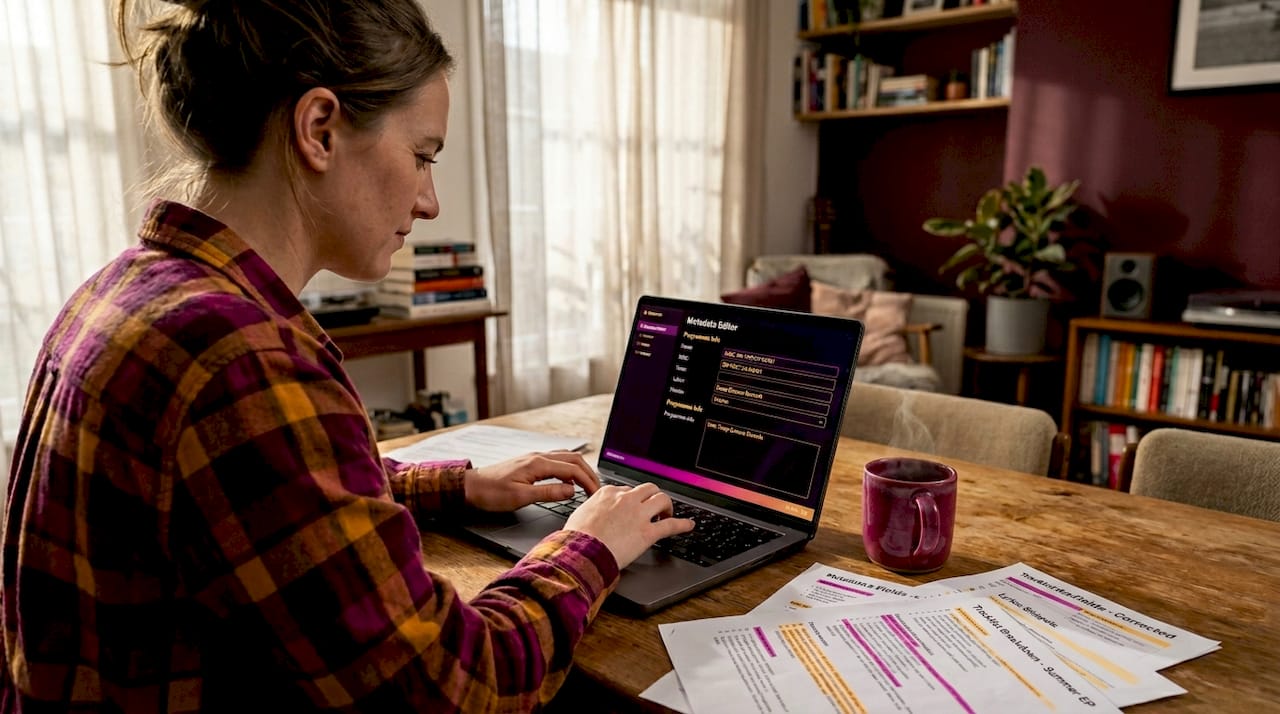
These are not edge cases. They happen constantly, even to experienced artists who are releasing their fifth or sixth record. The difference between a smooth release and a stressful one often comes down to a single field being filled in incorrectly.
Common pitfalls to watch for:
- Inconsistent artist name spelling across platforms (e.g., “The Johns” vs “Johns, The”)
- Missing or duplicated ISRC codes on individual tracks
- Artwork that contains text, a website URL, or social media information
- Wrong explicit content flag, marking a clean track as explicit or vice versa
- Mismatched featured artist credits between the audio file tags and the distributor submission form
- Incorrect release type (single vs EP vs album) which affects how platforms categorise and display your work
Here is a side-by-side look at correct versus incorrect practice for some of the most common submission fields:
| Field | Incorrect practice | Correct practice |
|---|---|---|
| Artist name | “Dave smith” | “Dave Smith” (consistent capitalisation, matches all platforms) |
| Explicit flag | Marked as clean despite containing profanity | Correctly flagged as explicit |
| Artwork resolution | 1500 x 1500 pixels JPEG | 3000 x 3000 pixels JPEG, no text overlays |
| ISRC code | Left blank or duplicated from another track | Unique ISRC for each individual track |
| Release date | Same day as submission | At least 2 to 4 weeks from submission date |
| Genre | Left at default “Pop” | Accurate primary and secondary genre tags |
The consequences of getting these wrong range from minor delays to full rejection. Worse, a misattributed ISRC can mean your royalties are paid to the wrong party or go unclaimed entirely.
Pro Tip: Create a personal distribution checklist and run through it before every submission. Include every field above and add any others your chosen distributor flags as common errors. Five minutes of checking can save two weeks of waiting.
A well-managed YouTube distribution workflow follows the same principles. Correct titles, descriptions, and content IDs on YouTube protect your income and improve searchability for your visual content too.
Distribution, promotion, and getting noticed
Even after a flawless release, distribution is only the beginning. Here is how it connects directly with effective music promotion and boosting your audience.
Distributors and aggregators handle delivery to DSPs, metadata formatting, rights and ownership verification prerequisites, assignment and maintenance of identifiers such as ISRC and UPC codes, territory and release configuration, and the downstream monetisation workflow including royalties reporting and payout. In short, a clean distribution sets up every promotional opportunity that follows.
When your metadata is accurate and your ownership is verified, you unlock several important promotional pathways:
- Spotify for Artists pre-save campaigns. These require your release to be live in the Spotify system before fans can save it. Early distribution enables early pre-save setup.
- Editorial playlist pitching. Spotify allows you to submit tracks for editorial consideration up to seven days before release. Apple Music and Amazon Music have similar processes. All of them require your release to be properly submitted and in review before you can pitch.
- Algorithmic discovery. Platforms like Spotify use your metadata, genre tags, and listener behaviour to recommend your music to new audiences through features like Discover Weekly and Release Radar.
- Social media linking. Properly distributed releases generate a Spotify artist page link, an Apple Music artist profile, and shareable smart links that route listeners to their preferred platform.
Studies have found that tracks submitted with complete and accurate metadata receive considerably more algorithmic recommendations than those with missing or generic tagging. The platform rewards artists who respect the system.
Your online promotion strategies should begin the moment your distributor confirms submission. Do not wait until release day. The pre-release window is when you should be warming up your audience, engaging press, and building anticipation.
Strong music promotion strategies also include visual content. Pairing your audio release with a compelling music video or lyric video creates a second discovery point on YouTube and social platforms. Music video strategies extend your promotional reach well beyond what audio alone can achieve.
The overlooked realities of independent music distribution
With these fundamentals covered, let us step back for a candid look at what most guides miss about the independent music distribution process.
Most distribution guides treat the process as a purely technical task. Submit files, wait, release. But after working with independent artists across many genres, the pattern is clear: the musicians who grow fastest are the ones who treat distribution as the foundation of a larger creative and commercial strategy, not just a formality they tick off before moving on.
Here is what rarely gets said: your metadata is essentially your music’s CV. It tells platforms who you are, what genre you make, who you collaborated with, and where your music belongs. Skimping on it is the equivalent of sending a job application with your name spelt wrong. You might still get through, but you will not be taken seriously.
The other overlooked reality is the compounding effect of small errors. A single typo in your artist name can create a duplicate profile that splits your streaming numbers. Mismatched credits can mean a collaborator does not receive their royalty share. An incorrect ISRC can cause your track to be unrecognised by Content ID systems, leaving YouTube ad revenue unclaimed. These are not hypothetical problems. They happen to artists at every level of experience.
We have also noticed that artists who invest in visual assets before their release date consistently perform better in the first 30 days. A video ad campaign launched in parallel with your audio release creates dual discovery channels and gives you paid promotional options that audio-only artists simply do not have access to.
The uncomfortable truth is that most independent releases underperform not because the music is weak, but because the infrastructure around the release was not prepared. Distribution is not bureaucracy. It is the architecture that determines whether your music reaches its potential audience or disappears into the catalogue of 100,000 daily uploads that nobody hears.
Get support for your next release
Armed with new knowledge, here is how you can tap into expert resources for your next distribution and promotion push.
Understanding distribution theory is one thing, but executing a well-structured release campaign is another challenge entirely. That is where having the right tools and support makes a genuine difference.

Music Video Marketplace is built specifically for independent artists who want to move fast without cutting corners. We enable musicians to create a long form video in minutes, ready to upload to YouTube, and then build a targeted ad campaign around that song. Instead of spending weeks coordinating assets, you can have a professional video and a live ad campaign running alongside your distribution in a fraction of the time. For indie artists who want their next release to actually land, this is the kind of support that closes the gap between a release and a real promotion push.
Frequently asked questions
What’s the difference between a distributor and a music aggregator?
A distributor provides direct delivery to digital and physical sales channels, while an aggregator groups multiple artists’ releases for efficient delivery to streaming platforms. Both handle delivery to DSPs, metadata formatting, rights verification, and royalty reporting, but their structures and pricing models differ.
Do I need an ISRC or UPC code to distribute music?
Yes, these identifiers are essential for correct tracking, reporting, and royalty payout on nearly all major platforms. ISRC and UPC assignment is required for territory and release configuration and the downstream monetisation workflow.
What are the most common reasons a song gets rejected by streaming platforms?
Most rejections are due to metadata errors, mismatched artist information, incorrect explicit flags, or artwork that does not meet requirements. Distribution failures are most commonly caused by these metadata and content problems.
How far in advance should I schedule my release?
Plan to schedule your release 2 to 4 weeks ahead to prevent delays and maximise pre-release promotion. Scheduling releases with adequate lead time significantly reduces the risk of rejection or delays that can harm your release momentum.
Does distribution cover music video platforms too?
Some distributors support delivery to video platforms, but you often need separate video-specific workflows. YouTube in particular has its own Content ID system and delivery requirements that are distinct from standard audio distribution processes.
Recommended
- Digital music promotion explained: proven strategies | Music Video Marketplace Blog
- Optimise your YouTube music distribution workflow | Music Video Marketplace Blog
- Music industry marketing explained: strategies for indie artists | Music Video Marketplace Blog
- Promote your music online: essentials for indie artists | Music Video Marketplace Blog
Read next
 Music industry marketing explained: strategies for indie artistsLearn what music industry marketing really means for indie artists, with actionable strategies, real case studies, and channel benchmarks to grow your career in 2026.
 Music marketing trends shaping success for independent artistsDiscover the top music marketing trends shaping success for independent artists in 2026, from video strategies to AI tools and fan community building.
 Music promotion ideas for DJs: 2026 guideDiscover effective music promotion ideas for DJs in 2026! Elevate your reach with digital strategies, playlist pitching, and social media tips.
 Music Branding Through Video: Amplifying Artist IdentityMusic branding through video maximizes artist visibility, connects with fans, and powers YouTube ad campaigns. Learn visual branding essentials and strategies.
Turn the idea into a finished music video.
Drop your track into the Studio and build your visual in minutes.