
How to write music video scripts: a practical guide
Learn how to write music video scripts that transform songs into visual stories. Master the art of crafting compelling AV scripts today!

How to write music video scripts: a practical guide
TL;DR:
- A music video script is a two-column document aligning audio cues with visual instructions to tell a visual story. Developing a clear concept and detailed treatment ensures cohesive storytelling and avoids costly on-set changes, while an industry-standard AV format keeps audio and visuals synchronized for efficient production. Proper scripting emphasizes emotional authenticity, matching visual energy to music and planning for flexibility to create engaging videos on limited budgets.
A music video script is a two-column document that synchronises audio cues with corresponding visual elements to create a cohesive visual story. Known in the industry as an Audio/Visual script, or AV script, it is the primary planning tool that separates a polished production from a disorganised shoot. Learning how to write music video scripts means understanding that your job is not to transcribe lyrics onto a page. Your job is to translate a song’s emotional truth into a sequence of images that work with or without sound.
How to develop a concept and treatment for your music video script
The concept is the soul of the project, dictating every shot, location, and casting decision before a single camera rolls. Without a strong central theme, you are essentially pointing a camera at someone performing a song. That produces footage, not a music video.
A concept answers one question: what does this song feel like, and how do you show that feeling visually? A track about loneliness might centre on a single figure in an empty city. A high-energy dance record might use fragmented, kaleidoscopic imagery. The concept does not need to be complex. It needs to be clear.
Once your concept is solid, write a treatment. A treatment is a short 2-page document that outlines the story, visual style, colour palette, and key imagery. Think of it as a pitch document that aligns the artist, director, and production crew before anyone commits time or money. A well-written treatment prevents expensive misunderstandings on set.
Follow these steps to build your concept and treatment:
- Listen to the track repeatedly. Note the emotional arc, the tempo shifts, and the moments that feel most cinematic.
- Write a one-sentence concept statement. If you cannot summarise the idea in one sentence, it is not clear enough yet.
- Research visual references. Collect film stills, photography, and artwork that match the mood. Directors call this a mood board.
- Draft the treatment. Cover the story, the visual world, key scenes, and the overall tone. Keep it to two pages.
- Share it with the artist and crew. Gather feedback and revise before moving to the full script.
Pro Tip: Kill expensive ideas at the treatment stage, not on shoot day. If a scene requires a helicopter or a crowd of 200 extras, flag it now and find a creative alternative that serves the same emotional purpose.
What are the key components of a professional music video script?
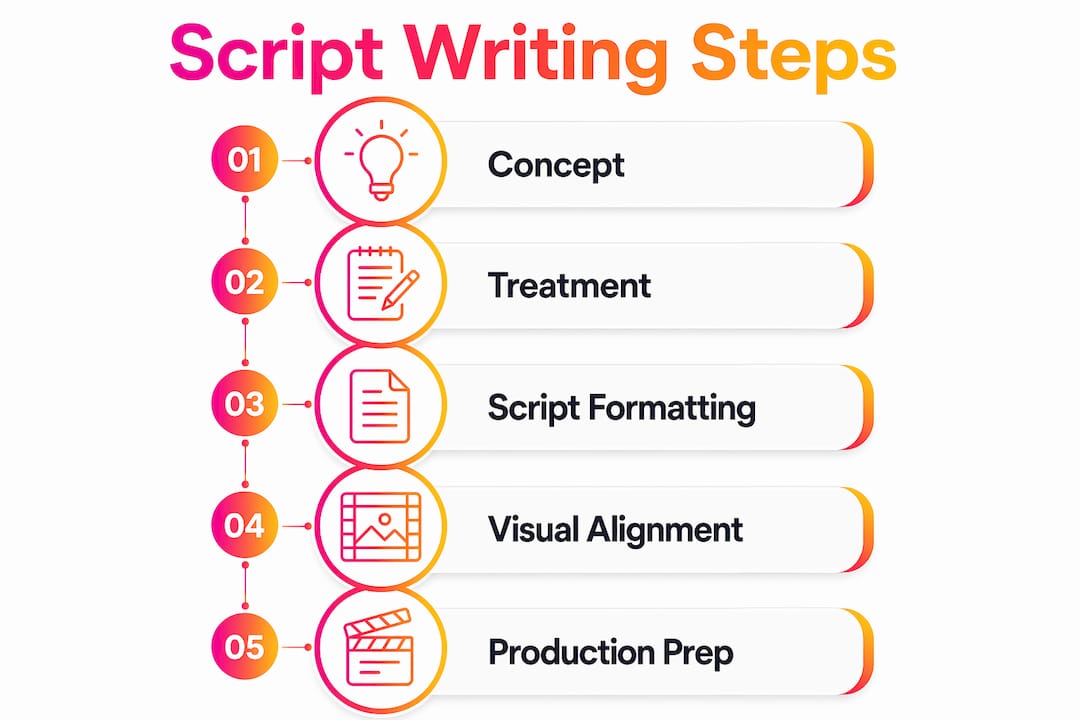
The industry-standard format for a music video script is the two-column AV script. The left column contains all audio information: lyrics, music cues, sound effects, and voiceover. The right column contains the corresponding visual descriptions: scene headings, action lines, camera angles, and transitions. Every row in the table represents a moment in time, keeping audio and visual locked together.
This format is not arbitrary. It forces you to think about what the viewer sees at the exact moment they hear each lyric or musical phrase. That discipline produces tighter, more intentional storytelling.
| Script component | Purpose |
|---|---|
| Scene heading | Identifies location, time of day, and interior or exterior setting |
| Audio column (left) | Contains lyrics, music cues, and any spoken dialogue |
| Visual column (right) | Describes action, camera angle, and shot type for each audio moment |
| Timing cues | Marks specific timestamps or bar numbers to synchronise edits |
| Transitions | Indicates cuts, dissolves, or wipes between scenes |
| Camera directions | Specifies movements such as pan, tilt, dolly, or close-up |
Timing cues deserve particular attention. Mark the timestamps where the chorus hits, where the beat drops, and where the song goes quiet. These are your editorial anchors. An editor working from your script should be able to cut the video without ever speaking to you.
Pro Tip: Write your visual descriptions in present tense and active voice. “The camera pushes in on her face” is clearer than “A close-up is used.” Your crew reads dozens of scripts. Make yours the easiest one on set.
How do you align visuals with musical energy and narrative?
Matching visual intensity to musical energy is the core technique that separates a professional music video from amateur footage cut to a song. Slow, calm visuals belong in the quiet verses. Fast cuts, dynamic camera movements, and high-contrast imagery belong in the chorus and bridge. When the music swells, the edit should swell with it.
The deeper skill is interpreting subtext rather than literal meaning. A lyric about “burning bridges” does not require footage of an actual fire. It might mean a character walking away from a relationship, shot in warm amber tones with a slow zoom out. Interpreting the music’s subtext produces imagery that feels emotionally true rather than illustrative.
Plan for silent viewing from the start. Many music videos are watched without sound, particularly on social media platforms where autoplay defaults to mute. Your visuals must tell a compelling story independently. If the video only makes sense with the audio, you have a problem. Strong visual storytelling works on both levels simultaneously.
Key techniques for visual and musical alignment:
- Map the song’s emotional arc. Write out the energy level of each section (verse, pre-chorus, chorus, bridge) before scripting a single shot.
- Use colour temperature as an emotional signal. Warm tones suggest intimacy or nostalgia. Cool tones suggest distance or tension.
- Match cut rhythm to tempo. In a 120 BPM track, cuts every two beats feel natural. Cutting against the beat creates deliberate tension.
- Script reaction shots. Faces carry emotion. A close-up of a character reacting to an event often communicates more than the event itself.
- Plan for the silent viewer. Include visual storytelling devices such as text on screen, expressive performance, and clear narrative action that read without audio.
AI tools can assist with initial script drafts. Specificity in your prompts determines the quality of the output. Include the genre, tempo, emotional tone, setting, and any narrative details. A vague prompt produces a generic script. A detailed prompt produces a usable starting point. You can also find music video content ideas that help frame your visual direction before you open an AI tool.
Understanding how short-form video promotes music in 2026 also shapes scripting decisions. Clips from your video will likely circulate on short-form platforms, so script at least two or three visually arresting moments that work as standalone excerpts.
How do you prepare your music video script for production?
A finished script is not a finished plan. The next step is a script breakdown, which acts as a master inventory for production. Every location, prop, costume, piece of equipment, and crew member gets listed against the scenes that require them. A thorough breakdown prevents the most common and costly production mistake: arriving on set without something you need.
Follow this process to move from script to production-ready plan:
- Colour-code your script by category. Use one colour for locations, another for props, another for special equipment. This makes the breakdown faster and harder to miss.
- List every location and check availability. Confirm permits, access times, and any restrictions before locking the shoot schedule.
- Build a shot list from the script. Every visual description in your right-hand column becomes a shot. Number them and assign each to a shooting day.
- Share the script with every department head. The director of photography, the art director, and the costume designer all need the script before pre-production meetings begin.
- Flag open scenes deliberately. Over-scripting kills authenticity. Mark certain scenes as flexible, giving the artist room to perform naturally rather than hitting pre-set marks.
Open scenes are a professional technique, not a sign of poor planning. The best music video directors script the structure tightly and leave specific moments unscripted to capture genuine performance energy. That balance between control and spontaneity is what gives great music videos their life. For a deeper look at how music video automation can support your production workflow, the Musicvideomarketplace blog covers the practical side in detail.
Key takeaways
A strong music video script combines a clear concept, an industry-standard AV format, and a thorough production breakdown to turn a song into a visual story.
| Point | Details |
|---|---|
| Start with a concept | Define the central theme in one sentence before writing a single line of script. |
| Write a treatment first | A 2-page treatment aligns the artist and crew before production begins. |
| Use the AV script format | Two columns keep audio and visual locked together throughout the script. |
| Match visuals to musical energy | Slow cuts for quiet sections, fast cuts for high-energy moments. |
| Build a script breakdown | List every location, prop, and crew requirement to avoid costly delays on set. |
What I have learned from scripting music videos
The biggest mistake I see from first-time music video writers is treating the script as a formality. They write something vague, hand it to the crew, and assume everyone will figure it out on the day. They never do. A vague script produces a vague video.
The second mistake is the opposite: over-scripting every second of the performance. I have been on sets where the artist was so constrained by the shot list that their performance felt mechanical. The camera captured the choreography perfectly and missed the person entirely. The fix is deliberate flexibility. Script the structure. Leave the performance breathing room.
The insight that changed how I approach music video scripting is this: the script is not for the director. It is for everyone else. The director holds the vision in their head. The script is the tool that gets the gaffer, the art director, the costume designer, and the editor all working towards the same vision without a meeting for every question. Write it with that reader in mind and your production will run faster and better.
For creators working with limited budgets, the narrative strength of your concept matters far more than production value. A video shot on a single location with a clear emotional story will outperform a technically polished video with no point of view. Spend more time on the concept and treatment than on any other part of the process.
— Music
Musicvideomarketplace: from script to screen, faster
Writing a strong script is the foundation. Getting it produced is the next challenge, and that is where time and budget pressure hit hardest.

Musicvideomarketplace gives musicians and filmmakers access to ready-made 4K music videos that can be customised and uploaded to YouTube in minutes. The platform removes the gap between a finished script concept and a publishable video, letting you focus on the creative work rather than the logistics. Whether you are an artist promoting a new track or a filmmaker building a portfolio, Musicvideomarketplace supports the full production process from concept to ad campaign.
FAQ
What is an AV script in music video production?
An AV script is a two-column document that places audio cues in the left column and corresponding visual descriptions in the right column. It is the industry-standard format for music video scripting.
How long should a music video treatment be?
A treatment is typically a 2-page document covering the story, visual style, colour palette, and key scenes. It serves as the alignment document between the artist and the production crew.
How do you script visuals for a song without sound?
Design visuals that tell a clear story through performance, action, and imagery alone. Many viewers watch music videos on mute, so every key moment should communicate emotion without relying on audio.
Can AI tools help you write a music video script?
AI tools can generate useful first drafts when given detailed prompts that include genre, tempo, emotional tone, and setting. The more specific your prompt, the more usable the output.
What is a script breakdown and why does it matter?
A script breakdown is a master inventory listing every location, prop, costume, and piece of equipment required for each scene. It prevents costly delays by ensuring nothing is overlooked before the shoot begins.
Recommended
- How to storyboard song videos: a practical guide | Music Video Marketplace Blog
- Effective video content strategies for musicians: a guide | Music Video Marketplace Blog
- Music Video Production Guide for Musicians on YouTube | Music Video Marketplace Blog
- How to create long-form music video tutorials on YouTube | Music Video Marketplace Blog
Read next
 Inside Loraa White’s Vintage Country Creative OfficeLoraa White’s newly redecorated office in Dromore, Co. Down captures her love of creativity, upcycling, and countryside charm. With vintage furniture, rich colours, and DIY touches, it’s the perfect cosy space for music video shoots and content creation.
 Location Release for a Music Video: A UK GuideWhat a location release is, who must sign it in the UK, what it should cover, and what insurance and fees to expect before you film your music video.
 Lyric video cost: pricing bands and what to budgetDiscover the costs of creating a lyric video, from DIY options to bespoke productions, and find the best budget-friendly solutions.
 How to storyboard song videos: a practical guideMaster how to storyboard song videos to save time and costs. Create a clear, effective plan that boosts your music video production today!
Turn the idea into a finished music video.
Drop your track into the Studio and build your visual in minutes.