
Role of subtitles in music videos: 2026 guide
Discover the role of subtitles in music videos. Enhance engagement and viewership to make your content stand out in 2026.

Role of subtitles in music videos: 2026 guide
TL;DR:
- Subtitles in music videos improve viewer engagement, accessibility, and search discoverability across platforms. They increase completion rates by over 80% and serve diverse audiences, including non-native speakers and sound-off viewers. Producing high-quality, synchronized subtitles is low-cost and enhances organic growth and artistic expression.
Subtitles in music videos are synchronised textual representations of lyrics and audio cues that appear on screen in time with the music. The role of subtitles in music videos extends far beyond accessibility. Captions can increase completion rates by over 80% and boost ad recall by 8%, making them one of the most measurable tools a creator has. For music creators and enthusiasts who want their videos to reach wider audiences and perform better on platforms like YouTube, TikTok, and Instagram, subtitles are not optional. They are the difference between a video that gets watched and one that gets skipped.
What is the role of subtitles in music videos?
Subtitles do three things simultaneously: they make lyrics legible, they signal to platform algorithms that content is rich in text, and they remove the barrier of needing audio to enjoy a video. Each of these functions compounds the others.

Lyric-based captions trigger emotional recognition in a way that generic captions do not. A viewer scrolling silently through their feed stops when they read a line that resonates. That pause is the engagement signal that platforms reward with wider distribution. The emotional hook of a lyric on screen works faster than a visual alone.
The importance of subtitles also shows up in how creators are discovered. When a viewer searches for a phrase from a song they half-remember, captioned videos surface in results because the text is indexed. Uncaptioned videos are invisible to that search. This is a concrete, measurable advantage that costs nothing extra once a subtitle file exists.
How do subtitles improve engagement and accessibility?
The subtitles impact on music video performance is backed by clear audience data. 63% of American adults under 30 prefer watching video content with subtitles even when they fully understand the spoken language. That preference is not about hearing loss. It is about comprehension, focus, and habit.
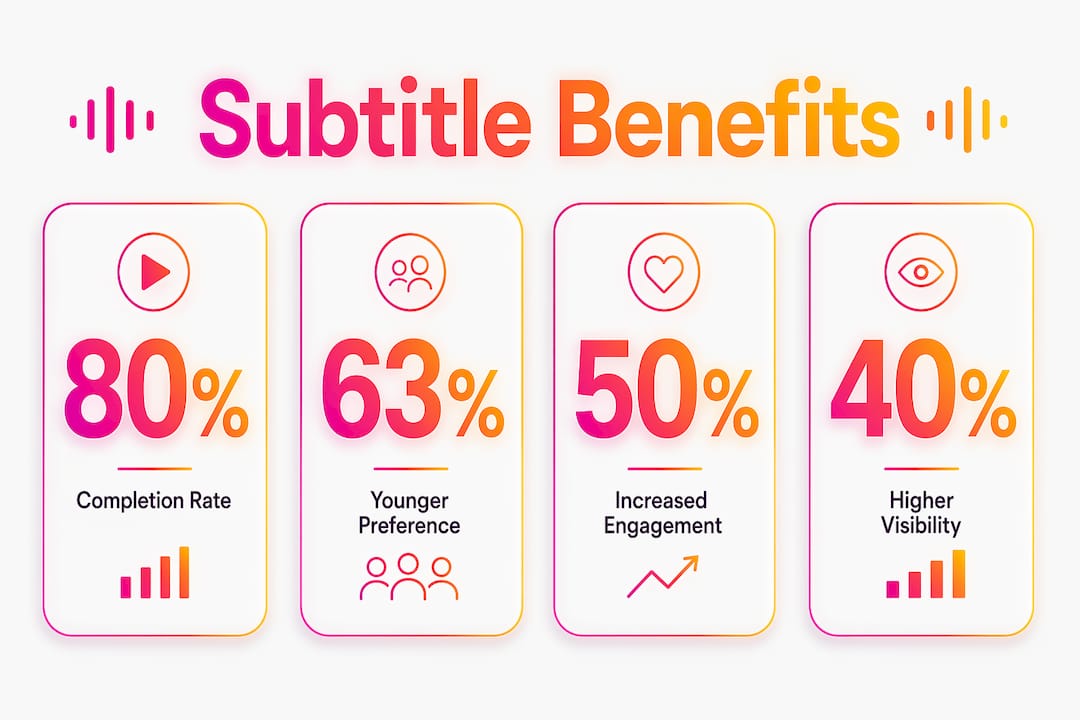
The same research shows that 40% use subtitles to enhance comprehension, and 33% use them specifically in noisy environments. These are not edge cases. They describe the everyday viewing context of a commuter on the Tube, a student in a library, or someone watching on their phone in a busy café.
The benefits of captions in music extend to audiences that creators often underestimate:
- D/Deaf and hard of hearing viewers rely on captions to access lyrics entirely.
- Neurodiverse viewers, including those with dyslexia or attention differences, process text and audio together more effectively.
- Non-native speakers use subtitles to follow lyrics they might otherwise miss.
- Sound-off viewers make up a significant portion of social media consumption, particularly on TikTok and Instagram Reels.
Captioned media is a standard requirement for inclusive content, according to the National Deaf Center. Treating subtitles as a universal design tool rather than a niche accommodation reaches every one of these groups at once. That is not a small audience. It is the majority of viewers on most platforms.
Pro Tip: If your video will run as a paid ad, captions are especially critical. Ads play without sound by default on many platforms, and captioned ads consistently outperform uncaptioned ones on recall metrics.
Best practices for subtitle creation in music videos
The technical quality of subtitles matters as much as their presence. Poorly timed or inaccurate captions actively harm viewer experience. Syllable-level lyric synchronisation is the standard for immersive music video subtitles. When text appears a beat late or disappears before the line ends, viewers notice. That friction breaks the emotional connection the music is trying to build.
SDH subtitles: going beyond lyrics
SDH (Subtitles for Deaf and Hard of Hearing) is the industry standard that goes further than basic lyric text. SDH subtitles capture non-speech audio cues such as musical tone shifts, sound effects, and atmospheric descriptions. For a music video, this might mean indicating a key change, a drum break, or a moment of silence. These cues are part of the artistic experience, and SDH ensures no viewer misses them.
Style, font, and placement
Caption style, including font, colour, animation, and placement, should match the visual brand and the platform where the video will live. A bold white font with a drop shadow works on YouTube. A kinetic, animated lyric style performs better on TikTok. Instagram Reels favour centred, short-line captions that do not obscure the visual frame.
Practical guidelines for subtitle style:
- Keep each subtitle line to no more than two lines of text.
- Use a font size large enough to read on a mobile screen without zooming.
- Avoid placing text over faces or key visual elements.
- Match caption colour to the video’s colour palette where possible, using contrast to maintain legibility.
- Limit each subtitle’s on-screen duration to match the natural rhythm of the lyric phrase.
Pro Tip: Create separate subtitle files for each platform rather than burning text directly into the video. This lets you adjust style and timing per platform without re-editing the video itself.
Common pitfalls to avoid include auto-generated captions left uncorrected, captions that appear too early or linger too long, and subtitle text that uses the wrong line breaks, splitting a phrase mid-thought. Each of these errors signals low production quality to viewers and algorithms alike.
How do subtitles affect music video SEO and platform algorithms?
Major platforms prioritise captioned content because captions improve the engagement metrics that algorithms use to decide distribution. Watch time, completion rate, and interaction signals all improve when captions are present. The algorithm does not know why viewers are staying longer. It only knows that they are, and it rewards that with wider reach.
The YouTube music algorithm specifically indexes caption text as part of its search and recommendation logic. A song with a distinctive lyric in its captions can surface in searches for that phrase, even if the video title does not include it. This is organic discovery that requires no additional spend.
The SEO benefits of captions in music break down by platform:
| Platform | Caption benefit | Key metric rewarded |
|---|---|---|
| YouTube | Text indexing for search | Watch time and completion |
| TikTok | Algorithm reach boost | Completion rate and shares |
| Instagram Reels | Accessibility compliance | Saves and replays |
Social engagement also increases with subtitles. Viewers who can read lyrics are more likely to quote them in comments, share the video with a specific line highlighted, or save it to return to later. These behaviours compound over time, building a community around the song rather than a single view event. Creators who want to boost music video engagement consistently find that captions are one of the highest-return additions they can make.
Are subtitle-rich music videos cost-effective to produce?
The cost gap between a full music video and a lyric video with integrated subtitles is significant. Full music video productions range from £5,000 to £50,000 or more. Lyric-integrated video content, by contrast, can cost between £0 and £50 per month and be produced in as little as five minutes to one hour depending on complexity.
That cost difference does not mean a compromise in impact. Lyric videos with well-timed, visually considered subtitles consistently outperform expensive productions on engagement metrics when distributed on social platforms. The reason is straightforward: the subtitle is the content. The viewer is there for the song.
AI tools now enable auto-generation, style customisation, and multiple caption versions in seconds. This has changed the workflow for independent creators entirely. A creator can generate a timed caption file, adjust the style to match their visual brand, and export platform-specific versions without specialist software or a post-production team.
Pro Tip: Use AI-generated captions as a starting point, then review every line manually against the audio. AI tools handle timing well but frequently mishear homophones, slang, or dialect-specific pronunciation. A five-minute review prevents embarrassing errors.
For creators exploring video creation tools for musicians in 2026, the category of AI-assisted lyric video tools has matured significantly. Most support direct export to YouTube, TikTok, and Instagram formats, with caption files included. The barrier to producing subtitle-rich content is lower than it has ever been. Understanding how short-form videos promote music in this environment makes the case for investing even modest time in subtitle quality.
Key takeaways
Subtitles are not an add-on to music videos. They are a core distribution, engagement, and accessibility tool that every creator should treat as standard practice.
| Point | Details |
|---|---|
| Completion rates rise sharply | Captions increase music video completion rates by over 80%, directly improving algorithm distribution. |
| Broad audience reach | Subtitles serve d/Deaf viewers, neurodiverse audiences, non-native speakers, and sound-off viewers simultaneously. |
| SEO and search indexing | Caption text is indexed by YouTube and other platforms, enabling organic discovery through lyric searches. |
| SDH is the quality standard | SDH subtitles include audio cues and tone descriptions, giving all viewers the full artistic experience. |
| Low cost, high return | Lyric videos with subtitles cost a fraction of full productions and consistently match or exceed their engagement performance. |
Why creators underestimate subtitles every single time
I have watched creators spend thousands on cinematography and then upload a video with no captions, or worse, with auto-generated captions full of errors. The assumption is that the music speaks for itself. It does not, not on a platform where the default state is silent.
The subtlety that most guides miss is this: subtitles change the relationship between the viewer and the song. When someone reads a lyric at the same moment they hear it, the line lands differently. It becomes something they possess, something they can quote, share, or return to. That is not an accessibility feature. It is an artistic one.
Creators who treat subtitles as a creative element, choosing fonts that match the mood, timing lines to the beat, using colour to signal emotional shifts, produce videos that feel considered. Viewers respond to that. They stay longer, share more, and remember the song. The storytelling dimension of music videos is amplified, not diminished, by text on screen.
The global opportunity is also underused. Effective subtitle localisation captures emotional and cultural nuance, not just literal translation. A creator who invests in localised captions for Spanish, French, or Portuguese audiences is not just adding accessibility. They are making a bid for a new fanbase entirely. That is the real upside that most creators leave on the table.
— Music
How Musicvideomarketplace helps creators add subtitles that work
Musicvideomarketplace gives musicians the tools to produce a long-form video in minutes, upload it to YouTube, and run an ad campaign for their song, all from one place.

Subtitle integration is part of that workflow. Creators using Musicvideomarketplace can produce captioned lyric videos without a production team or specialist software, keeping costs low while meeting the quality standards that platforms reward. Whether you are releasing your first track or scaling a catalogue, the platform supports caption creation, style customisation, and direct publishing. Visit Musicvideomarketplace to see how it fits your release strategy.
FAQ
Do subtitles actually increase music video views?
Yes. Captions increase completion rates by over 80%, which directly signals to platform algorithms to distribute the video more widely, resulting in more views over time.
What is the difference between subtitles and SDH in music videos?
Standard subtitles display lyrics only. SDH subtitles also include non-speech audio cues such as tone shifts and sound effects, giving d/Deaf and hard of hearing viewers the full artistic experience.
Do subtitles help with music video SEO?
Yes. Platforms like YouTube index caption text, so keywords within lyrics appear in search results. This enables organic discovery without additional advertising spend.
Are lyric videos cheaper than full music videos?
Significantly. Lyric video production can cost as little as £0 to £50 per month, compared to £5,000 to £50,000 or more for a full production, with comparable or better engagement on social platforms.
Why do younger viewers prefer subtitles even without hearing difficulties?
63% of adults under 30 prefer subtitled video for reasons including comprehension, focus, and viewing in noisy environments. It is a generational viewing habit, not an accessibility need.
Recommended
- Tendances vidéo 2026 : guide pour les musiciens | Music Video Marketplace Blog
- Understanding copyright in music videos: a 2026 guide | Music Video Marketplace Blog
- Why video content matters for musicians in 2026 | Music Video Marketplace Blog
- Types of music thumbnails: the 2026 creator’s guide | Music Video Marketplace Blog
Read next
 The role of YouTube cards: a 2026 strategy guideDiscover the role of YouTube cards in boosting viewer engagement. Learn how to use this powerful tool effectively for your strategy.
 Role of YouTube in Music: Powering Indie Artist SuccessRole of YouTube in music—explore music discovery, channel features, long-form video, campaign strategies, and risks for independent artists worldwide.
 SRT Captions for a Music Video: How to Make and Upload ThemLearn how to write an SRT caption file for a music video: the exact format, how to time lyrics, caption instrumentals, fix errors and upload to YouTube.
 The role of end screens on YouTube for musiciansDiscover the critical role of end screens on YouTube for musicians. Turn engaged viewers into subscribers and boost your video’s impact!
Turn the idea into a finished music video.
Drop your track into the Studio and build your visual in minutes.