
The importance of storytelling in music
Discover the importance of storytelling in music and how it transforms songs into memorable narratives. Connect deeper with your audience.

The importance of storytelling in music
TL;DR:
- Storytelling in music integrates lyrics, melody, and instruments into emotional narratives that foster lasting listener connections.
- It gives songs emotional depth and cultural significance, making them memorable across generations.
Storytelling in music is the practice of merging lyrics, melody, and musical composition into emotional narratives that connect listeners to characters, moments, and meaning beyond the notes themselves. The importance of storytelling in music is not a stylistic preference. It is the mechanism by which songs achieve lasting resonance, cultural weight, and genuine emotional impact. Narrativity in popular lyrics has been rising steadily since the 1990s, driven largely by hip-hop’s ascent, confirming that audiences are not just listening to music. They are listening for stories. Whether you write country ballads, rap verses, or indie folk, understanding how narrative functions in your work is the difference between a song people hear and a song people remember.
Why does storytelling in music matter so much?
The role of storytelling in music is to give listeners something to hold onto. A chord progression can move you, but a chord progression attached to a specific moment, a character, or a turning point in someone’s life will stay with you for decades. Music’s staying power across generations is directly linked to its storytelling quality, which creates shared experiences that connect listeners across time. That is not a vague claim. It is the reason Bob Dylan won the Nobel Prize in Literature, and it is the reason Ice Cube’s “It Was a Good Day” still circulates in cultural conversation more than thirty years after its release.
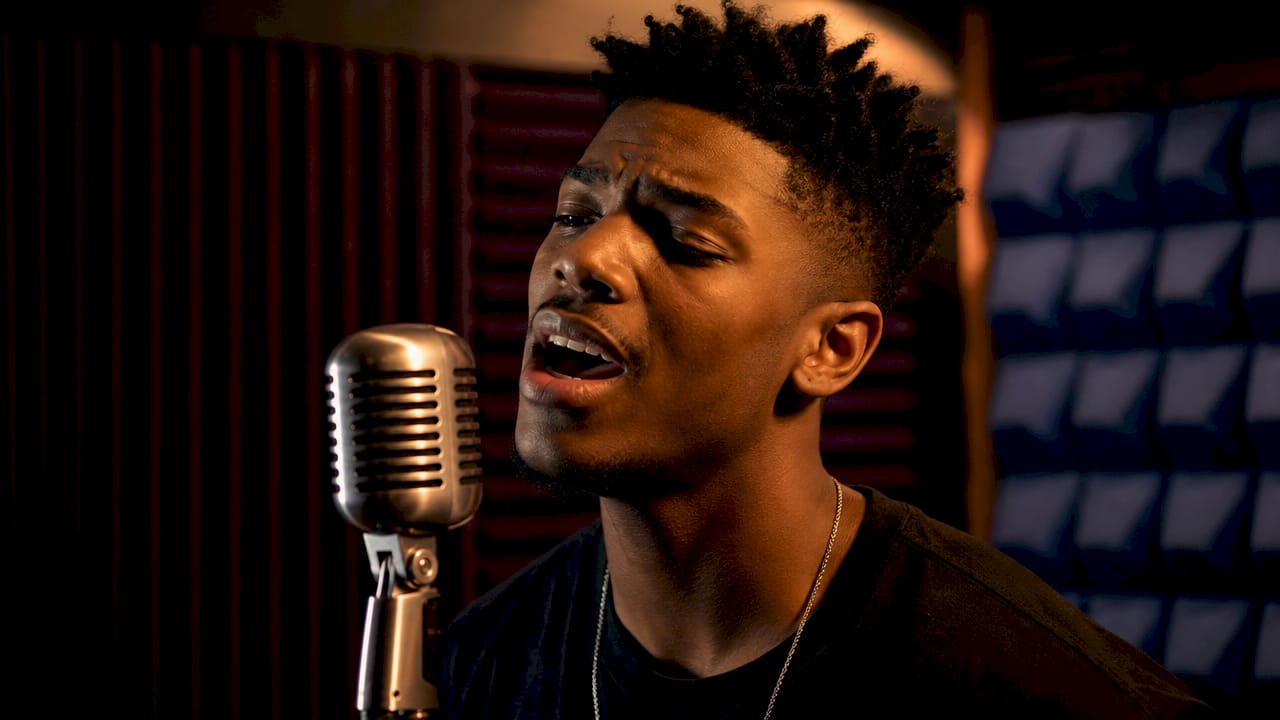
Narrative in music operates on multiple levels simultaneously. Lyrics carry characters and events. Melody carries emotional tone. Harmony and rhythm carry tension and release. When these elements align around a coherent story, the result is a song that functions almost like a short film in the listener’s mind. That layered quality is what separates music as a storytelling medium from almost every other art form.
How do lyrics function as narrative in songs?
Lyrics are the most direct narrative device in music, and their power lies in specificity. Narrativity in lyrics refers to the presence of characters, sequential events, and a constructed world that the listener can inhabit. A UC Berkeley analysis of over 5,000 Billboard Hot 100 songs from 1960 to 2024 confirmed that narrative elements in popular music have increased substantially since the 1990s. Hip-hop is the primary driver of that shift, overturning earlier assumptions that lyricism and narrativity were separate qualities.
Consider what makes certain songs impossible to forget:
- Ice Cube’s “It Was a Good Day” places the listener inside a single day with granular, place-specific detail. The narrative works because it is lived in, not abstract.
- Taylor Swift’s “All Too Well” (Ten Minute Version) reconstructs a relationship through a series of precise, sensory moments. The scarf, the kitchen, the autumn leaves. Each image anchors an emotion to a concrete scene.
- Bob Dylan’s “The Ballad of Hollis Brown” builds a slow, suffocating narrative arc using repetition and escalating dread. The structure itself becomes part of the story.
“Specific, lived-in lyric details build vivid scenes that emotionally engage listeners rather than abstract language.” — songwriting best practices analysis
Figurative language amplifies this effect. Metaphor, hyperbole, and irony in lyrics are reinforced by tonal variation, rhythm, and harmony to build emotional narratives. A lyric that says “I’m drowning” lands differently when the instrumentation drops to a sparse, low register. The music is not illustrating the lyric. It is deepening it.
How do musical elements tell stories without words?
The role of narrative in music extends well beyond lyrics. Melody, harmony, rhythm, and instrumentation each carry narrative information independently, and skilled composers use them to shape the listener’s emotional journey before a single word is sung. Musical shifts in melody, harmony, and rhythm actively guide emotional storytelling, filling narrative gaps that lyrics alone cannot reach.
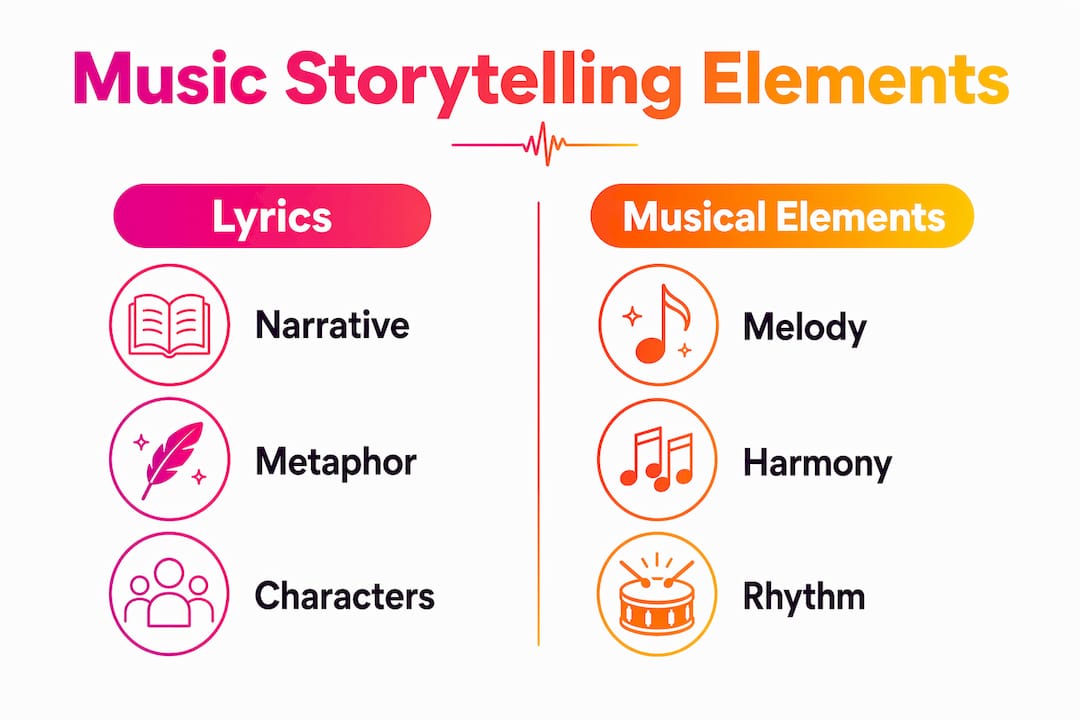
Musical semiotics is the study of how sound functions as a sign system. In practical terms, it means that a legato phrase (smooth, connected notes) signals resolution, warmth, or safety, while a staccato phrase (short, detached notes) signals tension, urgency, or unease. Instrumentation acts as a narrative character, with articulation and tone conveying emotions and story elements even without words. A solo cello entering after a full orchestral swell does not need lyrics to communicate grief. The listener already feels it.
This is why film composers like Hans Zimmer and Ennio Morricone are studied alongside novelists and screenwriters. They understand that instrumental choices foreshadow emotional tension, adding narrative depth before lyrics arrive. The same principle applies to your song’s intro, bridge, or outro. Every musical decision is a narrative decision.
Pro Tip: Before you write a single lyric, map the emotional arc of your song using only instrumentation. If the music alone does not convey the journey from tension to resolution, the lyrics will be doing all the heavy lifting and the song will feel flat.
Does storytelling vary across genres and cultures?
Storytelling is not equally distributed across genres, and that disparity reveals something important about how narrative functions as a marker of artistic prestige. Grammy-nominated country songs contain significantly higher narrative elements than other tracks on the same albums. The nomination itself signals that storytelling quality is being recognised and rewarded at the industry’s highest level.
| Genre | Storytelling role | Notable characteristic |
|---|---|---|
| Hip-hop | Primary narrative driver since the 1990s | Character-driven, place-specific, autobiographical |
| Country | High narrativity linked to award recognition | Linear story arcs, rural imagery, emotional resolution |
| Folk | Historical and cultural preservation | Oral tradition, communal memory, generational transmission |
| Classical/orchestral | Purely instrumental narrative | Semiotics, harmonic tension, programmatic structure |
What is striking is the overlap between hip-hop and country. Despite occupying opposite ends of the cultural spectrum in popular perception, both genres prioritise narrative specificity and character-driven lyrics above almost everything else. This shared commitment to storytelling is what gives both genres their devoted, multigenerational audiences.
Cultural context also shapes how narrative is received. Western scales carry emotional associations built over centuries of listening. Indian ragas operate within entirely different narrative frameworks, where a raga’s time of day or season is part of its story. Understanding the cultural narrative frameworks your audience brings to your music is part of knowing how to tell your story effectively.
Practical ways to strengthen storytelling in your songwriting
Applying the role of narrative in music to your own work requires deliberate choices at every stage of composition. The following steps give you a structured approach to building stronger narrative into your songs.
- Start with a specific moment, not a theme. “Heartbreak” is a theme. “Standing in the car park after the last conversation we ever had” is a scene. Scenes generate narrative. Themes generate abstractions.
- Map your song’s emotional arc before you write. Decide where the tension peaks, where the release comes, and what the listener should feel at the end. Every verse, chorus, and bridge should serve that arc.
- Use instrumentation to foreshadow. If your chorus is the emotional climax, build harmonic tension in the pre-chorus. Let the music signal what is coming before the lyrics confirm it.
- Avoid abstract language in your verses. Words like “pain”, “love”, and “loss” are placeholders. Replace them with the specific image or action that caused the feeling.
- Treat your chorus as the narrative conclusion, not just the hook. The best choruses resolve the tension built in the verse, even if only temporarily. They answer a question the verse has raised.
Pro Tip: Study how storytelling in music videos extends your song’s narrative into a visual dimension. A well-constructed video does not illustrate your lyrics. It adds a second layer of story that deepens the listener’s emotional experience.
The impact of stories in songs is also amplified when the audiovisual package is coherent. If your song tells a story of displacement and your video shows a character in an unfamiliar city, the two narratives reinforce each other. If they contradict each other, the listener’s attention splits. Coherence between sound and image is a storytelling technique in its own right, and it is one that DJ marketing strategies have used effectively to build audience loyalty across live and digital formats.
Key takeaways
Storytelling in music works because it aligns lyrics, melody, and instrumentation into a single emotional arc that listeners can inhabit, remember, and share.
| Point | Details |
|---|---|
| Narrativity is rising | Analysis of 5,000+ songs confirms narrative elements in popular music have grown since the 1990s. |
| Lyrics need specificity | Concrete, scene-based lyrics engage listeners far more effectively than abstract emotional language. |
| Instrumentation tells stories | Articulation, harmony, and rhythm convey narrative tension and emotion independently of lyrics. |
| Genre shapes narrative prestige | Grammy-nominated country tracks show measurably higher narrativity than non-nominated album cuts. |
| Audiovisual coherence matters | Aligning your song’s narrative with its visual presentation deepens the listener’s emotional response. |
Why I think most songwriters underestimate the music itself
Most conversations about storytelling in music focus almost entirely on lyrics. That is understandable. Lyrics are legible. You can quote them, analyse them, and teach them. But in my experience, the songs that genuinely move people are the ones where the music is telling the story just as hard as the words are.
I have listened to thousands of songs where the lyrics are technically strong but the instrumentation is generic. The story is there on the page, but it is not in the room. Then I hear something like Sufjan Stevens’ “Death With Dignity”, where the fingerpicked guitar pattern itself sounds like grief, and the lyrics almost feel secondary. The music arrived at the emotion first. The words confirmed it.
The most overlooked narrative tool in songwriting is the arrangement. Not the melody, not the chord progression, but the specific decision about which instrument enters when, at what dynamic level, and with what articulation. That is where shared narrative experience is actually built. Listeners may not be able to name what moved them, but they felt the cello drop out before the final chorus. They felt the silence. That silence was a sentence.
If you are a songwriter who has been focusing exclusively on your lyrics, spend one session working only on your arrangement as a narrative tool. You will hear your song differently. So will your audience.
— Music
Take your story further with Musicvideomarketplace
The most powerful songs deserve a visual narrative to match. Musicvideomarketplace enables musicians to create a long-form music video in minutes and launch a YouTube ad campaign directly from the platform, so your story reaches the audience it was written for.

Whether you are a solo songwriter releasing your first single or an established artist building a catalogue, visual storytelling for musicians is the natural extension of everything you have built in the studio. Visit Musicvideomarketplace to see how quickly you can turn your song’s narrative into a complete audiovisual release, ready for promotion on the world’s largest video platform.
FAQ
What is the role of storytelling in music?
Storytelling in music is the use of lyrics, melody, harmony, and instrumentation to create emotional narratives that connect listeners to characters, moments, and meaning. It is the primary mechanism by which songs achieve lasting cultural relevance and emotional impact.
Why do specific lyrics work better than abstract ones?
Specific, lived-in details build vivid scenes that engage listeners emotionally, while abstract language creates distance. Concrete images give listeners something to inhabit rather than simply observe.
Does music tell stories without lyrics?
Yes. Instrumentation, articulation, and harmonic shifts convey narrative tension and emotional states independently of words. Film scores and classical compositions demonstrate this capacity at the highest level.
Which genres use storytelling most effectively?
Hip-hop and country consistently show the highest narrative density in popular music. Grammy-nominated country tracks show measurably higher narrativity than non-nominated cuts, and hip-hop has been the primary driver of rising narrativity in popular music since the 1990s.
How does storytelling affect a song’s longevity?
Songs built around strong narrative frameworks create shared experiences that resonate across generations. The enduring popularity of narrative-rich songs is tied directly to their capacity to connect listeners through a common emotional story.
Recommended
- The role of storytelling in DJ marketing | Music Video Marketplace Blog
- Storytelling vidéo : boostez l’impact de vos clips musicaux | Music Video Marketplace Blog
- Storytelling im Musikvideo: So Fesselst Du Dein Publikum | Music Video Marketplace Blog
- Storytelling audiovisual para DJs: potencia tu música y conecta | Music Video Marketplace Blog
Read next
 The Power of Networking in the Music IndustryLoraa White, founder of Music Video Marketplace and Business Woman of the Year, highlights the power of networking, teamwork, and the upcoming Creator Community connecting musicians and creatives.
 The role of analytics in music marketingDiscover the vital role of analytics in music marketing to grow your fanbase, improve campaigns, and understand listener engagement. Click to learn more!
 The role of branding in music industry successDiscover the vital role of branding in music industry success. Learn how to craft your unique identity to stand out and connect with fans.
 Sync vs Master Rights: What Musicians Need to ClearSync rights cover the song, master rights cover the recording. Learn who grants each, how fees split in the UK, and how to clear both for YouTube and ads.
Turn the idea into a finished music video.
Drop your track into the Studio and build your visual in minutes.