
The role of storytelling in DJ marketing
Discover the crucial role of storytelling in DJ marketing. Learn techniques to engage audiences and leave a lasting impact beyond the music.

The role of storytelling in DJ marketing
TL;DR:
- Most DJs underestimate the power of storytelling in marketing, which creates emotional connections beyond technical skills. Effective narratives transform facts into worlds that engage audiences, making them invest emotionally and remember the artist long-term. Applying episodic storytelling and deliberate emotional arcs across bios, sets, and visuals enhances audience loyalty and brand perception.
Most DJs think their marketing job is done once they’ve posted a tracklist and a high-contrast photo. It isn’t. The role of storytelling in DJ marketing is arguably more powerful than any technical skill or equipment choice, because it’s the only thing that makes strangers care. Audiences don’t connect with specifications. They connect with meaning, tension, and identity. This article breaks down the psychology behind narrative-driven DJ promotion, practical techniques for bios, live sets, and content, and why the DJs who master this approach are the ones fans remember long after the music stops.
Table of Contents
- Key takeaways
- The role of storytelling in DJ marketing
- Crafting a compelling DJ brand story
- Episodic storytelling in live sets and intros
- Marketing assets that use storytelling effectively
- My perspective on storytelling in DJ marketing
- Bring your story to life visually
- FAQ
Key takeaways
| Point | Details |
|---|---|
| Narrative transportation builds affinity | When audiences are mentally pulled into a story, they engage more deeply and resist counterarguing. |
| Emotionality flips sustain attention | Deliberately shifting emotional tone within content keeps audiences engaged across long-form DJ sets and podcasts. |
| Bios shape perception | Controlling which details appear in your bio actively reshapes how audiences and bookers categorise you. |
| Episodic content builds loyalty | Treating each set, video, or post as part of a continuing series creates sustained fan investment. |
| Human authorship matters | Foregrounding AI in your creative process risks weakening the narrative connection listeners form with your music. |
The role of storytelling in DJ marketing
There’s a concept in psychology called narrative transportation theory. It describes what happens when a person becomes so absorbed in a story that they mentally leave their immediate surroundings and enter the narrative world. The result isn’t just enjoyment. Transported audiences show higher brand affinity, better recall of key messages, and crucially, they counterargue less. In plain terms, they stop being sceptical.
For DJs, this has a direct and underused application. Every bio, set, social post, or promo video is an opportunity to transport your audience somewhere. The ones that fail do so because they present facts. The ones that work present a world. Consider the difference between “DJ X plays techno across Europe” and “DJ X grew up in a port town where container ships arrived from every continent, and that chaos shaped every set they’ve played since.” Both are about the same person. Only one makes you curious.
The practical upshot is this. Effective storytelling for DJs isn’t about fabricating a persona. It’s about selecting and arranging true details in a way that pulls the listener in.
- Emotional specificity beats vague claims. “Passionate about music” says nothing. “Obsessed with a specific chord transition heard at 3am in a Marseille warehouse” says everything.
- Tension is your best tool. Every good narrative has a problem. What did you struggle with, reject, or have to fight for?
- The audience is the protagonist. The best DJ narratives make the listener feel like the story is happening to them, not just about you.
Pro Tip: When writing any piece of marketing copy, ask yourself: would a stranger find this interesting if they had never heard your music? If the answer is no, you haven’t found the story yet.
Crafting a compelling DJ brand story
Your bio is not a CV. It’s a controlled narrative. Pioneer DJ’s guidance on writing a DJ bio is explicit on this point: the most effective bios emphasise what is unique and deliberately omit details that box you into a past scene or an outdated label. That last part surprises most DJs. Omission is a storytelling tool, not a lie.

If you spent three years playing commercial venues before finding your true sound, you don’t need to include that chapter. If you do include it, frame it as a turning point, not a fact. The narrative strategy here is to control audience perceptions before they form independently. When audiences encounter gaps in a narrative, they fill those gaps themselves. Those interpretations rarely favour the artist.
Reshaping your brand narrative involves three practical steps:
- Identify your singular differentiator. Not “I play underground house.” More like: “I reconstruct forgotten Afrobeat samples into four-on-the-floor arrangements no one has heard before.” Be precise enough that no other DJ could say the same sentence about themselves.
- Find the origin story. Where did the obsession start? A specific moment, place, or person is always more interesting than a timeline. The impact of narrative in DJ branding is most visible in artists whose origin stories feel lived-in rather than manufactured.
- Reset deliberately. If your current brand is being held back by an old reputation, introduce a new project name, visual identity, or conceptual framework. Anyma didn’t emerge from nowhere. It emerged from a decision to wrap a live concept in a narrative architecture that audiences could follow.
Pro Tip: Write three different versions of your bio: a 50-word version, a 200-word version, and a 500-word version. Each should feel like it belongs to the same story, just with different levels of detail. Inconsistency across lengths is one of the most common and damaging narrative mistakes DJs make.
Episodic storytelling in live sets and intros
Anyma’s debut album is one of the clearest examples of episodic narrative in DJ branding. The project evolved over two years on tour, with each track functioning as an episode in a larger story. Audiences who followed the project felt invested because they were watching a narrative unfold, not just consuming releases. This is the difference between a fanbase and an audience.
You can apply the same logic to your sets without a two-year tour budget. The key is designing emotional arcs deliberately. Research on 33,598 podcast episodes and TED Talks found that emotionality flips within long-form content significantly boost engagement, particularly for audiences with a high need for emotional experience. A set that moves in one emotional direction, all build and no release, loses people. A set that moves people through tension, release, euphoria, and reflection keeps them present.
Here’s how to apply a three-point narrative structure to DJ radio introductions and set frameworks, as recommended by Doubleclap Radio’s work on narrative-led intros:
- Opening hook. Don’t introduce yourself generically. Open with a sonic or verbal motif that signals the emotional territory you’re entering. A question, an unexpected sound, or a fragment of dialogue all work better than “I’m DJ X, and here’s my mix.”
- Mid-set identity moment. This is where you reveal something about yourself or the concept behind the set. Not a biography, but a moment of meaning. It could be a spoken dedication, a transition into a track with personal significance, or a visual cue if you’re streaming.
- Closing resolution. The outro should feel earned. It should return to a motif introduced at the start, bringing a sense of completion. Audiences feel this even if they can’t articulate why. It’s the difference between a set that felt like it went somewhere and one that just ended.
Pro Tip: Map your set’s emotional arc before you play it, not after. Write down the intended emotional states at each phase: unsettled, curious, exhilarated, reflective. Then check whether your track selection actually delivers those states in that order.
Marketing assets that use storytelling effectively
The format of your content matters less than the narrative strategy behind it. That said, some formats consistently outperform others when storytelling is the goal.
| Format | Story strength | Common mistake |
|---|---|---|
| Promo video | High. Combines visual, audio, and narrative. | Generic “in the mix” footage with no story hook. |
| Radio set with intro | High. Captive audience for long-form narrative. | Opening with name and generic “welcome” phrase. |
| Social media clips | Medium. Short form limits arc but hooks well. | Posting without a connecting thread across posts. |
| Bio and press kit | Medium. Permanent and widely read. | Treating it like a CV rather than a narrative. |
| AI-generated content | Low. Risk of narrative disengagement. | Foregrounding AI authorship in promotional copy. |
That last row deserves particular attention. An experimental study found that labelling music as AI-composed reduces the imaginative engagement listeners form with the narrative, even when the music itself is identical to a human-made version. If you use AI tools in your creative process, which many DJs reasonably do, promote the human intent behind them rather than the tool itself.
Authentic, lo-fi content that foregrounds your real perspective consistently outperforms polished content that feels generic. This connects to a broader principle of cross-channel brand consistency: your sonic cues, visual identity, and written voice should all feel like they belong to the same story. When they don’t, the subconscious friction reduces how easily audiences connect with you.
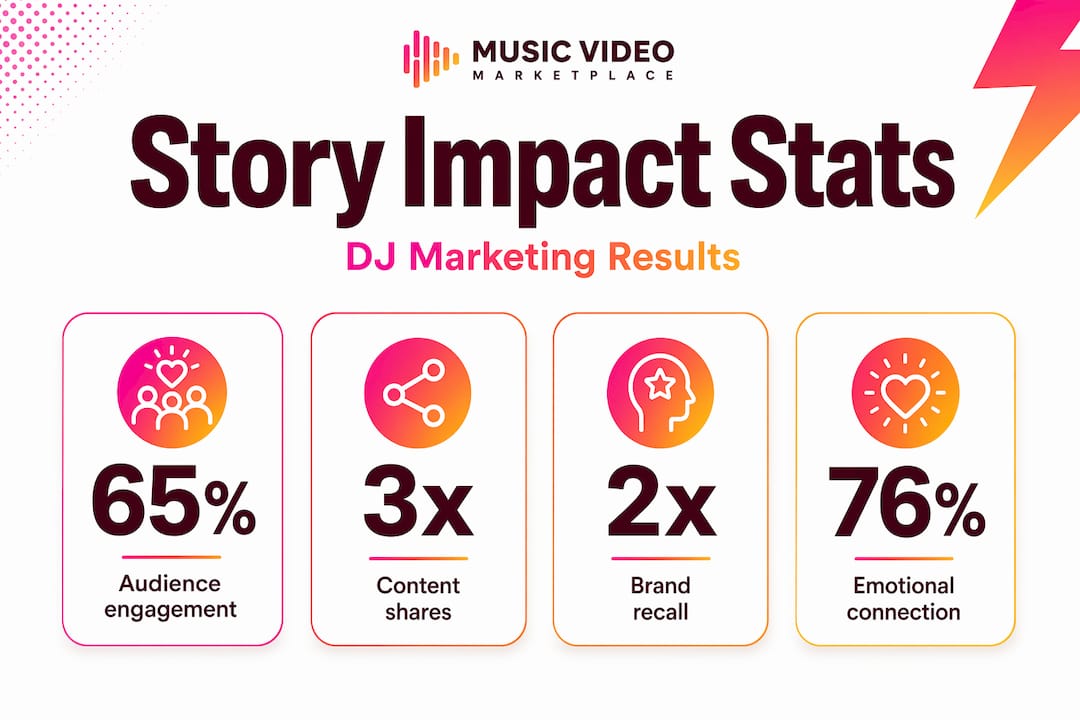
You can learn more about making narrative-driven promo videos that translate this storytelling thinking into formats bookers and fans actually watch.
My perspective on storytelling in DJ marketing
I’ve worked across enough DJ branding projects to know that storytelling is the most underestimated tool in this industry. DJs spend thousands on equipment and almost nothing on narrative. And then they wonder why their follower count stagnates while someone with half the technical ability builds a devoted following.
What I’ve found actually matters is emotional pacing, not emotional intensity. Intensity is easy. Pacing is rare. Most DJs either play it flat or go full throttle. The DJs who genuinely move people understand that audiences need moments of uncertainty, softness, and even discomfort before the release lands. This applies as much to a bio as it does to a set.
The other thing I’d push back on is the idea that authenticity means sharing everything. It doesn’t. Strategic omission is one of the most powerful narrative tools available to you. The story you don’t tell shapes how people interpret the one you do. Controlling that silence is a skill. The impact of narrative in DJ branding isn’t just about what you put forward. It’s about what you choose to leave out and why.
If you take one thing from this: stop trying to tell people what you do. Start giving them a reason to care.
— Music
Bring your story to life visually
Narrative doesn’t stop at words. The most compelling DJ marketing combines story with visuals that reinforce the same emotional arc. Musicvideomarketplace was built precisely for this. In minutes, you can create a long-form video built around your music, upload it to YouTube, and launch an ad campaign behind it. No production team, no lengthy back-and-forth.

For DJs, this means your brand story doesn’t have to live only in a bio or a radio intro. It can exist in a visual format that reaches new audiences on the world’s second largest search engine. Explore the trending video packages at Musicvideomarketplace to find assets that match the tone, genre, and emotional identity of your project. The story you’ve worked hard to craft deserves a visual format that carries it forward.
FAQ
What is the role of storytelling in DJ marketing?
Storytelling in DJ marketing shifts audience perception from passive listening to emotional investment. When audiences are transported by a narrative, they engage more deeply and remember the artist longer.
How do emotionality flips improve DJ set engagement?
Research across tens of thousands of podcast episodes shows that deliberate emotional shifts within long-form content increase audience arousal and retention. For DJ sets, this means designing intentional ups and downs rather than a single sustained mood.
Why does a DJ bio need storytelling rather than just facts?
If a DJ doesn’t control their narrative framing, audiences fill the gaps with their own interpretations, which may not serve the artist’s brand. Storytelling in a bio actively shapes those perceptions before they form.
Does using AI tools hurt DJ marketing narratives?
Using AI is not the problem. Foregrounding AI as the creative author is. Studies show that AI attribution weakens narrative engagement even when the content is identical to human-made work. Promote your human intent, not the tool.
How can DJs apply episodic storytelling across content?
Treat each set, release, or video as one episode in an ongoing series. Design recurring sonic or visual motifs that audiences recognise across touchpoints, and let each piece advance the narrative rather than reset it.
Recommended
- Storytelling audiovisual para DJs: potencia tu música y conecta | Music Video Marketplace Blog
- Master DJ video marketing to grow your fanbase in 2026 | Music Video Marketplace Blog
- Create DJ promo videos that drive engagement and bookings | Music Video Marketplace Blog
- Why use long form video for DJs: 2026 guide | Music Video Marketplace Blog
Read next
 The song marketing funnel explained for indie artistsLearn how to explain song marketing funnel concepts that truly resonate with today's listeners. Boost your fanbase and engagement now!
 Try Before You Buy, Affordable music videosGet a professional, ready-made music video for just £99 or $99. Try before you buy and promote your music fast with Music Video Marketplace
 Types of artist income diversification that actually payExplore effective types of artist income diversification to build multiple revenue streams and avoid the feast-or-famine cycle.
 The role of content in artist growth: 2026 guideDiscover the role of content in artist growth. Learn how strategic content can deepen audience engagement and build your brand in 2026.
Turn the idea into a finished music video.
Drop your track into the Studio and build your visual in minutes.