
 Try the Workspace
The role of analytics in music marketing
Discover the vital role of analytics in music marketing to grow your fanbase, improve campaigns, and understand listener engagement. Click to learn more!

The role of analytics in music marketing
TL;DR:
- Analytics in music marketing translate platform data into strategic decisions that grow an artist’s fanbase and improve targeted campaigns. Key metrics like save rate, source of streams, and demographic data reveal genuine listener engagement and effective marketing channels, while owned audiences provide stability beyond platform dependencies. Regular cross-platform reviews and incrementality testing enhance understanding of campaign impact, but creative instincts remain essential for authentic artistic growth.
Analytics in music marketing is the practice of converting platform data into strategic decisions that grow an artist’s fanbase, improve campaign targeting, and reveal exactly where listener engagement breaks down. The role of analytics in music marketing extends far beyond counting streams. Tools like Spotify for Artists and TikTok’s analytics dashboards expose the behavioural signals that actually predict growth: saves, follows, skip rates, and source-of-stream breakdowns. Raw stream counts alone are the least actionable metric without listener counts and source context alongside them. Understanding this distinction separates artists who grow deliberately from those who chase numbers without direction.
What are the most important analytics metrics in music marketing?
The first mistake most artists make is treating streams as the primary measure of success. Streams count every play, including passive ones from radio-style playlists, while monthly listeners represent unique accounts that played your music in the last 28 days. The ratio between the two tells you whether you are building a returning audience or simply accumulating one-time plays. A high stream count with a low monthly listener ratio signals passive discovery, not genuine connection.

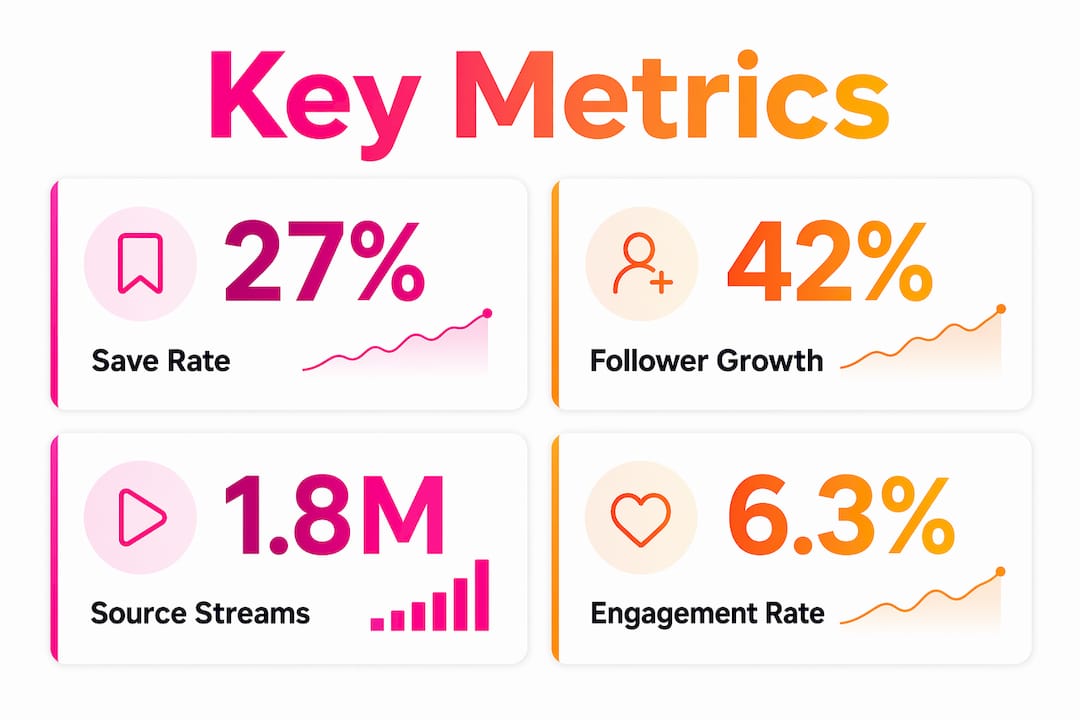
Save rate is the metric that separates a good release from a forgettable one. Saves and follows predict repeat engagement more reliably than streams or listens alone, because they represent a deliberate act by the listener. When someone saves a track, they are signalling intent to return. Spotify’s algorithm reads that signal and increases the likelihood of placing your track in personalised playlists like Discover Weekly and Release Radar.
Source-of-streams data is equally revealing. Knowing whether your plays come from algorithmic playlists, listener-curated playlists, or external sources like YouTube or Instagram tells you which marketing channels are actually working. If 80% of your streams come from algorithmic sources and almost none from external, your social media promotion is not converting. That is a specific, fixable problem.
Demographic data from Spotify for Artists, including age ranges, gender splits, and city-level breakdowns, allows you to target paid advertising with precision. If your top city is Manchester but you have never run a campaign there, you have an untapped market with proven demand.
Key metrics to prioritise, in order of strategic value:
- Save rate (saves divided by streams): the strongest intent signal
- Follower growth rate: indicates whether listeners are committing to your catalogue
- Source of streams: reveals which channels drive discovery
- Skip rate: high early skips signal a weak intro or mismatched audience
- City and demographic data: informs paid targeting and tour routing
Pro Tip: Apply a question-first approach to your analytics rather than clicking through tabs. Ask “where are my listeners discovering me?” before opening the dashboard, then find the data that answers it. Question-first analytics improve decision-making across releases far more than passive metric monitoring.
| Metric | What it tells you |
|---|---|
| Save rate | Listener intent and algorithm recommendation strength |
| Monthly listeners vs streams ratio | Depth of audience engagement |
| Source of streams | Which marketing channels convert to plays |
| Skip rate | Whether your intro hooks the right audience |
| City-level data | Where to focus paid campaigns and live bookings |
Owned audience data vs algorithmic growth: which matters more?
Algorithmic growth on Spotify, TikTok, or YouTube feels powerful because it scales without direct cost. The problem is that it is entirely platform-dependent. One algorithm update, one policy change, or one shift in content format can erase months of momentum overnight. First-party data collected from fans via email or SMS stabilises growth by enabling retention regardless of what any platform decides to do next.
First-party data refers to information you collect directly from fans with their consent. Email subscribers, SMS opt-ins, and direct message lists are all owned channels. Unlike a Spotify follower, an email subscriber is yours permanently. You can reach them without paying for reach, without competing with an algorithm, and without worrying about a platform shutting down.
The strategic value compounds over time. An email list of 2,000 genuinely engaged fans who open your messages and buy tickets is worth more than 50,000 Spotify followers who have never saved a track. Owned audiences create continuity beyond fragile algorithmic distribution, and that continuity becomes the foundation for every future release.
The most effective approach combines both. Use algorithmic platforms for discovery and reach, then convert high-intent listeners into owned connections. Pre-save campaigns, gated content, and direct fan links on platforms like Linktree or Beacons all serve this purpose.
Practical steps for building owned audience alongside algorithmic growth:
- Add an email capture to every pre-save or release link
- Offer exclusive content (stems, early access, behind-the-scenes footage) in exchange for sign-ups
- Use SMS platforms like Community or Subtext to send direct messages to fans
- Treat your email open rate as a health metric for your fanbase, not just a marketing stat
- Review fan engagement strategies that move beyond reach to genuine retention
Pro Tip: Convert high-intent moments into owned connections. When a fan pre-saves your track, that is the highest-intent action they can take before release. Redirect them immediately to an email sign-up or SMS opt-in. That single step turns an algorithm-dependent interaction into a permanent fan relationship.
What is incrementality testing and how does it improve music marketing measurement?
Most music marketers measure campaign success by looking at what happened during a campaign period and assuming the marketing caused it. That is correlation, not proof. A release might have performed well because of organic word-of-mouth, a playlist placement, or a viral TikTok moment that had nothing to do with your paid spend. Incrementality testing with geo holdouts is the method that isolates actual channel lift from background noise.
A geo holdout test works by dividing your market into two groups: a treatment group that receives your marketing campaign and a control group that does not. You measure both groups before and during the campaign, then compare the difference. The gap between treatment and control is the true incremental lift your campaign generated.
Designing a defensible test requires discipline. Here is the core process:
- Select comparable markets. Choose treatment and control cities or regions that show parallel trends in streaming or engagement before the test begins.
- Establish a pre-period baseline. Run the measurement for several weeks before the campaign launches to confirm the markets behave similarly without intervention.
- Define your KPIs and decision thresholds upfront. Decide before the test what result would justify continued spend, what would prompt a pause, and what would indicate the channel has no effect.
- Run the test for a sufficient duration. A 17-week geo holdout with proper KPI alignment provides defensible measurement. Shorter tests are vulnerable to noise.
- Analyse the gap, not the total. The incremental lift figure, not the overall campaign performance number, is what justifies your budget.
This approach matters because music marketing budgets are rarely large. Spending £2,000 on a TikTok campaign and seeing streams rise does not prove the campaign worked. A geo holdout test tells you whether those streams would have happened anyway.
| Measurement approach | What it shows | Limitation |
|---|---|---|
| Pre/post campaign comparison | Overall performance change | Cannot isolate marketing from organic growth |
| Geo holdout incrementality test | True channel lift vs control | Requires careful market selection and sufficient duration |
How to apply cross-platform analytics to smarter release plans
No single platform tells the full story of a release. Cross-platform analytics detects momentum mismatches that would be invisible if you only monitored one dashboard. A TikTok spike that does not translate to Spotify streams is a conversion problem, not a reach problem. The content is generating awareness but failing to move listeners to the streaming platform. That diagnosis changes your entire response.
The most useful workflow is a weekly cross-platform review that asks three questions: Where is momentum building? Where is it stalling? What is the next action? Platforms like Spotify for Artists, TikTok Analytics, and YouTube Studio each provide different pieces of the picture. Spotify shows intent signals. TikTok shows discovery and virality. YouTube shows watch time and retention, which are strong indicators of whether your visual content holds attention.
Combining platform data into one roadmap guides smarter, coordinated release plans by revealing which channels are working together and which are operating in isolation. Tools like Viberate and Chartmetric aggregate this data across platforms, reducing the time spent switching between dashboards.
Practical signals to act on quickly:
- Rising saves on Spotify in the week after release: pitch to editorial playlists immediately, as the save rate signals readiness for algorithmic push
- High TikTok video completions but low Spotify streams: add a direct streaming link to your TikTok bio and use a sound-to-stream redirect tool
- Strong YouTube watch time but low subscriber conversion: add end screens and cards directing viewers to subscribe and follow on Spotify
- City-level streaming spikes: respond with geo-targeted paid ads in that city within 48 hours to amplify organic momentum
Pro Tip: Sustained algorithmic playlist performance backed by strong saves and follows indicates durable momentum far more reliably than day-one spikes. Do not judge a release in the first 72 hours. Review your data at the two-week mark, when algorithmic signals have had time to compound.
Key takeaways
Data-driven music marketing succeeds when you prioritise intent signals like saves and follows over raw stream counts, combine owned audience channels with algorithmic discovery, and measure campaign impact through incrementality rather than correlation.
| Point | Details |
|---|---|
| Prioritise intent signals | Save rate and follower growth predict sustainable growth better than stream counts alone. |
| Build owned audience channels | Email and SMS lists provide continuity that platform algorithms cannot guarantee. |
| Use incrementality testing | Geo holdout tests isolate true channel lift and justify marketing spend with evidence. |
| Review cross-platform data weekly | Momentum mismatches between TikTok and Spotify reveal specific conversion problems to fix. |
| Apply a question-first analytics mindset | Define what decision you need to make before opening any dashboard. |
Why analytics still cannot replace your creative instincts
I have worked with artists who became so focused on their Spotify for Artists dashboard that they started writing music to serve the data rather than the other way around. Save rate went up. Artistic identity went quiet. That is the trap analytics sets if you let it.
The real value of analytics in music promotion is not to tell you what to create. It is to tell you whether what you have created is reaching the right people, and whether your marketing is doing its job. Those are operational questions, not creative ones. Keep them separate.
The artists I have seen grow most consistently are the ones who build systematic measurement habits without becoming obsessed with the numbers. They check their data at defined intervals, ask specific questions, act on clear signals, and then return to making music. They do not refresh their Spotify dashboard hourly. They treat analytics as a feedback loop, not a scoreboard.
The uncomfortable truth about data-driven music marketing is that the data is only as useful as the questions you bring to it. A save rate of 8% means nothing without knowing your genre average. A TikTok spike means nothing if you have not set up the conversion path to capture it. Analytics sharpens your judgement. It does not replace it.
— Music
Take your music marketing further with Musicvideomarketplace
Understanding your analytics is only half the equation. Acting on those insights with the right content is where growth actually happens.

Musicvideomarketplace enables musicians to create a long-form video in minutes, upload it directly to YouTube, and launch an ad campaign for their song without needing a production team or a large budget. When your cross-platform data shows a momentum spike, you need to respond fast with quality content. Musicvideomarketplace gives you that speed. Explore how music ad campaigns can be built around your analytics signals, or visit Musicvideomarketplace to start turning your data into a campaign today.
FAQ
What is the role of analytics in music marketing?
Analytics in music marketing converts platform data into strategic decisions about audience targeting, campaign timing, and content performance. The core function is identifying which listener behaviours, such as saves, follows, and source-of-stream patterns, indicate genuine engagement rather than passive exposure.
Why do saves matter more than streams on Spotify?
Saves and follows signal listener intent and predict repeat engagement more reliably than stream counts, which include passive plays. Spotify’s algorithm uses save rate as a key signal when deciding whether to place a track in personalised playlists like Discover Weekly.
What is incrementality testing in music marketing?
Incrementality testing measures the true lift a marketing channel generates by comparing a treatment market that receives the campaign against a control market that does not. It proves causation rather than correlation, which is critical for justifying and optimising marketing spend.
How does owned audience data differ from algorithmic reach?
Owned audience data, collected via email or SMS opt-ins, belongs to the artist permanently and is unaffected by platform algorithm changes. Algorithmic reach scales quickly but is entirely dependent on platform decisions, making it inherently unstable as a sole growth strategy.
How often should artists review their analytics?
A weekly cross-platform review is the most practical cadence for most artists. Check Spotify for Artists for intent signals, TikTok Analytics for discovery momentum, and YouTube Studio for retention data, then identify one specific action to take before the next review.
Recommended
- Music campaign metrics explained for marketers | Music Video Marketplace Blog
- Music marketing trends shaping success for independent artists | Music Video Marketplace Blog
- Fan engagement strategies that power your music marketing | Music Video Marketplace Blog
- Music industry marketing explained: strategies for indie artists | Music Video Marketplace Blog
Read next
 The role of branding in music industry successDiscover the vital role of branding in music industry success. Learn how to craft your unique identity to stand out and connect with fans.
 The role of content in artist growth: 2026 guideDiscover the role of content in artist growth. Learn how strategic content can deepen audience engagement and build your brand in 2026.
 The role of storytelling in DJ marketingDiscover the crucial role of storytelling in DJ marketing. Learn techniques to engage audiences and leave a lasting impact beyond the music.
 The Power of Networking in the Music IndustryLoraa White, founder of Music Video Marketplace and Business Woman of the Year, highlights the power of networking, teamwork, and the upcoming Creator Community connecting musicians and creatives.
Turn the idea into a finished music video.
Drop your track into the Workspace and build your visual in minutes.