
Types of artist income diversification that actually pay
Explore effective types of artist income diversification to build multiple revenue streams and avoid the feast-or-famine cycle.

Types of artist income diversification that actually pay
Three business models sit behind every artist income stream: active work you trade hours for (commissions, workshops), leveraged assets you build once and sell repeatedly (prints, licensing, courses), and platform income built on an owned audience (subscriptions, patronage, memberships). Most working artists need at least one stream from each category to avoid the feast-or-famine cycle that comes from relying on a single sales channel.
If you’re starting from scratch or trying to add to what you already do, these tend to give the fastest signal on whether they’re worth pursuing:
- Commissions (fastest cash, because the buyer already wants the piece)
- Prints or reproductions of existing work
- Licensing your imagery to brands, publishers or manufacturers
- Teaching workshops, in person or online
- A subscription or patronage tier through something like Patreon or Ko-fi
- Selling to trade buyers: interior designers, hospitality groups, corporates
- Applying for grants or funding tied to your medium or region
Pro Tip: Don’t try to launch five streams in one month. Pick the one that uses artwork or skills you already have, and give it a genuine 60 to 90 days before judging whether it works.
Table of Contents
- What are the main types of artist income diversification?
- Every income stream worth considering, and who it actually suits
- How long each stream takes to pay off, and what it costs upfront
- A 6-step checklist and a 90-day test to add one new stream
- Three real diversification mixes and what they actually looked like
- What building a diversified studio practice actually costs you
- Key takeaways for diversifying artist income
- Sources
What are the main types of artist income diversification?
Diversifying artist income isn’t about collecting as many revenue lines as possible. It’s about balancing three different mechanics, because each one behaves differently when demand dips, or when you’re unwell, or when a gallery closes its doors for six months.
Active income is the one most artists already know: you do the work, you get paid, and the money stops the moment you stop working. Commissions and in-person workshops sit here. Leveraged income comes from an asset you build once and that keeps earning without your direct time input, print-on-demand ranges and online courses are the classic examples. Platform or hybrid income relies on an audience you own, rather than one you rent from a gallery or marketplace, paid newsletters, memberships and recurring patronage fall into this bracket, according to career guidance from Prospects.
The industry term for this whole approach is a “portfolio career”, and it’s increasingly the norm rather than the exception. Practitioners who thrive tend to mix institutional work, commercial commissions and independent projects rather than betting everything on gallery representation, per the same Prospects research. The rationale isn’t just financial. It’s about control: a single gallery relationship or a single platform algorithm can dictate your entire income if you let it.
The time ceiling problem
Every active income stream has a hard cap. You only have so many studio hours, and a commission or a workshop only pays once per hour worked. This is the “time ceiling”, and it’s the single biggest reason artists burn out chasing more commissions instead of building assets that outlive the hours spent on them. A print or a licensed image, once created, can sell on repeat with no additional labour. This is exactly why licensing and prints appear so often in advice on scaling artist income, according to Artwork Archive.
The “seven streams of income” concept, borrowed from personal finance and adapted for creative careers, makes a similar point: multiple income sources reduce the odds that a single downturn (a cancelled show, a slow season, an algorithm change) sinks your whole business, according to Up the Gains. You don’t need seven. Three or four, chosen deliberately, usually does the job.
A 6-step way to decide what to add next
- Audit what you already have. Look at finished work, teaching ability, an audience list, or unused studio capacity before inventing something new.
- Check audience fit. A stream only works if your existing audience (or a reachable new one) actually wants it.
- Price the upfront cost. Factor in platform fees, materials, and the hours needed before first sale.
- Set a runway. Decide how many weeks or months you’ll test it before reviewing results.
- Look for quick wins first. Favour streams that use assets you already own over ones needing months of setup.
- Define your metrics before launch. Conversion rate, repeat buyers, time-to-first-sale and margin all matter more than vanity views.
A rough time allocation many creative business coaches recommend is spending around 80% of your working hours on reliable, paying client work and 20% on building the leveraged assets that eventually reduce your dependence on that same client work, according to Crafty & Competent.
| Metric | Why it matters | What to track |
|---|---|---|
| Time-to-first-sale | Tells you how quickly a stream generates cash | Days from launch to first paying customer |
| Margin | Reveals whether the stream is actually profitable | Revenue minus materials, fees, and time cost |
| Repeat buyers | Signals demand stability | % of customers who buy more than once |
| Conversion rate | Shows if your offer matches your audience | Enquiries or views converted to sales |
Pro Tip: Add one stream at a time. Introducing two new revenue lines simultaneously makes it impossible to tell which one is actually working, and it splits studio time you need for the craft itself.
Every income stream worth considering, and who it actually suits
Here’s the practical catalogue. Some of these will fit your practice immediately; others need groundwork you haven’t built yet. Read them against your own medium, not as a checklist to complete in full.
Commissions are bespoke pieces made to a client’s brief. They suit painters, illustrators, potters and portrait artists with a clear body of work to point to. The buyer is already committed before you start, which makes commissions one of the most reliable ways to generate early income, per Artwork Archive. The upside: higher price per piece, direct relationship with the buyer. The downside: pure time-for-money, and scope creep is common. Effort versus scale: high effort, zero passive potential.
Original artwork sales through your own site, a local gallery, or an online marketplace suit any visual artist with finished pieces. Pros: full margin control, builds a collector base. Cons: unpredictable timing, and inventory sits as unsold stock if it doesn’t move. This sits closer to active income but carries some leverage if collectors return.
Prints and reproductions let one original generate multiple sales. They suit anyone with strong 2D work: illustrators, painters, photographers. Pros: low marginal cost once set up, scales without proportional labour. Cons: upfront investment in printing or a print-on-demand account, and quality control matters. This is genuinely leveraged income: the effort is front-loaded, the payoff is repeatable.

Licensing means selling the right to use your imagery, on fabric, stationery, packaging, or in publishing, rather than selling the physical piece. It suits artists with a distinctive, reproducible style. Pros: royalties can continue for years from one image. Cons: contracts are complex, and you need to understand rights and usage terms before signing anything. Musicvideomarketplace’s guide to licensing income covers similar rights and royalty structures that apply just as much to visual licensing deals.
Teaching and workshops, in person or hybrid, suit artists who enjoy explaining process as much as making. Pros: immediate cash, builds community. Cons: prep time is real, and it’s still active income with a hard time ceiling.
Online courses and e-books turn a workshop into a leveraged asset. They suit artists with a teachable, repeatable technique. Pros: sells while you sleep, once built. Cons: production takes weeks or months, and marketing an evergreen course never really stops.
Subscriptions and patronage through Patreon or Ko-fi suit artists with an engaged social following. Pros: predictable monthly income, deepens audience loyalty. Cons: you need consistent, compelling content to avoid churn, patrons cancel fast if value drops, according to Artwork Archive.
Merchandise and print-on-demand (mugs, tote bags, stickers) suits artists with bold, graphic styles. Pros: near-zero inventory risk with the right supplier. Cons: margins are thin per unit, and it rarely becomes a primary income source alone.
B2B sales, selling to interior designers, hospitality groups, or corporate buyers, suit artists producing work at scale or in series. Pros: larger, repeat orders than consumer sales typically offer. Cons: longer sales cycles and you need a portfolio and pitch that reads as professional, not hobbyist, per Artsy Shark’s guide to trade sales. This is one of the most underused streams on this list.
Grants and funding suit artists working in socially engaged, experimental, or research-led practice. Pros: no obligation to produce sellable work. Cons: applications are time-intensive and competitive, and money often arrives months after you apply.
Art fairs and markets suit artists who enjoy direct sales conversations. Pros: instant cash, direct feedback. Cons: stall fees and travel eat into margin, and it’s exhausting as a sole income source.
Sponsorships and brand deals suit artists with a public profile or niche audience. Pros: can pay well for relatively little production. Cons: inconsistent, and dependent on your visibility staying high.
| Stream | Active vs passive | Upfront time/skill | Ongoing maintenance | Recurring potential | Typical channel |
|---|---|---|---|---|---|
| Commissions | Active | Moderate (portfolio needed) | Low | Low | Direct enquiry, referral |
| Original sales | Active | Low to moderate | Low | Low | Own site, galleries |
| Prints | Leveraged | Moderate (setup, quality) | Low | Moderate to high | Online shop, POD platform |
| Licensing | Leveraged | High (rights knowledge) | Low | High | Agents, direct pitches |
| Teaching/workshops | Active | Moderate | Moderate | Low | In-person, local listings |
| Online courses | Leveraged | High (production time) | Low to moderate | High | Course platforms, own site |
| Subscriptions/patronage | Platform | Low to moderate | High (content demand) | Moderate | Patreon, Ko-fi |
| Merchandise/POD | Leveraged | Low | Low | Low to moderate | Online shop |
| B2B/trade sales | Active/leveraged mix | High (pitching skill) | Moderate | High | Direct outreach, trade shows |
| Grants/funding | Active | High (application time) | Low | Low | Funding bodies |
| Art fairs/markets | Active | Moderate (stock, stall) | Low | Low | In-person events |
| Sponsorships | Active | Low to moderate | Low | Low to moderate | Social platforms, direct approach |
Starting steps, briefly: for commissions, publish a clear pricing page and a simple enquiry form. For prints, test one image through a print-on-demand account before investing in your own stock. For licensing, research two or three agents or manufacturers in your niche and send a tight portfolio. For subscriptions, launch with a single tier and a realistic posting schedule before adding complexity.
How long each stream takes to pay off, and what it costs upfront
Expectations matter here as much as tactics. Some of these streams pay within days; others take months of quiet groundwork before a single sale lands.
Fast to income (immediate to 3 months): commissions, original sales, art fairs and markets. You’re selling something that already exists or that a buyer has already committed to.
Moderate lead time (1 to 6 months): prints and merchandise (setup and supplier testing), teaching and workshops (building a following willing to pay), subscriptions (growing a patron base slowly).
Long lead time (3 to 12 months): licensing deals (contract negotiation and outreach), online courses (production plus audience building), grants (application and decision cycles), meaningful B2B relationships (trust takes time to build with trade buyers).
Typical cost categories to budget for, broadly:
- Platform fees: Patreon, Ko-fi, print-on-demand suppliers and marketplaces all take a cut, usually a percentage per sale or a monthly fee.
- Production costs: printing, materials, packaging, or software for course creation.
- Fulfilment: postage, packing materials, and the time cost of handling orders yourself versus outsourcing.
- Marketing spend: even a modest paid social budget or a few pounds boosting a post can shorten the time to first sale considerably.
One sentence worth taking seriously: as your income streams multiply, so does the paperwork, and it’s worth speaking to an accountant or checking HMRC’s current guidance on self-employment and business structure before you assume all this income is taxed the same way.
Licensing and online courses tend to need the most patience. Digital assets and licensing arrangements almost always require upfront development time before any recurring revenue shows up, so plan your cash-flow runway with that lag built in, not as an afterthought.
A 6-step checklist and a 90-day test to add one new stream
Adding income streams works best as a structured trial, not a leap of faith. Here’s the process.
- Choose one stream that uses an asset, skill, or audience you already have.
- Audit your existing assets and audience honestly. Do you have 50 email subscribers or 5,000? Ten finished paintings or one?
- Set one measurable test goal, such as “sell 10 prints” or “get 15 paying patrons”, rather than a vague ambition.
- Build a minimum viable version of the offer. A single print run, one course module, one workshop date.
- Launch with low-cost promotion: your existing social following, an email to your list, or a small paid boost.
- Evaluate against your metric checklist (time-to-first-sale, margin, repeat buyers) before deciding whether to scale or drop it.
| Field | Example entry |
|---|---|
| Goal | Sell 15 prints of one existing piece |
| Audience | Existing Instagram followers and email list |
| Offer | One image, three sizes, limited run |
| Price | Set to cover printing cost plus a genuine margin |
| Promotion channels | Instagram posts, one email, one story series |
| Measurement | Track sales daily for 90 days against the goal |
A few outreach scripts to adapt rather than copy word for word: a pitch to a trade buyer might open with “I produce a body of work in [medium] that fits interiors in [style/setting] and I’d love to send a short portfolio for your next project.” A social post selling prints could be as simple as “This piece is now available as a limited print run, three sizes, link in bio.” A workshop sign-up message works best kept short: “Spaces open for [date], hands-on session, beginners welcome, link to book below.”
Three real diversification mixes and what they actually looked like
The painter who added prints and Patreon. Starting position: one-off gallery sales only, income arriving in unpredictable spikes. New streams: a print-on-demand shop for her three best-selling images, plus a £5 monthly Patreon tier with behind-the-scenes process videos. Timeline to first income: prints sold within two weeks of launch; Patreon took closer to two months to reach 20 paying members. Illustrative ranges (not guaranteed): prints added a modest but steady few hundred pounds a month once established; Patreon added a smaller, more stable monthly baseline. Key lesson: the print shop needed almost no ongoing maintenance, but Patreon demanded a genuine weekly content commitment she hadn’t budgeted time for.
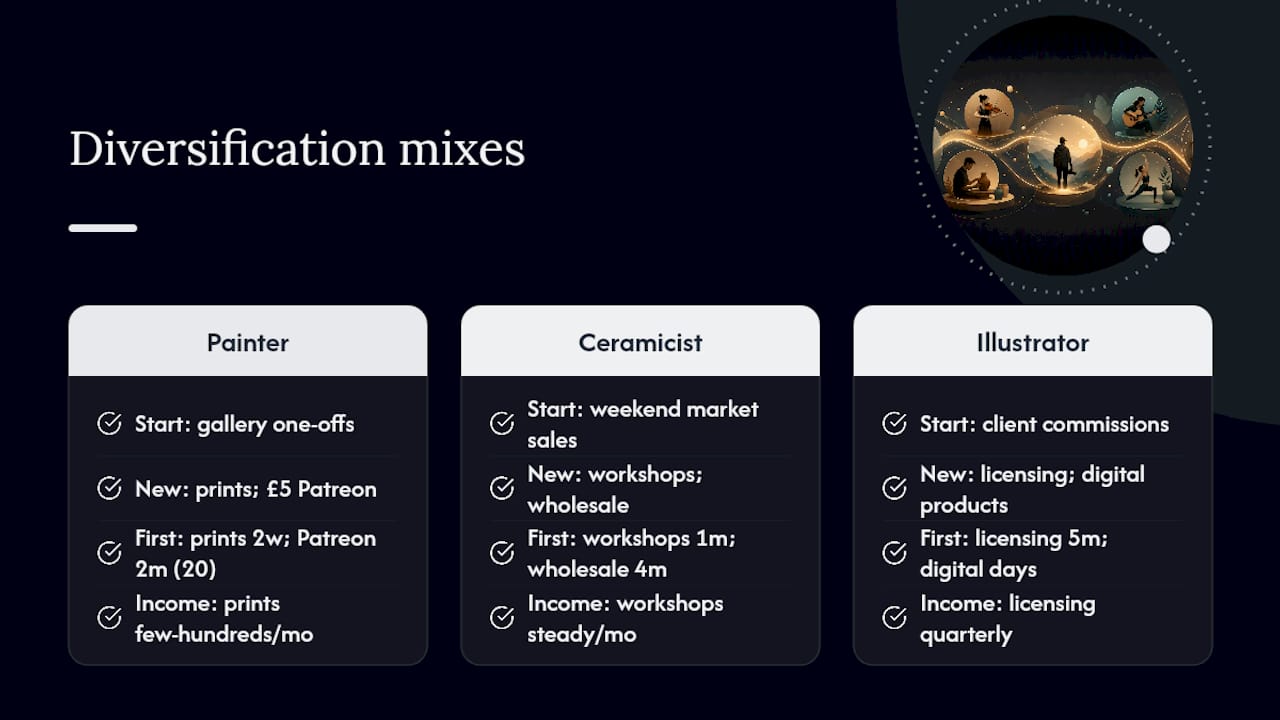
The ceramicist who combined workshops with wholesale. Starting position: selling finished pieces at weekend markets only. New streams: monthly studio workshops for beginners, plus a wholesale arrangement supplying two local homeware shops. Timeline to first income: workshops filled within a month using existing social contacts; the wholesale deal took nearly four months of relationship-building before the first order. Illustrative ranges: workshops became the more consistent monthly earner; wholesale orders were larger but arrived only a few times a year. Key lesson: wholesale buyers move slowly, so patience and follow-up mattered more than a polished pitch.
The illustrator who shifted from commissions to licensing and micro-products. Starting position: fully booked on client commissions but exhausted, with no time left to grow. New streams: licensed a set of illustrations to a stationery brand, and launched a small range of digital planner inserts. Timeline to first income: the licensing deal took around five months from first pitch to signed contract; the digital products sold within days of listing. Illustrative ranges: licensing royalties arrived quarterly in modest but reliable payments; digital products brought smaller but immediate sums.
The pattern across all three: none of them dropped their original income source overnight. Each one tested a new stream alongside existing work, watched it for a few months, and only then decided how much time to shift.
Three lessons worth copying directly: start the new stream while your existing income is still running, not after it dries up. Give a leveraged stream at least 90 days before judging it, since setup time is longer than most people expect. And track the maintenance cost of each stream honestly, because a subscription tier that “just” needs one post a week still adds up over a year.
What building a diversified studio practice actually costs you
Adding income streams isn’t free, even when the marketing advice makes it sound simple. Every new stream you take on competes for the same finite studio hours as the work that got you here in the first place, and pretending otherwise is how artists end up producing worse work across the board.
My honest view: the artists who diversify well are ruthless about sequencing, not about ambition. They don’t chase every stream on a list like this one. They pick the stream that costs them the least creative attention for the income it returns, and they protect a fixed block of studio time that no new revenue idea is allowed to touch. A print shop that runs itself is worth more to a working artist than a Patreon that demands weekly video content, even if the Patreon looks more impressive on paper, because the print shop doesn’t compete with the hours you need for the next body of work.
The honest tip: sequence leveraged income before platform income wherever you can. A print run or a licensing deal, once live, asks very little of you week to week. A subscription or membership asks for something new constantly, and that ongoing demand is exactly the kind of thing that quietly erodes the studio time your whole career depends on.
Key takeaways for diversifying artist income
The most reliable way to diversify artist income is to combine one active stream, one leveraged asset, and one platform-based revenue line, tested one at a time.
| Point | Details |
|---|---|
| Mix, don’t multiply | Choose one stream from each of active, leveraged, and platform models rather than adding many similar ones. |
| Test before scaling | Run any new stream for 90 days against a measurable goal before deciding whether to invest further. |
| Sequence for sustainability | Add leveraged assets before demanding platform commitments to protect studio time long term. |
| Track the numbers | Monitor time-to-first-sale, margin, and repeat buyers for every stream you trial. |
| Get the tax side right | Speak to an accountant or check HMRC guidance as soon as more than one income stream is running. |
Sources
- Fine artist (Prospects)
- 6 ways to diversify your income and make more money as an artist (Artwork Archive)
If you’re weighing up how a new video-based income line might fit your existing practice, the comparison of creator income stacks is worth a read, and musicians exploring similar diversification through video content can find practical routes into it through Musicvideomarketplace, which helps artists turn a single song into a full video and a ready-to-run ad campaign without weeks of production work.
This article provides general guidance and is not a substitute for professional tax or business advice. Always confirm your specific tax position and legal obligations with an accountant or directly with HMRC.
Recommended
- Maximise your music income: a guide to smart monetisation | Music Video Marketplace Blog
- Why content diversification for DJs matters in 2026 | Music Video Marketplace Blog
- DJ YouTube monetisation: boost your income in 2026 | Music Video Marketplace Blog
- How independent musicians monetise video content effectively | Music Video Marketplace Blog
Read next
 Understanding copyright in music videos: a 2026 guideLearn essential copyright rules for music videos in 2026. Understand licensing, fair use limits, and practical protections to avoid legal issues and monetise your content legally.
 Video monetisation for musicians: complete guide 2026Learn how musicians earn from YouTube in 2026 with ad revenue, Content ID, and fan funding. Discover RPM benchmarks, YPP tiers, and strategies to maximise income.
 Visual marketing for DJs: boost engagement in 2026Learn how DJs can use visual content to boost engagement, build brand identity, and increase bookings with proven strategies for social media and live events.
 Try Before You Buy, Affordable music videosGet a professional, ready-made music video for just £99 or $99. Try before you buy and promote your music fast with Music Video Marketplace
Turn the idea into a finished music video.
Drop your track into the Studio and build your visual in minutes.