
What is audio branding: a guide for marketers
Discover what is audio branding and how it shapes brand identity. Learn to leverage sound to enhance recognition and emotional connection.

What is audio branding: a guide for marketers
TL;DR:
- Audio branding uses sound to express a brand’s identity across all touchpoints, reaching audiences through devices where visuals can’t compete. It activates emotional memory quickly, making it more effective at building recognition and trust than visual branding alone. Successful strategies include creating a system of assets like sonic logos and motifs to ensure consistent, long-term recognition across channels.
Audio branding is the deliberate creation and use of sound to express a brand’s identity across every touchpoint where it appears. Unlike a logo, which requires a screen or printed surface, sound reaches audiences through speakers, headphones, and smart devices in contexts where visuals simply cannot compete. The field is also known as sonic branding, and the two terms are used interchangeably across the industry. For marketing professionals and brand strategists, understanding what audio branding is and how it works is no longer optional. Sound is now a primary channel for building recognition, trust, and emotional connection.
How does audio branding influence brand perception and engagement?
The neurological case for sonic branding is clear. Humans process sound in approximately 0.3 seconds, compared to 1.2 seconds for visual information. That speed advantage means auditory cues trigger emotional and memory responses before a viewer has consciously registered what they are seeing.
This is not a minor difference. Faster processing means sound encodes brand associations more efficiently than visuals alone. When a brand pairs a consistent audio identity with its visual presence, it doubles the number of sensory pathways through which audiences form memories.
“Ads with distinct sonic brand cues are 8.53 times more effective at driving branded attention than ads without these auditory markers.”
That figure reframes the conversation for any marketing professional still treating music as a production afterthought. A brand that invests in a distinctive sonic identity does not just sound better. It commands measurably more attention from the audiences it is trying to reach.
Emotional memory encoding is the deeper mechanism at work. Sound activates the limbic system, the part of the brain responsible for emotion and long-term memory. A well-designed sonic identity does not just remind audiences of a brand. It makes them feel something about it, and those feelings persist long after the ad or content has ended.
What are the core components of a sonic branding strategy?
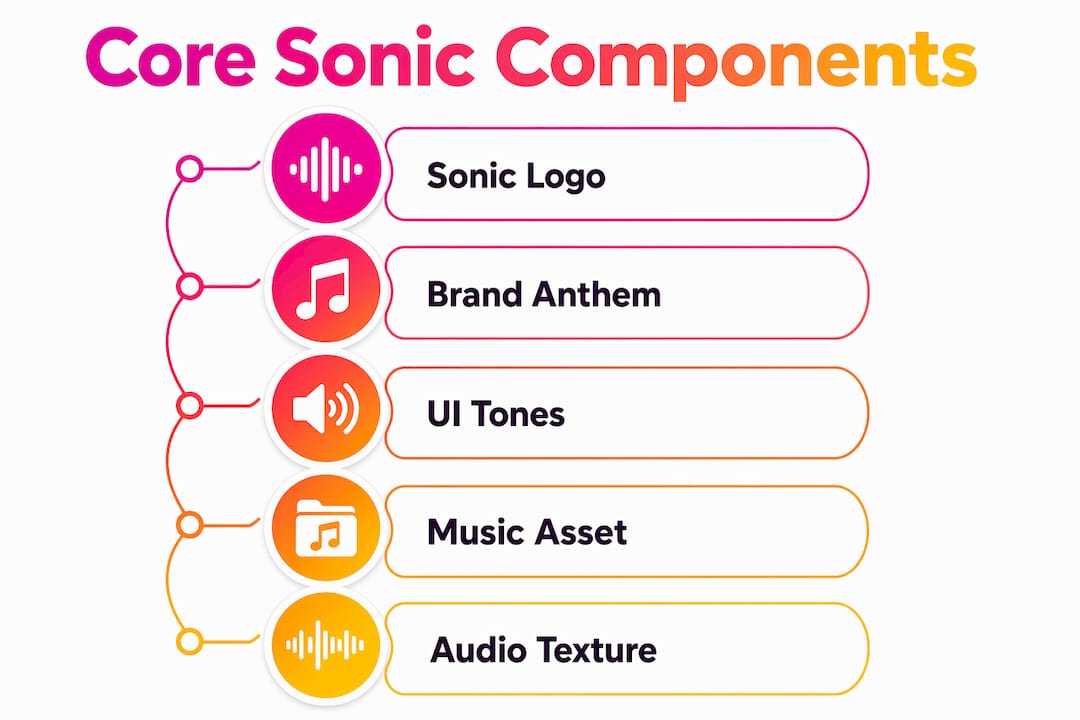
A complete audio branding strategy is built from several distinct assets, each serving a different function across the brand’s touchpoints.
- Sonic logo: A short, distinctive musical phrase of two to five seconds that functions as the auditory equivalent of a visual logo. Sonic logos incorporating brand names are 9 times more effective for brand attribution than purely musical cues alone.
- Brand anthem or theme: A longer composition, typically 60 to 90 seconds, that expresses the brand’s full emotional character. This is used in brand films, major campaigns, and events.
- Sound motifs: Shorter melodic or rhythmic fragments derived from the core theme. These are adapted for different formats, lengths, and contexts while remaining recognisable.
- UI and product sounds: The audio feedback built into apps, websites, and physical products. Notification tones, confirmation chimes, and error sounds all carry brand meaning.
- Audio guidelines: A written and audio document specifying how all sound assets are used, adapted, and protected across the organisation.
The distinction between a jingle and a sonic identity matters here. A jingle is a single piece of music written for one campaign. A sonic identity is a system. It is designed to be flexible and extensible, allowing sound assets to be tailored for different formats while maintaining recognisability across all of them.
Pro Tip: Test your sonic logo using the swap test. If a competitor could use your sound without anyone noticing, it lacks true brand ownership. A strong sonic logo is so specific to your brand that competitor substitution is immediately noticeable.
| Element | Function |
|---|---|
| Sonic logo | Instant brand recognition in 2–5 seconds |
| Brand anthem | Full emotional expression for campaigns and events |
| Sound motifs | Adaptable fragments for varied formats and lengths |
| UI sounds | Auditory feedback within products and digital platforms |
| Audio guidelines | Governance document for consistent use across teams |
How does audio branding complement visual branding?
Visual branding and sonic branding are not competing disciplines. They are complementary systems that reinforce each other when designed together.

A visual logo works when someone is looking at a screen, a package, or a sign. Sound works everywhere else. Audio branding reaches audiences through audio-first devices and multitasking environments where visuals cannot compete. A commuter listening to a podcast, a driver hearing a radio ad, or a user receiving a phone notification are all reachable through sound alone.
The integration of the two systems is where the real value lies. When a brand’s visual identity and sonic identity share the same emotional character, each reinforces the other. A viewer who hears the sonic logo while seeing the visual logo encodes a stronger, more durable memory than either stimulus could create alone.
There are four practical reasons to integrate audio into brand strategy from the outset:
- Consistency across channels. A brand that sounds the same on a TV ad, a podcast sponsorship, and a mobile app creates a unified experience that builds trust over time.
- Presence in audio-first contexts. Smart speakers, streaming platforms, and voice assistants are growing channels where visual branding has no presence at all.
- Emotional differentiation. Sound communicates personality, warmth, and energy in ways that typography and colour alone cannot.
- Competitive protection. A distinctive sonic identity is an owned asset. Generic stock music is not, and it offers no competitive advantage.
Audio branding should be treated as strategic infrastructure designed early in brand development, not as a decorative afterthought. Brands that bolt sound on at the end of a campaign cycle miss the compounding recognition benefits that come from consistent, long-term sonic presence.
What are the best practices for implementing audio branding?
Effective implementation follows a clear process, and the most common mistakes come from skipping stages or treating the project as a one-off creative task.
Start with a strategic brief. Before any music is composed, the brand team needs to define the emotional territory the sound should occupy. What does the brand feel like? What does it stand for? What should audiences feel when they hear it? These questions are answered through workshops, competitor audits, and audience research, not by asking a composer to “make something that sounds like us.”
Brief composers with precision. Vague feedback produces generic results. Briefing composers with specific timestamped audio references leads to clearer creative outcomes. Share reference tracks with notes explaining what works and why, rather than describing a mood in abstract terms.
Plan for the full timeline. A comprehensive audio branding project typically spans 8 to 12 weeks from initial discovery to delivery of the sonic toolkit. Brands that allocate two weeks for a sonic identity project will receive a rushed result that does not hold up across formats.
Avoid sonic anonymity. Nearly 62% of marketing content relies on generic stock music. That figure represents a significant proportion of brands that sound interchangeable. Stock music is a shortcut that costs brands the recognition they are trying to build.
Pro Tip: Measure sonic brand equity before and after a sonic identity launch. Track unaided brand recall in audio-only contexts, listener sentiment scores, and ad completion rates. These metrics reveal whether your sound is building genuine recognition or simply filling silence.
Build a sound system, not a single track. The goal is a musical DNA that is extensible across formats. A 30-second TV ad, a five-second pre-roll, and a two-second notification chime should all feel like they belong to the same brand. That coherence requires a system, not a playlist.
The role of branding in music industry success illustrates this principle well. Artists who build a consistent sonic identity across their releases create stronger audience loyalty than those who change their sound with every campaign. The same logic applies to commercial brands.
Key takeaways
Audio branding is the most underused strategic asset in marketing, and brands that build a distinctive sonic identity gain measurable advantages in attention, recall, and emotional connection that visual branding alone cannot deliver.
| Point | Details |
|---|---|
| Sound processes faster than visuals | Auditory cues trigger emotional memory in 0.3 seconds, encoding brand associations more quickly. |
| Sonic branding multiplies ad effectiveness | Ads with distinct sonic cues are 8.53 times more effective at driving branded attention. |
| A sonic identity is a system, not a track | Effective audio branding comprises a sonic logo, motifs, UI sounds, and audio guidelines. |
| Stock music creates sonic anonymity | 62% of marketing content uses generic stock music, making brands sound interchangeable. |
| Integrate sound early in brand strategy | Audio branding designed at the strategy stage compounds recognition benefits over time. |
Why sound is the branding frontier most marketers are ignoring
The brands I see winning on attention are not the ones with the biggest visual budgets. They are the ones that have made a deliberate decision about how they sound. That decision is still rare, and that rarity is an opportunity.
The shift towards audio-first consumption is not a trend to watch. It is already here. Podcast advertising, smart speaker interactions, and streaming platform sponsorships are all contexts where a brand’s visual identity is completely invisible. If your brand has not defined how it sounds in those contexts, it has no presence in them at all.
The uncomfortable truth is that most brands are not building sonic identities. They are licensing stock music and calling it done. The growth in custom music investment tells part of the story, but the 62% stock music figure tells the rest. The majority of brands are still choosing anonymity by default.
Sound designed early in brand development compounds. A sonic logo heard consistently across three years of advertising builds a level of recognition that no single campaign can create. The brands that understand this are building assets. The ones that do not are renting sounds they will never own.
For marketers working with musicians and artists, the connection is direct. Music branding through video is one of the most effective ways to establish a sonic identity that audiences associate with a specific creative voice. The principles are identical whether the brand is a consumer product or an independent artist.
— Music
How Musicvideomarketplace supports your audio branding
Musicvideomarketplace gives musicians and brands the tools to put their sound in front of audiences at scale. Creating a long-form video and launching a YouTube ad campaign for a song takes minutes on the platform, not weeks.

For brand strategists working with musical talent, that speed matters. A sonic identity is only as effective as the reach it achieves. Musicvideomarketplace connects the creative work of audio branding with the distribution and campaign infrastructure needed to build genuine recognition. Whether you are launching a brand anthem or amplifying an artist’s signature sound, the platform removes the friction between creation and audience. Explore what Musicvideomarketplace can do for your next audio campaign.
FAQ
What is audio branding in simple terms?
Audio branding is the use of sound, including music, sonic logos, and UI tones, to express a brand’s identity and build recognition across every channel where audiences encounter it.
Why does sonic branding matter for marketing professionals?
Sound processes faster than visuals and activates emotional memory more directly. Ads with distinct sonic cues are 8.53 times more effective at driving branded attention than those without auditory markers.
What is the difference between a jingle and a sonic identity?
A jingle is a single piece of music created for one campaign. A sonic identity is a full system of adaptable sound assets, including a sonic logo, motifs, and UI sounds, designed for consistent use across all brand touchpoints.
How long does an audio branding project take?
A comprehensive sonic branding project typically spans 8 to 12 weeks from initial discovery through to delivery of the complete sonic toolkit.
What is sonic anonymity and how do brands avoid it?
Sonic anonymity occurs when a brand uses generic stock music that makes it sound interchangeable with competitors. Brands avoid it by commissioning an ownable sonic identity built around a distinctive musical DNA rather than licensed tracks.
Recommended
- A musician’s guide to music branding: build your identity | Music Video Marketplace Blog
- The role of branding in music industry success | Music Video Marketplace Blog
- Music Branding Through Video: Amplifying Artist Identity | Music Video Marketplace Blog
- Qué es branding musical para DJs: guía 2026 | Music Video Marketplace Blog
Read next
 What is long form music content: a 2026 guideDiscover what long form music content is and how it engages audiences. Learn its benefits for artists in our 2026 guide!
 Why labels invest in video content: a label marketer's guideDiscover why labels invest in video content to boost revenue, enhance audience engagement, and maximize marketing efforts for lasting results.
 Why producers use video campaigns: the 2026 guideDiscover why producers use video campaigns for measurable success. Learn how to boost sales, brand awareness, and ROI in 2026.
 Label reporting dashboards: the UK guide for 2026Discover the essential types of label reporting dashboards for 2026. Learn how each dashboard enhances your operation and decision-making.
Turn the idea into a finished music video.
Drop your track into the Studio and build your visual in minutes.