
A musician's guide to music branding: build your identity
Unlock your potential as an artist! Discover what music branding really is and learn how to build a unique identity that connects with your audience.

A musician’s guide to music branding: build your identity
TL;DR:
- Successful music branding blends sound, story, and visuals for lasting audience recognition.
- Consistent sonic identity and emotional tone are essential for brand coherence and loyalty.
- Ongoing, unified branding across channels and assets builds trust and audience engagement.
Music branding is not just about a flashy logo or well-lit press photos. The world’s most successful artists are instantly recognisable because of something far deeper — a consistent blend of sound, story, and aesthetic that audiences feel before they can even name it. Independent artists who treat branding as merely visual are leaving enormous growth potential on the table. This guide breaks down exactly what music branding entails, how sonic identity works alongside visuals, which assets and channels matter most, and what real campaigns teach us about building a lasting audience connection.
Table of Contents
- What is music branding: core principles
- Music branding beyond visuals: sonic identity and moods
- Brand assets and channels: bringing your music brand to life
- Music branding in action: case studies and digital impact
- Why music branding is more than a ‘look’: lessons for serious artists
- Strengthen your music brand with expert support
- Frequently asked questions
Key Takeaways
| Point | Details |
|---|---|
| Build your brand foundation | Start by clarifying what, how, and why you create music—this shapes all branding decisions. |
| Go beyond visuals | Effective branding incorporates sonic identity, mood, and consistent messaging for deep audience connection. |
| Leverage assets and channels | Align all brand materials and distribution channels to your unique identity to maximise impact. |
| Consistency drives recognition | Repeating visual and sonic elements builds memorable, recognisable brands that thrive in digital spaces. |
What is music branding: core principles
Music branding is the practice of creating a coherent identity that communicates who you are as an artist across every point of contact with your audience. That means every song, post, interview, playlist pitch, and live performance sends a signal. When those signals are consistent, audiences form a clear picture of you. When they are not, people simply move on.
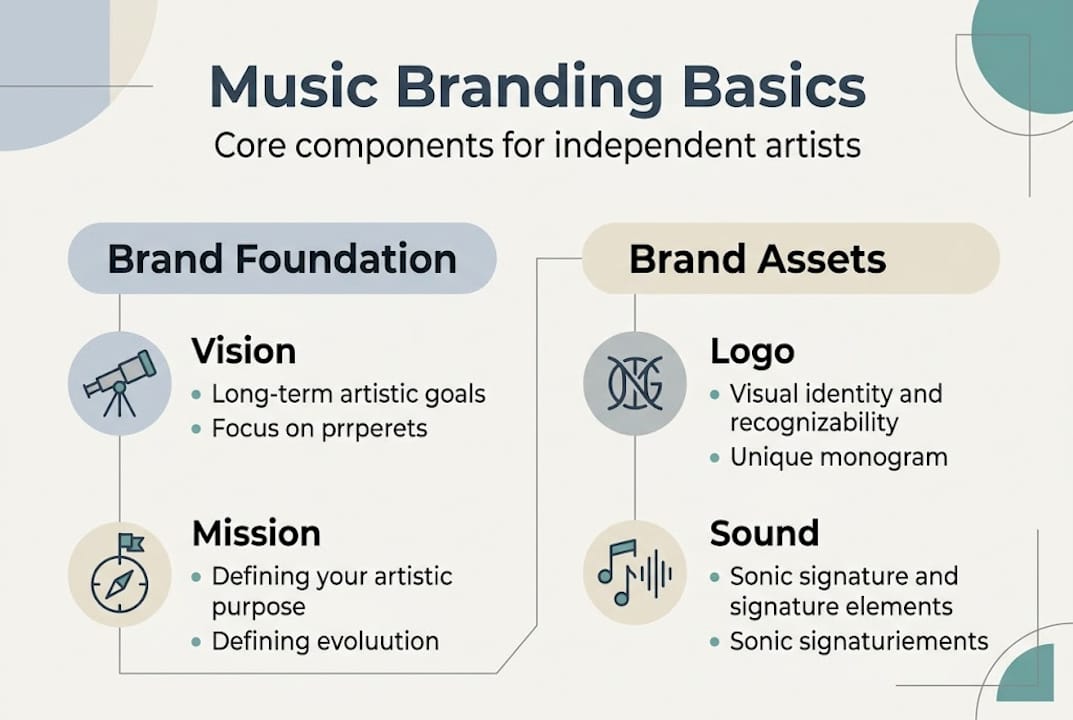
The clearest framework for understanding music branding is the foundation approach. Think of it in three layers: what you make, how you make it, and why you make it. Your “what” is the genre, the instrumentation, the tempo range, the production style. Your “how” covers the craft decisions — do you prioritise raw emotion over polish, live recording over studio perfectionism? Your “why” is the motivation underneath everything, the belief or experience that drives your music. As the Guide to Artist Branding outlines, artist branding is often structured as a “foundation” (what/how/why) that then extends into brand expression across visuals and marketing channels.
Once that foundation exists, brand expression becomes straightforward. Everything from your social media colour palette to the tone of your email newsletter should trace back to the same core statement. Here is what brand expression typically includes:
- Visual identity: logo, fonts, colour palette, photography style, artwork
- Messaging: artist bio, social captions, press release language, interview tone
- Sonic cues: intro motifs, outro styles, signature sounds
- Marketing channels: social platforms, streaming presence, YouTube, live events
“Your brand is not what you say it is. It is what your audience experiences every time they come into contact with your music, your visuals, and your story.”
Musicians exploring indie artist marketing strategies often discover that the clearest brands are built from the inside out, not the outside in. In other words, you cannot design a logo that resonates if you have not first defined why your music exists. The visual layer should be the final step, not the first.
A useful way to pressure-test your brand foundation is to write a single sentence that covers all three layers. For example: “I make atmospheric electronic music for late-night listeners who feel more comfortable in headphones than in crowds, because I believe solitude is underrated.” Every creative and marketing decision you make should align with that sentence. If something contradicts it, it weakens your brand.
Music branding beyond visuals: sonic identity and moods
Once you understand the brand foundation, it is key to recognise that branding is not just visual — it is deeply sonic. This is where many independent artists stop short. They sort out a logo and a colour scheme and then wonder why their audience is not growing. The missing piece is almost always sonic consistency.

Sonic branding means treating your sound as a repeatable system with defined parameters rather than a collection of random creative choices. As sound branding research confirms, music branding is not limited to the artist’s visual identity; it can include sonic branding principles that treat sound as a system with repeatable parameters. For independent musicians, this translates into defining what your sound actually is with enough precision that you can replicate its essence across different songs, EPs, and albums.
Here is a practical comparison to help you understand the difference between weak and strong sonic branding:
| Weak sonic branding | Strong sonic branding |
|---|---|
| Switches genre each release | Consistent genre and sub-genre |
| Varied production styles per song | Signature production approach |
| Inconsistent tempo and energy | Defined energy range across catalogue |
| No recurring motifs | Recognisable sonic signatures |
| Mood varies randomly | Clear emotional territory |
Pro Tip: Write a short “sonic brief” for your music, the same way a designer writes a visual brief. Include your tempo range, key instruments, energy level, and the emotions you intend to evoke. Share it with collaborators, producers, or session musicians before every project.
The mood and emotional territory your music occupies is equally important. Think about the artists you instantly recognise: their music reliably makes you feel something specific. That reliability is not an accident. Music video branding experts note that the most effective artists choose an emotional lane and stay in it consistently, even when individual songs explore different themes. A melancholic singer-songwriter does not suddenly release an upbeat party anthem without explanation. When they do, audiences feel confused rather than excited.
Your sonic identity also connects directly to which listener moods you serve. Spotify, Apple Music, and other platforms categorise music by mood and activity as much as by genre. Artists who understand their emotional territory can target playlist curators more effectively, pitch to mood-based playlists, and build audiences who return because the music reliably delivers a specific feeling.
- Define the primary emotion your music serves (introspection, euphoria, comfort, tension)
- Identify 3 to 5 sonic parameters that never change across releases (instrumentation, key instrument, production texture)
- Create a “reference catalogue” of tracks by other artists that represent your target sonic territory
- Use these references when briefing collaborators or pitching to playlist curators
Brand assets and channels: bringing your music brand to life
Now that sonic identity is clear, it is time to turn your brand into visible assets and decide where to share them. Brand assets are the tangible materials that carry your identity across every platform and interaction.
Here is a structured approach to building your asset library:
- Logo and wordmark: a simple, scalable visual mark that works at profile picture size and on merchandise
- Photography: a consistent style and era of photos rather than random selfies or studio shots
- Colour palette: two to four colours that appear across all social content, artwork, and promotional materials
- Fonts: one or two typefaces used consistently in graphics and website
- Artist bio: short (50 words), medium (150 words), and long (300 words) versions ready for different contexts
- Sonic logo: a short audio signature (three to five seconds) used in video content and advertisements
- Social content templates: pre-designed graphic formats for announcements, quotes, release posts, and stories
- Merchandise concepts: products that physically embody the brand aesthetic
As the Guide to Artist Branding emphasises, visuals and statements work best when they reflect the same core motive and listener experience — so every asset you create should trace back to your foundation statement.
Channel selection is just as important as asset quality. Not every platform suits every artist. Here is a practical overview:
| Channel | Best for | Brand priority |
|---|---|---|
| Visual storytelling, audience engagement | High visual consistency | |
| YouTube | Long-form video, behind-the-scenes, ads | Strong video brand voice |
| TikTok | Discovery, short-form clips, virality | Personality and authenticity |
| Spotify | Streaming, playlist pitching | Sonic and mood consistency |
| Live events | Deep fan relationships, merchandise | Full sensory brand experience |
Research into brand recall in events shows that branded experiences result in significantly higher recall than passive content. That finding transfers directly to live music. A well-branded gig, from stage design to merchandise to social sharing moments, leaves a far stronger impression than even the best Instagram feed.
Pro Tip: Rather than trying to be everywhere at once, choose two platforms where your audience already spends time and commit to brand consistency on those first. Spreading yourself across six platforms with inconsistent branding is far less effective than owning two channels completely.
When planning your channel strategy, think about where your listeners discover music, not where you personally enjoy spending time. If your audience skews older, YouTube and Spotify will outperform TikTok. If you make music for young urban audiences, TikTok and Instagram Stories deserve your primary attention. Align your expert music ad campaign strategies with the platforms your audience already trusts. Following music ads best practices will also ensure your paid promotion reinforces rather than contradicts your organic brand efforts.
Music branding in action: case studies and digital impact
With assets and channels ready, let us look at how music branding inspires action, grows audience, and shapes digital results in real campaigns.
The most widely cited example of data-driven music branding is Spotify Wrapped. Every year, Spotify transforms listening data into a highly personal, shareable branded experience for both listeners and artists. The results speak for themselves: Spotify Wrapped 2022 was accessed by over 156 million users in its first few days of availability, functioning as a masterclass in using product data to generate shareable content that drives organic social and earned media.
What makes Wrapped so instructive for independent musicians is not its scale but its principles. The campaign works because it is:
- Personal: every user gets a unique version, making it feel made for them
- Visually consistent: the branded colour palette and animation style is immediately recognisable
- Emotionally relevant: it connects music to memories, moods, and identity
- Shareable by design: the format is built to be posted, sparking millions of organic impressions
Independent artists can apply the same logic at a smaller scale. Sharing “year in review” content, milestone posts, or behind-the-scenes moments that make listeners feel personally involved in your journey creates the same emotional currency Spotify Wrapped generates at scale.
“The best music marketing does not feel like marketing. It feels like an invitation into something the audience already cares about.”
Successful independent musician video campaigns demonstrate that engagement multiplies when artists combine visual storytelling with consistent sonic and narrative branding. Artists who document their creative process, share the story behind a lyric, or show the making of a music video create multiple points of emotional connection rather than a single release moment.
Digital music promotion strategies built around consistent branding also drive compounding growth. When each piece of content reinforces the same identity, new listeners who discover you from one post can immediately find that identity across every other platform. That coherence is what converts a casual stream into a loyal follower.
The lesson from real campaigns is clear. Music branding is not a one-off exercise before a release. It is an ongoing practice that builds recognition, emotional resonance, and audience loyalty over time.
Why music branding is more than a ‘look’: lessons for serious artists
Here is a hard-won truth that most musicians miss: the biggest mistake in music branding is treating sound selection as an afterthought. Artists spend weeks on artwork and minutes on whether a sonic choice fits their identity. But as sonic branding governance research makes clear, you must treat sound selection as governance — approved musical parameters and consistency — not merely picking “nice” tracks for campaigns. Without that discipline, inconsistency quietly undermines recognition every time you release something new.
The artists who build the deepest audience relationships are not always the most talented. They are the most coherent. Their music, visuals, and narrative all speak the same language. When a new listener finds them on YouTube, scrolls their Instagram, and streams their latest single, every touchpoint confirms the same identity. That confirmation is what builds trust. And trust is what turns a stream into a ticket purchase.
We have seen this pattern repeatedly. Artists who invest in video marketing trends while maintaining sonic and visual consistency grow faster and retain audiences longer than those who chase trends without a clear brand anchor. The brand is the thread. Everything else hangs from it.
Strengthen your music brand with expert support
If you are ready to implement these music branding strategies, explore resources and support designed for musicians like you.
Building a coherent music brand requires the right tools alongside the right strategy. From defining your sonic identity to launching a campaign that reaches real listeners, having expert support makes the process significantly faster and more effective.

At Music Video Marketplace, we help independent artists create long-form videos in minutes and launch ad campaigns that put your music in front of the right audience. Explore our music branding resources to see how we support every stage of your brand journey. You can also find practical music video engagement tips to make sure your YouTube presence converts viewers into loyal fans. Your brand is ready to grow.
Frequently asked questions
How do I start developing my music brand as an independent artist?
Begin by defining your brand foundation — what you make, who it is for, and why — then tie visual and sonic elements to this core statement. As the Guide to Artist Branding explains, this foundation then extends into brand expression across visuals and marketing channels.
Can music branding include more than visuals and artwork?
Yes, music branding covers sonic identity — repeatable sound parameters and motifs — as well as mood, narrative, and audience experience. Sound branding principles treat sound as a system with consistent parameters rather than random creative choices.
What makes a successful music branding campaign?
Successful campaigns use clear brand foundations, consistent visual and sonic identities, and leverage channels for shareable, memorable audience experiences. The Spotify Wrapped model is a prime example of branded content that feels personal and drives massive organic reach.
How does sonic branding improve music recognition?
Sonic branding creates a consistent musical DNA so audiences easily identify your work across different releases and platforms, building loyalty and memorability over time. Consistent sound parameters ensure listeners always know they are in your world.
Recommended
- Music ad campaigns: expert strategies for real results | Music Video Marketplace Blog
- Music industry marketing explained: strategies for indie artists | Music Video Marketplace Blog
- Promote your music online: essentials for indie artists | Music Video Marketplace Blog
- Create standout explainer videos for your record label | Music Video Marketplace Blog
Read next
 A Ready Made Music Video Is A Smart Move For MusiciansBuy ready-made music videos online to save time and money while getting high-quality visuals for your songs. Boost your fanbase, stand out on social media, and release professional content instantly with Music Video Marketplace
 All Ready Made Music Videos £99If you’ve ever struggled to afford a music video, this is the moment everything changes. Music Video Marketplace is making high-quality visuals accessible to every artist.
 Audience targeting for musicians: your 2026 guideUnlock your music career in 2026! Discover what is audience targeting for musicians and how it drives ticket sales and engagement.
 Complete Youtube Music Upload Workflow for MusiciansExplore the youtube music upload workflow step-by-step, from video creation to ad campaign launch, for independent musicians and artists worldwide.
Turn the idea into a finished music video.
Drop your track into the Studio and build your visual in minutes.