
Why build a YouTube presence? Unlock growth as a musician
Discover why build a YouTube presence is crucial for musicians. Unlock growth and connect with fans on the world's top music discovery platform.

Why build a YouTube presence? Unlock growth as a musician
TL;DR:
- YouTube is the primary discovery platform for over half of Gen Z music listeners.
- Consistent, optimized content builds a long-term, passive income and dedicated fanbase.
- Success relies on long-term cataloging and SEO, not viral moments or expensive gear.
More than half of Gen Z discover new music exclusively through YouTube Music recommendations, making it the single most powerful discovery engine for independent artists today. If you are still waiting for a label to hand you an audience, you are missing the platform where real fans are actively searching for their next favourite artist. YouTube is not a bonus channel you add once you are famous. It is the foundation you build before fame arrives. This article will walk you through exactly why YouTube matters, how to build a presence that grows over time, and how to turn that presence into a sustainable music career.
Table of Contents
- Why YouTube is essential for independent musicians
- Key strategies for building your YouTube music channel
- How YouTube supports income and long-term growth
- Common misconceptions and how to overcome them
- Why most musicians still underestimate YouTube’s potential
- Take your YouTube music career to the next stage
- Frequently asked questions
Key Takeaways
| Point | Details |
|---|---|
| Discoverability edge | YouTube is where over half of Gen Z find new music and allows musicians to convert searchers into fans. |
| Sustainable income | Income streams like ad revenue and Content ID can provide stable, recurring earnings for musicians. |
| Practical strategy matters | Building a presence means using playlists, varied content formats, and regular uploads rather than chasing viral trends. |
| Growth without big budget | Success is driven by consistency and authenticity, not expensive studio gear or huge teams. |
Why YouTube is essential for independent musicians
With those impressive discovery numbers in mind, let us explore why YouTube specifically offers unique opportunities no independent musician should ignore.
YouTube is not simply a video hosting site. It is the world’s second-largest search engine, sitting just behind Google, which owns it. That means when someone types “lo-fi bedroom pop UK” or “emotional indie folk 2026” into the search bar, YouTube serves them results just like Google would. For an independent musician, that is an extraordinary opportunity. You do not need a publicist. You do not need a distributor pushing your track to editorial playlists. You need a well-optimised video that answers what people are searching for.
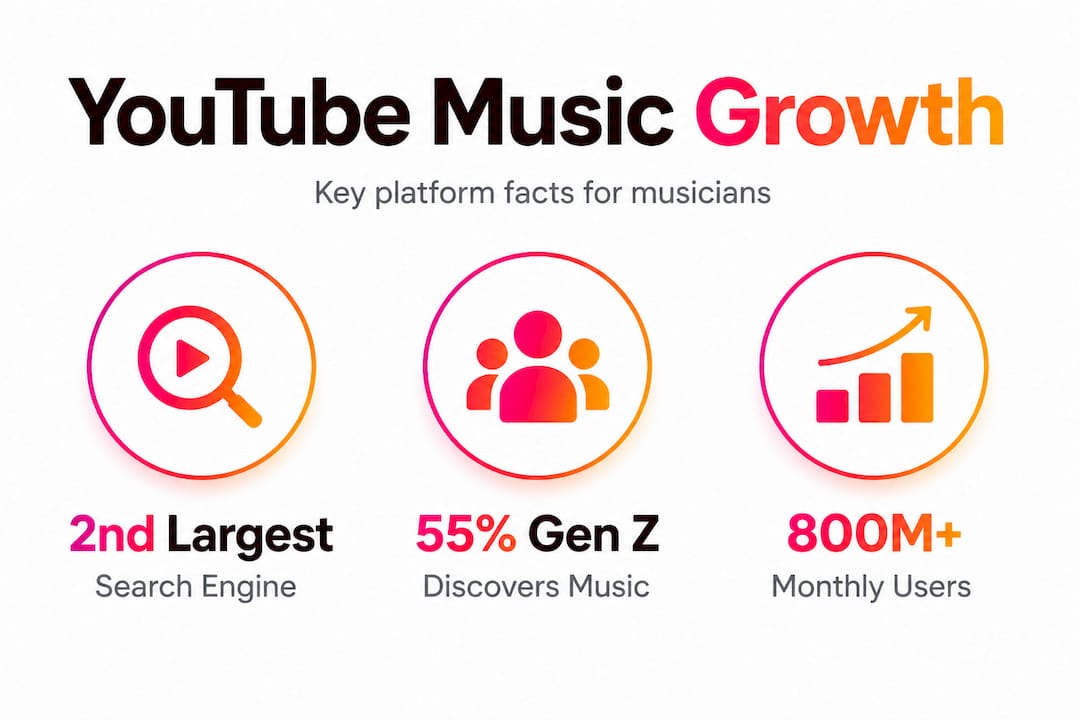
Compare this to platforms like Spotify or SoundCloud. Those platforms are primarily audio-based, meaning discovery relies heavily on algorithmic playlist placement or social sharing. TikTok offers viral potential but short attention spans. YouTube bridges both worlds. A user can find your fifteen-second clip in a Reel or Short, then land on your full three-minute music video, then fall into a playlist of your entire discography. That journey from discovery to dedicated fan is uniquely possible on YouTube.
The numbers back this up clearly. Independent artists grew 20% on YouTube Music in recent years, now representing 40% of the top charts, and received 25% of total creator payouts. These are not fringe statistics. This is a reshaping of the entire music industry happening in real time.
“YouTube is where the search happens. If you are not there, you are invisible to an entire generation of music listeners who never touch radio or Spotify’s browse page.”
To understand how to leverage YouTube’s advantages for musicians fully, it helps to see the platform as a catalogue, not a broadcast channel. Every video you upload is a permanent asset working for you around the clock. Pair that with guidance on boosting your online presence across channels, and YouTube becomes the hub connecting everything else.
Key reasons independent musicians should prioritise YouTube:
- Search discoverability: Fans look up lyrics, song meanings, and live versions on YouTube daily
- Long-form storytelling: You can share your story, process, and personality in ways audio alone cannot
- Fan conversion: Short-form clips hook people; long-form content converts them into loyal listeners
- Monetisation pathways: Ad revenue, Content ID, and fan support tools create multiple income streams
- Evergreen content: A well-tagged video from two years ago can still pull in new fans today
Key strategies for building your YouTube music channel
Now that you know why YouTube is pivotal, let us break down the steps to build a real presence that grows your audience and career.
Building a YouTube channel is not just about uploading music videos and hoping for the best. The platform rewards those who treat it like an ecosystem. That means building playlists, diverse formats, and SEO-optimised metadata that drive traffic from Shorts and TikTok to your long-form content where real fan conversion happens.
Here is a practical step-by-step approach to establishing that ecosystem:
- Optimise your channel profile. Use a clear artist photo, a compelling channel banner, and a well-written “About” section that includes keywords your ideal listeners would search for. Think genre, mood, and location.
- Create content pillars. Decide on three to four content types you will produce consistently. Music videos are essential, but so are behind-the-scenes clips, vocal or instrument covers, and even short documentary-style vlogs about your creative process.
- Build playlists strategically. Group your videos by theme, mood, or project. Playlists keep viewers watching longer, which signals quality to the YouTube algorithm.
- Master basic SEO. Your video title, description, and tags should all reflect what a listener would actually type into the search bar. Tools like TubeBuddy or VidIQ can help you research this.
- Use Shorts to feed your main channel. Post thirty to sixty-second clips of your best moments, then include a call to action directing viewers to the full video. This is how you use TikTok’s energy without abandoning YouTube’s depth.
- Engage in the comments. Reply, pin fan comments, and ask questions. The algorithm notices engagement signals, and fans notice that you actually care.
Pro Tip: Consistency matters far more than production quality in your early stages. Uploading a slightly imperfect video every week will outperform a polished video posted every three months. Start simple. A decent smartphone camera and natural light are genuinely enough to begin.
Here is a comparison of the main content formats available to you, so you can decide what to prioritise:
| Content format | Best purpose | Production effort | Discovery potential |
|---|---|---|---|
| Music videos | Core catalogue, brand identity | Medium to high | High with good SEO |
| Shorts | Hook new viewers, algorithm boost | Low | Very high |
| Behind-the-scenes vlogs | Fan connection, personality | Low to medium | Medium |
| Cover songs | Search traffic, new audiences | Low to medium | High |
| Live performances | Authenticity, fan loyalty | Low | Medium |
| Tutorials or songwriting content | Niche authority, repeat visits | Medium | High in specific niches |
For a deeper look at how to structure all of this, explore effective content strategies for musicians and the broader video content strategies guide to see how other artists are building their channels. You can also look at promotion strategies to maximise reach to understand how to amplify each piece of content once it is live.
How YouTube supports income and long-term growth
But building a channel is not just about gaining attention. It is also your route to financial and fan-base sustainability.

The most inspiring example of this is Secession Studios, a composer who built 720,000 subscribers and a full-time income through consistent weekly uploads, with roughly two-thirds of his revenue coming from Content ID alone, without ever chasing viral trends. He did not go viral once. He simply showed up, uploaded quality work on a reliable schedule, and let the compound effect of a growing catalogue do the work over years.
This is not a one-off story. It is a repeatable model that any independent musician can follow.
YouTube offers several distinct income streams worth understanding:
| Income stream | How it works | Realistic earning potential |
|---|---|---|
| Ad revenue (AdSense) | YouTube pays per 1,000 views on monetised content | Low early on, grows with channel size |
| Content ID | Earn revenue when others use your music in their videos | Strong passive income for producers |
| Super Thanks | Fans tip directly during or after videos | Scales with engaged community |
| Channel memberships | Monthly fee for exclusive content | Predictable recurring income |
| Merchandise shelf | Sell products directly via YouTube | Pairs well with a fanbase |
“The goal is not to go viral. The goal is to build a catalogue of content that earns money and discovers new fans every single day, even while you sleep.”
Pro Tip: Even moderate subscriber growth creates recurring income when channel assets like playlists and older uploads are managed well. A video you uploaded eighteen months ago can still generate ad revenue and Content ID income today. Treat every upload as a long-term investment, not just a moment.
For a clearer picture of how to put this into practice, read about boosting music reach on YouTube and learn about best practices with YouTube ads to understand when paid promotion makes sense. And if you want to convert channel viewers into paying fans offline, look into building a loyal fanbase through merchandise and community touchpoints.
Common misconceptions and how to overcome them
Many musicians hesitate because of persistent myths and fears. Let us clear these up and show why they should not hold you back.
The biggest myth in the room is this: you need to go viral to succeed on YouTube. This simply is not true, and believing it may be the single most damaging thing for an independent musician’s career. The Secession Studios story proves that weekly uploads and catalogue depth consistently outperform sporadic viral attempts. Viral moments are unpredictable and often attract the wrong audience. Steady growth builds the right one.
Here are the most common doubts musicians have, and the honest truth behind each one:
- “I need expensive gear.” False. A modern smartphone records at 4K. Your listeners care about your music and your personality, not your camera model.
- “I need a team.” False. Thousands of independent artists run successful channels entirely solo. You are the team to start with.
- “Nobody will find me without a label.” False. YouTube’s search and recommendation algorithm actively surfaces independent content. Labels are not gatekeepers here.
- “I need to be an entertainer, not just a musician.” Partially false. You need to be yourself, which may include some personality and storytelling. But you do not need to be a YouTuber. You just need to show up consistently.
- “If my first videos flop, it is over.” Completely false. Every successful channel has early videos with almost no views. Growth is not linear, and early uploads often gain traction months or years later.
“You do not need a label, expensive gear, or a viral hit to build an audience on YouTube. You need a plan, patience, and the willingness to keep showing up.”
Understanding the importance of music video content will help you see how even simple video content builds a presence that audio platforms simply cannot replicate. And if you want practical ways to grow your viewers into active fans, look at resources on boosting audience engagement that go beyond simply chasing views.
The reality is that the barrier to entry on YouTube has never been lower. The competition, yes, is real. But so is the opportunity. Authenticity and consistency beat production value and budget almost every time at the independent level.
Why most musicians still underestimate YouTube’s potential
Here is the uncomfortable truth that most music content does not say out loud: the majority of independent musicians are not failing on YouTube because they lack talent. They are failing because they are chasing the wrong thing.
Everyone wants the viral moment. The one video that blows up overnight and delivers a hundred thousand subscribers by morning. That is the fantasy. And because that fantasy is so vivid, musicians spend months or even years waiting for the right moment to post, perfecting one video, or avoiding YouTube altogether because it feels too competitive.
Meanwhile, the artists who are quietly succeeding are the ones nobody talks about publicly. They upload every week. They optimise their titles. They reply to comments. They treat their channel like a long-term business asset rather than a lottery ticket. And after two or three years of doing this without fanfare, they have a catalogue of forty or fifty videos, a growing subscriber base, and multiple income streams running passively in the background.
The other major blind spot is YouTube’s search engine value. Most musicians think of YouTube as a social platform, similar to Instagram or TikTok, where virality and trending content rule the day. But YouTube’s search function means that a well-optimised video about “how to write a chord progression for sad indie songs” or “original acoustic guitar music for studying” can pull in thousands of views every single month for years, without a single share or trending moment.
This is what we mean by evergreen content. It works long after you stop actively promoting it. And building a library of video engagement tips into your strategy means those videos keep converting passive viewers into active fans continuously.
The sustainable approach is less glamorous than going viral, but it is far more reliable. Build your channel like a catalogue, not a highlight reel. Every video is an asset. Every optimised title is a quiet investment. Every consistent upload adds one more entry point for a new fan to discover you. That is how a real music career is built in 2026.
Take your YouTube music career to the next stage
You now have the understanding, the strategy, and the evidence to build something real on YouTube. The question is no longer whether you should be there. It is how quickly you can start building with the right tools.

Music Video Marketplace is built precisely for this moment. We help independent musicians create long-form videos in minutes, ready to upload directly to YouTube, and we make it simple to launch an ad campaign for your song so your content reaches the right audience from day one. Whether you are following our YouTube upload guide for the first time or looking to sharpen your YouTube distribution workflow, we have the resources and the platform to help you act on what you have just learnt. Your next upload should not wait.
Frequently asked questions
How often should independent musicians upload to YouTube?
Aim for at least one video per week, as consistent weekly uploads are what drive long-term subscriber growth and sustained visibility over time.
Can YouTube really help me build a fanbase if I have no followers yet?
Yes, because YouTube’s recommendation engine actively surfaces new artists to listeners who are already looking, with 55% of Gen Z discovering new music exclusively through its recommendations.
What kind of content works best for building a music presence on YouTube?
Mix music videos, vlogs, behind-the-scenes content, and Shorts, as diverse formats and playlists appeal to both fans and the algorithm simultaneously.
Do I need expensive cameras or studio equipment to start?
No. Authenticity and consistency matter far more than gear at the start, as proven by artists who built 720K subscribers via weekly uploads without chasing trends or high production budgets.
Recommended
- How YouTube algorithms boost musicians’ song visibility | Music Video Marketplace Blog
- Key advantages of YouTube for musicians in 2026 | Music Video Marketplace Blog
- Why YouTube matters for DJs: grow your audience and career | Music Video Marketplace Blog
- YouTube Promotion for Musicians: Driving Global Impact | Music Video Marketplace Blog
Read next
 Why optimise for YouTube to boost your music careerDiscover why optimising for YouTube's algorithm and ads delivers better music promotion results than chasing subscribers. Learn cost-effective strategies to boost visibility.
 Why use long form video for DJs: 2026 guideDiscover why use long form video for DJs in 2026. Build deeper fan connections and elevate your artist career with effective strategies!
 Why video boosts engagement for indie musicians on YouTubeDiscover why video boosts engagement for indie musicians on YouTube. Learn key strategies to enhance audience retention and grow your channel!
 What is YouTube monetisation for musicians: a guideLearn how YouTube monetisation works for musicians, including Partner Programme requirements, revenue streams, Content ID benefits, and practical strategies to maximise earnings from your music content.
Turn the idea into a finished music video.
Drop your track into the Studio and build your visual in minutes.