
Audience targeting for musicians: your 2026 guide
Unlock your music career in 2026! Discover what is audience targeting for musicians and how it drives ticket sales and engagement.

Audience targeting for musicians: your 2026 guide
TL;DR:
- Audience targeting helps musicians focus their marketing on specific listener groups based on behavior and demographics. It improves engagement and reduces wasted ad spend by tailoring messages to each fan tier, especially superfans. AI tools assist in identifying high-value fans and refining marketing strategies, leading to more effective campaign results.
Audience targeting for musicians is the practice of identifying distinct listener groups based on behaviour, demographics, and platform data, then delivering marketing that speaks directly to each group. What is audience targeting for musicians in practical terms? It is the difference between spending your budget on everyone and spending it on the people most likely to buy a ticket, stream your album, or share your music. Nearly 70% of consumers prefer personalised experiences, which means generic outreach actively pushes fans away. The industry term for this process is audience segmentation, and in 2026 it sits at the centre of every effective music marketing campaign.
What is audience targeting for musicians and why does it matter?
Audience targeting for musicians is the structured process of grouping your listeners by shared traits and then matching your marketing to each group’s behaviour. It replaces the assumption that all fans want the same thing with evidence that they do not. A superfan who has bought merchandise, attended three shows, and pre-saved your last release needs a completely different message from someone who heard one track on a playlist and followed you out of mild curiosity.

The financial case is straightforward. Focusing your budget on fan data reduces wasted ad spend and increases conversion by targeting the right age groups, locations, and interests. Targeting high-intent groups lowers your cost per result and raises your return. That is not a minor efficiency gain. For an independent artist with a limited budget, it is the difference between a campaign that pays for itself and one that drains your savings.
Audience segmentation also protects the relationships you have already built. Superfans feel the difference when they receive the same email as someone who barely knows your name. Treating your most loyal listeners like the general public signals that you do not see them, and over time that erodes the connection that makes them superfans in the first place.
How does audience segmentation refine fan targeting?
Fan segmentation typically covers 3–5 tiers: superfans, casual listeners, dormant fans, new subscribers, and purchasers. Each tier behaves differently, responds to different content, and requires a different communication strategy. Grouping them together and sending one message to all of them is the fastest way to make every group feel misunderstood.
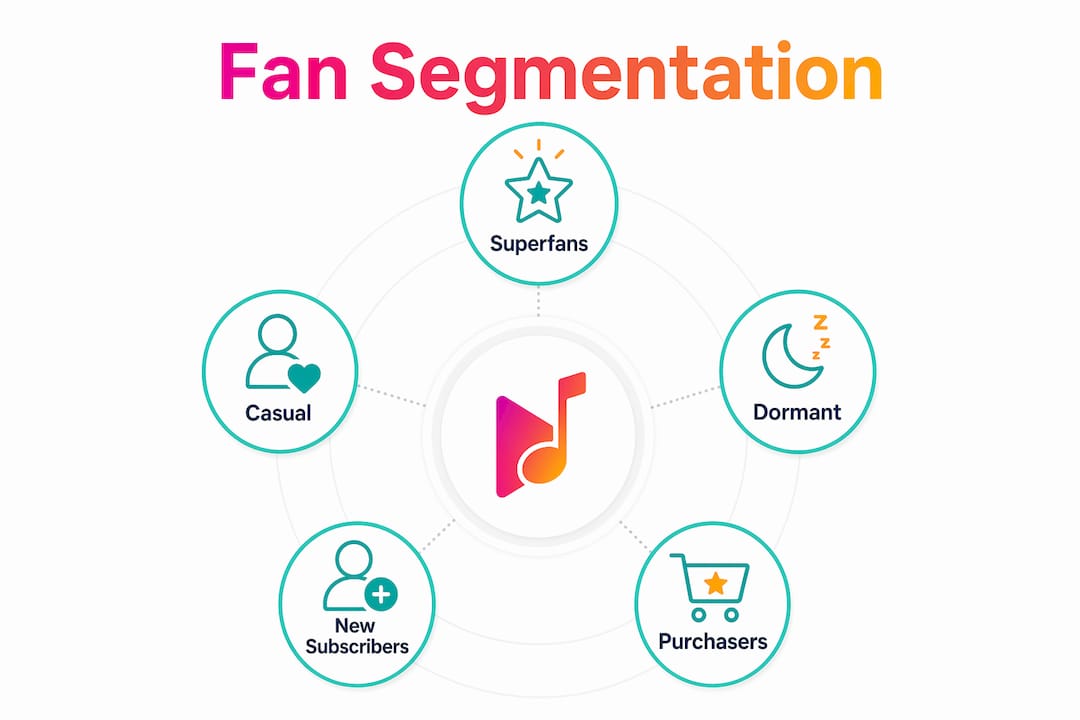
Behaviour-based segmentation is more reliable than demographic assumptions. A 45-year-old who streams your music daily, comments on every post, and buys every vinyl release is a superfan regardless of age. A 22-year-old who followed you after one viral clip and has not engaged since is a dormant fan. The behaviour tells you far more than the age bracket.
The actions that define each segment include:
- Superfans: repeat purchases, event attendance, social shares, pre-saves, and direct messages
- Casual listeners: occasional streams, passive social follows, and infrequent email opens
- Dormant fans: past purchasers or followers with no recent engagement
- New subscribers: recent sign-ups with no purchase or deep engagement history
- Purchasers: fans who have bought something but may not be active on social platforms
Pro Tip: Set a simple scoring rule before you build any segment. Assign points for actions: one point for a stream, three for a social comment, five for a ticket purchase. Anyone above a threshold score is a superfan candidate. This takes 30 minutes to set up and immediately separates your high-intent fans from the rest.
Communication frequency and content type should shift with each tier. Superfans can receive more frequent, more personal messages. Casual listeners need broader storytelling content that deepens their connection before you ask them for anything. Dormant fans respond best to a single, well-timed re-engagement message rather than a flood of catch-up emails.
What AI and data tools help musicians reach the right fans?
AI tools like Chartmetric reveal your audience’s age, location, platform preferences, and behaviour patterns, enabling more precise marketing decisions. Chartmetric pulls data from streaming platforms, social media, and radio airplay to give you a single view of who your listeners are and where they are most active. That kind of cross-platform picture was impossible to build manually even five years ago.
AI classification segments fans by behaviour across platforms, allowing musicians to identify superfans and casual listeners based on engagement rather than self-identification. Fan scoring systems integrate streaming, social, and e-commerce behaviours to produce a ranked list of your most valuable listeners. You do not need to guess who your superfans are. The data tells you.
The practical outputs from these tools include:
- Demographic breakdowns by age, gender, and location
- Platform preference data showing where fans are most active
- Engagement trend lines that reveal when interest is rising or falling
- Lookalike audience profiles for paid advertising
Pro Tip: If your data shows that 70% of your audience is aged 25–34, shift your ad targeting away from teenagers immediately. You are not abandoning younger fans. You are spending your budget where it converts.
Understanding music campaign metrics alongside your audience data gives you a complete picture. Raw fan numbers mean little without knowing which fans are actually driving your revenue and engagement. AI removes vanity metrics from the conversation and replaces them with signals that predict real-world behaviour.
Why does personalised marketing matter for different fan tiers?
Treating superfans like the general email list flattens relationships and reduces engagement. Superfans have invested time, money, and emotional energy in your music. They expect to be recognised for that. When they receive the same newsletter as someone who signed up last week, the implicit message is that their loyalty counts for nothing.
Personalised outreach strategies include early access to releases, exclusive content, and tailored messaging depending on the fan segment’s engagement level. Different messages for superfans and casual fans increase both engagement and conversion. The mechanics of this are not complicated, but they require discipline to maintain.
A practical framework for adapting messages by tier:
- New fans receive storytelling content: your background, your influences, and the meaning behind your music. The goal is depth, not a sales pitch.
- Casual fans receive behind-the-scenes content and invitations to participate, such as voting on artwork or naming a track. This moves them from passive to active.
- Superfans receive exclusive access: early ticket sales, private listening sessions, signed merchandise, and direct acknowledgement of their loyalty.
- Purchasers receive loyalty communications: thank-you messages, offers tied to their purchase history, and first-look access to new products.
Pro Tip: Create a separate email segment for anyone who has purchased from you more than once. Send them a message that references their purchase history by name. “You picked up the vinyl last year” lands differently than “Thanks for being a fan.” That specificity is what builds lasting loyalty.
Fan engagement strategies built around segment-specific content consistently outperform generic campaigns. The reason is simple: people respond when they feel seen. A message that reflects what a fan has actually done creates a moment of recognition that generic outreach never can.
Practical steps to implement audience targeting as a musician
Building an effective targeting system does not require a large team or a major label budget. It requires consistent data collection, honest analysis, and a willingness to act on what the data shows.
- Collect fan data from every touchpoint. Your email list, streaming platform dashboards, social media analytics, and ticket sales all contain audience information. Pull these together into a single view, even if that means a simple spreadsheet to start.
- Use platform insights to define your initial segments. Most streaming and social platforms provide demographic and engagement data at no cost. Use this to identify your top-performing age groups, locations, and content types before spending anything on paid tools.
- Test campaigns with small budgets before scaling. Run two versions of an ad with different targeting parameters and compare results over seven to fourteen days. The version with a lower cost per result tells you which segment is responding. Scale that one.
- Iterate based on feedback, not assumptions. If a segment stops responding, change the message before you change the audience. Fatigue is usually a content problem, not a targeting problem.
- Prioritise your budget according to segment value. Superfans generate the most revenue per person. Allocate a higher proportion of your budget to retaining and rewarding them before spending heavily on acquiring new casual listeners.
Expert strategies for music ad campaigns consistently point to one principle: the musicians who grow sustainably are the ones who treat fan data as an ongoing asset, not a one-time project. Reviewing your segment data monthly keeps your targeting sharp and your budget efficient.
Getting your music in front of new audiences also requires distribution beyond social media. Internet radio promotion reaches listeners who are actively seeking new music, which makes them a naturally receptive audience for targeted outreach.
Key takeaways
Audience segmentation is the single most effective way for musicians to turn fan data into career growth, because it replaces guesswork with evidence at every stage of marketing.
| Point | Details |
|---|---|
| Define segments by behaviour | Use streaming, purchase, and social data to rank fans, not demographic assumptions. |
| Superfans need exclusive treatment | Sending superfans generic content erodes loyalty and reduces long-term engagement. |
| AI tools remove vanity metrics | Platforms like Chartmetric reveal which fans drive real revenue, not just follower counts. |
| Personalise by tier | New fans need storytelling; superfans need access and recognition; purchasers need loyalty rewards. |
| Budget follows segment value | Allocate more spend to high-intent fans before chasing new casual listeners. |
Why I think most musicians are targeting the wrong people
Fan segmentation changed how I think about music marketing entirely. The most common mistake I see is musicians spending the majority of their budget trying to reach new people while their existing superfans quietly disengage. Acquiring a new fan costs far more than retaining one you already have. The data makes this obvious, yet the instinct to chase follower counts persists.
The second pitfall is treating segmentation as a one-time exercise. Fans move between tiers. A casual listener becomes a superfan after attending a live show. A superfan goes dormant after a long gap between releases. Your segments need to be reviewed regularly, or you end up sending the wrong message to the wrong person at the wrong moment.
The artists I have seen build genuinely sustainable careers are the ones who treat their fan data as a living document. They know their top 200 fans by behaviour, not by name, and they communicate with those fans in a way that reflects what those fans have actually done. That is not complicated. It is just consistent. The 2026 audience targeting guide from Musicvideomarketplace covers this in practical detail if you want a framework to follow.
— Music
How Musicvideomarketplace supports your fan targeting efforts
Musicvideomarketplace gives musicians a direct path from song to campaign. You can create a long-form video in minutes, upload it to YouTube, and launch a targeted ad campaign for your music without needing a production team or a marketing agency.

The platform is built for musicians who want to act on their audience data rather than just collect it. Once you know which segments to target, Musicvideomarketplace helps you reach them with video content that reflects your brand and speaks to the right listeners. Visit Musicvideomarketplace to build your first campaign and put your fan segmentation to work.
Pairing your targeting strategy with a music submission checklist ensures your promotional groundwork is solid before you spend on ads.
FAQ
What is audience targeting for musicians?
Audience targeting for musicians is the process of identifying distinct listener groups by behaviour and demographics, then delivering marketing tailored to each group. It replaces generic outreach with messages that reflect what each fan has actually done.
What are the main fan segments musicians should know?
Fan segmentation covers 3–5 tiers: superfans, casual listeners, dormant fans, new subscribers, and purchasers. Each tier requires different content, frequency, and messaging to maintain engagement.
How does AI help with audience targeting in music?
AI tools analyse streaming, social, and purchase data to score fans by engagement level and identify high-intent listeners. This removes vanity metrics and directs your budget toward the fans most likely to convert.
Why do superfans need separate treatment?
Superfans who receive generic communications disengage over time because the messaging signals their loyalty is not recognised. Exclusive access, early releases, and personal acknowledgement maintain the connection that makes them superfans.
How much should musicians spend on audience targeting tools?
Most streaming and social platforms provide free demographic and engagement data that is sufficient to build initial segments. Paid tools like Chartmetric add depth once your campaigns are generating enough data to justify the investment.
Recommended
- Audience targeting in music ads: 2026 guide | Music Video Marketplace Blog
- Tips for effective song ads: your 2026 guide | Music Video Marketplace Blog
- Top video marketing trends for musicians: 2026 strategies | Music Video Marketplace Blog
- 2026 trends in music promotion: what works now | Music Video Marketplace Blog
Read next
 Why a centralised artist dashboard transforms your releasesDiscover how a centralized artist dashboard enhances marketing efficiency, streamlines asset management, and boosts revenue for musicians.
 Why long-term content strategies pay off for musiciansDiscover how long-term content strategies can build your audience, increase revenue, and transform casual listeners into loyal fans.
 Benefits of video for artist acquisition: 2026 guideDiscover the benefits of video for artist acquisition. Learn how video transforms listeners into loyal fans and boosts engagement.
 All Ready Made Music Videos £99If you’ve ever struggled to afford a music video, this is the moment everything changes. Music Video Marketplace is making high-quality visuals accessible to every artist.
Turn the idea into a finished music video.
Drop your track into the Studio and build your visual in minutes.