
DJ YouTube monetisation: boost your income in 2026
Learn how DJs can navigate copyright, Content ID, and YouTube's Partner Programme to build real income from video content in 2026.
DJ YouTube monetisation: boost your income in 2026
TL;DR:
- Most DJ mixes using copyrighted tracks are ineligible for monetisation due to Content ID claims.
- Building a sustainable income on YouTube relies on creating original, policy-compliant content like tutorials and reviews.
- Focusing on audience growth and off-platform engagement yields higher revenue than attempting to earn solely from ad revenue.
Many DJs upload their mixes to YouTube expecting ad revenue to roll in, only to find their videos demonetised, claimed by rights holders, or stripped of income entirely. The platform’s copyright enforcement is far more aggressive than most people realise, and the gap between uploading content and actually earning from it is wider than it looks. Understanding how YouTube’s monetisation rules interact with DJ content is the difference between building a genuine income stream and spending hours creating videos that earn nothing. This guide breaks down exactly what works, what doesn’t, and how to build a strategy that actually pays.
Table of Contents
- YouTube monetisation basics: who is eligible and why it matters
- The rights issue: understanding copyright and Content ID as a DJ
- How DJs can actually earn: content types and monetisation options
- Alternatives and advanced options: YouTube Creator Music and smarter monetisation funnels
- Why most DJs miss out on YouTube monetisation—and what really works
- Take your DJ channel further with Music Video Marketplace
- Frequently asked questions
Key Takeaways
| Point | Details |
|---|---|
| Eligibility matters | YouTube requires 1,000 subscribers and strict watch time metrics before you can monetise as a DJ. |
| Copyright limits income | Even a single copyrighted song can redirect your entire video’s ad earnings to the rights holder. |
| Focus on original content | Publishing tracks, vlogs, or tutorials you fully own leads to reliable revenue. |
| Advanced options available | Creator Music, licensing, and promotion funnels can increase your income beyond basic ad revenue. |
YouTube monetisation basics: who is eligible and why it matters
Before you can earn a single penny from YouTube ads, your channel must qualify for the YouTube Partner Programme (YPP). The requirements are specific: 1,000 subscribers and either 4,000 valid public watch hours in the past 12 months or 10 million valid public Shorts views in the past 90 days. You also need no active strikes on your channel and 2-step verification enabled.
These thresholds exist because YouTube wants to protect advertisers and rights holders from low-quality or infringing content. The platform earns its revenue from advertisers, and those advertisers need assurance that their ads appear alongside trustworthy, policy-compliant videos. For DJs, this matters enormously because why YouTube matters for DJs goes far beyond ad revenue alone.
Here’s a quick summary of what YPP membership unlocks:
- Ad revenue sharing on eligible videos (YouTube keeps 45%, creators receive 55%)
- Channel memberships allowing fans to pay a monthly fee for perks
- Super Thanks and Super Chat for direct fan contributions during streams
- Access to YouTube Shopping to sell merchandise directly
- Priority support from YouTube’s creator team
The table below shows the two main eligibility routes side by side:
| Route | Requirement | Timeframe |
|---|---|---|
| Long-form content | 4,000 watch hours | Past 12 months |
| YouTube Shorts | 10 million Shorts views | Past 90 days |
Reaching these thresholds is only half the battle. Even after joining YPP, a DJ’s content must remain policy-compliant to keep earning. One copyright strike can pause monetisation across your entire channel, not just the offending video. This is why understanding the rights landscape before you hit upload is so important.
Pro Tip: Focus on building watch time through tutorials and behind-the-scenes content early on. These formats tend to attract longer viewing sessions than straight DJ mixes, helping you hit the 4,000-hour threshold faster.
The rights issue: understanding copyright and Content ID as a DJ
Content ID is YouTube’s automated copyright detection system, and it is extraordinarily thorough. When you upload a video, Content ID scans the audio and video against a database of copyrighted material submitted by rights holders. If it finds a match, the rights holder can choose to block the video, mute the audio, or claim the ad revenue for themselves.

For DJs, this creates an immediate problem. DJ mixes using copyrighted tracks trigger Content ID claims, and rights holders typically monetise the video themselves, cutting the creator out entirely. Worse, continuous DJ mixes are ineligible as Content ID references, meaning they cannot even be used to establish ownership.
Here’s how different content types stack up for monetisation:
| Content type | Monetisation status | Notes |
|---|---|---|
| Original music videos | Eligible | Must own all elements |
| DJ mix (copyrighted tracks) | Not eligible | Revenue goes to rights holders |
| Remixes (no licence) | Not eligible | Treated as infringement |
| Tutorial videos | Eligible | If no copyrighted music used |
| Live sets (licensed tracks) | Partial | Depends on individual licences |
Many DJs believe that crediting the original artists in the video description protects them. It does not. Credit is not a licence. The rights holder still controls what happens to the revenue, regardless of whether you’ve named them in the description.
Another common misconception is fair use for DJ mixes. Fair use is a legal doctrine, not a YouTube policy, and it rarely applies to full-length DJ mixes. Transformative use arguments are difficult to win, and disputing a Content ID claim without solid legal grounds can result in a copyright strike if the rights holder escalates.
The smarter approach is to build your YouTube presence around content that sidesteps these issues entirely. Tutorials, gear reviews, and promo video strategies that feature only original or royalty-free music keep your channel clean and your revenue intact.
Remember: A single copyrighted track in a 60-minute mix is enough to hand all ad revenue to that track’s rights holder. It doesn’t matter how much of the mix is original.
How DJs can actually earn: content types and monetisation options
The good news is that there are plenty of content formats DJs can use to build genuine, sustainable YouTube income. The key is shifting your thinking from “uploading mixes” to “creating original content that showcases your skills.”
Monetising your content on YouTube requires that everything in your video is original and authentic, and that you hold commercial rights to all elements including music, visuals, and any samples used. For DJs, this opens up several strong content categories:
- Tutorial videos: How to beatmatch, how to use specific DJ software, transition techniques. These attract consistent search traffic and require no copyrighted music.
- Gear reviews and unboxings: Controllers, mixers, headphones. High-value content that attracts sponsorship interest as your channel grows.
- Behind-the-scenes vlogs: Studio sessions, event preparation, travel to gigs. Personal content that builds audience connection.
- Original music videos: If you produce your own tracks, these are fully monetisable and can be promoted as ads.
- Live stream DJ sets using royalty-free or self-produced music: Builds community while keeping revenue in your pocket.
Pro Tip: Pair your tutorial videos with creative video content ideas to diversify your uploads. Channels that mix educational content with personal storytelling tend to grow faster and retain subscribers longer.
Think about what makes you valuable as a DJ beyond your mixes. Your technical knowledge, your taste, your journey as an artist: these are all content gold. A video explaining how you structure a set, or why you chose certain tracks for a particular crowd, can outperform a full mix in both views and revenue because it’s original, searchable, and fully monetisable.
For video monetisation for musicians, the principle is the same: own what you upload, and YouTube will reward you for it.
Alternatives and advanced options: YouTube Creator Music and smarter monetisation funnels
YouTube Creator Music is a licensing service built into the platform that allows YPP members to license tracks for use in their videos. Some tracks are available for a flat fee, while others operate on a revenue-sharing model where the rights holder takes a portion of your ad income.
However, Creator Music comes with significant restrictions. You cannot use licensed tracks in remixes, Art Tracks, visualisers, lyric videos, or karaoke content. You also cannot use them in brand-paid videos or content that falls into restricted categories. Revenue sharing adjusts your standard 55% creator share, for example halving it if you use one licensed track. Currently, Creator Music is available primarily in the US, limiting its usefulness for many DJs globally.
Here’s a comparison of monetisation approaches for DJs:
| Strategy | Potential income | Copyright risk | Scalability |
|---|---|---|---|
| Direct ad revenue (original content) | Medium | Low | High |
| Creator Music revenue share | Low to medium | Low | Medium |
| Funnel to bookings/merch | High | None | High |
| Uploading copyrighted mixes | None | Very high | None |
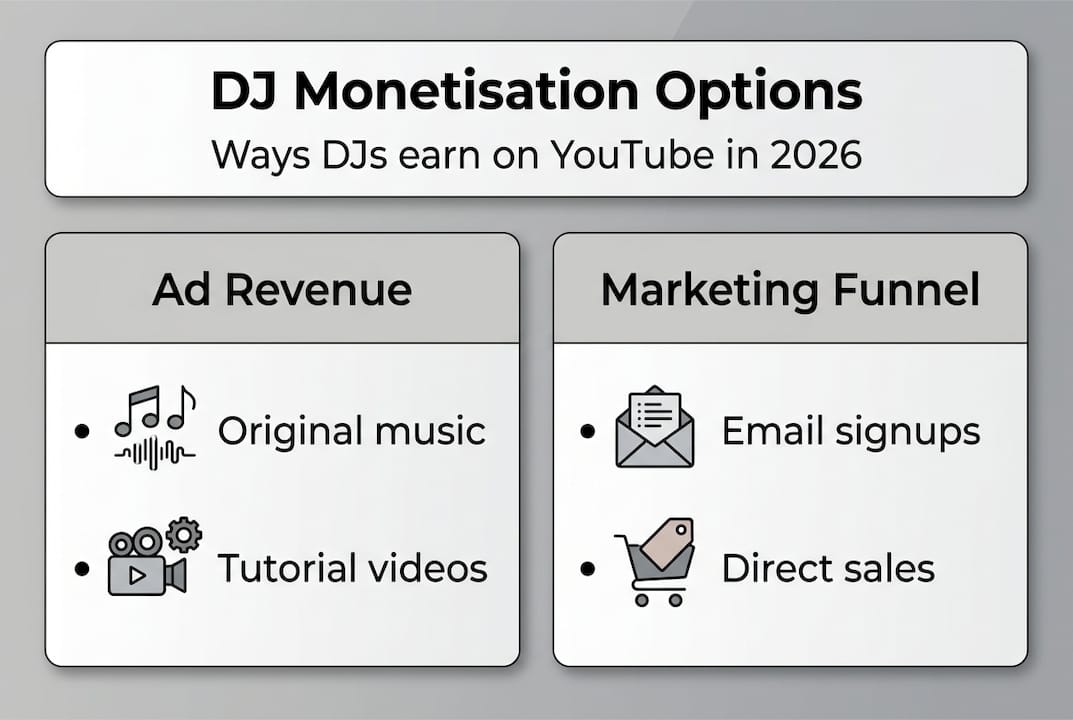
The DJ video marketing approach that consistently outperforms direct ad monetisation is the funnel strategy. Rather than relying on YouTube ads as your primary income, you use YouTube as a discovery engine. Views lead to followers, followers lead to email subscribers, and email subscribers convert into ticket buyers, music purchasers, and booking enquiries.
Pro Tip: Use YouTube’s end screens and cards to direct viewers to a free download or mailing list sign-up. Off-platform income from bookings and music sales almost always exceeds what YouTube ads alone can generate for a DJ.
Alternatives like Mixcloud are worth considering for your mix content specifically, as the platform has licensing agreements with major rights holders. This means your mixes can live there legally, while your monetisable original content lives on YouTube. Splitting your content across platforms strategically, as explored in boost video engagement guides, gives you the best of both worlds. Content ID accuracy sits at 99.7%, so there is virtually no way to slip copyrighted content past the system undetected.
Why most DJs miss out on YouTube monetisation—and what really works
Here’s the uncomfortable truth: most DJs approach YouTube with the wrong goal. They want ad revenue from mixes, but the platform’s architecture makes that nearly impossible without owning every element of the audio. Chasing that goal leads to frustration, wasted effort, and sometimes channel strikes.
The DJs who actually build income from YouTube are the ones who treat it as a marketing channel rather than a revenue channel. They upload original content consistently, use YouTube to grow an audience, and then convert that audience into real-world income through bookings, merchandise, and music sales.
YouTube’s Content ID scans at 99.7% accuracy, which means testing mixes privately before publishing is essential to avoid unexpected claims going public. More importantly, building a catalogue of wholly original content, whether that’s tutorials, vlogs, or original music, is what creates a channel that compounds in value over time.
For smart music income, the mindset shift is from “how do I earn from this video” to “how does this video earn for me elsewhere.” That reframe changes everything about how you plan, create, and publish content.
Take your DJ channel further with Music Video Marketplace
Original video content is the foundation of every successful DJ monetisation strategy on YouTube. Without it, you’re always fighting copyright claims and handing revenue to rights holders. With it, you control your income, your audience, and your growth.

Music Video Marketplace helps DJs and producers create professional long-form videos in minutes, ready to upload to YouTube and pair with targeted ad campaigns. If you’re ready to stop losing revenue to Content ID and start building a channel that actually works for you, explore how music video ads can accelerate your reach and turn your original content into a genuine income stream.
Frequently asked questions
Can I monetise my DJ mixes on YouTube if I credit all original artists?
No, credit alone does not allow monetisation. When mixes include copyrighted tracks, rights holders retain control of ad revenue regardless of whether you’ve credited them.
What happens if my DJ video triggers a Content ID claim but I have permission for one track?
You must prove you hold permission for every copyrighted element in the video. Even with one permitted track, any other claimed element means revenue goes to that rights holder.
Is fair use ever a defence for monetising DJ mixes on YouTube?
Fair use rarely applies to full-length DJ mixes and almost never overturns a Content ID claim in practice.
How can I avoid demonetisation as a DJ on YouTube?
Use wholly original or royalty-free music and ensure you hold commercial rights to all elements including music, visuals, and any samples in your videos.
Recommended
- Video monetisation for musicians: complete guide 2026 | Music Video Marketplace Blog
- Key advantages of YouTube for musicians in 2026 | Music Video Marketplace Blog
- YouTube music distribution: 5 key benefits in 2026 | Music Video Marketplace Blog
- Maximise your music income: a guide to smart monetisation | Music Video Marketplace Blog
Read next
 Effective video content strategies for musicians: a guideLearn how independent musicians can build a video content strategy on YouTube that boosts visibility, engagement, and music promotion in 2026.
 Examples of artist YouTube trailers: 2026 guideDiscover powerful examples of artist YouTube trailers that hook viewers instantly. Learn how to engage fans and elevate your music releases!
 Examples of video content for musicians in 2026Discover practical video content examples for musicians in 2026. Compare formats, evaluate options, and learn production tips to boost your YouTube reach effectively.
 Digital marketing for producers: grow your audience fastDiscover proven digital marketing strategies for independent music producers to grow their YouTube audience, boost streams, and increase revenue in 2026.
Turn the idea into a finished music video.
Drop your track into the Studio and build your visual in minutes.