
Music ad campaign strategies for independent artists
Learn how independent musicians can use targeted ad campaigns on YouTube and beyond to grow their audience, boost streams, and build sustainable momentum.
Music ad campaign strategies for independent artists

TL;DR:
- Targeted ad campaigns are accessible tools for independent musicians to boost discovery and engagement.
- Campaigns should be planned around clear goals, narrow targeting, and continuous testing to maximize ROI.
- Ad strategies function best as ongoing infrastructure, supporting organic growth through data-driven insights.
Most independent musicians assume ad campaigns are reserved for artists signed to major labels with marketing teams and unlimited budgets. That assumption is costing you listeners. Targeted ad campaigns are now one of the most accessible and measurable tools available to independent artists, and when used correctly, they shift discovery from random chance to deliberate audience building. This guide walks you through exactly how to plan, launch, and integrate ad campaigns so your music reaches people who are genuinely likely to connect with it, not just anyone scrolling past.
Table of Contents
- Why ad campaigns matter for independent musicians
- Planning your ad campaign: Goals, targeting and creative essentials
- YouTube ad campaigns: Tactics, benchmarks and real outcomes
- Integrating ads with organic promotion strategies
- The quiet infrastructure: Why the smartest artists use ads differently
- Boost your campaign results with Music Video Marketplace
- Frequently asked questions
Key Takeaways
| Point | Details |
|---|---|
| Targeted campaigns drive engagement | Focusing on precise audiences, ad campaigns deliver real fans who stream, save, and support your music long term. |
| Planning and testing are critical | Start with clear objectives and small-scale tests to find winning ad strategies before scaling up. |
| YouTube offers cost-effective discovery | YouTube ads can boost music visibility and cross-platform fan growth without huge budgets. |
| Ads amplify—not create—demand | Run ads only after organic validation to avoid amplifying weak content and maximise real impact. |
Why ad campaigns matter for independent musicians
Traditional music marketing meant flyers, radio plugging, and hoping a blogger picked up your press release. The audience was broad, the feedback was slow, and the cost was high relative to reach. Digital ad campaigns changed all of that. You now have the ability to put your music in front of specific listeners based on genre preferences, the artists they already follow, their location, and even their listening behaviour.
This precision matters enormously for independent artists operating on tight budgets. Every pound you spend should move a potential fan closer to pressing play, saving your track, or joining your mailing list. As one industry analysis notes, ad campaigns shift discovery from random chance to algorithmic alignment, boosting streams, saves, and fan engagement. These are not vanity metrics. They are the signals that tell platforms like Spotify and YouTube to recommend your music to even more people.
Here is a straightforward comparison between traditional and digital campaign approaches:
| Approach | Reach | Cost control | Measurability | Targeting precision |
|---|---|---|---|---|
| Traditional (radio, press) | Broad | Low | Poor | Minimal |
| Digital ad campaigns | Focused | High | Excellent | Precise |
The goals worth building campaigns around include:
- Streams and saves on Spotify or Apple Music
- YouTube views and subscribers
- Email list sign-ups via a landing page
- Pre-save completions ahead of a release
- Ticket sales for live shows
Consider an indie folk artist who spent £200 on a targeted YouTube campaign promoting a new single. By focusing on fans of similar artists within specific UK cities, she gained over 8,000 views, 300 new subscribers, and a noticeable spike in Spotify saves that triggered a playlist editorial review. That is the practical power of music ad campaign strategies done right.
For expert music marketing strategies, the consensus is clear: independent artists who treat advertising as a core part of their release strategy consistently outperform those who rely on organic reach alone. The algorithm rewards engagement, and ads are how you ignite it.
“Ads aren’t about buying fame. They’re about putting the right song in front of the right person at the right moment.” This mindset shift separates artists who grow sustainably from those who burn through budget with nothing to show.
Understanding video ads for music audience growth is also essential. Video content performs consistently across platforms and gives potential fans a real sense of your artistry within the first few seconds.
Planning your ad campaign: Goals, targeting and creative essentials
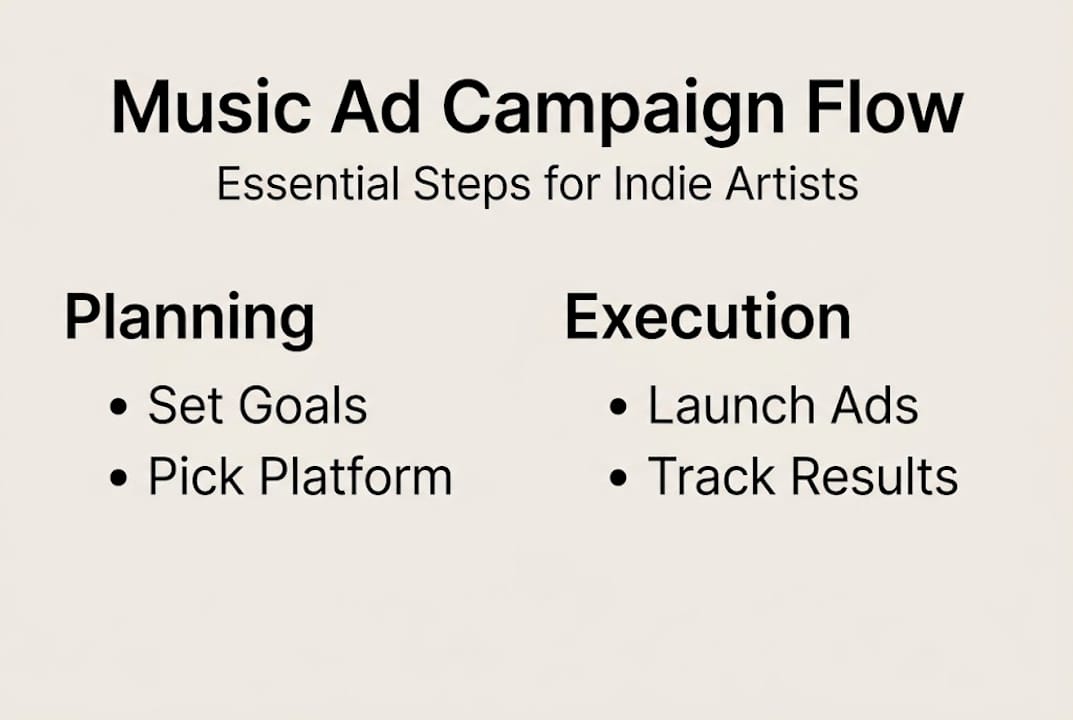
Understanding the value of ads is one thing. Building a campaign that actually works is another. The good news is that the process is learnable and repeatable. Key methodologies include starting with clear goals, narrow targeting, native creatives, small tests, and scaling winners while tracking metrics.
Here is a step-by-step approach to get started:
- Define your objective. Are you chasing streams, subscribers, or email sign-ups? Each goal requires a different campaign structure.
- Identify your audience. Think genre, mood, similar artists, age range, and geography. Narrow beats broad every time.
- Create your ad creative. Use short hooks in the first three seconds. Add subtitles for silent viewing. Make the ad feel native to the platform, not like a commercial.
- Set a test budget. Start small, around £5 to £10 per day, and run at least three creative variations.
- Track your metrics. Monitor click-through rate (CTR), cost per view (CPV), and conversions to meaningful actions.
- Scale what works. Once one creative outperforms, increase its budget and pause the underperformers.
Pro Tip: When building your audience on YouTube or Meta, use the “similar artist” targeting option. If your music sounds like a well-known indie act, target their fanbase directly. These listeners already know what they like and are far more likely to engage.
Here is a quick benchmark table for platform comparison:
| Platform | Ad format | Average CPV | Best for |
|---|---|---|---|
| YouTube | TrueView in-stream | £0.01 to £0.03 | Video views, subscribers |
| Meta (Instagram/Facebook) | Video story or reel | £0.02 to £0.05 | Fan awareness, clicks |
| TikTok | TopView or In-Feed | £0.01 to £0.04 | Viral reach, younger audiences |
For detailed music ad best practices, focus on the creative above all else. A well-targeted ad with weak creative will always underperform a mediocre targeting setup with compelling video. If you want to understand how to promote a song without a record label, campaigns built around authentic storytelling consistently outperform polished but impersonal content.
Revisiting your music ad campaign strategies after each campaign cycle is how you improve. Treat every campaign as a learning experiment, not a final verdict on your music.
YouTube ad campaigns: Tactics, benchmarks and real outcomes
YouTube remains one of the most powerful platforms for independent artists running ad campaigns. Its intent-based audience means people are actively searching for music, which makes your ad feel like a discovery rather than an interruption.
The primary format to use is TrueView in-stream. These ads play before or during videos and can be skipped after five seconds. You only pay when someone watches 30 seconds or more, or engages with your ad. This means you are paying for genuine interest, not passive exposure.
According to benchmarks for YouTube ads for musicians, a minimum effective budget of £300 to £450 per month delivers roughly 9,000 to 22,000 views and around 450 new subscribers. Those numbers assume solid targeting and a strong creative hook.
| Budget per month | Expected views | Expected subscribers | CPV range |
|---|---|---|---|
| £150 | 3,000 to 6,000 | 100 to 150 | £0.02 to £0.05 |
| £300 to £450 | 9,000 to 22,000 | 350 to 450 | £0.01 to £0.03 |
| £600+ | 25,000+ | 600+ | £0.01 to £0.02 |
Key tactics for YouTube success:
- Target videos from similar artists, not just keywords
- Geo-focus your campaign if you have upcoming tour dates in specific cities
- Retarget viewers who watched 50% or more of your previous videos
- Front-load your hook. The first three seconds must grab attention before the skip button appears
Pro Tip: Use YouTube’s custom intent audiences to reach people who have recently searched for your genre or similar artist names. This is one of the most underused targeting options available to independent musicians.
One algorithm unlock case study showed an indie pop artist gaining significant playlist placements after a sustained YouTube ad campaign drove consistent watch time and engagement signals over six weeks. That is the compound effect of boosting YouTube music reach through paid and organic channels working together.
For broader context on YouTube promotion for musicians and the key advantages YouTube offers musicians in 2026, the platform’s search and recommendation engine gives your ad campaign a longer shelf life than almost any other paid channel. Understanding YouTube ad best practices is what separates campaigns that fizzle from ones that compound.
Integrating ads with organic promotion strategies
Ads work best when they amplify something already showing signs of life. Running a campaign on a track that has no organic traction is like turning up the volume on a song nobody wants to hear. Ads should only run after organic validation to avoid amplifying weak content, and integrating with playlists and email can reduce your cost per stream by as much as 40%.
The most effective approach combines three phases:
- Pre-release: Run teaser ads to a warm audience (people who have engaged with your content before) to build anticipation
- Release push: Scale your budget for the first two weeks of release, when algorithmic signals matter most
- Retargeting: Re-engage people who watched your ad but did not take action, with a follow-up message or a different creative angle
Pro Tip: Build an email list in parallel with your ad campaigns. When someone clicks your ad and lands on a page where they can pre-save your track or get a free download in exchange for their email, you are converting paid traffic into a long-term asset that costs nothing to reach again.
It is also worth noting that Spotify ads often produce negative direct ROI on royalties but deliver positive algorithmic impact. Do not judge every channel on immediate return. Some ad spend plants seeds that bloom weeks later in playlist placements and algorithm recommendations.
“The artists seeing real growth treat ads like water for a plant, not like a switch for a light.” Consistent, strategic investment over time beats a single big spend every time.
Common pitfalls to avoid:
- Targeting audiences that are too broad, which wastes budget on uninterested listeners
- Sending ad traffic directly to a streaming link without a funnel or landing page
- Running ads without first checking whether the track has any organic engagement
- Ignoring ad campaign best practices around creative testing and iteration
Exploring different video ad types for musicians and understanding how video ads for indie artists fit into a broader strategy will help you build campaigns that do not just spend money but generate real momentum.
The quiet infrastructure: Why the smartest artists use ads differently
Here is something most ad guides will not tell you. The artists seeing consistent, sustainable growth are not treating ads as a one-shot launch strategy. They are using campaigns as ongoing infrastructure, the quiet engine running in the background while they focus on creating.
Conventional wisdom says: release a song, run a big ad push, hope it goes viral. The reality is that ads without ego treat campaigns as quiet infrastructure supporting organic channels and refining audience understanding. That means running low-budget evergreen campaigns between releases to keep your audience warm and your algorithmic signals active.
The most underrated benefit of a sustained ad campaign is the data. Every campaign tells you who is actually engaging with your music, what language resonates, which visuals stop the scroll. That intelligence feeds back into your organic content, your playlist pitching, and your next release strategy. Artists who understand video ads for music growth as a feedback loop rather than a megaphone build audiences that are genuinely invested, not just reached.
Stop thinking about ads as a gamble. Start thinking about them as the most honest market research available to an independent artist.
Boost your campaign results with Music Video Marketplace
You now have the framework. The next step is putting it into action without spending hours learning video editing or ad platform technicalities.

Music Video Marketplace is built specifically for independent artists like you. You can create a professional long-form video in minutes, upload it directly to YouTube, and launch an ad campaign for your song from one place. No agency needed. No steep learning curve. The platform also offers a growing library of resources, including ad campaign best practices, so you can keep refining your approach with every release. Whether you are launching your first campaign or scaling an existing one, this is where you start.
Frequently asked questions
How much budget do independent musicians need for effective ad campaigns?
Most successful YouTube ad campaigns for musicians start around £300 to £450 per month, delivering 9,000 to 22,000 views and roughly 450 subscribers, though meaningful testing can begin at £5 to £20 per day.
When should you run ads versus relying on organic growth?
Run ads only after you have validated content organically, because ads amplify what is already working and cannot manufacture genuine interest in a weak track.
How do ad campaigns impact Spotify streaming and royalties?
Spotify ads often produce negative direct ROI on royalties but deliver meaningful algorithmic lift that leads to playlist placements and long-term fan engagement.
What are the most important metrics to track in music ad campaigns?
Prioritise CTR, CPV, retention, and conversions to meaningful fan actions such as saves, email sign-ups, and playlist follows, rather than raw view counts alone.
Recommended
- Music ad campaigns: expert strategies for real results | Music Video Marketplace Blog
- Creative video campaign examples for independent musicians | Music Video Marketplace Blog
- Music industry marketing explained: strategies for indie artists | Music Video Marketplace Blog
- Best practices for music ads: promote your tracks effectively | Music Video Marketplace Blog
- AI-driven music video tips for rock & metal in 2026
Read next
 Music ad campaigns: expert strategies for real resultsLearn how independent musicians can plan, launch, and optimise YouTube music ad campaigns with real benchmarks, targeting strategies, and creative frameworks.
 Music advertising terms every musician needs to knowUnlock the secrets of music advertising terminology explained! Learn essential terms to maximize your ad campaigns and reach your audience effectively.
 Music video ad best practices for YouTube successUnlock the secrets to YouTube success with the best practices for video ads. Transform views into loyal fans and maximize your impact!
 Music Ad Budget: How to Plan Your Release Spend in the UKPlan a music ad budget for your next release: what to include, what £250, £1,000 and £5,000 can achieve, platform costs and when to scale.
Turn the idea into a finished music video.
Drop your track into the Studio and build your visual in minutes.