
Music advertising terms every musician needs to know
Unlock the secrets of music advertising terminology explained! Learn essential terms to maximize your ad campaigns and reach your audience effectively.

Music advertising terms every musician needs to know

TL;DR:
- Understanding evolving advertising terminology is crucial for independent musicians to target audiences effectively and optimize ad spend.
- Familiarity with platform-specific terms, campaign categories, and regular documentation updates helps prevent costly mistakes and improves campaign results.
You’ve just finished your best track yet, you’ve uploaded the video to YouTube, and you’re ready to run your first ad campaign. Then you open the ad manager and hit a wall: Official Artist Channels, audience segments, Sponsored Playlists, CPM, Carousel Ads. The terminology alone can make the whole thing feel impossible. For independent musicians, this confusion is not just frustrating — it can cost real money when campaigns miss their mark because a single term was misunderstood.
Table of Contents
- Why terminology matters in music advertising
- Key categories of music advertising terms
- Decoding YouTube ad campaign terminology
- Spotify Ads Manager: terminology artists must know
- What to do when terms get confusing
- Why staying fluent in ad terminology means staying competitive
- Take your music advertising further with expert help
- Frequently asked questions
Key Takeaways
| Point | Details |
|---|---|
| Understand platform language | Knowing advertising terms for YouTube and Spotify helps you create better-targeted music campaigns. |
| Stay updated on changes | Ad terminology changes frequently, so check recent resources and platform documentation before launching campaigns. |
| Cross-reference sources | Always verify definitions with official guides and up-to-date articles on music advertising. |
| Apply knowledge for impact | Confidently using the right terms will maximise your song’s reach and ad spend efficiency. |
Why terminology matters in music advertising
Words matter enormously in ad platforms. When you set up a campaign, every option you choose is defined by specific language, and that language determines exactly who hears your music and how much you spend doing it. Getting a term wrong is not just a minor inconvenience. It can mean your video ad appears in front of entirely the wrong audience, or that your budget disappears without reaching a single genuine fan.
There are a few reasons why this is getting harder, not easier:
- Platform vocabularies evolve constantly as new features launch
- Different platforms use different words for similar concepts
- Some terms look familiar but carry platform-specific meanings that differ from everyday usage
- Updates roll out quietly, so a definition that was accurate six months ago may now be outdated
“The terminology is not just cosmetic. It shapes the mechanics of how ads are delivered, who they reach, and what behaviour they trigger from listeners.”
As an example, platform-specific definitions change regularly: Google Ads has renamed key audience concepts, introducing terms like “audience segments” and “your data” to replace older remarketing language, while Spotify uses entirely distinct video format names that carry specific behavioural rules around sound and interruption. These are not small tweaks. They affect targeting logic at the campaign level.
Understanding video ads music promotion properly starts with understanding the vocabulary of the platforms you are using.
Key categories of music advertising terms
Before jumping into platform-specific language, it helps to organise ad terminology into clear categories. This way, when you encounter a new term, you can quickly place it and understand what part of your campaign it affects.
The four main categories are:
- Platform terms: labels that are unique to a specific ad ecosystem, like Google Ads or Spotify Ads Manager
- Audience terms: the language used to define, group, and retarget listeners based on their behaviour
- Ad format terms: names for the different types of video and audio promotional units available
- Targeting terms: settings and rules that control who sees your ad and when
Here is a quick comparison to show how terminology shifts between YouTube and Spotify:
| Concept | YouTube / Google Ads | Spotify Ads Manager |
|---|---|---|
| Retargeting your past listeners | “Your data” (formerly remarketing) | Custom audiences |
| Listener groupings | Audience segments | Audience targeting |
| Video ad unit | TrueView, bumper ad | Video Takeover |
| Promoted content placement | Channel targeting | Sponsored Playlist |
| Pricing model | CPV (cost per view) | CPM (cost per mille) |
The terminology for video ad types for musicians across these two platforms looks quite different on the surface, even when the underlying goal is the same: getting your music in front of listeners who are likely to connect with it.
Spotify has expanded its ad offerings significantly, introducing formats such as Sponsored Playlists and Carousel Ads within its Ads Manager platform. Carousel Ads are priced on a CPM basis, and Sponsored Playlists let artists or brands own a share of popular playlists for a defined period. Understanding that these exist as distinct named products helps you choose the right tool rather than guessing.

Decoding YouTube ad campaign terminology
YouTube is where many independent musicians start with paid promotion, partly because it is already where your music video lives. But the platform’s terminology has some specific quirks you need to understand before building a campaign.
Official Artist Channels explained
An Official Artist Channel (OAC) is a consolidated YouTube channel that pulls together an artist’s music videos, albums, and singles under a single verified channel. It gives fans one place to find everything. However, there is a critical distinction when it comes to advertising.
Google confirms that targeting or excluding an Official Artist Channel in Google Ads applies only to videos directly uploaded to that channel. If some of your videos live on a label’s channel, a distributor’s channel, or a third-party channel, those are not automatically covered by your OAC targeting settings. You would need to target each of those channels separately.
This creates a real-world problem many musicians do not realise until they check their campaign reports and notice certain videos are not receiving ad traffic.
Audience terminology changes on Google Ads
- Audience segments: The current term for groups of users who share certain characteristics or behaviours, used to build your targeting.
- Your data: Replaced the term “remarketing.” This refers to audiences built from your own sources, such as people who have already watched your videos or visited your website.
- Custom intent audiences: Groups defined by specific search terms and content, useful for targeting people actively looking for music in your genre.
- Affinity audiences: Broader groups defined by long-term interests, such as music fans or fans of a particular genre category.
Pro Tip: When setting up your YouTube ad campaign, always cross-reference the current Google Ads help documentation before launching. Terminology updates can change what a targeting option actually does, even if the label in the interface looks familiar.
The best practices for YouTube ads consistently emphasise verifying your channel ownership and upload history before building targeting rules around your OAC, precisely because of these edge-case complications.
One of the clearest advantages of YouTube music ads is the precision of audience segmentation available, but that precision is only useful if you understand the terminology well enough to configure it correctly.
Spotify Ads Manager: terminology artists must know
Spotify operates its own self-serve advertising platform called Spotify Ads Manager, and it comes with its own vocabulary. If you are used to Google Ads language, some of this will feel unfamiliar.
Here are the key terms to know:
- Sponsored Playlists: An ad format that gives an artist or brand prominent placement associated with a popular Spotify playlist for a set period. Your logo, name, or image appears alongside the playlist, and Spotify’s ad offerings confirm this is a distinct paid product within Ads Manager.
- Carousel Ads: A rotating banner format that displays multiple images or messages in sequence. Priced on a CPM (cost per mille, meaning cost per thousand impressions) basis, these are visual rather than audio-led.
- Split Testing: A built-in feature within Ads Manager that lets you run two versions of an ad simultaneously to compare performance. This is identical in function to A/B testing on other platforms, just under a different name.
- Automated Bid: A bidding option that lets Spotify’s system optimise your bids automatically to get the best results within your set budget, rather than you setting bids manually.
- Video Takeover: Spotify’s primary video ad format, shown to users who are actively using the app (screen in view). This format is served with sound on by default, which is a significant behavioural distinction from some YouTube formats that begin muted.
- Audio Ads: Sound-based ads played between songs, served regardless of whether the user is looking at the screen.
The sound-on/sound-off distinction matters enormously for music promotion. A Video Takeover on Spotify plays with sound, which means your hook needs to land immediately in the first two seconds. On some YouTube formats, the video starts muted and relies on visuals first. These are not just format differences — they require fundamentally different creative approaches.
Pro Tip: Always check the best practices for music ads specific to each platform before finalising your creative. A video optimised for YouTube’s autoplay behaviour may not land the same way on Spotify’s screen-active Video Takeover format.
What to do when terms get confusing
Even experienced marketers get caught out when platforms update their terminology with little notice. The rename of “remarketing” to “your data” in Google Ads is a perfect example: the underlying function stayed broadly similar, but campaigns built using older guides suddenly referenced terms that no longer existed in the interface.
Here is a practical process for handling terminology confusion:
- Go to official documentation first. Google’s Ads Help Centre and Spotify’s Ads Manager support pages are updated with each platform change. If a term confuses you, search it there before anywhere else.
- Check the publication date on any guide you read. An article from 2022 explaining Google Ads audience terminology may now be entirely outdated. Platform definitions change regularly, so recency matters enormously.
- Cross-reference with at least two sources. Community forums and music marketing blogs can be helpful, but verify any definition against official platform sources before you act on it.
- Keep a personal glossary. As you encounter new terms in your campaigns, note them down with their current definitions and where you found the definition. This becomes a personal reference that speeds up future campaigns.
- Run small tests before scaling. If you are unsure whether a targeting option is doing what you think, run a small test campaign with a limited budget before committing significant spend.
“Treat terminology fluency as an ongoing skill, not a one-time learning exercise. Platforms update their language as they update their products.”
Staying current with digital music promotion strategies means treating the tools themselves as a subject worth learning, not just a means to an end. The musicians who get the best results from ad campaigns are not always the ones with the biggest budgets. They are often the ones who understand the platform’s language well enough to use every feature correctly.
Building strong YouTube music content is also part of this. The better you understand what the platform considers a well-structured video, the more effectively your ad content will perform alongside the right targeting settings.
Why staying fluent in ad terminology means staying competitive
Here is something worth saying plainly: most independent musicians treat advertising language as an obstacle to get past on the way to launching a campaign. We think that framing is exactly backwards.
The musicians who treat ad terminology as a genuine skill, something worth learning and staying current on, consistently recover from platform changes faster than those who do not. When Google Ads renamed remarketing to “your data,” musicians who understood the underlying concept adapted quickly. Those who had only memorised the old term without understanding what it meant were left confused and wasted time trying to find where the feature had gone.
Platform changes are not going to slow down. If anything, advertising vocabulary will grow more complex as video ad formats become more personalised and as YouTube’s algorithm continues to refine how music content is surfaced and monetised. Behavioural targeting, interest-based segments, and first-party data strategies are all evolving rapidly, and each evolution brings new language with it.
The practical implication is simple: build a habit of reading platform release notes, checking help documentation, and reviewing your campaign settings at least once per quarter. Fifteen minutes of reading official documentation every few weeks is enough to stay ahead of the majority of terminology shifts.
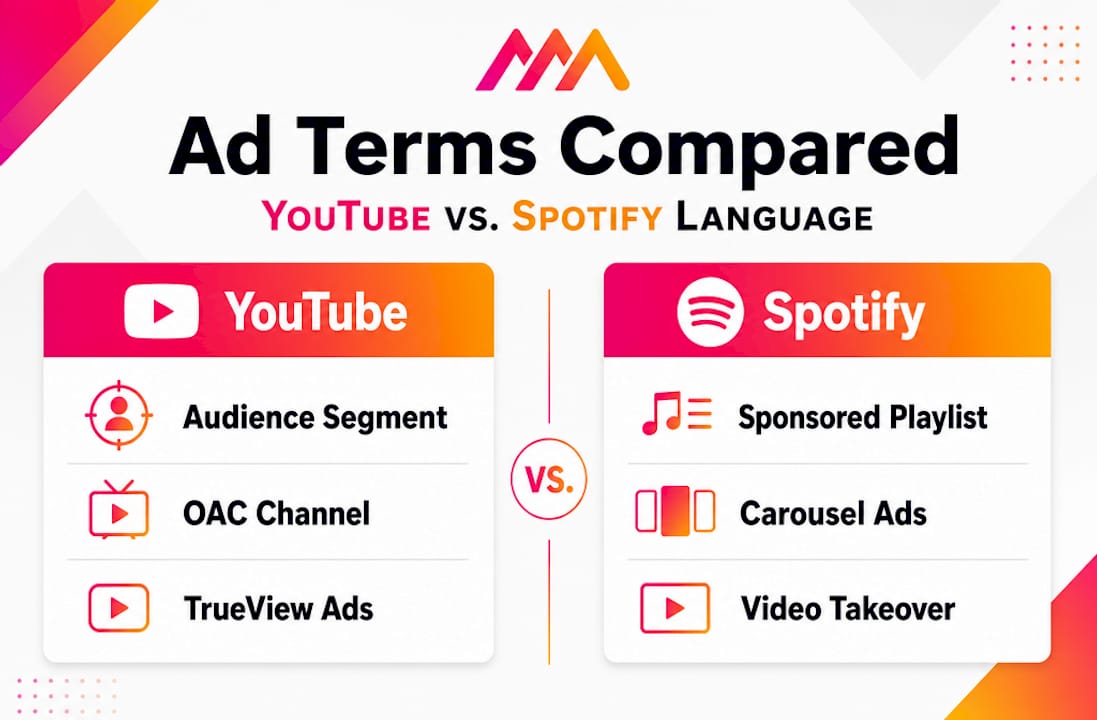
There is also a creative opportunity embedded in this. When you understand what a Sponsored Playlist actually means on Spotify, or what the difference between an affinity audience and a custom intent audience is on YouTube, you stop making generic decisions. You start making specific, informed choices that match your music and your audience far more precisely. That specificity is what separates campaigns that build genuine fanbases from campaigns that burn through budgets with nothing to show for it.
Take your music advertising further with expert help
Understanding ad terminology is your foundation, and now you need the right tools to build on it.

At Music Video Marketplace, we help independent musicians create long-form videos in minutes, ready to upload to YouTube and launch as a professional ad campaign for their song. You do not need a production team or an agency. You need a clear process and the right platform to execute it. Explore real campaign examples from musicians who have used video ads to grow their audiences, and see exactly how understanding the terminology translates into campaign results you can actually measure.
Frequently asked questions
What is an Official Artist Channel on YouTube?
An Official Artist Channel on YouTube consolidates an artist’s music videos and content under one verified channel, but only videos uploaded directly to that channel can be targeted or excluded in Google Ads campaigns.
What does ‘audience segment’ mean in Google Ads?
“Audience segment” is Google Ads’ current term for a defined group of users you want to target, replacing older terminology and consolidating various audience types under a unified label.
How are Sponsored Playlists different from Carousel Ads on Spotify?
Sponsored Playlists associate your brand with a popular playlist for a set period, while Carousel Ads display multiple rotating visuals priced on a CPM basis, making them better suited for visual brand awareness.
Why do some terms in music advertising keep changing?
Platforms update terminology to reflect new product features and compliance requirements, meaning definitions shift regularly and always checking official documentation before launching a campaign is essential.
Recommended
- Music ad campaigns: expert strategies for real results | Music Video Marketplace Blog
- Music marketing trends shaping success for independent artists | Music Video Marketplace Blog
- Music industry marketing explained: strategies for indie artists | Music Video Marketplace Blog
- A musician’s guide to music branding: build your identity | Music Video Marketplace Blog
- Mastering the music collaboration process for seamless production – Audome
Read next
 Music video ad best practices for YouTube successUnlock the secrets to YouTube success with the best practices for video ads. Transform views into loyal fans and maximize your impact!
 Music Video Best Practices: 28% More Reach With YouTube AdsDiscover proven music video best practices that increase YouTube reach by 28% through optimized content, strategic ads, and effective audience engagement for independent musicians.
 £400–£2,500 Music Video Budgets: Licence, Edits & Ads for IndiesSee realistic sample budgets (£400–£2,500) and exact line items — licence, edits/exports, and ad spend — plus a pre-purchase checklist and when Music...
 Music ad campaigns: expert strategies for real resultsLearn how independent musicians can plan, launch, and optimise YouTube music ad campaigns with real benchmarks, targeting strategies, and creative frameworks.
Turn the idea into a finished music video.
Drop your track into the Studio and build your visual in minutes.