
The role of content in artist growth: 2026 guide
Discover the role of content in artist growth. Learn how strategic content can deepen audience engagement and build your brand in 2026.

The role of content in artist growth: 2026 guide
TL;DR:
- Content helps artists build audiences and attract industry support by combining music, personal, educational, and promotional posts. Consistent storytelling and a balanced content mix strengthen brand identity, trust, and long-term careers. Artists can protect creativity and optimize growth by batching content, owning their audience, and testing engagement signals before investing heavily.
Content for artists is the purposeful creation and sharing of music-related, personal, and educational material designed to grow audiences, deepen engagement, and define an artist’s brand. The role of content in artist growth has never been more critical. With over 120,000 new songs uploaded daily, standing out requires more than talent. UNESCO predicts a 24% decline in revenues for music creators by 2028 due to AI disruption. Artists who treat content as a core career tool, not an afterthought, are the ones building lasting careers in this environment.
What types of content best support sustainable artist growth?
The most effective content strategy for musicians is not random posting. A research-backed content allocation splits output into 40% music-focused, 30% personal or lifestyle, 20% educational, and 10% promotional. That ratio matters because it mirrors how real relationships form: people connect with the person before they commit to the product.
Music-focused content includes lyric videos, studio sessions, and song breakdowns. Personal content covers day-in-the-life clips, creative rituals, and honest reflections on the craft. Educational content, such as tutorials or gear reviews, positions you as an authority and attracts a wider audience beyond existing fans. Promotional content, kept to just 10%, lands harder precisely because it is rare.
Value-first content consistently outperforms constant promotion. When fans receive genuine insight or entertainment, they return. When they receive only sales pitches, they scroll past. The 10% promotional ceiling is not a restriction. It is a trust-building mechanism.
- Music content: Live performances, lyric videos, behind-the-scenes recording footage
- Personal content: Creative routines, personal milestones, honest reflections on making music
- Educational content: Tutorials, gear reviews, songwriting tips, industry Q&As
- Promotional content: New releases, merchandise drops, ticket announcements
Pro Tip: Batch your promotional posts around release windows. Fans tolerate a short burst of promotion far better than a constant drip of sales messages spread across weeks.
How does content marketing build artist brand identity and attract industry partners?
Storytelling and identity-driven content make artists more attractive to labels and publishers by proving audience connection before any meeting takes place. A label no longer needs to guess whether an artist can connect with people. The content record shows it plainly.
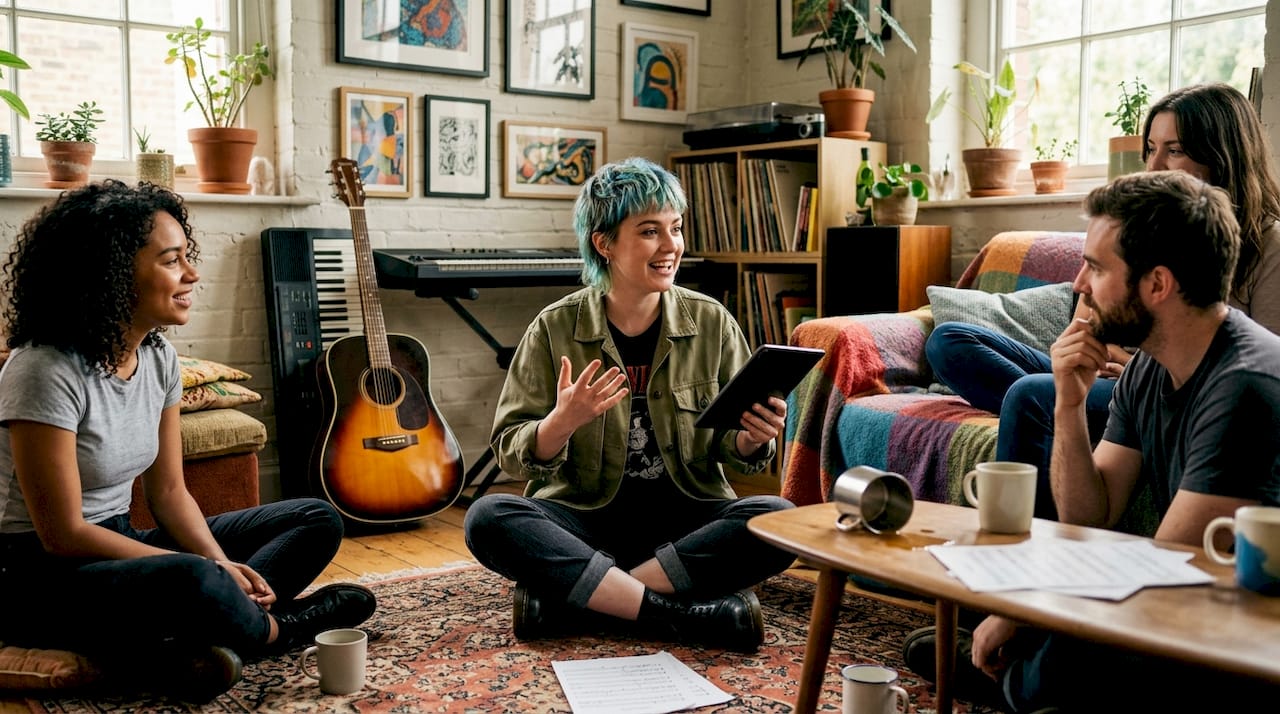
Narrative-driven content works because it creates emotional context around the music. A song becomes more meaningful when fans know the story behind it. A music video becomes more memorable when it reflects a consistent visual identity. Artists who link their personality directly to their music build fan loyalty that algorithms cannot manufacture. This is why storytelling across platforms has become a defining skill for artists in 2026.
Effective brand identity content includes:
- Consistent visual language: Colour palettes, fonts, and aesthetics that appear across all platforms
- Recurring narrative themes: Returning to the same emotional territory that defines your music
- Video storytelling: Long-form YouTube content that gives fans a deeper view of your world
- Cross-platform coherence: The same core identity expressed differently on each channel
Artists who build a recognisable identity through content are also building a portfolio that industry partners can evaluate. A well-documented creative journey, told through video and social content, is now a credible substitute for a traditional press kit. For a deeper understanding of this process, the musician’s guide to music branding from Musicvideomarketplace covers the practical steps in detail.
What are the best practices for converting content engagement into loyal fan relationships?
Content is a feedback loop, not a broadcast channel. Every post tells you something about your audience: what they respond to, what they ignore, and what makes them act. Artists who read those signals grow faster than those who simply post and hope.
The most effective structure for building loyal fans follows a clear funnel. Short-form platforms like TikTok and Instagram Reels serve as discovery tools. They introduce you to people who have never heard your name. The funnel then moves from discovery to depth, using Instagram and YouTube to build genuine engagement with fans who already know you. The final stage is ownership: driving fans to email lists, newsletters, or private communities where no algorithm controls the relationship.
- Discovery: Post short, high-impact clips on TikTok and Instagram Reels to reach new audiences
- Depth: Use Instagram carousels and YouTube videos to give existing fans richer content
- Ownership: Convert engaged fans into email subscribers or community members
- Retention: Send regular newsletters, exclusive updates, and early access offers to your list
- Feedback: Use replies, saves, and comments to understand what content to make next
Email is the most underrated tool in an artist’s content kit. Email newsletters achieve 52% open rates among artist fans, compared to the 15–20% industry average. That gap is enormous. It means a fan on your email list is roughly three times more likely to see your message than a follower on a social platform.
The trap most artists fall into is feeding the algorithm indefinitely without building anything they own. Without a clear exit strategy from social media, artists risk empowering platforms at their own expense. Every piece of content should point somewhere: a link in bio, a sign-up page, a community group.
Pro Tip: Add a single, consistent call to action to every piece of content you post. Not a different link every week. One destination, repeated until fans know it by heart.
How to protect creativity and avoid burnout while producing content
Batch filming and separating content production from visibility tasks protects creatives from burnout and maintains authenticity. The artists who burn out fastest are those who treat every day as a content day. The ones who sustain it treat content production as a scheduled task, separate from the creative work of making music.
Protecting your creative energy requires clear boundaries between two distinct modes of work. Production mode is when you make music, write lyrics, and develop ideas. Visibility mode is when you film, edit, and post. Mixing the two degrades both.
- Batch filming: Set aside one or two days per month to film multiple pieces of content at once
- Separate calendars: Keep your creative schedule and your content schedule in different planning documents
- Repurpose ruthlessly: One studio session can yield a behind-the-scenes clip, a lyric snippet, and a process video
- Set posting limits: Decide how many posts per week you can sustain without strain, then stick to it
Marketing and storytelling can coexist with authentic creativity. The fear that content creation will dilute your artistic identity is understandable. But the artists who navigate this best are those who treat content as an extension of their art, not a separate job. The goal is not to become a content creator who also makes music. The goal is to be a musician whose content reflects who you already are.
How can artists measure and optimise their content strategy?
Successful artists test short content snippets publicly to validate resonance before launching full promotion campaigns. Posting a 15-second clip of a new song costs nothing. Running a paid campaign behind a song nobody has responded to costs real money and yields poor results.
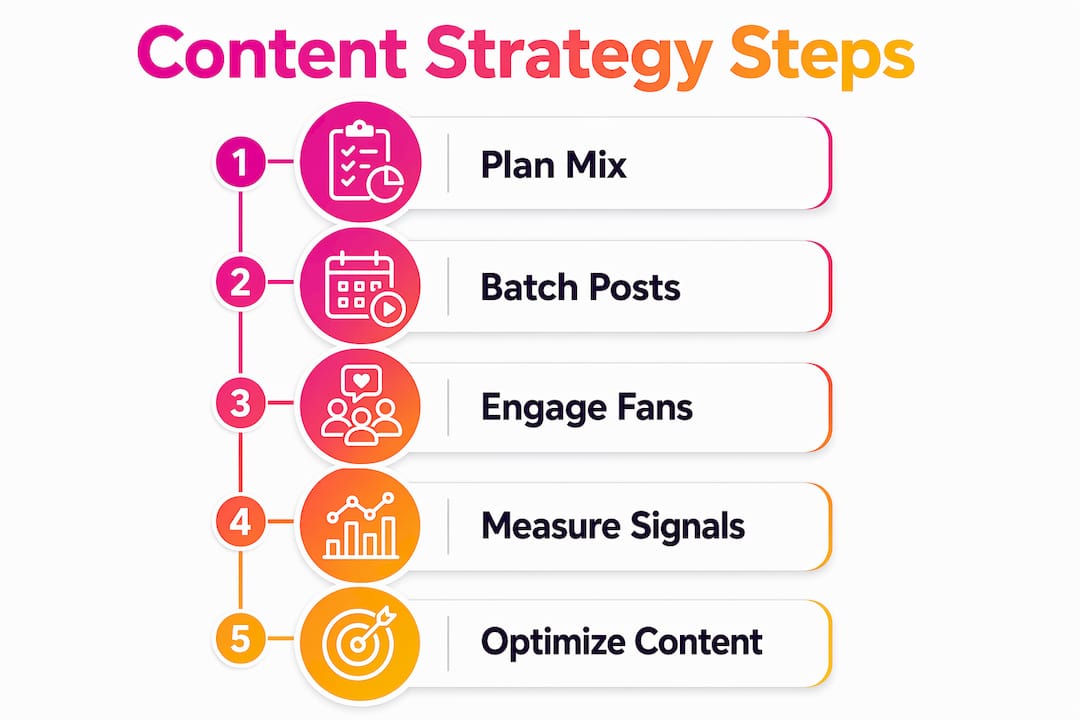
The signals that matter most are saves, comments, and replays. A save means someone valued the content enough to return to it. A comment means it prompted a reaction. A replay means it held attention. Likes are the weakest signal because they require the least effort from the viewer.
| Engagement signal | What it tells you | Action to take |
|---|---|---|
| Saves | Content has lasting value | Produce more of this format |
| Comments | Content sparked a reaction | Respond and build dialogue |
| Replays | Content held attention | Use similar hooks in future posts |
| Shares | Content resonated beyond your audience | Prioritise for paid promotion |
| Likes only | Passive approval | Test a stronger hook or call to action |
Repeated content exposure builds trust and recognition more than novelty does. This is a counter-intuitive finding for artists who feel pressure to constantly produce something new. Consistency with a proven format outperforms constant reinvention. Once you find a content series that generates saves and comments, run it for at least six weeks before changing course. For practical guidance on building this into a long-term plan, the artist video content strategy guide from Musicvideomarketplace is worth reading alongside this framework.
Key takeaways
Content is the primary tool musicians use to build audiences, attract industry partners, and create career longevity in a market with over 120,000 daily song uploads.
| Point | Details |
|---|---|
| Use a balanced content mix | Allocate 40% music, 30% personal, 20% educational, and 10% promotional content. |
| Build owned fan channels | Drive followers from social platforms to email lists where you control the relationship. |
| Validate before you promote | Test content with organic posts and check saves and comments before spending on paid campaigns. |
| Protect creative energy | Batch film content separately from music production to avoid burnout and identity dilution. |
| Storytelling attracts partners | Narrative-driven content proves audience connection to labels and publishers more effectively than a press kit. |
What I have learned about content and the long game
The conversation around content and artists has shifted considerably over the past few years. When I first started paying close attention to how musicians were building careers outside the traditional label system, the dominant advice was simple: post more. The assumption was that volume solved visibility. It does not.
What actually builds a career is the accumulation of trust over time. An artist who posts three times a week with genuine intent, clear identity, and consistent themes will outperform one who posts daily with no coherent message. I have watched artists with modest follower counts sell out intimate venues because their content built a real community. I have also watched artists with large followings struggle to sell tickets because their content never gave fans a reason to care beyond the scroll.
The artists I find most compelling are not the ones chasing trends. They are the ones who use content to document a creative life that is already worth watching. That distinction is subtle but it changes everything about how the content feels to the audience. Fans can tell the difference between an artist performing for the camera and one who simply lets the camera in.
My honest view is that the burnout problem is real and underreported. The pressure to produce content at platform speed is genuinely damaging to creative work. The solution is not to opt out entirely. It is to build a system that serves your music rather than consuming it. Batch your filming. Own your audience. Test before you spend. These are not marketing tactics. They are career decisions.
— Music
How Musicvideomarketplace helps artists create content that works
Producing consistent, high-quality video content is one of the biggest practical barriers artists face. Writing a content plan is straightforward. Executing it with professional-grade video is where most musicians stall.

Musicvideomarketplace enables musicians to create a long-form video in minutes, ready to upload directly to YouTube and pair with an ad campaign for their song. The platform removes the production bottleneck that stops artists from acting on their content strategy. Whether you are building your first YouTube presence or scaling an existing one, professional video production through Musicvideomarketplace gives you content that reflects the quality of your music. Your story deserves to be told well.
FAQ
What is the role of content in artist growth?
Content is the primary mechanism through which artists build audience relationships, establish brand identity, and attract industry partners. It functions as both a discovery tool and a long-term trust-building asset.
How often should musicians post content?
Consistency matters more than frequency. A sustainable posting schedule that you can maintain for months outperforms a burst of daily posts followed by silence.
What content type works best for music artists?
A mix of 40% music-focused, 30% personal or lifestyle, 20% educational, and 10% promotional content produces the strongest long-term engagement, according to independent music marketing research.
Why is email more valuable than social media followers?
Email newsletters achieve open rates of around 52% among artist fans, compared to the 15–20% industry average for general email marketing. Social platforms limit organic reach; email does not.
How do artists avoid burnout from content creation?
Batch filming on dedicated production days, separate from music-making sessions, protects creative energy and maintains the authenticity that makes content worth watching.
Recommended
- Content outreach for musicians: your 2026 guide | Music Video Marketplace Blog
- Examples of video content for musicians in 2026 | Music Video Marketplace Blog
- Artist video content strategy for YouTube success 2026 | Music Video Marketplace Blog
- Why video content matters for musicians in 2026 | Music Video Marketplace Blog
Read next
 The role of storytelling in DJ marketingDiscover the crucial role of storytelling in DJ marketing. Learn techniques to engage audiences and leave a lasting impact beyond the music.
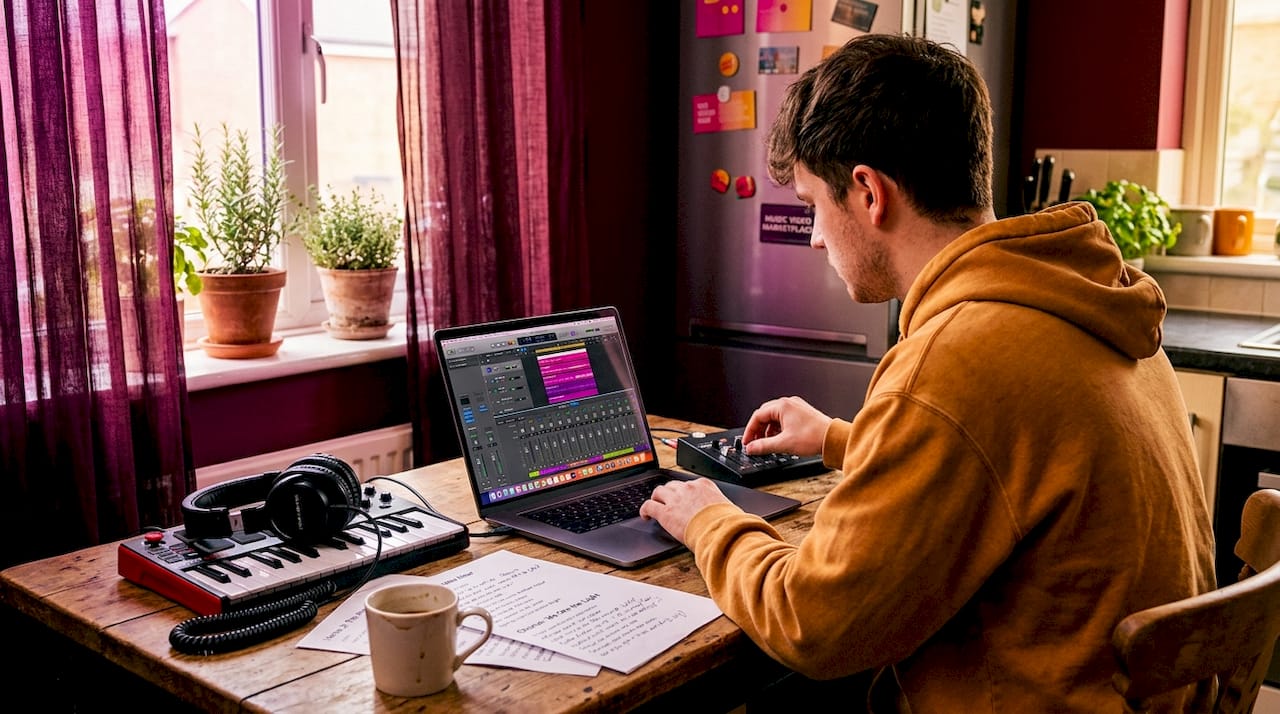 The song marketing funnel explained for indie artistsLearn how to explain song marketing funnel concepts that truly resonate with today's listeners. Boost your fanbase and engagement now!
 Try Before You Buy, Affordable music videosGet a professional, ready-made music video for just £99 or $99. Try before you buy and promote your music fast with Music Video Marketplace
 The role of branding in music industry successDiscover the vital role of branding in music industry success. Learn how to craft your unique identity to stand out and connect with fans.
Turn the idea into a finished music video.
Drop your track into the Studio and build your visual in minutes.