
What is video SEO for musicians: boost your YouTube reach
Learn how video SEO helps musicians optimise YouTube content for better discoverability. Master metadata, keywords, and engagement strategies to grow your audience.

What is video SEO for musicians: boost your YouTube reach
Musicians uploading videos to YouTube often wonder why their content doesn’t reach the audience it deserves. The answer lies in video SEO: videos with keyword-optimised metadata see up to 50% higher search impressions and 30% more views. This article explains how video SEO works specifically for musicians, demystifies YouTube’s algorithm, and provides actionable strategies to enhance your music video discoverability and grow your fanbase.
Table of Contents
- Introduction To Video Seo For Musicians
- How YouTube’s Algorithm Works For Music Videos
- Keyword Research And Metadata Optimisation For Musicians
- Common Misconceptions About Video Seo For Musicians
- Building And Implementing An Effective Video Seo Strategy
- Case Studies And Real-World Examples
- Conclusion And Next Steps For Musicians
- Boost Your Music Videos With Music Video Marketplace
Key takeaways
| Point | Details |
|---|---|
| Video SEO optimises music videos for discoverability | Proper metadata and keywords help YouTube surface your content to relevant audiences. |
| YouTube’s algorithm favours engagement and relevant metadata | Watch time, likes, comments, and accurate titles drive rankings more than video quality alone. |
| Keyword research and accurate metadata are crucial | Long-tail keywords and strategic descriptions connect your music with niche listeners. |
| Common myths can hinder effective SEO | Tags matter less than engagement; video quality alone doesn’t guarantee visibility. |
| Consistent strategy and analytics improve reach | Regular monitoring and adjustments based on data accelerate channel growth. |
Introduction to video SEO for musicians
Video SEO is the process of optimising video content to rank higher in search results and recommendations on platforms like YouTube. For musicians, this means crafting metadata, thumbnails, and engagement strategies that help YouTube understand your content and connect it with listeners actively searching for new music.
General SEO focuses on text-based content and websites, whilst video SEO emphasises factors unique to video platforms: watch time, audience retention, click-through rates, and engagement signals. Music-specific factors include genre relevance, artist recognition, and how listeners interact with your tracks through replays, shares, and playlist additions.
Optimised metadata acts as a roadmap for YouTube’s algorithm. Titles, descriptions, tags, and captions provide context about your music style, mood, and target audience. Without this information, even exceptional tracks struggle to reach potential fans because YouTube cannot accurately categorise or recommend your content.
Many musicians assume uploading high-quality videos guarantees success. Whilst production value matters, YouTube music content for musicians requires strategic SEO to maximise visibility. Consider these challenges:
- Millions of music videos compete for attention daily
- YouTube prioritises content that keeps viewers on the platform longer
- Algorithms favour videos with strong early engagement signals
- Without metadata optimisation, your video may never appear in search results
Video content quality provides the foundation, but SEO determines whether your target audience ever discovers it. Combining compelling visuals with strategic optimisation creates the best path to sustainable growth.
How YouTube’s algorithm works for music videos
YouTube’s algorithm evaluates hundreds of signals to determine which videos to recommend and rank. For music videos, metadata optimisation can improve rankings by 25%, whilst engagement signals add another 30%. Understanding these factors helps musicians craft content that aligns with algorithmic priorities.
Watch time measures total minutes viewers spend watching your video. Longer watch times signal valuable content, prompting YouTube to recommend your video more frequently. Audience retention shows what percentage of viewers watch through to the end, revealing whether your content maintains interest.
Engagement metrics carry substantial weight for music videos:
- Likes and dislikes indicate emotional response
- Comments suggest viewers feel connected to your music
- Shares demonstrate fans actively promoting your work
- Playlist additions show listeners want repeated exposure
YouTube treats music content distinctively because listening habits differ from other video categories. Fans often replay favourite tracks, creating higher repeat view rates. The platform recognises this pattern and rewards music videos that generate loyal, returning audiences.
Metadata quality directly influences initial discoverability. Accurate titles and descriptions help YouTube match your video with relevant search queries. Tags provide additional context, though their impact is smaller than many musicians believe.
Pro tip: Monitor your retention graphs in YouTube Analytics to identify exactly where viewers drop off. If most leave before the chorus, consider creating shorter intro sequences or adding visual hooks earlier in future videos.
The YouTube music algorithm musicians rely on rewards consistency. Regular uploads train the algorithm to recognise your content patterns and recommend your videos more confidently to subscribers and potential fans.
Keyword research and metadata optimisation for musicians
Effective keyword research starts with understanding what terms your target audience uses when searching for music. Generic terms like “rock song” face massive competition, whilst using long-tail keywords helps target niche music audiences more effectively by capturing specific listener intent.
Begin by brainstorming phrases that describe your music style, mood, and influences. Use YouTube’s search bar to see autocomplete suggestions, revealing popular search terms. Check competitors’ video titles and descriptions for keyword patterns that resonate with similar audiences.
Optimise each metadata element strategically:
- Titles: Include your primary keyword within the first 50 characters. Balance SEO with readability by crafting titles that intrigue human viewers whilst signalling relevance to algorithms.
- Descriptions: Place important keywords in the first 150 characters, which appear before the “show more” button. Include links to streaming platforms, social media, and related videos.
- Tags: Add 8 to 12 relevant tags mixing broad terms (your genre) with specific phrases (your song title). Don’t stuff tags; focus on accuracy.
- Captions: Upload accurate lyrics as closed captions. YouTube indexes this text, improving searchability for viewers seeking specific lyrics or phrases.
Avoid these common metadata mistakes:
- Keyword stuffing that makes titles unreadable
- Generic descriptions copied across all videos
- Misleading tags unrelated to your content
- Ignoring the description’s first paragraph where YouTube pulls preview text
Pro tip: After your video has been live for two weeks, review YouTube Analytics to see which search terms drove traffic. Update your description to emphasise high-performing keywords whilst maintaining natural language.
The complete YouTube music upload workflow includes metadata optimisation as a core step. This table shows metadata priority for maximum impact:
| Element | Priority | Character Limit | Primary Purpose |
|---|---|---|---|
| Title | Highest | 60 characters | Search visibility and click-through |
| Thumbnail | Highest | Visual only | Click-through rate |
| Description first 150 chars | High | 150 characters | Preview and initial SEO |
| Full description | Medium | 5000 characters | Context and links |
| Tags | Low | 500 characters | Additional categorisation |
Consistent metadata across your channel helps YouTube recognise your brand and content themes, strengthening your overall channel authority over time.

Common misconceptions about video SEO for musicians
Many musicians hold beliefs about video SEO that actually limit their growth. Dispelling these myths clarifies what truly drives YouTube success and helps you focus efforts on high-impact activities.
The biggest misconception is that exceptional video quality automatically generates views. Whilst professional production enhances viewer experience, it doesn’t teach YouTube’s algorithm what your content offers or who should see it. Metadata provides that crucial context.
Another widespread myth overestimates tag importance. Musicians often spend hours researching tag combinations, believing tags are the primary ranking factor. In reality, tags have less than 5% impact on YouTube ranking relative to metadata and engagement. Titles and descriptions matter far more.
Some artists assume initial upload settings are permanent. You can update metadata anytime, and strategic updates based on analytics improve performance. YouTube re-indexes updated content, potentially improving rankings as you refine keyword targeting.
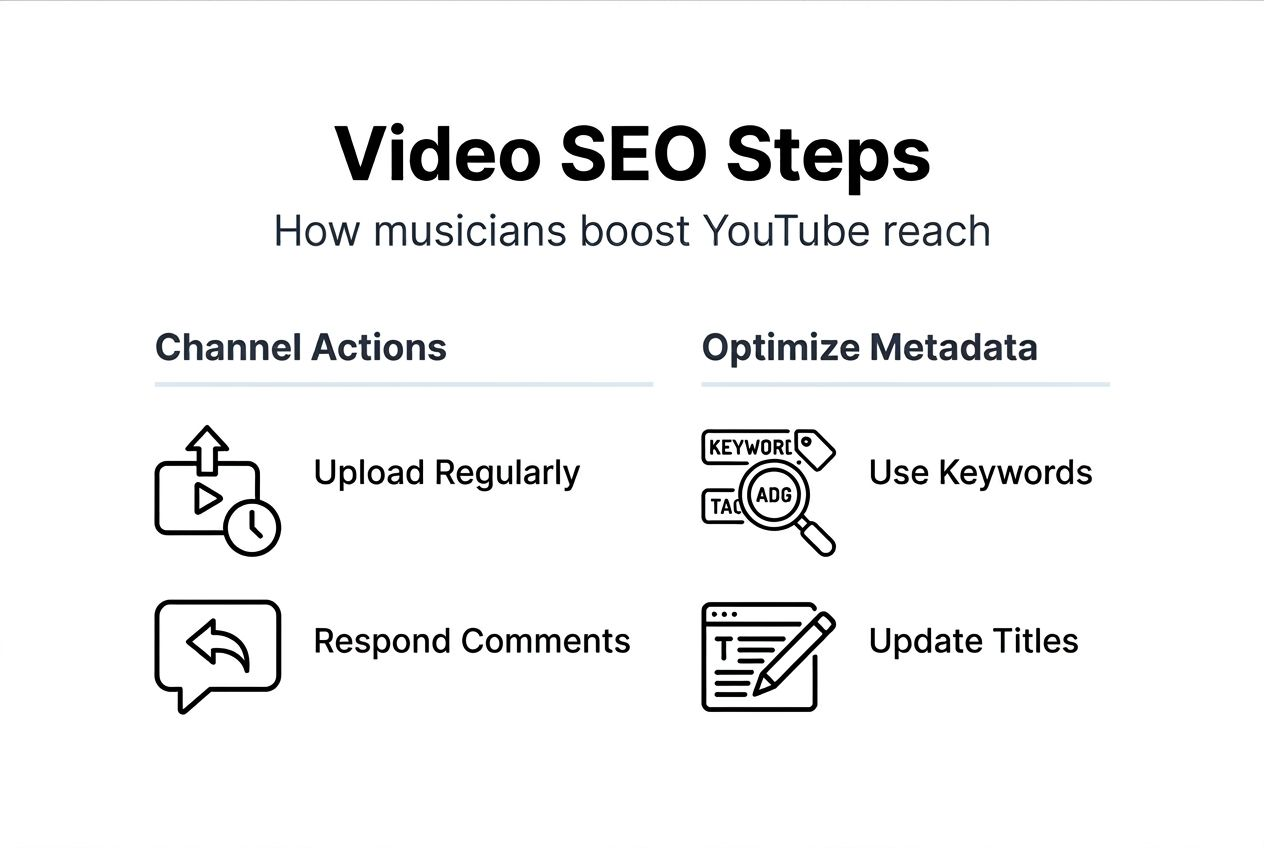
Many musicians neglect community interaction, not realising that responding to comments signals active engagement to YouTube’s algorithm. Videos where creators interact with viewers receive ranking boosts because the platform values content that fosters community.
A dangerous misconception suggests paying for views or engagement artificially boosts rankings. YouTube detects fraudulent activity and penalises channels, potentially removing videos or suspending accounts. Authentic growth takes longer but builds sustainable audiences.
Some believe uploading frequently matters more than quality or optimisation. Consistency helps, but poorly optimised frequent uploads perform worse than strategic, well-optimised content released on a manageable schedule. Focus on doing SEO properly rather than rushing content.
Common mistakes that undermine SEO efforts:
- Copying competitors’ exact metadata without customising for your unique content
- Ignoring mobile viewers who comprise most YouTube traffic
- Failing to create custom thumbnails that accurately represent your music style
- Never reviewing analytics to understand what works
The boost music video engagement tips article explores how genuine audience interaction outweighs shortcuts. Regular analytics review beats guesswork because data reveals exactly how viewers discover and interact with your content.
Building and implementing an effective video SEO strategy
Creating a structured approach transforms video SEO from overwhelming to manageable. Independent musicians with structured SEO strategies grow channels 40% faster than those using ad-hoc methods. Follow this workflow to systematically optimise your music videos.
- Conduct keyword research before filming or uploading. Identify 3 to 5 target phrases that describe your song’s genre, mood, and themes. Use these to shape your title and description.
- Create compelling thumbnails that visually communicate your music style. Include readable text, high contrast colours, and imagery that sets accurate expectations.
- Write metadata draft including optimised title, detailed description with timestamps, and relevant tags. Front-load important keywords.
- Upload and optimise by adding accurate captions, selecting appropriate category, and enabling features like cards and end screens.
- Promote strategically by sharing your video across social platforms, embedding it on your website, and including it in relevant playlists.
- Monitor analytics weekly to track watch time, traffic sources, and audience retention. Identify patterns and adjust future content accordingly.
- Update metadata after two weeks based on which search terms drive traffic. Refine descriptions to emphasise high-performing keywords.
Thumbnails and playlists significantly impact engagement and watch time. Custom thumbnails increase click-through rates by clearly communicating content value. Organise videos into thematic playlists that encourage binge-watching, increasing overall channel watch time.
YouTube Analytics provides actionable insights:
- Traffic sources show whether viewers find you through search, suggested videos, or external sites
- Audience retention graphs reveal exactly when viewers lose interest
- Demographics data helps target content to your actual audience
- Click-through rate indicates whether your thumbnails and titles compel clicks
Balancing organic SEO with paid advertising accelerates growth. Organic strategies build sustainable audiences over time, whilst targeted ads provide immediate visibility. The music video creation guide explains how professional video assets support both approaches.
This comparison clarifies when to emphasise each strategy:
| Approach | Best For | Timeline | Cost |
|---|---|---|---|
| Organic SEO | Long-term growth, loyal fans | 3 to 6 months | Time investment |
| Paid ads | Product launches, rapid visibility | Immediate | Monetary budget |
| Combined strategy | Maximum reach and sustainability | Ongoing | Both time and money |
Pro tip: Schedule uploads for consistent days and times when your analytics show peak audience activity. Regular scheduling trains subscribers to expect new content, improving early engagement signals that boost algorithmic ranking.
Effective strategy evolves based on results. What works for one artist may not suit your audience, so prioritise testing and adaptation over rigid adherence to generic advice.
Case studies and real-world examples
Examining how independent musicians successfully implemented video SEO provides concrete evidence of these strategies’ effectiveness. Channels optimising metadata and engagement see substantial organic growth and fan interaction, demonstrating that strategic effort produces measurable results.
One indie folk artist restructured their entire back catalogue with optimised metadata, focusing on long-tail keywords like “acoustic camping music” and “rainy day folk songs”. Within four months, their channel’s monthly views increased 320%, with older videos suddenly appearing in relevant searches and recommended feeds.
An electronic producer combined metadata optimisation with strategic community engagement. They responded to every comment within the first 48 hours of upload, encouraging discussion about production techniques. This active interaction signalled valuable content to YouTube’s algorithm, resulting in 45% higher placement in suggested video feeds.
A singer-songwriter used analytics to identify their most successful traffic sources, then doubled down on those channels. They discovered that covers of popular songs drove substantial traffic to original work, so they created a strategic mix optimising both cover and original content for discovery.
Key patterns emerge from successful implementations:
- Artists who update metadata based on analytics outperform those who never revisit initial uploads
- Combining SEO optimisation with genuine audience interaction creates compounding benefits
- Consistent upload schedules paired with strong metadata generate reliable growth
- Custom thumbnails and strategic playlist organisation significantly extend watch time
One rock band integrated their video SEO strategy with targeted advertising campaigns. They used organic performance data to identify which videos resonated most, then allocated ad budget to amplify already-successful content. This approach generated 5 times higher return on ad spend compared to promoting videos without proven organic traction.
These examples illustrate that video marketing for musicians succeeds when SEO foundations are solid. Professional video quality combined with strategic optimisation and data-driven refinement creates sustainable channel growth.
The common thread across successful musicians is commitment to ongoing improvement rather than one-time optimisation. They treat SEO as an evolving practice, continuously learning from analytics and adapting strategies to maximise results.
Conclusion and next steps for musicians
Video SEO represents a crucial skill for musicians seeking to expand their reach on YouTube in 2026. Optimised metadata helps algorithms understand and categorise your content, whilst engagement strategies signal value to both platforms and potential fans. The combination of keyword research, strategic metadata, compelling thumbnails, and data-driven refinement creates sustainable visibility.
Ongoing SEO practice yields compounding returns. Each optimised video strengthens your channel’s authority, making future uploads easier to rank. Regular analytics review identifies what resonates with your audience, enabling smarter content decisions.
Platforms like Music Video Marketplace support musicians by providing professional video assets that form the foundation for effective SEO strategies. High-quality visual content combined with strategic optimisation positions your music for maximum discoverability.
Start implementing these strategies today. Review your existing videos’ metadata, conduct keyword research for upcoming releases, and commit to monitoring analytics weekly. Small, consistent improvements generate significant growth over time.
Boost your music videos with Music Video Marketplace
Creating professional video content that supports your SEO efforts requires both quality assets and efficient workflows. Music Video Marketplace enables musicians to generate stunning 4K music videos in minutes, providing the visual foundation that attracts viewers and keeps them engaged.

High-quality video production enhances every aspect of your SEO strategy. Professional visuals improve watch time and audience retention whilst custom options ensure your content stands out in crowded search results. The platform also streamlines creating ad campaigns, helping you amplify reach once organic SEO establishes a strong foundation.
Explore how Music Video Marketplace complements your video SEO strategy by delivering professional assets that help your music connect with audiences actively searching for new artists.
FAQ
What is video SEO for musicians?
Video SEO helps musicians optimise videos for better discoverability on platforms like YouTube. It focuses on keywords, metadata, and engagement strategies specifically relevant to music content. By implementing proper SEO techniques, your videos reach listeners actively searching for your genre and style.
How can I improve my music video’s ranking on YouTube?
Focus on optimising titles, descriptions, and creating engaging thumbnails that accurately represent your content. Encourage interactions like comments, shares, and playlist additions through genuine community engagement. Use analytics to monitor performance and adjust your YouTube music upload workflow based on which strategies drive the most traffic to your channel.
What mistakes should musicians avoid with video SEO?
Relying solely on video quality without optimising metadata leaves YouTube unable to categorise your content properly. Overusing tags whilst neglecting more important elements like titles and descriptions wastes effort on low-impact activities. Ignoring audience engagement and analytics prevents you from learning what works, making it impossible to improve. The common video SEO mistakes article explores these pitfalls in detail.
Can paid ads replace organic video SEO efforts?
Paid ads accelerate visibility but cannot replace organic SEO for sustainable growth. Advertisements provide immediate reach to targeted audiences, whilst organic SEO builds long-term discoverability and loyal fan communities. Best results come from combining both strategies: use organic SEO to establish strong foundations, then amplify successful content with targeted ads. Understanding paid ads versus organic SEO helps you allocate resources effectively for maximum impact.
Recommended
- Video Marketing: Boosting Musicians’ Reach on YouTube | Music Video Marketplace Blog
- YouTube Music Content: Boosting Reach for Musicians | Music Video Marketplace Blog
- Boost music video engagement: proven tips for 28% reach | Music Video Marketplace Blog
- Role of Video in Music Promotion: Unlocking Reach | Music Video Marketplace Blog
Read next
 What is a YouTube channel trailer for musicians?Discover what a YouTube channel trailer is and how it can boost your subscriptions by 30-50%. Elevate your music career now!
 What is video optimisation: a creator's guideDiscover what is video optimization and learn key techniques to boost playback quality and discoverability for your videos.
 What is YouTube monetisation for musicians: a guideLearn how YouTube monetisation works for musicians, including Partner Programme requirements, revenue streams, Content ID benefits, and practical strategies to maximise earnings from your music content.
 Video Marketing: Boosting Musicians' Reach on YouTubeVideo marketing for musicians explained: learn key concepts, types, creation processes, practical tips, and mistakes to avoid for YouTube success.
Turn the idea into a finished music video.
Drop your track into the Studio and build your visual in minutes.