
Your music release campaign process for maximum impact
Unlock the secrets of a successful music release campaign process. Learn how to maximize your impact and engage fans effectively!

Your music release campaign process for maximum impact
TL;DR:
- A well-structured music release campaign extends across pre-release, release, and post-release phases, increasing visibility and engagement.
- Prior planning of assets, deadlines, and content sequencing prevents delays and leverages algorithmic advantages.
You pour months into writing, recording, and mixing a track, and on release day it gets 47 streams, mostly from your mum and two mates from secondary school. That quiet disappointment is not a talent problem. It is a process problem. A well-structured music release campaign process changes the outcome entirely, turning a single upload into a multi-week momentum machine that feeds algorithms, earns playlist placements, and builds real fan relationships. This guide walks you through every phase, from the first asset you prepare to the post-release data you need to act on.
Table of Contents
- How a phased music release campaign works
- Essential assets and timing: what to prepare and when
- Executing your release: maximising video and fan engagement
- Monitoring, optimisation, and momentum: post-release tactics
- Beyond streaming: lifting outcomes with bundles and community actions
- What most artists miss when running their first campaign
- Get support for your next music release campaign
- Frequently asked questions
Key Takeaways
| Point | Details |
|---|---|
| Start early | Building your release campaign 6–8 weeks in advance gives you time to secure distribution, assets, and press. |
| Layer your assets | Use a variety of video and content formats across platforms to boost engagement on release day and beyond. |
| Prioritise fan actions | Plan your rollout to encourage saves, completions, and shares, as these drive algorithms and meaningful results. |
| Track and adapt | Monitor campaign data, focus on growth rates and engagement, then fine-tune your post-release strategy. |
| Go beyond streaming | Bundles, contests, and community-driven tactics lift outcomes and build long-term fan relationships. |
How a phased music release campaign works
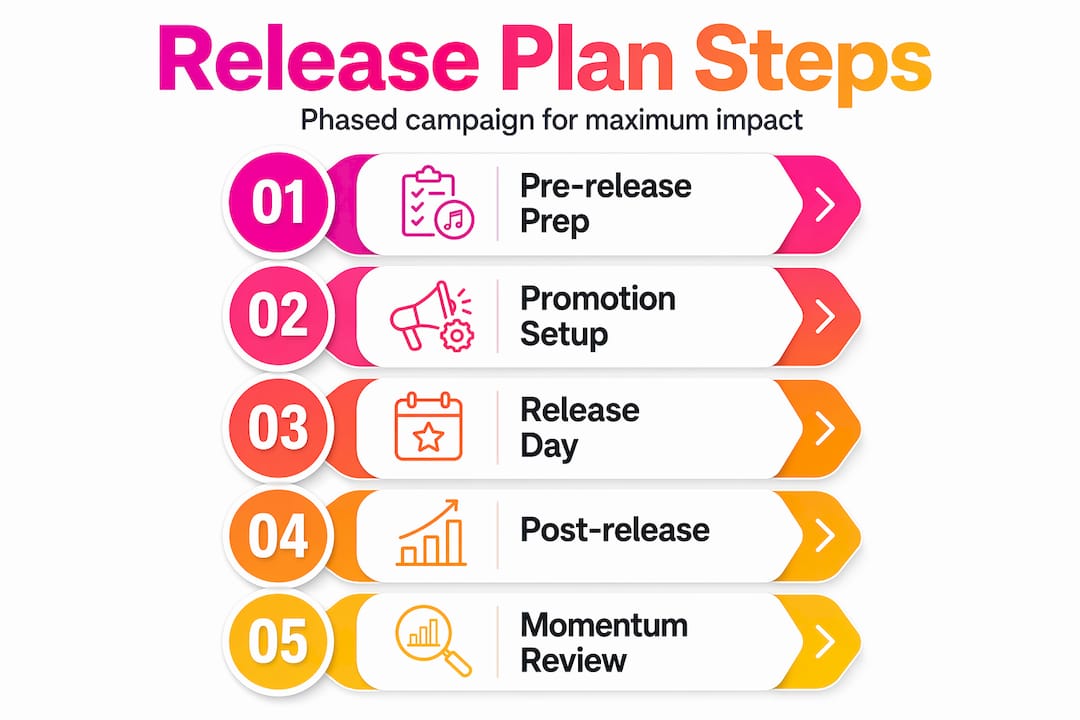
Before diving into individual tasks, it helps to see the whole shape of a campaign. Most artists treat a release like a single moment. In reality, a well-structured campaign runs across three distinct phases: pre-release, release day and week, and post-release. Each phase has a different job.
The pre-release phase is where you do the invisible work that determines everything else. Distribution, metadata, artwork, press kits, and video assets all need to be ready before you announce anything publicly. The release phase is your activation window, where you fire every piece of content you have prepared. The post-release phase is where most independent artists go quiet, and where the real opportunity actually lives.
Here is a practical timeline to anchor your planning:
| Phase | Timeframe before release | Key activities |
|---|---|---|
| Pre-release prep | 6 to 8 weeks | Distribution upload, metadata, playlist pitch, press kit |
| Content and press | 4 to 6 weeks | Music video, artwork, promo content, media outreach |
| Launch week | Release day to 7 days | All content live, ads running, fan activation |
| Post-release | Week 2 onwards | Data review, follow-up content, sustained engagement |
Working backwards from your release date forces clarity. When you know you need your distributor upload done eight weeks out, you stop treating it as a last-minute task.
A practical campaign follows these numbered steps:
- Set your release date and work backwards to assign every deadline.
- Upload your master audio to your distributor with complete, accurate metadata.
- Submit your Spotify editorial pitch as early as possible, ideally three to four weeks before release.
- Finalise your music video and all supporting visual content.
- Build your content calendar, mapping every post, video, and ad to a specific date.
- Activate your launch week with simultaneous content drops and fan engagement.
- Review your data at the end of week one and adjust your post-release plan accordingly.
“The artists who consistently outperform their peers are not necessarily the most talented. They are the most prepared. A campaign built on a clear timeline removes the panic that kills good releases.”
Pro Tip: Build your music video production workflow into your campaign calendar as a fixed deadline, not a floating task. Video production almost always takes longer than expected.
Early action also unlocks algorithm opportunities that late movers simply cannot access. Playlist editors need time. Distributors need processing time. YouTube’s recommendation engine rewards content that builds engagement steadily, not content that spikes once and disappears.
Essential assets and timing: what to prepare and when
Now that you understand the phases, let us get specific about what you actually need to have ready and when.
Missing a distributor processing window or an editorial pitch deadline is one of the most common and most avoidable campaign mistakes. Missing these windows forces you into a purely algorithm-dependent strategy, which is harder and slower for independent artists without an existing large audience.
Here are the core assets every independent artist needs before going public:
- Audio master: finalised, properly mastered WAV or FLAC file ready for distribution
- Metadata: song title, artist name, ISRC code, genre tags, and release date all confirmed and consistent across platforms
- Artwork: square format, high resolution, platform-compliant cover art
- Music video: uploaded to YouTube, ideally as a Premiere to build anticipation before release
- Press kit: bio, high-resolution photos, and a one-paragraph pitch about the song
- Content calendar: every social post, video, and ad mapped to a date for the six weeks surrounding release
The timing of these assets matters as much as the assets themselves. Your distributor upload should happen six to eight weeks before release day. Your music video creation should be complete at least four weeks out, giving you time to schedule a Premiere and build pre-release buzz.
| Asset | Deadline before release | Why it matters |
|---|---|---|
| Distributor upload | 6 to 8 weeks | Ensures processing and editorial pitch eligibility |
| Spotify editorial pitch | 3 to 4 weeks | Editorial playlists require advance submission |
| Music video upload | 2 to 4 weeks | Premiere scheduling and YouTube indexing |
| Press outreach | 4 weeks | Journalists work on lead times |
| Social content ready | 2 weeks | Avoids last-minute scramble |
Pro Tip: Add a three-day buffer to every deadline on your calendar. Distributors occasionally have processing delays, and artwork sometimes gets rejected for technical reasons. Building in buffer time means a small problem does not become a campaign-derailing crisis. Pairing this discipline with well-planned ad strategies dramatically increases your return on every pound you spend promoting the release.
Executing your release: maximising video and fan engagement
With everything in place, it is time to activate. The biggest mistake artists make on release day is treating it as a single upload event. Your release week should feel like a content avalanche, not a single stone dropping into still water.

YouTube campaigns perform best when you treat them as an ecosystem of multiple formats rather than one upload. That means your official music video, a Short cut from the most visually striking moment, a lyric video or visualiser, and ideally a Premiere or livestream to mark the release itself.
Here is how to sequence your video content across release week:
- Two weeks before: upload your music video as a YouTube Premiere and start promoting the countdown.
- Release day: go live with your Premiere, post your first Short, and activate all social content simultaneously.
- Day two or three: drop a behind-the-scenes or acoustic performance video to sustain the momentum.
- Day five to seven: post a reaction video, a fan content repost, or a Q&A to keep the conversation alive.
- Week two: release a second Short using a different moment from the track to reach new audiences.
Engagement signals matter enormously on every platform. Saves, completions, shares, and comments all tell algorithms that your content is worth recommending. A video with 2,000 views and a 70% completion rate will outperform one with 10,000 views and a 20% completion rate in terms of ongoing reach. Design your content to hold attention, not just attract it.
“Releasing a song is not a moment. It is a campaign. Every piece of content you publish in that first fortnight is either feeding the algorithm or starving it.”
Fan participation is one of the most underused tools in a song release campaign process. Run a contest asking fans to create a video using your track. Offer a limited bundle to the first 50 people who share your release post. Create a direct-to-consumer (D2C) package that includes a signed lyric sheet and early access to your next single. These actions generate real engagement signals and press attention simultaneously.
Pro Tip: If your main music video is not ready on release day, do not delay the launch. Activate with a lyric video or visualiser instead. Explore video campaign examples from independent artists who have done exactly this and still built strong opening weeks.
You can also study music video engagement tactics and fan engagement strategies to sharpen your approach before launch day.
Monitoring, optimisation, and momentum: post-release tactics
After launch day, your next challenge is turning short-term attention into ongoing fanbase momentum. Most artists check their stream count once, feel either elated or deflated, and move on. That is the wrong approach entirely.
Momentum compounds when campaigns are sustained and optimised around threshold behaviours like save rate, completion, and engagement, not just big one-day pushes. A campaign that maintains consistent activity for four weeks will almost always outperform one that peaks on day one and goes silent.
Here is what to monitor after release:
- Save rate on Spotify: the percentage of listeners who save your track. A save rate above 5% is a strong signal.
- Monthly listener growth: are you retaining new listeners week on week?
- YouTube completion rate: are viewers watching past the 30-second mark?
- Audience spikes: did a particular post, playlist add, or ad cause a spike? Find out why and repeat it.
- Comment and share activity: qualitative engagement often predicts long-term fan loyalty better than raw numbers.
Growth rate and save rate matter more than raw stream totals for meaningful campaign evaluation. An artist with 5,000 streams and a 7% save rate is in a far better position algorithmically than one with 20,000 streams and a 1% save rate.
Pro Tip: Set a weekly 30-minute review session in your calendar for the four weeks following release. Look at your data, identify the one thing that performed best, and build your next piece of content around that insight. Pair this with fan engagement measurement to understand which actions are actually building your audience.
Beyond streaming: lifting outcomes with bundles and community actions
To make your release truly stand out, consider going beyond digital streaming and building direct relationships with fans. Streaming royalties for independent artists are small. The real value of a release campaign often lies in what it enables outside the platforms.
Established campaign examples show that D2C bundles, limited signed formats, contests, and community-driven interactivity can materially lift release outcomes in terms of pre-orders, community growth, and press coverage, well beyond what streaming alone delivers.
Here are four ways to build this into your campaign:
- Limited edition formats: a run of 100 signed CDs or a coloured vinyl pressing creates scarcity and collector appeal, even for emerging artists.
- D2C bundles: pair your digital release with a physical item, an exclusive track, or early access to a future release to increase average order value.
- Community contests: ask fans to submit cover art, dance videos, or personal stories connected to your song. The best entries get shared publicly, which generates organic reach.
- Interactive release events: a listening party on Discord, a live Q&A on Instagram, or a private listening session for your most engaged fans all create memorable moments that money cannot buy.
The key is integrating these elements into your campaign timeline rather than bolting them on as afterthoughts. A contest announced two weeks before release builds anticipation. The same contest announced the day after release feels reactive.
“The artists who build lasting fanbases are not the ones with the most streams. They are the ones who make fans feel like insiders.”
What most artists miss when running their first campaign
Here is the uncomfortable truth: most first campaigns fail not because of bad music, but because of bad sequencing and unrealistic expectations.
Artists routinely overestimate the power of a single release day spike. Seeing 500 streams in 24 hours feels exciting, but if that number drops to 20 streams a day by day three and you have no follow-up plan, the algorithm has already moved on. The real work of a music release campaign process happens in weeks two, three, and four, when most artists have already stopped posting.
Metadata errors are another silent campaign killer. Wrong ISRC codes, inconsistent artist name formatting across platforms, or missing genre tags all limit your discoverability. These are not glamorous problems, but they are fixable, and fixing them before upload costs nothing.
The post-release phase is where campaigns either compound or collapse. Artists who review their data, adjust their content, and keep engaging their audience for a full month after release consistently outperform those who treat release day as the finish line. Think of your release as the beginning of a conversation, not the end of a project.
One more thing: do not confuse activity with strategy. Posting every day is not a campaign. A campaign has a goal, a timeline, a set of assets, and a feedback loop. If you cannot describe your campaign in three sentences, it is not a campaign yet. Pair your planning discipline with music ad campaign strategies that are built around measurable outcomes, and you will see a meaningful difference in your results.
Get support for your next music release campaign
Running a full music release campaign as an independent artist is genuinely demanding. Creating quality video content alone can take weeks, and building an ad campaign on top of that often feels out of reach without a team.

Music Video Marketplace is built specifically for independent and emerging artists who need to move fast without sacrificing quality. The platform lets you create a long-form video in minutes, ready to upload directly to YouTube, and launch an ad campaign for your song without needing a production crew or a marketing agency. Whether you need creative assets, campaign tools, or practical guidance on your next release, it is all in one place. Explore the hub and give your next release the campaign it actually deserves.
Frequently asked questions
How long does a full music release campaign process take?
A campaign should begin preparations at least 6 to 8 weeks before release day, with visuals and press organised four to six weeks prior. The post-release phase should run for at least three to four weeks after launch.
What are the key video formats to include in a music release campaign?
Use a mix of formats: official music video, Shorts, lyric or visualiser videos, and a Premiere or livestream. Campaigns using multiple formats consistently generate higher engagement than single-upload approaches.
How important is playlist pitching for Spotify?
Playlist pitching is vital. The editorial pitch tool requires your song to be in Spotify’s system at least seven days before release, but three to four weeks in advance is best practice for independent artists.
Which metrics should I focus on to measure campaign success?
Prioritise growth rate and save rate over raw stream totals. A high save rate signals genuine fan interest and feeds Spotify’s recommendation algorithms far more effectively than passive streams.
What actions can increase fan excitement and sales beyond streaming?
D2C bundles, contests, and limited signed formats can drive substantial uplift in sales and engagement. Early access incentives and interactive community events also build the kind of loyalty that sustains an artist’s career long after the release cycle ends.
Recommended
- Music ad campaigns: expert strategies for real results | Music Video Marketplace Blog
- Best practices for music ads: promote your tracks effectively | Music Video Marketplace Blog
- Optimise your YouTube music distribution workflow | Music Video Marketplace Blog
- Creative video campaign examples for independent musicians | Music Video Marketplace Blog
Read next
 YouTube music distribution: 5 key benefits in 2026Discover how independent musicians can use YouTube for music distribution, monetisation, and discovery in 2026. Practical strategies for real growth.
 Complete Youtube Music Upload Workflow for MusiciansExplore the youtube music upload workflow step-by-step, from video creation to ad campaign launch, for independent musicians and artists worldwide.
 A musician's guide to music branding: build your identityUnlock your potential as an artist! Discover what music branding really is and learn how to build a unique identity that connects with your audience.
 Why musicians use explainer videos to promoteDiscover when explainer videos actually work for musicians, from crowdfunding campaigns to fan education, and when to focus on formats that grow your audience.
Turn the idea into a finished music video.
Drop your track into the Studio and build your visual in minutes.