
Step-by-step guide to launching your first music ad campaign
Unlock your music's potential with our step by step music ad campaign guide. Learn to drive streams and grow your fanbase effectively!
Step-by-step guide to launching your first music ad campaign
TL;DR:
- Structured video ad campaigns can significantly boost music streams and fan engagement.
- Prepare diverse video assets in multiple orientations and lengths before launching ads.
- Monitor results patiently over 7 to 14 days, focusing on conversions and cost efficiency.
You’ve put real effort into your track. The mix is tight, the lyrics hit hard, and your closest supporters love it. Yet it’s sitting at 200 plays three weeks after release, barely moving. The frustrating truth is that great music alone doesn’t guarantee listeners, and most independent artists have no reliable system for getting in front of new fans. Video ad campaigns on platforms like YouTube can change that completely, but only when you approach them with a clear, structured method. This guide walks you through every stage, from gathering your assets to reading your results, so you can run ads that drive real streams, clicks, and fans rather than empty impressions.
Table of Contents
- What you need before you launch
- Step-by-step: Setting up your music ad campaign
- Optimising and monitoring your results
- Troubleshooting and common pitfalls
- What most musicians miss about video ad campaigns
- Ready to launch your campaign? Get professional music videos and expert support
- Frequently asked questions
Key Takeaways
| Point | Details |
|---|---|
| Prep the right assets | Gather at least three videos in different orientations, all between 10 and 60 seconds, before you start your campaign. |
| Follow each setup step | Systematically define your goal, prepare creatives, set your audience, configure budget, and track conversions for best results. |
| Measure real actions | Focus your optimisation on conversions like clicks, streams and subscriptions, not just views or impressions. |
| Avoid over-targeting | Steer clear of too-narrow content targeting and prioritise intent-based audience selection for broader reach. |
What you need before you launch
Now that you understand why a structured music ad campaign matters, let’s explore what you’ll need to get started.
Before you touch a single campaign setting, you need the right materials in place. Launching without them is like going on tour without a setlist. You’ll waste money, time, and momentum. Getting this foundation right is genuinely the fastest route to a campaign that performs.
Here’s what you need as a minimum:
- A finished, mastered track ready for public release
- A YouTube channel for your artist project (even a basic one works)
- At least three video assets covering different orientations and lengths
- A Google Ads account linked to your YouTube channel
- A clear landing destination: a Spotify page, Apple Music link, website, or subscription page
- Optional but helpful: alternate artwork or graphic treatments for visual variety
The video asset requirement deserves more detail because it’s where most musicians underestimate the work involved. Asset requirements for video campaigns from Google specify that campaigns perform best with multiple video assets by orientation, including at least one vertical and one square video, and that videos should fall within the 10 to 60 second range. This isn’t arbitrary. YouTube serves ads across a huge variety of placements, from full-screen mobile Shorts to widescreen desktop pre-rolls, and a single horizontal video will simply miss a large slice of your potential audience.
| Asset | Recommended quantity | Notes |
|---|---|---|
| Horizontal video (16:9) | 1 to 2 | Standard YouTube pre-roll format |
| Square video (1:1) | 1 minimum | Works across feeds and in-stream |
| Vertical video (9:16) | 1 minimum | Essential for Shorts and mobile placements |
| Video length | 10 to 60 seconds each | Shorter for hooks, longer for storytelling |
| Thumbnail or artwork | 1 to 3 variants | Used in companion banners and display ads |
For video campaign inspiration and to understand how other independent artists have structured their creative assets, it’s worth reviewing real examples before you start producing your own. You’ll notice that the best-performing artist ads lean into raw authenticity rather than polished perfection.
Pro Tip: Don’t let perfect be the enemy of launched. A vertical clip shot on your phone with good lighting and a punchy hook in the first three seconds will consistently outperform a beautifully produced horizontal video that nobody watches past the five-second skip. Get the variety right and test what resonates.
If you want a broader grounding in how video content ties into your overall release strategy, the music video marketing basics guide covers the fundamentals well and is a useful companion to this walkthrough.
Step-by-step: Setting up your music ad campaign
With your materials ready, you can now dive into setting up the actual campaign. Here’s how to do it step by step.
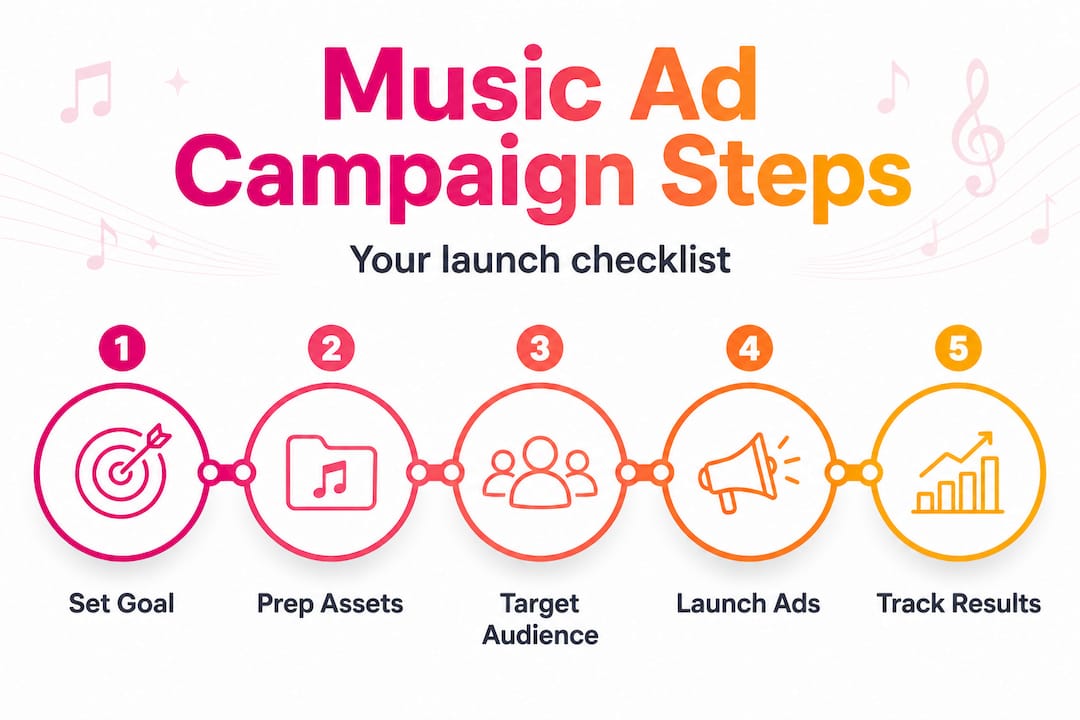
- Set your campaign goal. Choose “Website traffic,” “Product and brand consideration,” or a conversion-based goal depending on what you want fans to do. For most artists, getting streams or sign-ups, a conversion goal is the strongest choice.
- Upload your video assets to YouTube. All ads need to be live YouTube videos. Upload each orientation as an unlisted video so it’s available for your campaign without cluttering your public channel feed.
- Structure your ad groups. Create separate ad groups for different targeting approaches. One group might target fans of similar artists, another might focus on specific placements like music channels.
- Define your audience. Use custom intent audiences based on search behaviour, or build audiences from your own fan data. Targeting fans of artists in your genre is one of the most cost-effective approaches available to independent musicians.
- Set your daily budget. Start with a modest amount you’re comfortable spending while learning. Even £5 to £10 per day can generate useful data within two weeks.
- Choose your bidding strategy. See the comparison table below.
- Configure conversion tracking. Install the Google tag on your landing page before you go live. Without this, you’re flying blind.
- Review and launch. Double-check that your videos are linked correctly, your destination URL works, and your targeting makes sense.
| Bidding strategy | Best for | Pros | Cons |
|---|---|---|---|
| Target CPA | Artists with a clear cost-per-action goal | Predictable spend per result | Needs enough conversion data to optimise |
| Maximise conversions | Artists starting out with limited data | Easy to set up, automated | Less control over individual conversion costs |
According to Google’s guidance on conversion-focused campaigns, the campaign mechanics that matter most for independent artists are targeting the right audience using intent and placement signals rather than broad assumptions, hooking viewers fast in the opening seconds, and setting up tracking so you optimise for real downstream outcomes like subscriptions, click-throughs, and streaming activity.
The hook question is one artists consistently underestimate. Your ad has roughly three to five seconds before a viewer can skip. If those seconds don’t create immediate curiosity or emotional pull, most people will move on. Lead with your strongest musical moment, a bold visual, or a line of dialogue that creates a question the viewer wants answered.
For a detailed YouTube ad setup walk-through, there’s a dedicated guide that covers the technical steps inside Google Ads with screenshots and field-by-field guidance.
Pro Tip: Custom intent audiences built around artist names and genre-specific search terms almost always outperform broad demographic targeting for musicians. If your track sounds like a blend of two known artists, build an audience targeting fans who actively search for both. You’ll pay for more relevant views and waste far less of your budget on uninterested listeners.
For more advanced approaches, the expert ad campaign strategies resource explores what established independent artists do differently once they have baseline data to work with.
Optimising and monitoring your results
With your campaign live, it’s not just about set-and-forget. You need to track, learn, and improve.

The single biggest mistake musicians make after launching is checking their results after 48 hours and drawing conclusions. Campaign algorithms need time to learn. Google’s system tests your creative assets, adjusts bidding, and identifies which audience signals correlate with conversions. Interrupt that process too early and you’ll make changes that actually hurt performance.
Here’s what to monitor once your campaign is running:
- Cost per conversion: The amount you’re spending for each stream, click, or subscription. This is your north star metric.
- Click-through rate (CTR): The percentage of people who see your ad and click through to your destination. A low CTR often signals that your hook or creative isn’t resonating.
- View rate: The percentage of people who watch past the skip point. Useful for diagnosing creative fatigue.
- Conversion rate: Of the people who click through, how many complete the action you want?
For conversion-oriented campaigns, Google recommends setting up conversion tracking before launch, using Target CPA or Maximise conversions bidding, and waiting at least 7 to 14 days before drawing conclusions or making significant changes. For Target CPA campaigns specifically, your daily budget should be set to at least 15 times your target CPA to give the algorithm enough room to optimise properly.
“The data in the first week is often noisy. A campaign that looks like it’s underperforming on day three might be your best-ever result by day ten. Patience backed by proper tracking is the real competitive advantage.”
This patience is genuinely hard for musicians who are excited about a release and want instant feedback. But the artists who resist the urge to tweak constantly are the ones who build reliable, repeatable campaigns over time.
For further reading on optimising music ad campaigns and understanding which levers to pull at each stage, there’s a dedicated resource that breaks down the optimisation process with real examples. You’ll also find practical guidance on increasing YouTube ad reach once your baseline campaign is stable.
Troubleshooting and common pitfalls
Every campaign runs into hiccups. Here’s how to handle the most common ones with confidence.
Even well-planned campaigns can stall or underperform. Knowing the warning signs and their fixes saves you both money and frustration.
Common pitfalls to avoid:
- Ignoring conversion tracking entirely. Running ads without tracking is the most common and most costly mistake. You’ll have no idea what’s working, what to scale, or what to cut.
- Narrowing your audience too much. It feels logical to be precise, but over-targeting starves the algorithm of data and limits delivery. Start broader, then narrow based on actual results.
- Using only horizontal videos. A single orientation means you’re automatically excluded from mobile-first placements, which represent a growing share of YouTube viewing time.
- Making changes too frequently. Every time you adjust targeting or bids significantly, the algorithm restarts its learning phase. This is a hidden cost most musicians don’t realise exists.
- Chasing vanity metrics. Views and impressions feel exciting. They’re not the same as fans, streams, or revenue.
On the topic of content targeting, Google advises against using keyword, topic, or placement targeting within conversion-focused video campaigns, because this type of layering tends to restrict delivery and hurt performance. If you want placement control for specific reasons, treat it as a separate experiment with its own budget, and validate the impact with actual measured results before committing.
On the creative side, Google’s asset guidance is clear: even if you use tools that help assemble or generate video content, you should supply your own videos and ensure variety across orientations and lengths. Relying entirely on automated creative often produces generic results that don’t capture your artist identity, and audiences can tell.
Pro Tip: Run at least two different video variants within each ad group whenever possible. This gives the algorithm something to compare, and you’ll often be surprised which version wins. A less polished, more personal clip frequently outperforms a heavily produced one when the music itself is the product.
For a clear YouTube ad campaign guide that specifically addresses indie musician budgets and workflows, there’s a resource tailored to artists who are managing everything themselves. You’ll also find creative music video ideas that can help you generate more asset variety without a big production budget.
What most musicians miss about video ad campaigns
With best practices and pitfalls handled, let’s look at what truly drives effective artist ad campaigns in a way most never discuss.
Here’s the honest reality: most musicians approach video ads the same way they approach organic social media. They upload something, hope for large reach, and measure success by how many people saw it. This mindset almost guarantees wasted budget.
The artists who build genuine momentum from paid campaigns think about it completely differently. They treat every campaign as a structured experiment. Multiple video assets go in. Conversion tracking is set up before a single pound is spent. And the question isn’t “how many views did I get?” but “what did those views actually lead to?”
The gap between a musician who spends £200 on ads and gains 50 real fans versus one who spends the same and gains nothing isn’t talent or budget. It’s measurement. When you track real actions, like streams, newsletter sign-ups, or playlist saves, you can iterate quickly. You cut what doesn’t work and double down on what does. Most musicians simply don’t do this, which is exactly why growing your music audience through paid video remains an under-exploited advantage for those who get it right.
There’s also a mindset shift required around assets. Musicians tend to think about “the video,” singular. Successful ad campaigns think about “a library of creative tests.” The more variants you feed the system, the faster it learns what your audience responds to, and the faster your cost per conversion drops. This is not about having a big production budget. It’s about being systematic rather than precious.
Ready to launch your campaign? Get professional music videos and expert support
If you want to shortcut the learning curve and get access to proven creative or expert guidance, here’s your next step.
Creating high-quality, ad-ready video assets is consistently the biggest barrier for independent musicians who want to run effective campaigns. The strategy is learnable. The platform mechanics are manageable. But producing multiple video variants in different formats and lengths is where most artists stall.
Music Video Marketplace is built specifically to solve this problem. You can create a long-form video in minutes, upload it directly to YouTube, and launch an ad campaign for your song without needing a production team or a large budget. Whether you need ad-ready creative assets, guidance on campaign structure, or a faster route from finished track to active promotion, the platform gives you the tools to move quickly and confidently. Stop waiting for your music to be discovered. Start putting it in front of the right people today.
Frequently asked questions
How many videos do I need for a music ad campaign?
You should prepare at least three videos, including both vertical and square orientations, with each video running between 10 and 60 seconds in length, as recommended by Google Ads for effective video campaigns.
What’s the recommended budget for an effective YouTube music ad campaign?
For Target CPA campaigns, Google recommends a daily budget of at least 15 times your target CPA, while Maximise conversions campaigns should have a daily budget of at least 10 times your expected video CPA.
How long should I run my campaign before making changes?
You should monitor performance for at least 7 to 14 days before making any significant adjustments, giving the algorithm sufficient time to optimise your bids and delivery.
Should I use automated creative generation or upload my own videos?
Google recommends uploading your own videos and providing variety across orientations and lengths, even if you use tools that assist with creative assembly, to ensure your ads genuinely represent your artist identity.
Recommended
- How to launch music ads on YouTube: A step-by-step guide | Music Video Marketplace Blog
- Best practices for music ads: promote your tracks effectively | Music Video Marketplace Blog
- YouTube ad campaigns for indie musicians: a clear guide | Music Video Marketplace Blog
- YouTube ad campaign examples for musicians: proven strategies | Music Video Marketplace Blog
- Step by Step Video Ads: Easy E-Commerce Growth Guide | QuickAdVideo Blog
- Digital advertising campaign guide for Australian SMEs
Read next
 The role of creative storytelling in brand engagementDiscover the role of creative storytelling in brand engagement. Learn how narratives enhance brand value and drive audience action.
 The role of influencers in music advertisingDiscover the crucial role of influencers in music advertising and learn how to leverage them for profitable campaigns. Don't miss out!
 Tips for effective song ads: your 2026 guideUnlock success with tips for effective song ads! Learn how to amplify your music through strategic ad spending and organic engagement.
 Split Testing Music Ads: 7 Checks for Musicians Before LaunchLearn how musicians can test music ads one variable at a time, track cost per meaningful outcome, and use a clear stop rule before scaling campaigns.
Turn the idea into a finished music video.
Drop your track into the Studio and build your visual in minutes.