
 Try the Workspace
The role of creative storytelling in brand engagement
Discover the role of creative storytelling in brand engagement. Learn how narratives enhance brand value and drive audience action.

The role of creative storytelling in brand engagement
TL;DR:
- Creative storytelling significantly boosts audience engagement and behavioral change by transforming brand messages into memorable experiences. The most effective techniques include cause, conflict, resolution arcs, multi-timeline structures, and surprising elements that enhance long-term memory. Human oversight remains essential to ensure cultural authenticity and emotional depth, even with AI assistance.
Creative storytelling is defined as the strategic use of narrative arcs, characters, and emotional tension to communicate brand value and change audience behaviour. It is not a creative flourish added to a campaign. It is the campaign. Research from the World Federation of Advertisers confirms that ads with story arcs double behavioural change effectiveness compared to non-story advertising. The role of creative storytelling, then, is to transform abstract brand messages into experiences that audiences remember, feel, and act upon. For content creators, marketers, and business professionals, understanding this distinction is the difference between campaigns that fade and brands that endure.
How does creative storytelling shape memory and emotion?
The brain is biologically wired for narrative. Without story structure, information arrives as random data. The brain processes it poorly, retains little, and the audience disengages. Narrative gives the brain a filing system, reducing cognitive overload and creating the conditions for genuine attention.

Neuroscience explains why this works at a chemical level. Emotionally engaging stories trigger the release of oxytocin, a neurochemical that increases empathy and sustains attention. This is not metaphor. It is biology. When a brand story creates emotional stakes, the audience’s brain physically responds by becoming more receptive to the message.
Memory retention follows the same logic. Storytelling matches or exceeds the effectiveness of survival processing, one of the most powerful mnemonic techniques known to cognitive science. Survival processing asks people to imagine whether information would help them survive. Storytelling achieves the same depth of encoding through narrative immersion alone.
“Without story structure, information is processed as random data causing cognitive breakdown and poor retention.” — Neuroscience of Storytelling, Mark O’Neill
Unexpected narrative elements amplify this effect further. Illogical and unexpected narrative tactics make advertisements 2.7 times more effective at encoding in long-term memory. The reason is participation. When a story breaks expectation, the audience’s brain works harder to resolve the gap. That cognitive effort deepens the memory trace.
Pro Tip: Build one genuinely unexpected moment into every brand story. It does not need to be absurdist. It needs to be surprising enough to make the audience lean in and fill the gap themselves.
What narrative techniques boost brand storytelling impact?
Effective creative narrative techniques share one quality: they create and sustain emotional investment. Structure is the mechanism. Without it, even visually spectacular content fails to hold attention.
The cause, conflict, and resolution arc is the most reliable framework. Coherent narrative arcs with emotional stakes consistently outperform attention-grabbing chaos. The brain’s boredom filter activates when content prioritises visual spectacle over story logic. A brand video that cuts rapidly between striking images but tells no story triggers disengagement, not excitement.
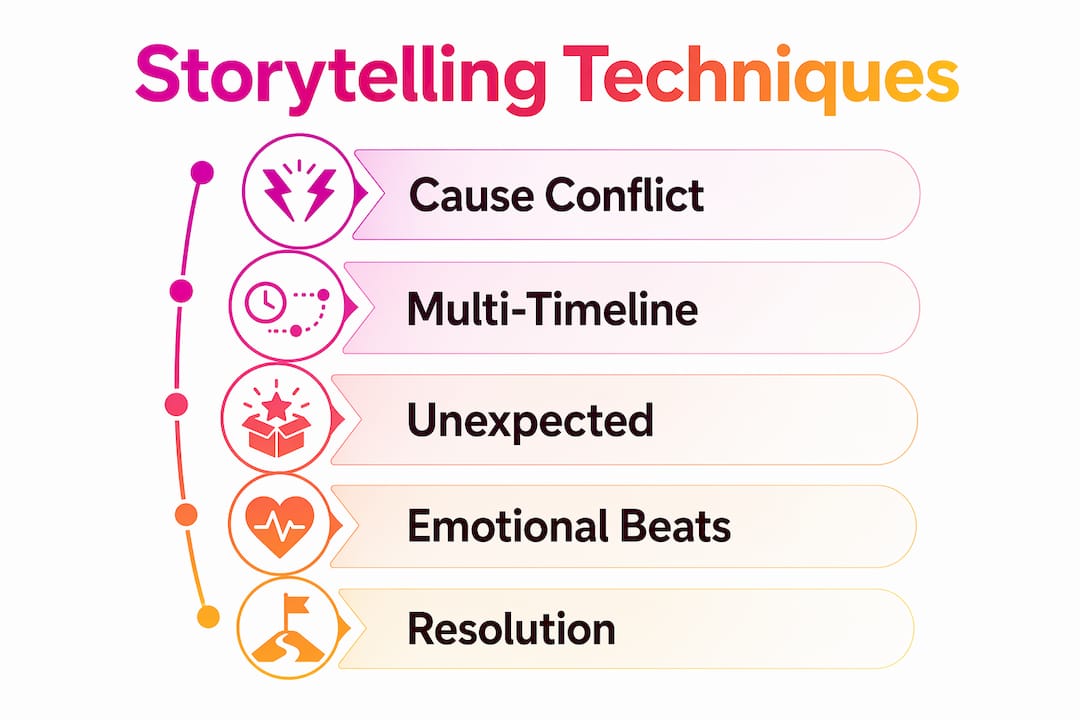
Three structural techniques stand out for marketers and content creators:
-
Cause, conflict, resolution arcs. Establish a character with a clear problem. Build tension through conflict. Resolve it in a way that positions the brand as part of the solution. This is the oldest story structure in human culture, and it works because it mirrors how the brain naturally organises experience.
-
Multi-timeline storytelling. Alternating between two time periods or storylines forces the audience to participate actively. They must hold both threads in mind and anticipate how they connect. Emotional parity between storylines is non-negotiable here. If one timeline is emotionally flat, the tension collapses and the audience disengages.
-
Foreshadowing and planted details. Placing a detail early that pays off later creates a sense of inevitability. The audience feels clever for noticing it. That feeling of reward builds brand affinity.
| Technique | Strength | Common pitfall |
|---|---|---|
| Cause, conflict, resolution | Universal emotional resonance | Weak conflict makes the story feel flat |
| Multi-timeline structure | Forces active audience participation | Emotional imbalance between timelines kills tension |
| Foreshadowing | Creates reward and brand affinity | Payoff must be clear or the audience feels cheated |
| Unexpected narrative elements | 2.7x memory encoding boost | Randomness without logic reads as noise |
The most common mistake marketers make is confusing novelty with incoherence. Novelty serves the story. Incoherence breaks it. Every unexpected element must connect back to the narrative logic, even if that connection is revealed only at the end.
Pro Tip: Map your brand story’s emotional beats before you write a single line of copy. If the emotional arc does not rise and fall with intention, no amount of production quality will save it.
Storytelling in marketing vs. conventional direct-message tactics
The performance gap between story-led and feature-led advertising is measurable and significant. Ads that communicate brand value directly are 15% more likely to perform well. Delivering that same value through storytelling doubles the performance lift to 30%. That is not a marginal improvement. It is a structural advantage.
Direct-message advertising lists features, prices, and benefits. It answers the question “what does this product do?” Storytelling answers a different question: “why does this product matter to my life?” The second question creates emotional resonance. Emotional resonance creates memory. Memory drives purchase decisions long after the ad has ended.
The limitations of attention-grabbing tactics without narrative depth are well documented. Rapid cuts, loud music, and visual effects can generate initial views. They do not generate brand memory or behavioural change. The brain’s boredom filter, described in research by Shane Snow, activates precisely when content lacks narrative coherence. Attention without story is a leaky bucket.
Long-term brand growth depends on relationship building, not transaction triggering. Consider the difference between a brand that runs a price-led promotion and a brand that tells a consistent story about its values over years. The promotion drives a short-term sales spike. The story builds the kind of trust that makes customers return without needing a discount.
- Story-led ads produce a 30% performance lift vs. 15% for direct-feature ads
- Unexpected narrative elements increase long-term memory encoding by 2.7 times
- Narrative structure reduces cognitive overload, making messages easier to retain
- Emotional resonance from storytelling sustains brand preference between purchase moments
- Feature-led messaging answers “what”, while story-led messaging answers “why it matters”
The importance of storytelling in music illustrates this principle clearly. Songs that tell stories are remembered for decades. Songs that list attributes are forgotten within weeks. The same logic applies to every brand communication.
How should marketers apply storytelling strategy in 2026?
Storytelling requires the same rigour as financial or legal planning in business strategy. The most effective brand stories are not creative decoration. They are the strategy itself, executing business objectives by shaping culture and changing behaviour. Marketers who treat storytelling as an afterthought produce campaigns that entertain without converting.
The practical application starts with a clear brief. Define the behaviour you want to change. Identify the emotional barrier preventing that change. Build a story that addresses the barrier directly, with a character the audience recognises and a conflict they feel.
AI-generated content presents a specific risk here. Relying solely on AI-generated content risks producing what practitioners call “business cringe”: technically correct but emotionally hollow brand communication. AI can generate structure. It cannot generate cultural intelligence, lived experience, or the kind of editorial judgement that makes a story feel true. Human oversight is not optional. It is the quality control mechanism.
Four principles for applying storytelling in 2026:
- Treat story as strategy, not decoration. Every campaign brief should begin with the narrative, not the channel plan.
- Protect human editorial input. Use AI for efficiency, but keep a human editor responsible for emotional truth and cultural accuracy.
- Build for brand memory, not just reach. A story seen by fewer people but remembered by all of them outperforms a message seen by millions and forgotten immediately.
- Invite audience co-creation. Stories that leave space for the audience to participate, through interpretation, response, or continuation, build deeper brand relationships than closed narratives.
The storytelling in music videos context makes this concrete. A music video that tells a story gives viewers a reason to watch again, share, and discuss. A music video that is purely visual spectacle gets one view and disappears. The narrative is the retention mechanism.
Pro Tip: Before finalising any brand story, ask one question: “Would someone retell this to a friend?” If the answer is no, the story is not yet strong enough. Retellability is the ultimate test of narrative impact.
Key takeaways
Creative storytelling is the single most effective tool for changing audience behaviour, outperforming direct-feature advertising by a measurable margin when executed with narrative rigour and emotional intelligence.
| Point | Details |
|---|---|
| Story doubles behavioural impact | Story-led ads produce a 30% performance lift, twice the result of direct-feature messaging. |
| Memory encoding through narrative | Unexpected story elements increase long-term memory encoding by 2.7 times compared to conventional ads. |
| Structure is non-negotiable | Cause, conflict, and resolution arcs outperform visual spectacle by sustaining emotional engagement. |
| Human oversight protects quality | AI can generate story structure, but human editorial judgement delivers cultural accuracy and emotional truth. |
| Storytelling is business strategy | The most effective brand stories execute business objectives directly, not as creative add-ons. |
Why I believe storytelling is the most underused commercial tool
Most marketing budgets are allocated to distribution, not story. Brands spend heavily on media placement and almost nothing on the rigour of the narrative itself. That is the wrong order of operations. A weak story distributed widely is just expensive noise.
What I have seen consistently is that the brands with the strongest long-term growth are the ones that treat their story as a protected asset. They do not change it with every campaign cycle. They deepen it. They add chapters. They let the audience become part of the narrative. That kind of discipline is rare, and it is exactly what separates brands that grow from brands that merely spend.
The neuroscience is not complicated. The brain craves narrative because narrative is how humans have organised experience since before written language. When a brand gives the brain a story it can file, feel, and retell, it earns a place in memory that no media spend can buy. The video content trends for musicians in 2026 reflect this shift clearly. The artists gaining traction are not the ones with the biggest budgets. They are the ones with the most compelling stories.
The uncomfortable truth is that most brands know storytelling matters and still treat it as a nice-to-have. The research from the World Federation of Advertisers and Darden Business School is unambiguous. Story is strategy. Everything else is execution.
— Music
Bring your brand story to life with Musicvideomarketplace
Musicvideomarketplace exists for exactly this moment. You understand the power of narrative. Now you need the tools to put it on screen, fast.

Musicvideomarketplace enables musicians and content creators to produce a long-form video in minutes, ready to upload to YouTube and launch as a full ad campaign for their song. No production delays. No expensive crews. Watch how compelling narrative structure translates directly into audience engagement, or explore a creative video asset that demonstrates what story-led brand content looks like in practice. Your story is ready. Musicvideomarketplace gives it a stage.
FAQ
What is the role of creative storytelling in marketing?
Creative storytelling transforms brand messages into narratives that change audience behaviour. Research from the World Federation of Advertisers shows story-led ads produce a 30% performance lift, double the result of direct-feature messaging.
Why does storytelling improve memory retention?
Narrative gives the brain a structural filing system for organising information. Storytelling matches or exceeds survival processing, one of the most effective mnemonic techniques, for long-term memory retention.
What narrative techniques work best for brand storytelling?
Cause, conflict, and resolution arcs, multi-timeline structures, and unexpected narrative elements are the most effective techniques. Unexpected elements alone increase long-term memory encoding by 2.7 times.
How does storytelling differ from conventional advertising?
Conventional advertising answers “what does this product do?” Storytelling answers “why does this matter to my life?” The emotional resonance created by the second question drives stronger brand memory and longer-term purchase behaviour.
Can AI replace human storytelling in brand content?
AI can generate narrative structure but cannot replicate cultural intelligence or editorial judgement. Relying solely on AI-generated content risks producing emotionally hollow brand communication, a risk practitioners describe as “business cringe.”
Recommended
- The role of storytelling in DJ marketing | Music Video Marketplace Blog
- Storytelling in Music Videos: Boost Viewer Retention by 40% | Music Video Marketplace Blog
- The importance of storytelling in music | Music Video Marketplace Blog
- Fan engagement strategies that power your music marketing | Music Video Marketplace Blog
Read next
 The role of influencers in music advertisingDiscover the crucial role of influencers in music advertising and learn how to leverage them for profitable campaigns. Don't miss out!
 Tips for effective song ads: your 2026 guideUnlock success with tips for effective song ads! Learn how to amplify your music through strategic ad spending and organic engagement.
 Types of Video Ads for Musicians: Boosting ReachTypes of video ads for musicians, including YouTube, Meta, and TikTok formats. Learn best practices, real-world examples, and how to avoid common pitfalls.
 Step-by-step guide to launching your first music ad campaignUnlock your music's potential with our step by step music ad campaign guide. Learn to drive streams and grow your fanbase effectively!
Turn the idea into a finished music video.
Drop your track into the Workspace and build your visual in minutes.