
How independent musicians monetise video content effectively
Discover what is video monetization and how independent musicians can turn views into income. Learn effective strategies for success!
How independent musicians monetise video content effectively
TL;DR:
- Many musicians mistakenly believe YouTube ad revenue will sustain their careers, but average RPMs for music are quite low. Successful monetisation relies on diversifying income streams, building engaged audiences, and leveraging YouTube as a promotional tool rather than a primary income source. Ultimately, genuine audience engagement and cross-platform marketing drive sustainable income far more effectively than ad revenue alone.
Most musicians assume YouTube will pay them well once their music video takes off. The reality is more sobering. Music niche RPM averages just $0.75 to $1.65 per thousand views, compared to $8 to $20 for finance content creators. That doesn’t mean video monetisation isn’t worth pursuing. It means the strategy has to be smarter. This article walks you through eligibility rules, revenue streams, rights requirements, and the practical mindset shift that separates musicians who build sustainable income from those who wait for ad cheques that never quite arrive.
Table of Contents
- What is video monetisation for musicians?
- Eligibility requirements: The thresholds musicians must meet
- Maximising revenue: Original works, covers, and rights
- Why ads aren’t enough: The real strategy for emerging artists
- Why emerging artists must rethink YouTube monetisation
- Connect your music and monetise your video content
- Frequently asked questions
Key Takeaways
| Point | Details |
|---|---|
| Earnings are modest | Music channels on YouTube earn low ad revenue per view, so expectations should be realistic. |
| Reach eligibility thresholds | You need 1,000 subscribers and 4,000 watch hours to access most monetisation tools on YouTube. |
| Rights and originality matter | Only videos with full rights and original or licensed content can earn maximum revenue. |
| Ad revenue is not enough | YouTube works best as a discovery channel for musicians, with most income from streams, merch, and shows. |
| Strategise for real growth | Build a funnel from your videos to your other platforms to maximise fan engagement and income. |
What is video monetisation for musicians?
Video monetisation, in the simplest terms, means converting your video views into income through a platform’s official revenue programme. For independent musicians, YouTube is the primary stage for this. It has over 2 billion logged-in monthly users, and it remains the world’s largest music discovery platform by a considerable margin.
The foundation of YouTube monetisation is the YouTube Partner Program, known as YPP. Once accepted, you unlock multiple income streams beyond just adverts. These include ad revenue, a share of YouTube Premium subscription income, channel memberships, Super Thanks fan payments, and Shopping integrations. For working musicians, understanding this full picture is the first step in your YouTube monetisation guide.
Here is a quick look at the main YPP revenue streams and how relevant they are for musicians:
| Revenue stream | How it works | Relevance for musicians |
|---|---|---|
| Ad revenue | Adverts shown before or during your video | Primary but low RPM for music |
| YouTube Premium share | Portion of subscriber fees when Premium users watch | Passive, modest supplement |
| Channel memberships | Fans pay monthly for exclusive perks | Valuable for engaged fanbases |
| Super Thanks | One-off fan payments during or after videos | Great for live sessions and releases |
| Shopping | Sell merch directly via YouTube | Excellent for artists with merchandise |
The key thing to understand is that ad revenue is the most visible stream, but it is rarely the most lucrative for musicians. The music genre consistently records some of the lowest RPM figures on the platform, which is why the complete musician monetisation guide stresses diversifying across all available streams from day one.
Understanding the key YouTube advantages helps frame this correctly. YouTube’s value for musicians is not purely financial. It is also the most powerful discovery tool available to independent artists in 2026.
Eligibility requirements: The thresholds musicians must meet
Understanding what monetisation is, the next step is to know exactly who qualifies for these programmes and how to get there.
Getting into YPP is not instant. YouTube operates a tiered system, and you need to clear specific thresholds before any revenue flows. The standard YPP requirements are:
- Reach 1,000 subscribers on your channel
- Accumulate 4,000 valid public watch hours in the last 12 months, OR
- Achieve 10 million valid public Shorts views in the last 90 days
- Link a Google AdSense account
- Have no active Community Guidelines strikes on your channel
- Comply fully with YouTube’s monetisation policies
There is also a lower entry tier introduced in recent years. If you reach 500 subscribers, you can unlock fan funding tools such as Super Thanks and channel memberships before you qualify for full ad revenue. This is genuinely useful for emerging artists building an early community, because it lets you start earning from your most loyal fans while still working towards the larger threshold.
| Tier | Subscriber requirement | Watch hours / Shorts views | Revenue unlocked |
|---|---|---|---|
| Fan funding tier | 500 subscribers | 3,000 watch hours or 3M Shorts views | Memberships, Super Thanks |
| Full YPP | 1,000 subscribers | 4,000 watch hours or 10M Shorts views | Ads, Premium share, Shopping |
Reaching these thresholds faster is absolutely possible with the right approach. Following a structured music upload workflow keeps your release schedule consistent. Applying music video engagement tips such as strong thumbnails, compelling titles, and end screens directing viewers to more content helps stack watch hours quickly.

Pro Tip: Long-form original music videos consistently outperform Shorts for watch hour accumulation. A three-minute music video that earns 1,000 full views contributes 3,000 minutes to your watch hour total. Shorts rarely do this efficiently. Review music video length best practices to plan your content strategically from the start.
Maximising revenue: Original works, covers, and rights
Reaching eligibility doesn’t guarantee full earnings. Let’s break down what kinds of videos and content qualify and what to watch for.
This is where many independent musicians run into real problems. Simply being in YPP does not mean every video you upload will earn money. YouTube’s content eligibility rules are firm, and they have become stricter since 2025 in particular.
Original content is king. According to YouTube’s content eligibility guidelines, your music video must be original, hold all necessary rights to both the visual and audio elements, and avoid repetitious or mass-produced material. If you created the music, own the masters, and produced or commissioned the video yourself, you are in the strongest possible position for full monetisation.
Cover songs are complicated. When you record and upload a cover version of another artist’s song, the original publisher typically has a Content ID claim on the audio. This means:
- The publisher may monetise your video and take the ad revenue
- You could share revenue with the publisher depending on the agreement
- In some territories or situations, the video may be blocked entirely
- Your views still count, but your earnings may be zero or heavily reduced
Creator Music licences offer a middle path. YouTube’s Creator Music library lets you licence tracks legally for your videos. However, music policy guidelines confirm that using these tracks adjusts the revenue split below the standard 55% creator share. You earn something, but not everything.
Using Creator Music is a solid option for lyric videos or behind-the-scenes content where the track is a backdrop rather than the centrepiece. For your main music video releases, original masters give you full control and full revenue.
Here is how the different content types compare for monetisation purposes:
| Content type | Monetisation potential | Rights risk |
|---|---|---|
| Original music video (owned masters) | Full ad revenue and all streams | Low |
| Cover song video | Shared or zero ad revenue | High (Content ID claims) |
| Creator Music licensed video | Reduced revenue split | Low |
| AI-generated or mass-produced music | Denied or demonetised | Very high |
| Live performance (original) | Full revenue if rights are clear | Medium |
Pro Tip: Before uploading any video, use YouTube’s copyright in music videos checklist to confirm you hold all audio and visual rights. A single third-party clip used without clearance can cost you the entire video’s revenue, or worse, the channel.
One reassuring nuance worth knowing: videos with mild artistic elements such as subtle profanity or mature visual themes can still qualify as advertiser-friendly if handled tastefully. YouTube does not demand sterile content. They demand authentic original content, which is an important distinction for musicians making honest, expressive work. Understanding music content policies for YouTube in full helps you avoid unnecessary demonetisation without compromising your artistry.
Why ads aren’t enough: The real strategy for emerging artists
Even with the right content and eligibility, understanding what YouTube really pays is key. Here is what you must know to make your music video strategy work.
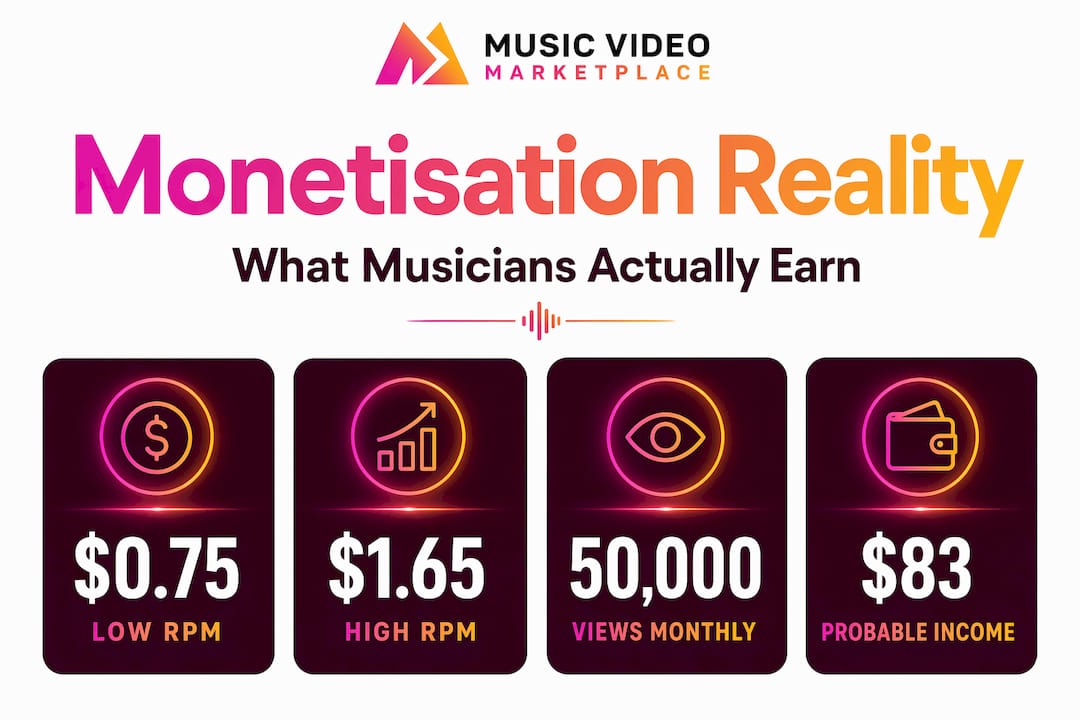
Let’s be direct. If you have 50,000 views on your music video in a month, which is a genuinely solid result for an independent artist, your ad revenue at an RPM of $1.20 would be approximately $60. That is not a living wage. It is a contribution, but it is not the point.
The music niche RPM reality shows averages of $0.75 to $1.65 per thousand views for long-form content. Shorts monetisation is dramatically worse, with RPM figures of just $0.03 to $0.08. For context, a finance YouTuber might earn $15 for the same 1,000 views that earns a musician $1.20.
This is not a criticism of YouTube. It reflects advertiser demand. Finance brands pay premium rates to reach audiences making financial decisions. Music fans are valuable too, but the advertiser ecosystem around music simply pays less.
The musicians who actually earn well from YouTube treat it as a promotional engine, not a revenue source. Here is what that strategy looks like in practice:
- Use your music videos to drive streams on Spotify, Apple Music, and other platforms where royalty rates are separate from YouTube’s ad system
- Direct your audience to ticketing pages for live shows, where margins are far higher
- Promote your merch store in every video description and at strategic end-screen moments
- Build your email list through gated content or exclusive offers mentioned in videos
- Use fan funding tools like Super Thanks to reward your most engaged viewers directly
Pro Tip: Build a clear funnel from your YouTube channel to every other revenue-generating platform you use. Your video description is prime real estate. Every video should contain links to your streaming profiles, your mailing list, your merch store, and your live show calendar. Following music video ad best practices helps you structure these touchpoints so they convert rather than clutter.
Also, YouTube’s own guidance for independent musicians reinforces this point. The platform explicitly acknowledges that for emerging artists, original music videos with high watch time are the fastest route to YPP eligibility, and that ad revenue should be treated as supplementary while promotional value drives the broader income strategy.
Why emerging artists must rethink YouTube monetisation
Pulling together everything we have covered, here is our view on what most musicians get wrong and what actually works.
The standard advice floating around music communities goes something like this: hit 1,000 subscribers, get monetised, and start earning from your videos. That framing is technically accurate but practically misleading. It trains musicians to fixate on ad revenue as a milestone worth celebrating, when in reality it is a very minor income stream for the vast majority of artists.
We have seen musicians spend months agonising over why their RPM is $0.90 instead of $1.50. That energy is almost entirely wasted. The CPM and RPM figures for music will always lag behind other categories because of how the advertising market is structured. This is not something individual artists can meaningfully change.
What you can change is how you position YouTube within your overall income architecture. The artists who build genuinely sustainable careers in 2026 use YouTube as their most powerful awareness tool, not their primary income source. They release consistent, high-quality original videos to grow their audience, use that audience to fill venues and sell records, and treat the ad cheque as a pleasant monthly bonus rather than a business plan.
Understanding YouTube CPM and RPM data confirms something many creators miss: geography and content format significantly affect your earnings. Targeting audiences in the US and UK through your thumbnail copy, SEO, and even the topics you address in your content can meaningfully lift your effective RPM. Long-form videos consistently outperform Shorts on earnings per view. These are the levers worth pulling.
The deeper point, though, is about community. Musicians who build genuine, engaged audiences on YouTube are creating something far more valuable than ad revenue. They are building a fanbase that follows them to live shows, buys their physical releases, and supports them through membership tiers and fan funding. That is the actual business model. The best practices for YouTube ads matter not because they maximise your $60 monthly ad cheque, but because they make your videos more watchable, more shareable, and more effective at converting casual viewers into committed fans.
Rethink monetisation entirely. It is not about the money YouTube pays you directly. It is about the audiences YouTube helps you build, and what those audiences then choose to spend with you elsewhere.
Connect your music and monetise your video content
Creating original, high-quality music videos consistently is one of the biggest practical barriers independent musicians face. Writing, recording, and releasing music is already a full-time endeavour. Adding professional video production on top of that is genuinely challenging without the right tools.

That is exactly what we built Music Video Marketplace to solve. Our platform enables you to create a long-form music video in minutes, ready to upload directly to YouTube, and then launch a targeted ad campaign for your song without needing a production team or a marketing budget that runs into thousands. Whether you are releasing your first single or growing an existing catalogue, we help you show up consistently with professional content that builds the kind of audience YouTube monetisation actually rewards.
Frequently asked questions
How much can a musician really earn from YouTube video monetisation?
Typical music RPM averages $0.75 to $1.65 per 1,000 views, far below finance or technology content, so most independent artists earn modest sums from ads alone unless they reach very large audiences.
Can I monetise a music video if it contains cover songs?
You can potentially monetise covers, but the original publisher may file a Content ID claim that redirects ad revenue to them, meaning you share or lose those earnings entirely.
What’s the fastest way to qualify for YouTube Partner Program as a musician?
Focus on releasing original music videos that earn strong watch time, grow engaged subscribers through consistent uploads, and prioritise long-form content to hit 1,000 subscribers and 4,000 watch hours as efficiently as possible.
Are there any content restrictions or risks for musicians in 2026?
Yes. YouTube applies strict inauthentic content reviews to music channels, targeting unmodified covers, AI-generated tracks, and mass-produced material, all of which risk demonetisation or removal.
How does YouTube Shorts monetisation compare to traditional music video uploads?
Shorts RPM averages just $0.03 to $0.08 per thousand views, making full-length original music videos a significantly better focus if your goal is to maximise earnings from your YouTube content.
Recommended
- Examples of video content for musicians in 2026 | Music Video Marketplace Blog
- Creative video campaign examples for independent musicians | Music Video Marketplace Blog
- Music Video Marketing Guide for Independent Musicians | Music Video Marketplace Blog
- Video monetisation for musicians: complete guide 2026 | Music Video Marketplace Blog
Read next
 How to convert songs to video: 2026 guideLearn how to convert songs to video in this 2026 guide. Discover the best tools and techniques for creating stunning videos for social media!
 How to create long-form music video tutorials on YouTubeUnlock the power of a long form video tutorial! Learn to create engaging YouTube music tutorials that build loyal audiences and boost your reach.
 How to launch song campaigns that actually get heardDiscover how to launch song campaigns that truly connect with your audience. Learn strategic steps for impactful music releases!
 Guide to YouTube music uploads for indie artists 2026Learn how to upload music to YouTube efficiently with this complete guide covering video creation, metadata optimisation, copyright protection, and promotional campaigns for independent musicians in 2026.
Turn the idea into a finished music video.
Drop your track into the Studio and build your visual in minutes.