
DJ audience demographics in the UK: who you're really playing to
Discover the types of DJ audience demographics in the UK, from Gen Z trends to insights on the 25-44 age group engaging with dance music.

DJ audience demographics in the UK: who you’re really playing to
DJs in the UK most often attract adults aged 25–44, with Gen Z now the fastest-growing segment of the dance-music audience. According to the Global DJ Census 2024, the DJ world itself is multi-generational, with the largest engagement centred on adults aged roughly 25–54. Meanwhile, a 2026 industry snapshot reports Gen Z makes up a significant portion of the total dance-music listening audience, reportedly around 40%, based on available industry summaries, driven largely by TikTok discovery and festival attendance.
The commercially valuable core is the 18–35 cohort. This group attends live events at a substantially higher rate than the general population, spends freely on experiences, and consumes music digitally every day. The sections below break that demographic insight into usable audience profiles, city-level concentrations, genre-linked personas, and practical targeting steps.
Key takeaways
The core UK DJ audience sits in the 18–45 age band, with Gen Z the fastest-growing segment and the 25–35 cohort the highest-spending one.
| Point | Details |
|---|---|
| Core age band | Adults aged 18–45 dominate; the 25–35 cohort spends most on tickets and events. |
| Gen Z growth | Gen Z represents around 40% of dance-music listeners and discovers artists primarily via TikTok. |
| City concentration | London, Manchester, Bristol, Glasgow, and Birmingham account for the bulk of UK club and festival demand. |
| Data limitations | Most figures come from self-reported DJ surveys; test national assumptions against your own venue analytics. |
| Musicvideomarketplace | Ready-to-edit long-form videos let DJs build YouTube presence and run targeted ad campaigns without a production budget. |
Table of Contents
- What major DJ surveys reveal about DJ audience demographics
- What are the main audience personas UK DJs attract?
- Where do DJ audiences concentrate across the UK?
- How does genre shape the audience you attract?
- How do DJ audiences find and consume music?
- How should DJs and promoters act on these demographics?
- How reliable is this data, and where does it come from?
- What psychographic traits define DJ audiences?
- How culturally diverse are DJ audiences in the UK?
- How has social media changed who follows DJs?
- How much do DJs earn, and what do audiences spend?
- What this data actually means for UK DJs in 2026
- Ready-to-edit video assets for DJs targeting the right audience
- Sources
What major DJ surveys reveal about DJ audience demographics
The Global DJ Census 2024 is the largest self-reported survey of DJs worldwide and the most useful starting point for understanding who is behind the decks and, by extension, who they are playing to.
A few headline findings stand out. The DJ population itself skews towards the 25–54 age band, which broadly mirrors the core audience those DJs serve. Many respondents identify as hobbyists rather than full-time professionals, a consistent pattern across earlier editions of the Census as well. The gender split among DJs remains predominantly male, though the gap has been narrowing as genres such as Afrobeats, R&B, and pop-oriented club music attract more female and non-binary practitioners. A US-market snapshot from Rascasse puts the EDM audience at roughly 52.7% male and 47.3% female, with an average age in the mid-30s. UK patterns are broadly comparable, though the UK skews slightly younger in urban club settings.
On equipment, the Census confirms a laptop-plus-controller setup as the dominant workflow, with a notable minority using standalone CDJs or all-in-one gear. Streaming integration inside DJ software is growing, reflecting how audiences now discover music through platforms rather than physical media.
| Metric | Finding |
|---|---|
| Core age band (DJs and audience) | 25–54, with 18–34 as the commercially active peak |
| Gen Z share of dance-music listeners | Reported near 40% in 2026 market summaries |
| Gender split (EDM audience, US proxy) | ~52.7% male, 47.3% female |
| DJ income from DJing | Majority earn little; a minority rely on it as main livelihood |
| Dominant DJ setup | Laptop + controller; CDJs a significant minority |
| Livestreaming uptake | Growing, particularly among under-35 DJs |
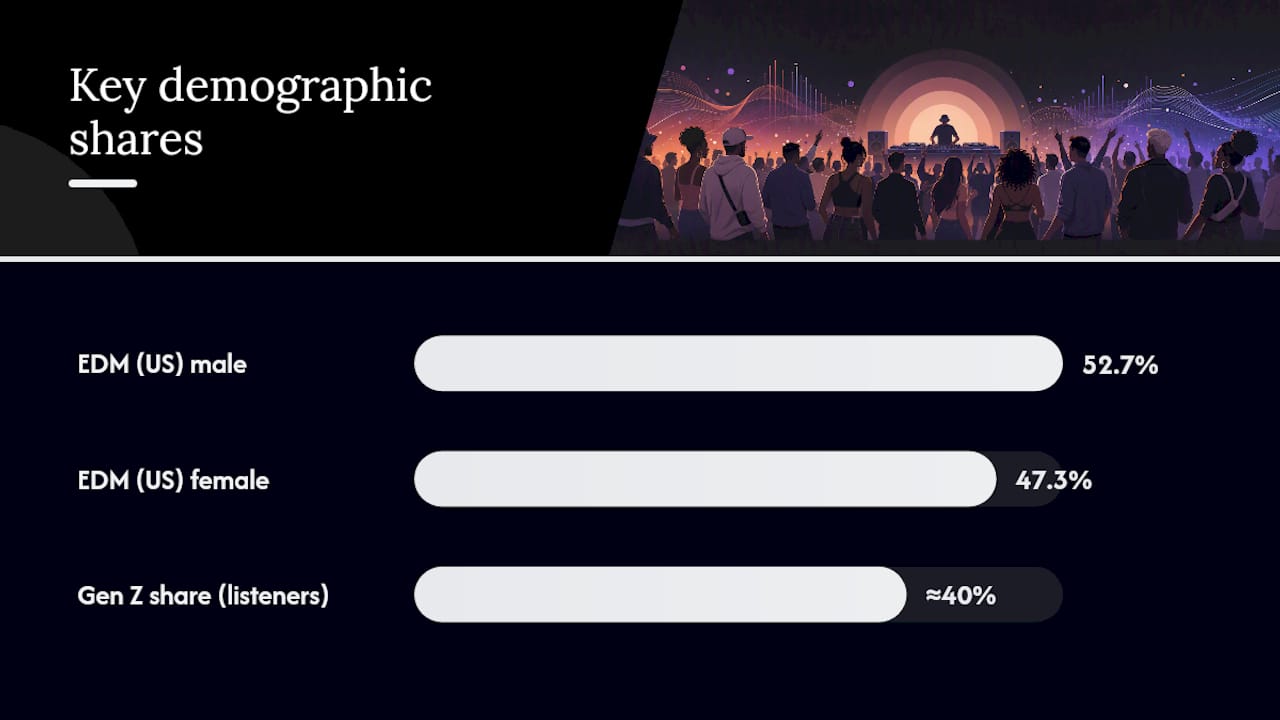
The income picture is worth dwelling on. Earlier Global DJ Census data consistently shows most practising DJs earn the bulk of their income outside music. That shapes the audience too: a hobbyist DJ playing private parties attracts a very different crowd from a club resident at a 2,000-capacity venue in Manchester.
What are the main audience personas UK DJs attract?
Raw numbers only get you so far. The more useful frame is the persona: a cluster of behaviours, motivations, and spending habits that tells you how to reach a group and what they want from a night out.
Festival explorers (18–28, urban and suburban) This group treats festivals as a lifestyle pillar, not an occasional treat. They discover artists through TikTok and Spotify algorithmic playlists, buy tickets months in advance, and share content heavily. Industry research highlights festivals as an integral part of younger fans’ identity rather than entertainment. They respond to short-form video teasers, artist-story content, and line-up reveals on Instagram Reels.

Pro Tip: For festival explorers, a 30-second vertical video clip of your set highlight, posted within 24 hours of the event, consistently outperforms a polished promotional graphic. Speed and authenticity beat production value here.
Weekly clubbers (21–35, city-centre) These are the regulars: the people who know the promoter by name and have a favourite room at their local venue. They follow DJs directly on Instagram and Resident Advisor, read tracklists, and care about sound system quality. The 18–35 EDM audience analysis from Media.co.uk confirms this cohort attends live events at around three times the general population rate.
Mobile and private-party attendees (30–55, suburban and rural) Weddings, corporate events, birthday parties. This audience is less genre-obsessed and more occasion-driven. They want a DJ who reads the room, plays recognisable tracks, and keeps the floor moving from 7pm to midnight. Discovery happens through word of mouth, Google search, and wedding directories rather than social media.
Livestream viewers (16–40, nationwide) Geography is irrelevant for this group. They tune in via Twitch, YouTube, and platforms like Hot Mic Radio for live DJ shows. Younger viewers (16–24) tend to watch on mobile during commutes; older viewers (30–40) often listen as background audio while working. Both groups convert to ticket buyers when a live event is within reach.
Lifestyle hobbyists and creator-fans (25–45, mixed) A growing segment identifies as both fan and aspiring creator. They buy DJ controllers, follow tutorial channels, and engage with behind-the-scenes content. Roughly a third of the broader dance-music audience identifies as creators in some capacity, making educational and process-driven content an effective engagement tool for this group.
The most common mistake DJs make is assuming their audience is one thing. A Friday-night club crowd and a Saturday-afternoon wedding crowd can share the same postcode and almost nothing else. Persona-first thinking is what separates DJs who grow from DJs who plateau.
Where do DJ audiences concentrate across the UK?
The Second UK Electronic Music Industry Report is clear: electronic-music demand clusters in major urban centres, with London, Manchester, Bristol, and Glasgow accounting for a disproportionate share of club nights, festival stages, and DJ bookings.
- London programmes the widest genre range, from deep house and techno in Hackney to Afrobeats and Amapiano in Peckham. Audiences are younger on average (21–34) and more ethnically diverse than anywhere else in the UK.
- Manchester has a strong legacy in house and rave culture. The city supports both large-capacity club nights and intimate 200-person warehouse events, attracting a 22–38 age band with high loyalty to local promoters.
- Bristol punches above its size in drum and bass, trip-hop, and leftfield electronic. Audiences here tend to be slightly older (25–40) and more genre-literate, with a strong student population refreshing the lower age band each September.
- Glasgow has one of Europe’s most respected club scenes. Sub Club and SWG3 draw a dedicated 20–35 crowd with a reputation for staying until the very end of a set. Audiences are knowledgeable and unforgiving of poor programming.
- Birmingham is growing fast, particularly in grime, garage, and Afrobeats. The 18–30 demographic is large and underserved by national promoters, creating genuine opportunity for DJs willing to build local roots.
The report also notes substantially higher club attendance among 16–34 fans in these cities, which justifies city-level advertising spend over broad national campaigns for most club-focused DJs.
Venue format matters as much as city. A 16-plus night at a 300-capacity venue attracts a different audience from an over-40 specialist night at the same address. Private parties and weddings draw the 30–55 band regardless of city. Programming decisions should reflect the night’s subculture, not just its postcode.
How does genre shape the audience you attract?
Genre is one of the strongest predictors of audience profile, and DJs who ignore it when planning their marketing are essentially guessing.
House and commercial dance attract the broadest age range, roughly 18–45, with a near-even gender split in mainstream club settings. The audience tends to be socially motivated: they come for the night out as much as the music. Spending on drinks, tickets, and merchandise is high.

Techno skews younger in its purist form (20–32 in dedicated nights) but carries a devoted older fan base at specialist events. The psychographic is more intense: these audiences research artists, follow labels, and travel significant distances for the right booking. Gender balance has improved markedly over the past decade, with female and non-binary attendees now a substantial share of most techno nights.
Hip-hop and R&B DJ nights attract a 18–35 audience with a stronger male skew in some markets, though this varies significantly by city. Radio-led discovery remains important here; radio DJ support in hip-hop and R&B still drives awareness in ways that pure social-media campaigns do not replicate.
Drum and bass and jungle retain a loyal 25–40 core alongside a younger cohort discovering the genre through streaming. Festival appearances by established names pull in casual listeners who would not attend a dedicated club night.
Genre is not just a musical choice. It is a demographic decision. A DJ who plays techno on Friday and commercial house on Saturday is not being versatile — they are speaking to two completely different audiences who require different marketing, different venues, and different visual identities.
How do DJ audiences find and consume music?
Under-35 fans in the UK are digitally active to a degree that makes social-first marketing non-negotiable. The UK Electronic Music Industry Report notes very high social follow rates among this group and substantial daily listening, with digital discovery central to how new artists break through.
Platform priorities break down roughly by age:
- TikTok drives discovery among 16–25s faster than any other platform. A track used in a viral video can move from obscurity to Shazam chart in 48 hours.
- Instagram Reels and Stories are the primary engagement layer for 22–35s. This is where DJs build parasocial relationships: behind-the-scenes clips, set highlights, and tracklist reveals.
- YouTube serves the 25–40 band for long-form content: full sets, mixes, and artist documentaries. It is also where DJ YouTube growth strategies pay off over time through search and recommendation algorithms.
- Twitch and livestream platforms attract a cross-age audience (16–40) for real-time interaction. Younger viewers watch on mobile; older viewers treat it as background listening.
- Podcasts and long-form audio index higher among specialist electronic-music fans than the general population, according to Media.co.uk’s EDM audience analysis. Fabric, Boiler Room, and genre-specific podcast feeds are genuine discovery channels for the 25–40 cohort.
Pro Tip: Content diversification across platforms is not about being everywhere. It is about matching the right format to the right age band. One long-form YouTube mix repurposed into three TikTok clips and two Instagram Reels reaches four distinct audience segments from a single recording session.
How should DJs and promoters act on these demographics?
Knowing the data is one thing. Turning it into bookings and audience growth is another. Here is a practical sequence:
- Define your primary persona. Pick one of the five personas described above as your core target. Not all of them. One. Your marketing, visual identity, and venue choices should all speak to that person first.
- Match venue and format to persona. Festival explorers need festival-adjacent bookings and outdoor-event content. Weekly clubbers need residency-style consistency. Mobile attendees need a strong Google presence and testimonials.
- Choose two or three promotion channels. For under-25s: TikTok and Instagram. For 25–35s: Instagram and YouTube. For 35-plus: Facebook events, email lists, and word of mouth still convert.
- Build platform-specific creative. A single set recording is raw material. Cut it into a 60-second TikTok highlight, a 3-minute Instagram Reel, and a full-length YouTube upload. Each format serves a different audience segment without requiring a separate shoot.
- Use video to run targeted ad campaigns. Long-form YouTube content combined with short social clips gives you the assets to run pre-roll ads targeting specific age bands and locations. This is where demographic knowledge translates directly into marketing spend efficiency.
- Test and iterate. City-level assumptions do not always hold at the venue level. A Bristol drum-and-bass night may skew older than the city average. Run small paid campaigns, check the age and gender breakdown in Meta Ads Manager or YouTube Analytics, and adjust.
Pro Tip: A ready-to-edit long-form video uploaded to YouTube and paired with a targeted ad campaign is one of the highest-leverage moves a DJ can make. It builds search presence, feeds the algorithm, and gives you a credible asset to send to promoters and bookers simultaneously.
How reliable is this data, and where does it come from?
The figures in this article draw from several distinct sources, each with its own strengths and limits.
- Global DJ Census (Digital DJ Tips, 2024): Self-reported survey of DJs worldwide. Large sample, but skews towards English-speaking, digitally active, hobbyist DJs. It tells you about the DJ population, not directly about audiences.
- Second UK Electronic Music Industry Report (VNPF, February 2024): A UK-specific market study covering venue data, audience attendance, and city-level demand. More directly audience-focused than the Census, but covers electronic music broadly rather than DJ-specific events.
- Media.co.uk EDM audience analysis: Marketing-oriented commentary on the 18–35 EDM cohort. Useful for commercial planning but not a primary academic study.
- Wifitalents 2026 dance-music industry statistics: An industry aggregator report. The Gen Z figure (~40% of dance-music listeners) is a summary statistic; treat it as directional rather than precise.
- Rascasse US EDM audience data (2026): Platform analytics for the US market. Gender and age figures are more granular than UK-specific sources, but the US is a different market. Use as a comparative reference, not a direct UK proxy.
The most important limitation across all these sources is the self-report problem. DJs describe themselves; audiences are rarely surveyed directly. City-level data from the VNPF report is the closest thing to genuine audience research available publicly for the UK. Local venue analytics and Meta Ads audience data remain the most accurate tools for any individual DJ’s actual crowd.
What psychographic traits define DJ audiences?
Beyond age and gender, DJ audiences share a cluster of values and lifestyle orientations that are more useful for marketing than demographics alone.
Experience-first spending is the defining trait of the core 18–35 cohort. This group prioritises nights out, festivals, and live events over material purchases. They will pay a premium for a good sound system, a well-curated line-up, and a venue with the right atmosphere. Brand loyalty is earned through consistent quality, not discounts.
Community and belonging matter enormously. Electronic-music audiences, particularly in techno, drum and bass, and house, often describe their scene as a second family. This creates strong word-of-mouth networks and high repeat attendance at events that get the culture right.
Creative identity is another thread. A significant share of the audience makes music, DJs themselves, or produces content. They engage with behind-the-scenes material, gear discussions, and production tutorials at a rate that general music fans do not. This is the audience that watches a DJ’s studio session video all the way through.
How culturally diverse are DJ audiences in the UK?
The UK’s electronic-music scene has always been shaped by Black British, South Asian, and Caribbean communities. Jungle, garage, grime, and UK funky all emerged from these communities, and their audiences reflect that heritage. London’s Afrobeats and Amapiano nights draw predominantly Black British audiences aged 18–35, while bhangra and Asian underground events serve South Asian communities across the Midlands and London.
Techno and house, historically rooted in Black American culture, have in some UK contexts skewed towards white audiences at the club level, though this varies significantly by city and promoter. Bristol and Glasgow tend to programme more diverse line-ups than some other cities, which in turn attracts more diverse crowds.
The practical implication for DJs and promoters is that genre and community are inseparable. Programming authentically for a community, rather than extracting its sounds without its people, builds long-term audience loyalty.
How has social media changed who follows DJs?
Social media has done two things simultaneously: it has widened the potential audience for any DJ to a global scale, and it has fragmented that audience into smaller, more specific communities.
Before TikTok, a DJ’s reach was largely limited to the cities where they played and the radio stations that supported them. Now, a single viral clip can introduce a DJ to hundreds of thousands of people who have never attended a live event. Gen Z’s TikTok-driven discovery behaviour has made it possible for bedroom DJs to build audiences that rival established club residents in raw follower numbers.
The demographic consequence is a younger, more geographically dispersed online audience sitting alongside an older, more locally concentrated live audience. These two groups require different content strategies. The online audience wants short, high-energy clips and personality-driven content. The live audience wants credibility signals: residencies, festival bookings, and peer endorsements.
Online communities, from Facebook groups to Discord servers to Reddit’s DJ forums, have also created micro-audiences around specific genres and equipment. A DJ who engages authentically in these spaces builds trust with a highly engaged niche rather than chasing a broad, shallow following.
How much do DJs earn, and what do audiences spend?
The income picture for DJs is more modest than the glamorous end of the profession suggests. Global DJ Census data consistently shows the majority of practising DJs earn little from DJing, with most relying on other employment for their primary income. A minority, typically those with residencies, touring schedules, or strong online followings, earn enough to treat DJing as their main livelihood.
This matters for audience targeting because it shapes the DJ’s own investment capacity. A hobbyist DJ playing occasional gigs has a limited marketing budget. A semi-professional with a regular residency can afford to invest in video content, paid advertising, and professional assets.
On the audience side, the 18–35 cohort is the highest-spending segment. Media.co.uk’s analysis notes higher disposable income tendencies and strong event attendance in this group. Ticket prices, merchandise, and on-the-night spending (drinks, travel, accommodation for destination events) are all higher among this cohort than among older or younger fans.
What this data actually means for UK DJs in 2026
The demographic picture is clear enough. What is less clear is what most DJs do with it, which is usually nothing.
The single most underused insight in all of this data is the gap between the online audience and the live audience. DJs spend enormous energy building Instagram followings among 18–24s who may never attend a live event, while neglecting the 30–45 cohort that has money, loyalty, and a genuine appetite for quality nights out. Programming for the latter, while maintaining digital visibility for the former, is the most commercially intelligent position available to a UK DJ right now.
Three practical implications worth acting on this season:
- Invest in the 30–45 audience. Specialist nights, over-30 events, and premium private bookings are underserved and high-margin. The demographic data supports this; most DJs’ marketing does not.
- Programme for diversity, not just genre. The UK’s most commercially successful electronic-music events are culturally specific. Afrobeats nights, South Asian club events, and LGBTQ+ specialist nights all outperform generic EDM programming in their respective communities.
- Put your budget into long-form video and targeted ads. A single well-produced YouTube video, paired with a Meta or YouTube ad campaign targeting your specific age band and city, will outperform six months of organic social posting for most DJs.
The data is a starting point, not a destination. Test your assumptions against your actual venue analytics before committing significant spend.
Ready-to-edit video assets for DJs targeting the right audience
Most DJs know their audience. Few have the video assets to reach them at scale. Musicvideomarketplace solves that gap directly: browse a library of human-made, ready-to-edit long-form music videos, upload your audio and branding, and export a YouTube-ready video in minutes. The same asset generates short social clips for TikTok and Instagram, and feeds directly into a targeted ad campaign for your song or event.

For DJs targeting the 18–35 festival and club persona, a polished long-form video on YouTube builds the credibility that promoters and bookers look for. For those building a mobile or wedding audience, it signals professionalism instantly. The benefits of video promotion for DJs are well documented; the barrier has always been production time and cost. Browse the ready-to-edit video catalogue and launch your first campaign today.
Sources
- Here Are The Results From Our 2024 Census, The Biggest DJ Survey In The World
- EDM and Electronic Music Listeners: Reaching the 18-35 Audience
- Dance Music Industry Statistics | 2026 Market Report
Recommended
- Why YouTube matters for DJs: grow your audience and career | Music Video Marketplace Blog
- Master DJ video marketing to grow your fanbase in 2026 | Music Video Marketplace Blog
- Why content diversification for DJs matters in 2026 | Music Video Marketplace Blog
- Audience targeting for musicians: your 2026 guide | Music Video Marketplace Blog
Read next
 Label fan engagement programmes: the complete guideDiscover the essential types of label fan engagement programs that boost audience loyalty and drive sales in the music industry.
 Label reporting dashboards: the UK guide for 2026Discover the essential types of label reporting dashboards for 2026. Learn how each dashboard enhances your operation and decision-making.
 What is audio branding: a guide for marketersDiscover what is audio branding and how it shapes brand identity. Learn to leverage sound to enhance recognition and emotional connection.
 Top video marketing trends for musicians: 2026 strategiesDiscover the top video marketing trends for musicians in 2026, from long-form storytelling and YouTube ads to short-form ROI and IRL campaign strategies.
Turn the idea into a finished music video.
Drop your track into the Studio and build your visual in minutes.