
 Try the Workspace
What YouTube ads cost UK advertisers in 2026
Discover what YouTube ads cost for UK advertisers in 2026, including average rates, budgeting tips, and key factors affecting expenses.

What YouTube ads cost UK advertisers in 2026
Most UK advertisers pay between £0.04 and £0.25 per view (CPV) or £3 to £12 per thousand impressions (CPM), depending on format, audience and season. The realistic mid-range for a typical UK campaign sits at £0.06 to £0.15 per view, with YouTube’s UK cost benchmarks showing Shorts placements running cheaper at roughly £3 to £4 CPM.
Here’s what that means for a real budget:
- 10,000 views at £0.06 CPV: around £600
- 10,000 views at £0.15 CPV: around £1,500
- 100,000 views at £0.06 CPV: around £6,000
- 100,000 views at £0.15 CPV: around £15,000
Quick reference: a mid-sized UK product launch aiming for 100,000 views should budget roughly £6,000 to £15,000 for the media spend alone, before production costs.
That’s the headline number. What actually determines where your campaign lands within that range is targeting precision, ad format and how competitive your industry is at auction, which is where the real budgeting decisions happen.
Key Takeaways
YouTube advertising costs in the UK are governed by auction dynamics, not fixed pricing, so your actual CPV or CPM depends on format, targeting, industry and timing far more than any single benchmark figure.
| Point | Details |
|---|---|
| Headline UK ranges | CPV typically runs £0.04 to £0.25 and CPM £3 to £12, with most campaigns landing in the middle. |
| Format changes billing | Skippable in-stream uses CPV, non-skippable and bumper use CPM, Shorts run cheapest at roughly £3 to £4 CPM. |
| Seasonality shifts cost | Q4 demand can push premium CPMs up by 40 to 60%, so budget more for December launches. |
| Start small, scale with data | Test at £10 to £30 a day for artist campaigns or £8 to £20 for local businesses before committing larger budgets. |
| Geography affects price | National UK targeting is usually cheaper per view than narrow London-only campaigns. |
Table of Contents
- How much do YouTube ads cost UK advertisers, and why does it vary?
- What are typical UK YouTube advertising prices right now?
- Which YouTube ad format should you budget for?
- What makes YouTube ad costs go up or down in the UK?
- How should you set your YouTube ad budget and bids?
- How can you lower your effective YouTube ad cost?
- How Musicvideomarketplace helps you plan a YouTube campaign
- Why UK benchmarks only get you halfway there
- Sources
How much do YouTube ads cost UK advertisers, and why does it vary?
YouTube doesn’t charge a flat rate. It charges you based on which billing model your campaign runs on, and the price within that model gets set by a live auction every time your ad is eligible to show. Understanding the four main units clears up most of the confusion around headline figures.
- CPV (cost per view): You pay when someone watches at least 30 seconds of your ad, watches the whole thing if it’s shorter, or clicks on it. This is the standard model for skippable in-stream ads and the one most UK advertisers use for brand awareness or music promotion.
- CPM (cost per mille): You pay per 1,000 impressions regardless of whether anyone watches to completion. Non-skippable in-stream ads and bumper ads run on this model because there’s no skip option to measure engagement against.
- CPC (cost per click): Rarer on YouTube but used for discovery and in-feed placements, where you pay only when someone clicks through to your video or channel.
- CPA (cost per acquisition): An outcome-based bidding strategy where Google’s algorithm sets the actual CPV or CPM behind the scenes to hit a target cost per conversion you define.
Every one of these runs through a second-price auction, meaning you don’t pay your maximum bid. You pay just enough to beat the next-highest competitor, adjusted by Google’s quality and relevance scoring. That’s why two advertisers targeting the same audience can pay wildly different amounts for the same inventory.
Reserved buys, including the YouTube masthead, sit outside this auction entirely. You negotiate a fixed price directly for guaranteed placement on the homepage, which typically costs many thousands of pounds per day and only makes sense for major national launches.
Pro Tip: If you’re new to YouTube ads, start with skippable in-stream on CPV bidding. You only pay for genuine engagement, and it gives you the cleanest data for deciding whether to scale up.
What are typical UK YouTube advertising prices right now?
Benchmark figures from UK-focused reporting put CPV at £0.04 to £0.25, with most campaigns clustering around £0.06 to £0.15 once targeting settles down. CPM ranges from £3 to £12, and CPC for click-based formats tends to sit in the £0.10 to £0.30 range depending on competition.
Industry matters more than most advertisers expect. Finance and insurance brands routinely bid at the top of the CPM range because customer lifetime value justifies it, while entertainment and music content typically sees lower costs because the audience pool is broader and less commercially loaded. That gap alone can double your effective cost for an identical view count.
Here’s what that translates to in practice:
- Reaching 10,000 views: £240 to £1,500, depending on where your CPV lands
- Reaching 100,000 views: £2,400 to £15,000 for the same range
- Small business monthly budget: roughly £400 to £1,600 for a sustained local or niche campaign
- Mid-sized business monthly budget: generally ranges from a few thousand to several thousand pounds for national campaigns
- Enterprise campaigns: start at a higher budget level, often involving multiple formats and audience segments
A small independent music label running a single-track campaign might budget £500 for a fortnight and expect somewhere between 3,000 and 8,000 views depending on CPV. A national retailer pushing a seasonal product might spend £5,000 in the same window and expect 40,000 to 80,000 views. The maths scales linearly once you know your likely CPV, which is why checking a live Google Ads cost estimate before committing budget matters more than trusting any published benchmark exactly.
Which YouTube ad format should you budget for?
Format choice changes both the billing model and the price band you’re working within, so picking the wrong one for your goal wastes money before you’ve even launched.
- Skippable in-stream: Billed on CPV, and generally the most cost-efficient format because you only pay for engaged viewers. Typical UK CPV sits at £0.04 to £0.25. This is the default choice for most awareness and consideration campaigns, including music video promotion.
- Non-skippable in-stream: Billed on CPM since there’s no skip button to measure intent against. Costs sit at the higher end of the CPM range because the format guarantees full exposure, which advertisers pay a premium for.
- Bumper ads: Six-second, non-skippable, also CPM-billed. Cheaper per impression than full non-skippable ads but designed purely for repetition and recall, not detailed storytelling.
- YouTube Shorts: The cheapest inventory currently available, with CPMs around £3 to £4 and CPV often landing at £0.08 to £0.25. Growing supply is pushing costs down further, making Shorts the strongest option for pure reach campaigns on tight budgets.
- In-feed/discovery ads: Billed on click, appearing in search results and suggested video feeds. Useful for capturing intent-driven viewers already browsing similar content.
- Masthead: Reserved, fixed-price placement on the YouTube homepage. Expensive and usually reserved for major national launches rather than typical business or music promotion budgets.
What makes YouTube ad costs go up or down in the UK?
Five factors do most of the work in explaining why your quoted CPV or CPM might sit well above or below the benchmarks. Get a handle on these and you can predict your likely cost band before you spend a penny.
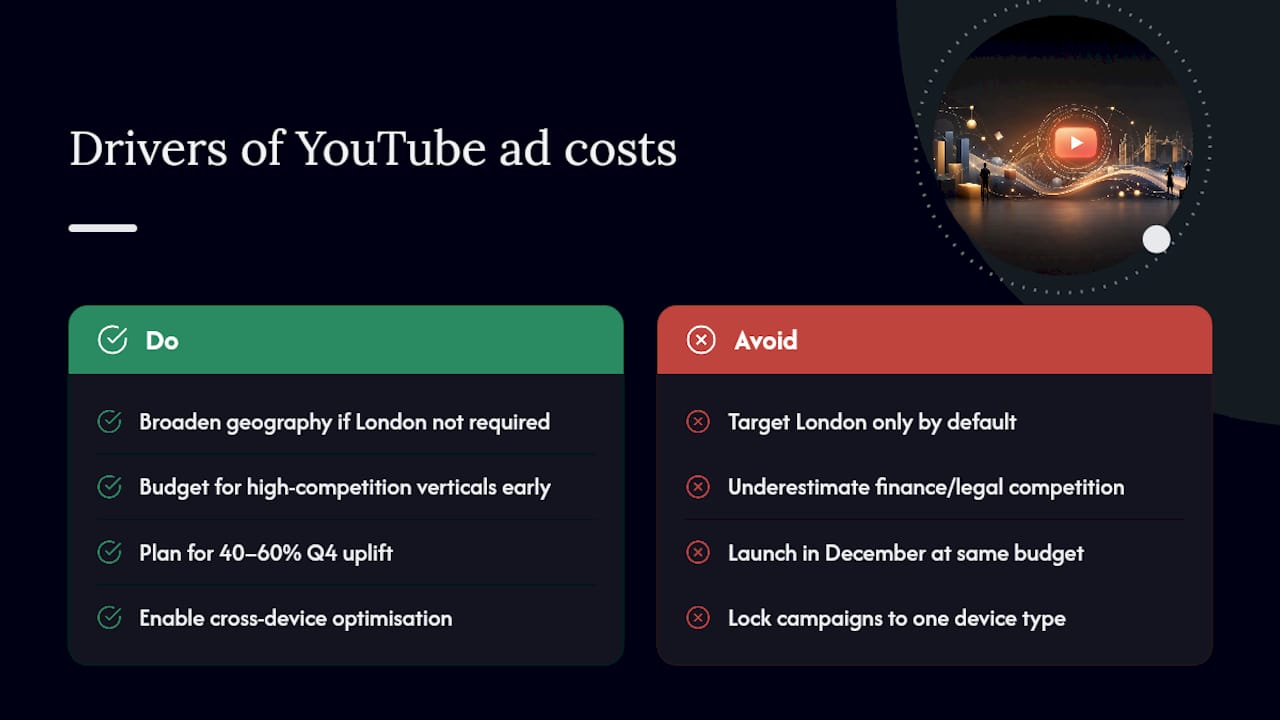
Targeting breadth and geography move cost more than most advertisers assume. Bidding narrowly for London audiences typically costs more than a national UK campaign because competition for that specific pool is fiercer. Regional targeting outside major cities often brings CPV down noticeably, an insight worth acting on if your product doesn’t need to be London-specific.
Industry vertical sets your competitive floor. Finance, insurance and legal services bid aggressively because a single converted customer is worth far more than the ad spend, pushing CPMs towards the top of the £3 to £12 range. Music, entertainment and lifestyle content sits lower because the commercial value per view is smaller.
Seasonality hits hard in the final quarter. Retail-heavy demand around Christmas can push CPMs up by 40 to 60% for premium placements, so a campaign planned for October at a certain budget may need significantly more in December to hit the same view count.

Creative quality and relevance affect your auction position directly. Google rewards ads with strong predicted engagement by charging less for the same placement, so a genuinely compelling thirty-second hook can lower your effective CPV without touching your bid.
Placement and device mix matter too. Mobile inventory, connected TV and desktop each carry different pricing, and campaigns that let Google optimise across all of them usually find cheaper inventory than those locked to a single device type.

Pro Tip: Before scaling any campaign, check whether your industry sits above or below the £3–£12 CPM midpoint. If you’re in a high-competition vertical, budget for the top of the range from day one rather than being caught out mid-campaign.
How should you set your YouTube ad budget and bids?
Setting a sensible starting budget is less about guesswork and more about matching your spend to your business size and confirming your tracking works before you scale.
- Choose a daily budget that matches your scale. Local businesses testing the waters typically start around £8 to £20 a day, enough to gather meaningful view data without overcommitting. National product launches usually need £50 to £150 a day to compete at auction against bigger spenders.
- Set a maximum CPV or target CPA rather than leaving bids uncapped. Manual CPV bidding gives you direct cost control early on; automated target CPA bidding works better once you have enough conversion data (usually a few hundred conversions) for Google’s algorithm to optimise against.
- Use a sample template as your starting point. A local small business might run £5 to £20 a day on skippable in-stream. A national product launch might sit at £50 to £150 a day across in-stream and Shorts. An artist promoting a new single might start at £10 to £30 a day to test creative and audience fit before committing to a full release-week push.
- Install conversion tracking before you spend anything meaningful. Without it, automated bidding has nothing to optimise towards, and you’ll end up paying auction prices with no way to judge whether the spend is actually working.
How can you lower your effective YouTube ad cost?
Cost efficiency comes down to what you show people and who you show it to, more than which button you press in the bidding settings.
- Front-load your hook. The first five seconds decide whether Google counts the view and whether the viewer sticks around, so lead with the strongest visual or line, not a slow build.
- Test multiple ad lengths. A 15-second cut and a 30-second cut of the same creative concept often perform very differently against the same audience.
- Use exclusion lists aggressively. Cutting out audiences who’ve already converted or clearly won’t convert stops you paying for views you don’t need.
- Layer in retargeting sequences. A teaser, then a full video, then a stronger call to action to people who’ve already watched, tends to cost less per conversion than cold targeting alone.
- Shift reach-building to Shorts and reserve pricier skippable in-stream inventory for the audience segments closest to converting.
- Cap frequency. Showing the same viewer your ad more than four or five times a week rarely improves results and just inflates spend.
Pro Tip: Track view-through conversions, not just clicks. Most people who see a YouTube ad and later convert never click it directly, so click-only measurement will make your campaign look far less effective than it actually is.
How Musicvideomarketplace helps you plan a YouTube campaign
Getting the media budget right only solves half the problem. You also need a video built for the format you’re paying for, and that’s where most music marketers lose time. Musicvideomarketplace lets you upload your track and branding straight into a ready-made, human-edited video template, export it in YouTube-ready formats, and generate the shorter cuts that Shorts inventory rewards.
For the campaign side, a few resources are worth reading before you launch:
- How to launch music ads on YouTube: a step-by-step guide covers the setup process end to end.
- YouTube ad campaign examples for musicians shows real budgeting and optimisation patterns.
- Music video promotion strategies covers pairing paid reach with organic growth.
If you’re weighing up creative partners more broadly, PTT Music is a useful industry resource for context on the wider music marketing landscape.
Why UK benchmarks only get you halfway there
Published CPV and CPM ranges are useful for setting expectations, but they flatten a genuinely uneven market into a single band. A finance brand and an indie musician quoting the same £0.10 CPV are competing in completely different auctions, and treating the benchmark as a fixed cost rather than a starting hypothesis is the most common budgeting mistake we see.
The advice that gets underweighted is creative quality’s effect on price. Advertisers obsess over bid strategy and targeting settings while treating the video itself as fixed. That’s backwards. A hook that holds attention past the first five seconds changes your relevance score, which changes your auction price, often more than any bidding tweak would. For music marketers especially, this is where the biggest wins sit: a video built for the platform, not a repurposed promo clip, tends to earn cheaper views before you’ve touched a single setting.
Prioritise the creative first. Set your budget with the benchmarks in this article as a guide, not a guarantee, and expect to adjust within your first fortnight of data.
— Music
Sources
- Paid Social Advertising Costs UK 2026 | Media Performance
- YouTube Ads Pricing Explained: Understand the Costs Clearly
- YouTube Advertising Cost UK 2025 | YouTube Ads Pricing Guide
- Starter Guide to YouTube Advertising Costs in 2026
Recommended
- Promotion payante sur YouTube : 9 avantages concrets en 2026 | Music Video Marketplace Blog
- Benefits of video ads for tour announcements in 2026 | Music Video Marketplace Blog
- DJ YouTube monetisation: boost your income in 2026 | Music Video Marketplace Blog
- Tips for effective song ads: your 2026 guide | Music Video Marketplace Blog
Read next
 Why music ads matter: boost streams, fans, and growthDiscover how music ads boost streams, grow your fanbase, and drive long-term results for independent artists. Learn costs, strategies, and when ads really work.
 Why use video ads to grow your music audienceDiscover why video ads are the most cost-effective way for musicians to build genuine fanbases on YouTube through strategic targeting and emotional engagement.
 YouTube ad campaigns for indie musicians: a clear guideLearn how YouTube ad campaigns work for independent musicians. Discover campaign types, targeting tips, and how to promote your music on a realistic budget.
 Top 4 vizzy.io Alternatives for Music Video Ads 2026Explore 4 vizzy.io alternatives to help decide on music video ad creation platforms for your creative needs and marketing efforts.
Turn the idea into a finished music video.
Drop your track into the Workspace and build your visual in minutes.