
Copyright essentials for DJ videos: stay safe and grow
Learn how YouTube copyright works for DJ videos, debunk common myths, and get practical steps to protect your channel and grow your audience in 2026.
Copyright essentials for DJ videos: stay safe and grow
TL;DR:
- YouTube’s Content ID system automatically scans all uploaded DJ videos for copyrighted tracks.
- Crediting artists does not grant usage rights, and even short clips can be claimed or blocked.
- Using original, licensed, or royalty-free music is the safest way to maintain monetization and channel safety.
Most DJs assume that typing “all rights belong to the original artists” in a video description is enough to keep their YouTube channel safe. It is not. The moment you upload a mix, YouTube’s automated systems are already scanning every track you have played, and the consequences can range from losing ad revenue to losing your entire channel. Whether you are posting a live set recording, a promotional mix, or a short clip to attract bookings, copyright rules apply equally to all of it. This guide breaks down exactly how YouTube’s enforcement works, clears up the most damaging myths, and gives you a practical plan for promoting your music without putting your channel at risk.
Table of Contents
- How YouTube detects and handles copyright in DJ videos
- Common copyright myths and pitfalls for DJs
- Fair use, licensing, and when DJs need permission
- Practical strategies: Minimise risk and maximise your reach
- Our perspective: Why copyright isn’t killing DJ creativity
- Level up your DJ videos with professional resources
- Frequently asked questions
Key Takeaways
| Point | Details |
|---|---|
| YouTube scans all DJ videos | Content ID automatically detects copyrighted tracks, leading to monetisation claims or blocks. |
| Myths don’t protect | Crediting artists or using short clips does not safeguard your video from copyright actions. |
| Licensing is essential | You must secure rights from both labels and publishers for each track used in your DJ video. |
| Test before you publish | Always upload DJ videos as unlisted first to spot issues and make edits before going public. |
| Success means adapting | Smart DJs navigate copyright rules and focus on building their fanbase with legal, creative content. |
How YouTube detects and handles copyright in DJ videos
YouTube’s enforcement is not manual. The platform uses an automated system called Content ID to scan every uploaded video against a database of copyrighted recordings. For DJs, this means a 60-minute mix containing 20 tracks could trigger 20 separate claims within minutes of uploading. The system is fast, broad, and largely indifferent to your intentions.
Understanding the difference between a claim and a strike is essential. They are not the same thing, and confusing them leads many DJs to underestimate real risks.
| Outcome | What happens | Impact on your channel |
|---|---|---|
| Copyright claim | Video stays up; rights holder takes ad revenue | Low immediate risk, but revenue loss |
| Worldwide block | Video is hidden globally | No views, no promotion |
| Regional block | Video hidden in specific countries | Reduced reach |
| Copyright strike | Formal violation recorded | Three strikes = channel termination |
For most DJ uploads, content claims are the most common outcome. Your video stays visible, but the rights holder collects any advertising revenue generated. That might sound manageable, but it means every view you earn is working for someone else’s pocket, not yours. Worldwide or regional blocks are more damaging for promotion because your audience simply cannot see the content.
Strikes are the serious end of the scale. YouTube’s copyright strike policy means that three active strikes result in permanent channel termination. You lose every video, every subscriber, and every piece of content you have built. Most DJs never reach three strikes, but a single strike still restricts your ability to livestream and upload longer videos.
What should you actually expect after uploading a mix? Here is a realistic picture:
- Multiple simultaneous claims from different rights holders
- Possible regional or worldwide blocks on popular tracks
- Ad revenue redirected away from your channel
- Occasional manual reviews if a rights holder disputes your use
Understanding YouTube monetisation for DJs is closely tied to understanding copyright in music videos, because the two systems interact constantly. A claimed video cannot earn you money even if your channel is otherwise monetised.
“Content ID is not a judgement on your creativity. It is an automated rights management tool, and knowing how it works is the first step to working around it.”
Common copyright myths and pitfalls for DJs
Now that you know how enforcement works, it is vital to identify where DJs often get tripped up. Misinformation spreads quickly in DJ communities, and acting on bad advice can cost you your channel.
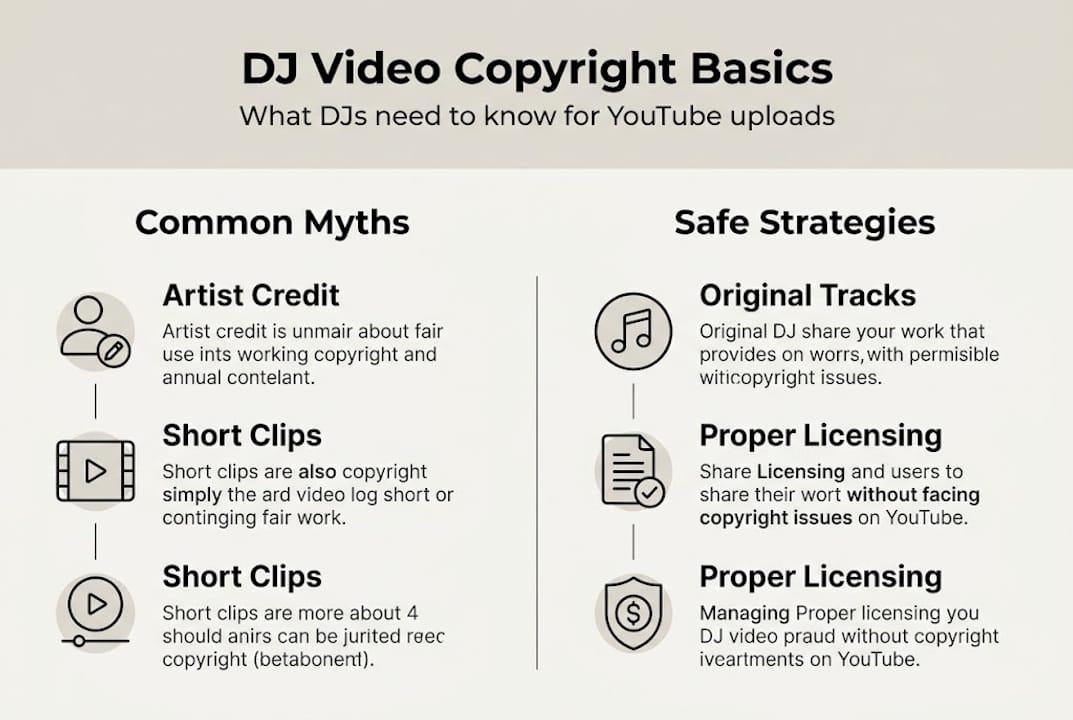
Myth 1: Crediting the artist protects you
This is the most persistent myth in DJ culture. Writing “Track: [Artist Name] [Label]” in your description feels like the right thing to do, but giving credit does not grant you usage rights. Copyright is a legal right, not a social courtesy. The artist or label still owns the recording, and crediting them changes nothing about that ownership.
Myth 2: Short clips or non-monetised videos are safe
Many DJs believe that using only 30 seconds of a track, or simply not enabling ads on their video, creates a legal safe harbour. Neither is true. Short clips are still subject to copyright rules, and Content ID will flag them regardless. Non-monetised videos can still be claimed or blocked by rights holders who object to the use.
Myth 3: Fair use covers promotional DJ content
Fair use is a legal doctrine that applies in very specific circumstances. Promotional DJ mixes almost never qualify. The fact that you are using music to promote your own DJ services is actually a commercial use, which works against a fair use argument rather than in favour of it.
Here is a quick summary of what does not protect you:
- Crediting the original artist in the description
- Adding “no copyright infringement intended” disclaimers
- Not enabling monetisation on your channel
- Using only short portions of tracks
- Claiming the content is for educational or promotional purposes
Pro Tip: Before making any DJ mix video public, upload it as an unlisted video first. Leave it for 24 to 48 hours and check the video’s copyright notices in YouTube Studio. This tells you exactly which tracks have been flagged, giving you the chance to edit before your audience sees it.
Understanding video monetisation myths is just as important as understanding the legal framework, because acting on false assumptions is what gets most DJ channels into trouble.
“The biggest risk is not the copyright system itself. It is the false confidence that comes from believing the myths.”
Fair use, licensing, and when DJs need permission
Understanding what does not work, let us get clear on what actually counts as legal and safe for DJs.
Fair use is a narrow legal exception in copyright law. Courts evaluate it using four factors: the purpose of the use, the nature of the original work, how much was used, and the effect on the market for the original. Fair use rarely applies to DJ mixes because most mixes use substantial portions of commercially released recordings for promotional or entertainment purposes, both of which work against a fair use claim. The famous Grey Album case illustrated just how complex and contested these arguments can become, even for highly creative works.
For a DJ mix to be legally uploaded, you typically need licences for two separate rights:
- The sound recording (owned by the record label or distributor)
- The musical composition (owned by the songwriter or publisher)
These are separate rights, and you need both. There is no blanket licence available for YouTube DJ mixes. Performing Rights Organisations cover live venues, not online video uploads.
| Approach | Legal protection | Practical reality |
|---|---|---|
| Royalty-free music | Full protection | Limited track selection |
| Original productions | Full protection | Requires production skills |
| Licensed tracks | Protection if cleared | Complex and costly to arrange |
| Commercial releases | No protection | High claim/block risk |
| White-label promos | Partial protection | Varies by agreement |
Here is a numbered approach to securing legal coverage for your DJ content:
- Use tracks you have produced yourself
- Source royalty-free or Creative Commons licensed music
- Contact labels directly for promotional licences (rare but possible for established DJs)
- Use platforms that offer pre-cleared music for video content
- Consult a music lawyer before uploading commercially sensitive content
Pro Tip: Build a dedicated playlist of tracks you own, have produced, or have confirmed are royalty-free. This becomes your go-to library for video content, saving you time and stress on every upload.
Understanding music licensing for video is not optional if you want to build a sustainable YouTube presence as a DJ.
Practical strategies: Minimise risk and maximise your reach
Having covered the legal essentials, here is how to put the rules into practice for your own DJ videos.
The single most effective habit you can build is testing before publishing. Upload your mix as a private or unlisted video first, wait for Content ID to process it, then review the copyright notices in YouTube Studio. Any flagged tracks will appear clearly, and you can decide whether to edit them out or accept the consequences before your audience ever sees the video.
Here is a step-by-step process for every DJ video upload:
- Prepare your mix and export the video file
- Upload as a private video in YouTube Studio
- Wait 24 to 48 hours for Content ID to complete its scan
- Review all copyright claims and blocks in the video details
- Edit out or replace any tracks that have been blocked worldwide
- Re-upload the edited version, or make the original public if claims are acceptable
- Monitor the video in the first week for any delayed claims
For music selection, royalty-free and original tracks are the only reliable way to ensure full monetisation rights on your videos. Performing Rights Organisations like PRS for Music cover live venues, but their licences do not extend to online video uploads, which is a common misunderstanding.
Pro Tip: When growing your audience on YouTube, consider mixing commercially released tracks with original edits or royalty-free sections. This approach lets you demonstrate your taste and technical skill while reducing the number of claims per video.
Effective video marketing strategies for DJs always account for copyright from the start, not as an afterthought. Combining strong digital promotion tips with smart music choices is what separates DJs who grow consistently from those who keep rebuilding deleted channels. Managing your content carefully, including organising your video files efficiently, also makes the editing and re-upload process far less painful.
Our perspective: Why copyright isn’t killing DJ creativity
Here is a view you will not often hear: copyright enforcement on YouTube is not the enemy of DJ culture. It is actually pushing DJs to become more creative, more strategic, and more business-savvy.
The DJs who grow the fastest on YouTube in 2026 are not the ones who avoid copyright issues by luck. They are the ones who understand the system well enough to work within it. A video with multiple claims but no blocks still reaches your audience. That reach translates into bookings, brand partnerships, and a loyal fanbase, none of which depend on ad revenue from YouTube.
The real opportunity is indirect revenue. A DJ who builds 50,000 genuine subscribers through consistent, well-promoted video content can command significantly higher booking fees, regardless of whether a single video ever earned a penny in ads. Understanding YouTube music distribution benefits reframes the platform as a promotional engine rather than a revenue stream.
Copyright rules also push DJs to develop their own sound. The DJs who invest in original productions, edits, and remixes are building a catalogue they actually own. That is a long-term asset that no Content ID system can touch.
Level up your DJ videos with professional resources
Copyright compliance and strong promotion are not opposites. With the right tools, you can protect your channel and build genuine momentum at the same time.

At Music Video Marketplace, we help musicians and DJs create professional long-form videos in minutes, ready to upload to YouTube and launch as ad campaigns. No scrambling for cleared footage, no guesswork on licensing. Our platform is built specifically for artists who want to promote their music without the copyright headaches. If you are ready to take your DJ video content seriously, explore how creating DJ promo videos through our platform can help you grow your bookings and fanbase faster.
Frequently asked questions
Can I upload a DJ video to YouTube if I don’t monetise it?
You can upload, but copyright owners may still claim or block your video regardless of whether you have monetisation enabled.
How can I check if my DJ mix will be flagged for copyright?
Upload your video as unlisted or private first; Content ID will scan it immediately and flag any copyright risks before you make it public.
Is using only short music clips in a DJ video safe?
No, short clips are still subject to copyright rules and can trigger claims or worldwide blocks just like full tracks.
What is the difference between a copyright claim and a strike?
A claim typically means the video stays visible but ad revenue goes to the rights holder, while a strike is a formal violation that can lead to channel termination after three occurrences.
Recommended
- Why YouTube matters for DJs: grow your audience and career | Music Video Marketplace Blog
- Create DJ promo videos that drive engagement and bookings | Music Video Marketplace Blog
- DJ YouTube monetisation: boost your income in 2026 | Music Video Marketplace Blog
- Creative video content ideas for producers: boost music promotion | Music Video Marketplace Blog
- Why the European Hard Dance Circuit Demands a Different Kind of Content
- Video file management tips for creators in 2026
Read next
 Creative video campaign examples for independent musiciansDiscover innovative video campaign examples for independent musicians. Learn proven YouTube strategies that boost engagement, streams, and audience growth with practical, budget-friendly tactics.
 Creative video content ideas for producers: boost music promotionDiscover the best creative video content ideas for music producers to boost YouTube promotion, increase retention, and grow your audience in 2026.
 Digital marketing for producers: grow your audience fastDiscover proven digital marketing strategies for independent music producers to grow their YouTube audience, boost streams, and increase revenue in 2026.
 Common errors in artist YouTube strategy: fix them fastDiscover how to fix common errors in artist YouTube strategy. Improve your discoverability with quick fixes that enhance metadata and engagement!
Turn the idea into a finished music video.
Drop your track into the Studio and build your visual in minutes.