
How to launch song campaigns that actually get heard
Discover how to launch song campaigns that truly connect with your audience. Learn strategic steps for impactful music releases!

How to launch song campaigns that actually get heard
TL;DR:
- Independent artists need structured campaigns with advance planning to make their music visible and achieve success. Effective promotion involves setting clear goals, batching content, optimizing YouTube presence, and running targeted paid ads over an eight-week timeline. Consistent engagement and systematized strategies ultimately build sustainable momentum beyond single releases.
Most independent artists spend months creating a song, then release it with a single social post and wonder why nothing happens. The silence is not because the music is bad. It is because a great song without a structured campaign is invisible. Knowing how to launch song campaigns properly means planning weeks in advance, building content in bulk, optimising your video presence on YouTube, and running paid ads that amplify what already works organically. This guide covers every stage, from goal setting to post-release engagement, so your next release lands the way it deserves to.
Table of Contents
- Understanding the foundation: campaign goals, timelines, and content assets
- Step-by-step preparation: pre-save campaigns, playlist pitching, and batch content creation
- Executing your song launch: optimising YouTube video content and strategic paid campaigns
- Maintaining momentum: launch week content cadence and post-release engagement
- Reconsidering song launches: why strategic campaigns beat one-off releases
- Tools and services to support your song campaign launch
- Frequently asked questions
Key Takeaways
| Point | Details |
|---|---|
| Plan early | Begin your song campaign planning at least six weeks before release to build momentum effectively. |
| Batch content | Create a diverse library of 15-20 video assets in dedicated sessions to maintain consistent audience engagement. |
| Use pre-saves | Launch pre-save campaigns 2-4 weeks before release to trigger early algorithm support and fan anticipation. |
| Test ads first | Run small organic tests of your creative before investing in paid campaigns to optimise budget effectiveness. |
| Maintain engagement | Interact actively with fans during launch week and post-release to sustain momentum and algorithmic favour. |
Understanding the foundation: campaign goals, timelines, and content assets
Before you record a single teaser clip or write a single caption, you need to answer three questions: what do you want this campaign to achieve, how long do you have, and what content can you actually produce?
Setting clear objectives shapes every decision that follows. Are you chasing pre-saves, first-week streams, YouTube subscribers, playlist placements, or email sign-ups? Pick one or two primary goals and make every piece of content serve them. Trying to achieve everything at once usually means achieving nothing clearly.
The 8-week rule is not a suggestion. An 8-week timeline is the industry standard for a single release, giving you enough time for preparation, pitching, and warming your audience before the track goes live. Artists who compress this into two weeks almost always skip crucial steps, like Spotify editorial pitching, which requires submission at least seven days before release but rewards those who give it more time.
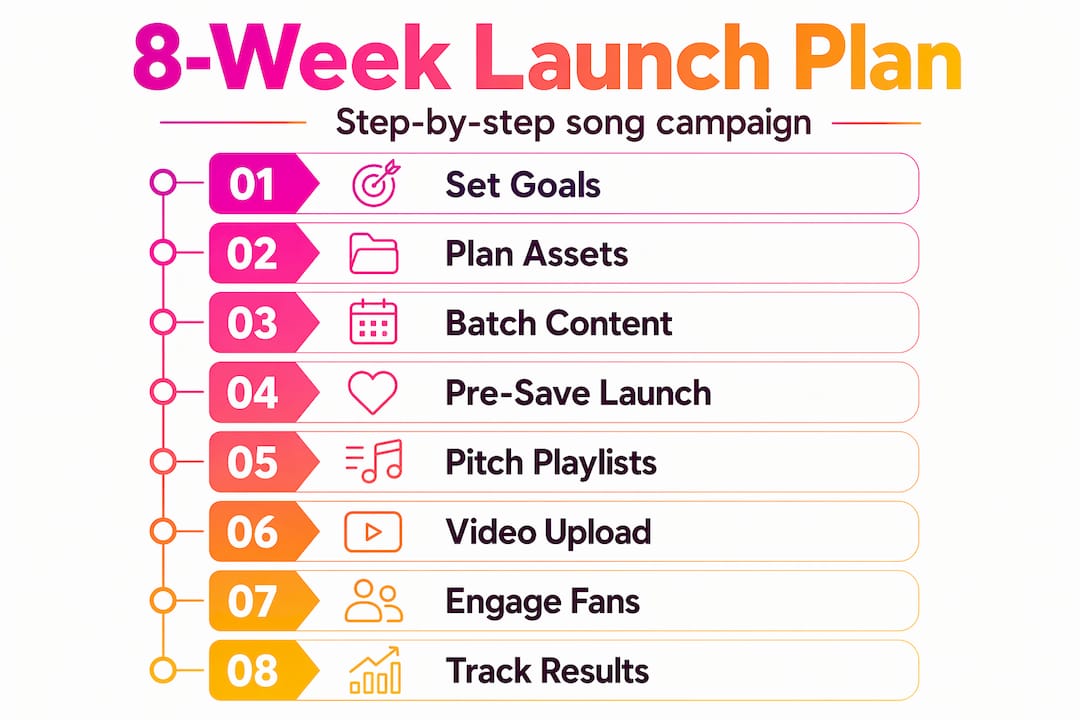
Content batching is one of the most underused tactics in independent music. Rather than scrambling to post something every day during launch week, you film everything in one or two focused sessions weeks in advance. Aim for 15 to 20 video assets per release, mixing original footage, repurposed clips, platform-adapted versions, and short teasers to maximise testing opportunities across channels.
Here is how a typical 8-week campaign timeline looks:
| Week | Focus area | Key actions |
|---|---|---|
| 8 to 7 | Strategy and assets | Set goals, batch content creation, register copyright |
| 6 to 5 | Pitching | Submit Spotify editorial pitch, reach out to curators |
| 4 to 3 | Pre-release build | Launch pre-save campaign, release teasers |
| 2 to 1 | Final push | Ramp up posting frequency, prep paid ads |
| Release week | Launch and engage | Release, post all day, respond to every comment |
| Post-release | Sustain | Acoustic versions, UGC, press outreach |
Key content assets to prepare before your campaign goes live:
- Flagship music video (for YouTube)
- 3 to 5 YouTube Shorts cut from the main video or studio footage
- Behind-the-scenes clips from recording or filming
- Lyrics or visualiser video for passive listeners
- Spoken or text-based content explaining the song’s story
- Static images, quote cards, and artwork for cross-platform use
Pro Tip: Register your song with your PRO (Performing Rights Organisation) before you release anything publicly. It takes minutes and protects every stream and sync placement from day one.
For a deeper look at the proven song promotion strategies that work across platforms, that resource is worth bookmarking before you proceed.
Step-by-step preparation: pre-save campaigns, playlist pitching, and batch content creation
With your foundation set, it is time to execute the pre-release phase, the period that determines how much momentum you carry into launch day.
-
Set up your pre-save link. Use a smart link service to create a pre-save landing page. Run pre-save campaigns 2 to 4 weeks before release and submit your editorial pitch via Spotify for Artists as early as possible. The pre-save link becomes your primary call-to-action across all channels during this phase.
-
Submit your Spotify editorial pitch. Log into Spotify for Artists, navigate to your upcoming release, and fill in every field: mood, tempo, genre, the story behind the song, and the instrumentation. Editors read these, and a specific, honest pitch outperforms a vague one every time. Write it as if you are telling a friend why this song matters.
-
Batch create your video content. Professional artists create 15 to 25 short-form video clips in one or two dedicated sessions well in advance. Block out a full day, film with your phone or camera, and vary the angles, locations, and formats. You are building your entire launch week supply in a single sitting.
-
Build your independent curator list. Spend time researching playlist curators who genuinely cover your genre. Personalise each message. Mention a specific playlist they manage and explain why your song fits. Generic outreach gets ignored. A personal note that shows you have actually listened to their playlist gets responses.
-
Begin teaser posting. Start sharing short clips 3 to 4 weeks out. Do not give everything away. A 10-second hook, a glimpse of the music video, a caption that says “out Friday” creates genuine anticipation rather than noise.
Pro Tip: Keep a shared folder or spreadsheet listing every asset you have created, where it is scheduled, and which platform it targets. Losing track of what you have posted is how campaigns fall apart mid-launch.
For practical guidance on creating video content for YouTube launch, and building your song promotion strategy basics, those two resources together cover the technical and strategic angles thoroughly.
Executing your song launch: optimising YouTube video content and strategic paid campaigns
Your YouTube presence deserves more attention than most independent artists give it. YouTube is the world’s second-largest search engine, and a well-optimised video continues driving streams months after release day.
Video titles matter for search. Use the format Artist Name – Song Title (Official Music Video) without deviation. This is not a creative choice; it is an SEO decision. Music video SEO best practices increase discovery by 40 to 60 percent, and the title format is one of the highest-impact variables.
Descriptions drive visibility. Include your streaming links within the first two lines of your description so they appear before the fold. Add full lyrics, credits, and social links below. YouTube’s algorithm reads descriptions, and viewers searching for lyrics often discover songs this way.
Build a diversified content portfolio:
- Flagship music video (3 minutes or longer for watch time)
- YouTube Shorts (under 60 seconds) cut from key moments
- Live session or acoustic version
- Studio process or behind-the-scenes documentary
- Lyric video for passive, background listening
YouTube Shorts act as a discovery engine that feeds audiences into your long-form content and streaming platforms. Think of Shorts as the trailer and the music video as the film.
For paid campaigns, the single biggest mistake is spending money on untested creative. Start paid campaigns only with proven creative, using small daily budgets of $5 to $10 for initial tests, then scaling the ads that actually perform. Begin with the video clips that got the strongest organic engagement and put budget behind those specifically.
Target audiences by interest in similar artists, specific genres, or geographic areas relevant to your sound. Broad “music lovers” targeting burns budget with almost nothing to show for it.
| Approach | Budget | Best for |
|---|---|---|
| Organic only | £0 | Building early data and engagement signals |
| Small test ads ($5/day) | £30 to £70 | Identifying which creative resonates |
| Scaled paid campaigns | £100 to £300+ | Amplifying proven winners |
For detailed guidance on launching YouTube music ads, YouTube music video best practices, and music ad best practices more broadly, those guides go much deeper on audience segmentation and bid strategy.
Pro Tip: Before you allocate any paid budget, post your top three teaser clips organically and wait 48 hours. The one with the highest save and share rate is almost always your strongest ad creative.
Maintaining momentum: launch week content cadence and post-release engagement
Launch day is not a finish line. It is the moment your campaign shifts from anticipation to execution.

Launch week should include morning release announcements, mid-day social proof, and evening reminders, plus responding to every comment. This is not vanity. Platforms reward accounts with high engagement rates, and every comment you reply to signals activity to the algorithm.
A practical launch day content schedule looks like this:
- 6am to 8am: Post your release announcement across all platforms. Include the streaming link prominently. Pin it.
- 11am to 12pm: Share an early reaction or a fan comment if you have pre-release listeners. Screenshot milestones.
- 2pm to 3pm: Post a behind-the-scenes clip or a short story about the song’s meaning.
- 6pm to 7pm: Evening reminder post, targeting people who have not yet listened.
- 9pm to 10pm: Engage with comments, share fan posts, and repost stories.
During the week following release, keep posting daily. Do not go quiet once the first day passes. Content formats to rotate through:
- Acoustic or stripped-back version of the song
- Reaction to reaching a streaming milestone
- Fan-generated content (UGC) reposted with credit
- Collaboration clips with other artists or producers
- Press coverage or playlist placements celebrated publicly
Post-release strategies using acoustic versions, fan UGC, collaborations, and press sharing extend a song’s lifespan considerably beyond the initial week. Songs often see their biggest streams two to three weeks after release when playlist placements confirm and algorithmic recommendations kick in.
Pro Tip: Reply to comments with genuine, specific responses rather than emoji-only replies. An artist who says “Thanks, I wrote this line after…” creates connection. That connection becomes loyalty.
For further ideas on song post-release strategies that keep your track performing beyond launch week, that resource is particularly useful.
Reconsidering song launches: why strategic campaigns beat one-off releases
Here is the perspective most music marketing content avoids saying plainly: the way most independent artists release music is structurally set up to fail, and it has nothing to do with talent.
The typical approach is to release a song, post about it twice, watch the numbers, feel disappointed, and repeat the cycle in three months hoping for different results. That is not a campaign. That is wishful thinking dressed up as a release strategy.
Treat your release as a project, not a single-day event to generate the sustained platform algorithm signals that actually move your career forward. Platforms like Spotify and YouTube reward consistent engagement over time, not spikes from a single post. An artist who posts one thing on release day and disappears trains the algorithm to ignore them.
The other misunderstood point is that paid advertising almost never rescues poor organic performance. It amplifies existing momentum. If your organic posts are getting 50 views each, paid ads on that same content will get you 150 views, not 50,000. The artists who see strong returns from paid campaigns are the ones who already tested their creative for free and only pushed money behind what already worked.
What actually compounds over time is a repeatable system. A content library built in advance, a consistent posting schedule, a pre-save campaign that conditions your audience to expect and anticipate your releases, and a post-release window where you stay visible for two to three weeks rather than going quiet. Each release builds on the previous one. That is how strategic song promotion insights translate into an actual audience rather than just numbers on a screen.
The artists gaining traction in 2026 are not necessarily the most talented. They are the ones running the most disciplined campaign cycles.
Tools and services to support your song campaign launch
Knowing the strategy is one thing. Having the right tools to execute it efficiently is what separates artists who stay consistent from those who burn out after two releases.

Music Video Marketplace helps independent artists create professional long-form videos in minutes and launch YouTube ad campaigns directly, removing the technical barrier that stops many musicians from using video properly. If you have been putting off creating a music video because of cost or complexity, that excuse no longer holds. Pair that with a smart link service for pre-saves and a solid content batch created weeks before release, and you have the infrastructure for a repeatable, scalable launch process. For the full picture on video creation guide and campaign execution, the Music Video Marketplace blog is the most practical resource available to independent artists right now.
Frequently asked questions
What is a pre-save campaign and why is it important?
A pre-save campaign encourages fans to save your upcoming song on streaming platforms before release, ensuring it appears in their libraries immediately at launch, which boosts algorithmic visibility. Pre-save campaigns starting 2 to 4 weeks before release improve fan library placement and algorithmic support from the first moment the track goes live.
How much should independent artists budget for a paid music campaign?
Beginners should start with £50 to £100 total per campaign, focusing on learning what creative performs before committing larger sums. Budget recommendations vary by career stage, with smaller budgets strongly advised for new artists who are still learning how campaign dynamics work.
Why use YouTube Shorts in a song campaign?
YouTube Shorts act as short teasers that drive discovery by pulling viewers towards your longer videos and streaming platforms, making them an effective entry funnel in your campaign. YouTube Shorts are primary discovery engines that feed audiences into your long-form content and streams.
When should I start building my content library for a song release?
Content batching should begin 6 to 8 weeks before release to build enough video assets for consistent, daily posting throughout the campaign. Independent artists should batch create 15 to 25 video clips weeks before release for a consistent content deployment that keeps momentum going well past launch day.
Recommended
- Music ad campaigns: expert strategies for real results | Music Video Marketplace Blog
- How to launch music ads on YouTube: A step-by-step guide | Music Video Marketplace Blog
- Best practices for music ads: promote your tracks effectively | Music Video Marketplace Blog
- Creative video campaign examples for independent musicians | Music Video Marketplace Blog
Read next
 How to monetise music videos in 2026Unlock your earning potential! Discover how to monetize music videos in 2026 with proven strategies and tips for independent artists.
 How to repurpose music videos for maximum reachDiscover how to repurpose music videos for maximum reach! Unlock new audiences and boost your views with these effective strategies.
 How to sequence song video launches in 2026Discover how to sequence song video launches effectively in 2026. Learn to engage audiences and maximize your music video's impact!
 How to convert songs to video: 2026 guideLearn how to convert songs to video in this 2026 guide. Discover the best tools and techniques for creating stunning videos for social media!
Turn the idea into a finished music video.
Drop your track into the Studio and build your visual in minutes.