
How to monetise music videos in 2026
Unlock your earning potential! Discover how to monetize music videos in 2026 with proven strategies and tips for independent artists.

How to monetise music videos in 2026

TL;DR:
- Music video monetisation involves earning income from ad revenue, licensing claims, fan support, and brand partnerships. Artists diversify income by stacking multiple revenue streams such as YouTube ads, Content ID, sponsorships, and memberships, which build stable revenue. Proper preparation, metadata optimization, registry registration, and content strategy are essential for sustaining monetisation and maximizing earnings.
Music video monetisation is the practice of earning income from videos featuring your recorded music, whether through ad revenue, licensing claims, fan support, or brand partnerships. The opportunity is real and growing: platforms like YouTube, combined with distribution tools such as DistroKid and CD Baby, give independent artists more ways to earn from their creative work than at any previous point. This guide covers every major revenue stream, the exact steps to get started, and the common mistakes that cost musicians money before they even realise what went wrong.
How to monetise music videos: the main revenue streams
Music video revenue does not come from a single source. The most successful artists stack multiple income streams across ad revenue, Content ID claims, fan engagement features, and direct brand partnerships. Understanding each stream separately is the first step to building a sustainable income.

YouTube Partner Programme ad revenue
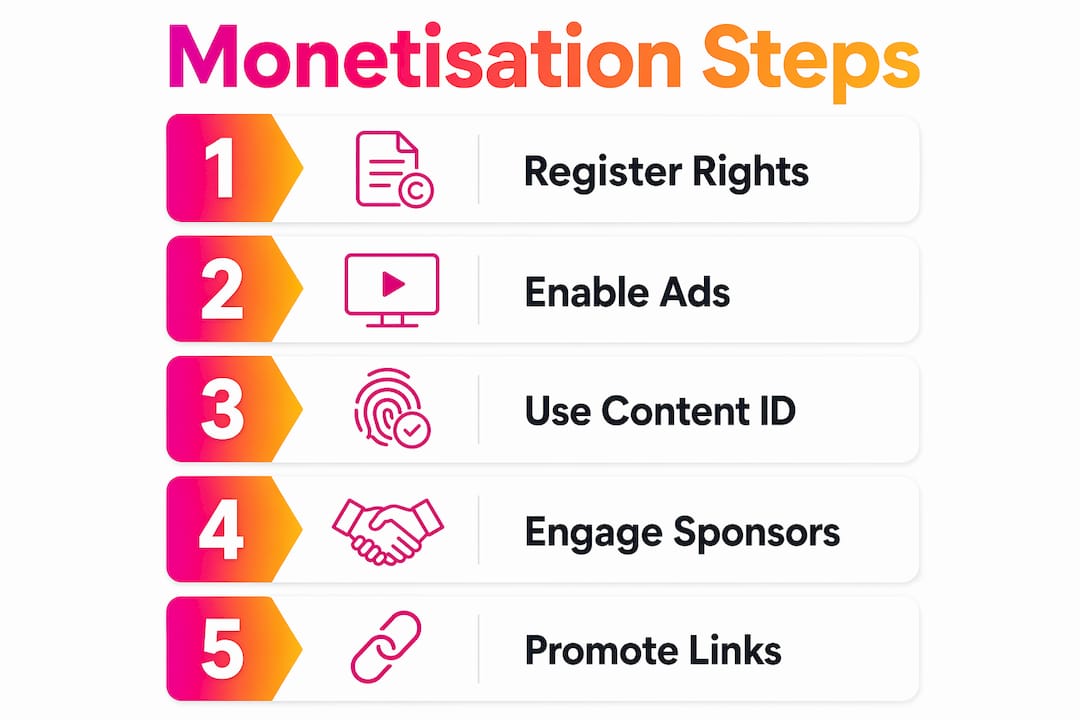
The YouTube Partner Programme (YPP) is the most widely recognised monetisation route for music video creators. To qualify, your channel needs 1,000 subscribers and 4,000 watch hours within 12 months, or 10 million Shorts views within 90 days. Once approved, YouTube places ads on your videos and pays you a share of the revenue generated. Artists with 10,000 subscribers can realistically earn £400 to £1,600 monthly from combined monetisation methods, which shows the genuine income potential for mid-sized channels.
Content ID: monetise every upload of your music
Content ID is YouTube’s automated rights management system, and it works differently from YPP. When a fan uploads a video using your track, Content ID identifies it and either places ads on that video or blocks it, depending on your settings. The critical advantage is that Content ID revenue starts immediately upon registration and does not require any subscriber or watch time thresholds. You register your music through distributors such as DistroKid, TuneCore, or CD Baby, and those distributors submit your catalogue to YouTube’s Content ID database on your behalf.
Brand sponsorships and fan engagement income
Beyond platform ad revenue, brand sponsorships represent a significant income tier. Mid-sized channels can command £400 to £1,600 per sponsored video, while larger channels with established audiences attract £4,000 to £16,000 per placement. YouTube also offers channel memberships, Super Chat, and Super Thanks, which allow fans to pay directly during live streams or on individual videos. These features activate once you meet YPP eligibility and add a layer of income that is not dependent on ad market fluctuations.
The table below compares the main revenue streams at a glance:
| Revenue stream | Eligibility requirement | Typical earning range |
|---|---|---|
| YPP ad revenue | 1,000 subs, 4,000 watch hours | Varies by views and niche |
| Content ID claims | Distributor registration only | Passive, scales with fan uploads |
| Brand sponsorships | Audience size and engagement | £400 to £16,000+ per video |
| Channel memberships | YPP approval | Recurring monthly fan income |
| Super Chat / Super Thanks | YPP approval | Per-stream or per-video tips |
Pro Tip: Register your music with Content ID through a distributor before your channel reaches YPP eligibility. You will earn from fan-uploaded content from day one, regardless of your subscriber count.
How to prepare music videos for monetisation on YouTube
Getting your channel and content ready for monetisation requires more than hitting subscriber targets. The setup process directly affects how much you earn and how quickly claims are processed.
-
Create a professional YouTube channel. Use consistent branding across your channel art, profile image, and video thumbnails. Channels with clear visual identity attract subscribers faster, which accelerates your path to YPP eligibility.
-
Optimise your metadata. Every video title, description, and tag set should reflect the search terms your audience actually uses. Include your artist name, song title, genre, and mood descriptors. Strong metadata increases organic discovery and watch time.
-
Register your music with a Content ID distributor. Submit your catalogue through DistroKid, CD Baby, or TuneCore before uploading videos. This protects your music and activates passive revenue from third-party uploads immediately.
-
Run a pre-upload copyright check. Always use YouTube Studio’s copyright check tool before publishing. This identifies any Content ID claims or demonetisation triggers in your video before it goes live, giving you time to resolve issues without losing early view momentum.
-
Target videos over eight minutes. Videos longer than eight minutes unlock mid-roll ad placements, which significantly increase ad revenue per view. For music videos, this works well for behind-the-scenes content, extended cuts, or documentary-style releases.
-
Activate all available monetisation features. Once you reach YPP status, turn on ads, channel memberships, the merch shelf, and Super Chat. Each feature adds an independent income layer that compounds over time.
-
Post consistently and engage your community. Regular uploads combining long-form videos and Shorts, paired with active comment responses and community posts, increase watch time and subscriber growth simultaneously.
Pro Tip: Link your music video descriptions to your distributor’s streaming page, your merch store, and your live show listings. Every video is a sales page if you treat it like one.
How to maintain monetisation and avoid common pitfalls
Earning money from music videos is one challenge. Keeping that income stable is another. Demonetisation is the most common threat, and most artists encounter it without understanding why it happened or how to prevent it.
The most frequent causes of demonetisation include:
- Sensitive content without context. Videos touching on mental health, substance use, or violence are not automatically demonetised. However, they require editorial framing. Sensitive-content videos can remain monetised when accompanied by clear editorial intent statements, trigger warnings in the description, and non-graphic visuals.
- Unresolved copyright claims. If a sample or interpolation in your track is not cleared, a rights holder can claim your video and redirect its revenue. Clear all samples before release.
- Policy breaches in metadata. Misleading titles, keyword stuffing in descriptions, or inaccurate tags can trigger manual reviews and demonetisation.
- Community guideline violations. Comments sections that attract spam or harmful content can affect your channel’s standing. Moderate actively.
“Artists can maintain ad-friendly status for sensitive content by documenting editorial intent and providing viewer resources, challenging common demonetisation myths.” YouTube Monetization Checklist for Sensitive Music Films
If a video is demonetised, do not simply accept the decision. Prepare an appeal packet with intent statements, transcripts, and relevant resource links. This documentation significantly improves your chances of having monetisation restored. Diversifying across Content ID, sponsorships, and fan support also means that a single demonetised video does not collapse your entire income.
Pro Tip: Write your editorial intent statement before you upload any video that touches on sensitive themes. Having it ready saves time and strengthens your appeal if YouTube flags the content.
How do YouTube Shorts compare to long-form videos for monetisation?
Shorts are a powerful discovery tool, but they are not an equivalent replacement for long-form music videos when it comes to revenue. The difference in earning rates is substantial.
YouTube Shorts pays £0.01 to £0.05 per 1,000 views, compared to £1 to £4 per 1,000 views for long-form content. That gap means a Short with one million views earns roughly the same as a long-form video with 25,000 views. The implication is clear: Shorts build audiences, but long-form videos build income.
| Format | Revenue per 1,000 views | Primary purpose |
|---|---|---|
| YouTube Shorts | £0.01 to £0.05 | Audience discovery and growth |
| Long-form video (8+ min) | £1 to £4 | Ad revenue and fan engagement |
The correct strategy is to use Shorts as a funnel. Post a 30 to 60 second clip from your music video as a Short, include a clear call to action directing viewers to the full video, and let the algorithm surface your content to new audiences. Artists who combine Shorts with regular long-form uploads consistently outperform those who focus on one format exclusively.
Pro Tip: Add a pinned comment to every Short linking directly to the full music video. Viewers who discover you through Shorts are already engaged. Make it effortless for them to watch more.
Key takeaways
Successful music video monetisation requires combining YouTube Partner Programme ad revenue, Content ID claims, and direct fan income into a single, diversified strategy rather than relying on any one source.
| Point | Details |
|---|---|
| Content ID starts immediately | Register with DistroKid, CD Baby, or TuneCore before your channel reaches YPP eligibility. |
| Long-form video earns more | Videos over eight minutes unlock mid-roll ads and earn significantly more per view than Shorts. |
| Sensitive content can stay monetised | Document editorial intent and use trigger warnings to protect ad-friendly status. |
| Shorts are a discovery tool | Use Shorts to funnel new viewers to long-form videos, not as a primary revenue source. |
| Diversification protects income | Combining YPP, Content ID, sponsorships, and fan support prevents single-point revenue failure. |
Why revenue stacking is the only strategy worth building
Most musicians I speak with are chasing the wrong metric. They fixate on subscriber counts or view totals when the real question is: how many independent income layers does this video activate? A video with 50,000 views that triggers Content ID claims on 200 fan uploads, carries a mid-roll ad placement, and links to a merch store will outperform a video with 500,000 views that relies solely on pre-roll ads.
The artists I have seen build genuinely stable income from video content share one habit: they treat every upload as a system, not a moment. They register their music before the video goes live, they write metadata that serves both search and compliance, and they prepare for demonetisation before it happens rather than scrambling after the fact.
The uncomfortable truth about music video monetisation is that the platform mechanics are not complicated. What separates artists who earn consistently from those who do not is documentation, consistency, and the willingness to diversify beyond ad revenue from day one. Brand sponsorships feel out of reach until you have a clear pitch deck and a media kit. Fan memberships feel premature until you ask your audience directly. Neither requires a massive channel. Both require intention.
If you are just starting out, the single most valuable action you can take today is registering your catalogue with a Content ID distributor. It costs nothing extra with most major distributors, it activates immediately, and it earns money from every fan who loves your music enough to use it in their own content. That is not a side strategy. That is the foundation.
— Music
Start monetising your music videos with Musicvideomarketplace
Musicvideomarketplace gives musicians a direct route from creative work to revenue. The platform lets you create a long-form video in minutes, upload it to YouTube, and launch an ad campaign for your song without needing a production team or a marketing budget.

Whether you are building your first monetised channel or scaling an existing catalogue, Musicvideomarketplace removes the technical barriers between your music and your audience. Explore the platform’s video promotion tools to see how quickly you can move from upload to income. For independent artists serious about turning video content into a reliable revenue stream, this is where the process becomes practical.
FAQ
What are the YouTube Partner Programme eligibility requirements?
To join the YouTube Partner Programme, your channel needs 1,000 subscribers and either 4,000 watch hours within 12 months or 10 million Shorts views within 90 days. Meeting either watch time threshold qualifies you for ad revenue, channel memberships, and Super Chat.
Can you make money with music videos without a large audience?
Yes. Content ID monetisation does not require any subscriber or watch time thresholds. By registering your music through a distributor such as DistroKid or CD Baby, you earn revenue from every fan-uploaded video that uses your track, regardless of your own channel size.
How do you avoid demonetisation on sensitive music videos?
Include an editorial intent statement in your video description, add trigger warnings where relevant, and use non-graphic visuals. YouTube’s policy allows sensitive-topic videos to remain monetised when the content is clearly framed with context and viewer resources.
What is the best platform for music video monetisation?
YouTube remains the leading platform for music video monetisation in 2026, combining ad revenue through the Partner Programme, passive income via Content ID, and direct fan support through Super Chat and channel memberships. A complete monetisation guide can help you maximise each of these streams.
How much can an independent musician earn from music videos?
Artists with 10,000 subscribers can generate the equivalent of £400 to £1,600 monthly through combined monetisation methods including ads, Content ID, and fan engagement features. Income scales with audience size, content consistency, and the number of active revenue streams.
Recommended
- Video monetisation for musicians: complete guide 2026 | Music Video Marketplace Blog
- How independent musicians monetise video content effectively | Music Video Marketplace Blog
- Maximise your music income: a guide to smart monetisation | Music Video Marketplace Blog
- Top video marketing trends for musicians: 2026 strategies | Music Video Marketplace Blog
Read next
 How to repurpose music videos for maximum reachDiscover how to repurpose music videos for maximum reach! Unlock new audiences and boost your views with these effective strategies.
 How to sequence song video launches in 2026Discover how to sequence song video launches effectively in 2026. Learn to engage audiences and maximize your music video's impact!
 Instant Music Videos-the fastest way to growInstant music videos help artists release faster, save money, and grow their fanbase. Upload your song, find the perfect visual match, and share your video instantly with Music Video Marketplace.
 How to launch song campaigns that actually get heardDiscover how to launch song campaigns that truly connect with your audience. Learn strategic steps for impactful music releases!
Turn the idea into a finished music video.
Drop your track into the Studio and build your visual in minutes.